
Image source: Wikimedia Commons / Сарапулов (CC BY)
So you've pulled back a patch of dead turf and found those pale, C-shaped larvae wriggling in the soil. First question on your mind is probably whether these things just stay grubs forever or eventually turn into something else. The short answer is yes, they do transform, and understanding what happens next can save your lawn a whole lot of frustration.
Image source: Wikimedia Commons / Сарапулов (CC BY)
Here's what caught my attention in our research. The grub stage is only one chapter in a complete metamorphosis cycle. The adult beetle emerges in late spring or early summer, and that's usually the moment the damage becomes impossible to ignore.
Quick Answer
Do grubs turn into anything? Yes. Grubs are the larval stage of scarab beetles.
After feeding underground through summer and fall, they overwinter as mature larvae, pupate in spring, then emerge as adult beetles like Japanese beetles, June bugs, European chafers, or May beetles. The entire cycle takes about one year for most common lawn pest species.
The Simple Answer: Yes, Grubs Turn Into Beetles
Every white grub you find in your lawn is a beetle in disguise. Specifically, these grubs belong to the Scarabaeidae family. That's the same family that produces Japanese beetles, June bugs, European chafers, May beetles, and dozens of other species most of us recognize instantly once they're flying around the porch light.
What makes this worth knowing is timing. The grub stage is when the underground feeding happens. The adult beetle stage is when they reproduce and lay the next generation of eggs.
Understanding that connection gives you two windows to intervene rather than just one.
The beetle that emerges depends entirely on which species of grub started the cycle. You can't have a Japanese beetle without first having Japanese beetle grubs in your soil. It's that straightforward.
What Exactly Is a Grub Anyway?
A grub is the larval form of a scarab beetle. Think of it as the insect equivalent of a caterpillar. It hasn't developed wings yet.
It hasn't hardened its outer shell. It's essentially a feeding machine designed to consume organic matter underground while storing energy for the transformation ahead.
Most lawn grubs share a few telltale features. They're C-shaped when at rest. They have a brown or tan head capsule with chewing mouthparts.
You'll see three pairs of thoracic legs near the head end, and the body is soft, pale, and segmented. Size varies from about a quarter inch to over two inches depending on species and age.
Here's where people get tripped up. Not every C-shaped larva in the soil is actually a grub. Cutworms, weevil larvae, and crane fly larvae (sometimes called leatherjackets) can look superficially similar if you're not paying close attention to the details.
That misidentification matters because it changes which control methods actually work.
The Grub-to-Beetle Lifecycle (Step by Step)

Image source: Bing (Web (fair-use with source credit))
The transformation follows a classic four-stage pattern called holometabolous metamorphosis. Every scarab species goes through it, though the calendar timing shifts by species and region.
Image source: Bing (Web)
Stage 1: Egg. Adult female beetles lay eggs in moist soil during midsummer. Japanese beetles typically dig one to three inches down and deposit their eggs in small clusters. A single female can lay 40 to 60 eggs over her lifetime.
The eggs hatch within about two weeks if soil moisture and temperature cooperate.
Stage 2: Larva (the grub). This is the stage doing the visible damage. The tiny grubs start feeding on grassroots and organic matter almost immediately. They go through three growth phases called instars, molting their skin each time they outgrow it.
By late fall, the grubs are near full size and begin burrowing deeper into the soil profile to escape freezing temperatures.
Stage 3: Pupa. In late spring, the mature grub stops feeding and enters a resting phase. Its body shortens, the outer casing firms up, and internally the entire organism reorganizes. Wings develop.
Legs reshape. The mouthparts restructure for a completely different diet. This pupal stage typically lasts one to three weeks.
Stage 4: Adult beetle. The fully formed beetle chews its way up through the soil and emerges, ready to feed on foliage, mate, and restart the whole cycle. Depending on adults' source of food, some serious damage to above-ground ornamentals and garden plants is possible in a matter of days.
What Different Grubs Turn Into
This is where the "do grubs turn into anything" question gets more interesting. The answer isn't just "beetles." It's specifically which beetles, and that distinction matters enormously for lawn care planning.
Japanese Beetle

Image source: Wikimedia Commons / Djngsf (CC BY-SA)
The Japanese beetle grub is probably the most notorious lawn pest in the eastern half of the United States. The adult shows up in early summer with an unmistakable metallic green body and copper-brown wing covers. It feeds on over 300 plant species and tolerates a wide range of turf types.
Flight activity peaks in mid to late summer, with eggs soon after.
June Bug / June Beetle
June bugs belong to the genus Phyllophaga and are among the most widespread scarab larvae in North America. The adults are chunky, reddish-brown to dark brown beetles that bang against windows and lights on warm evenings. The grubs are larger than Japanese beetle grubs and can do serious root damage to turf and pasture grasses.
Their lifecycle tends to run two to three years rather than one, which changes the treatment window significantly.
European Chafer
The European chafer arrived in the northeastern US decades ago and has since spread across much of the Northeast and Midwest. The adult beetle is a light tan to medium brown, slightly smaller than a June bug. What makes this one especially troublesome is its extraordinarily high grub tolerance threshold.
University extension data shows that European chafer grubs have a damage threshold of 25 to 30 grubs per square foot on many turf species, compared to roughly 5 to 10 for Japanese beetles and other common pest species.
May Beetle
May beetles are closely related to June beetles and follow a similar multi-year cycle. The grubs are often larger and more robust. Adults emerge in late spring and feed primarily on tree and shrub foliage at night.
Green June Beetle
This one stands out from the rest. Green June beetle grubs are mostly southern US residents and behave differently from other grubs. They surface at night to feed thatch and decaying organic matter, creating visible mounds and tunneling across the soil surface.
The adults are a velvety green, quite large, and often seen flying clumsily during daylight hours.
Oriental Beetle
Oriental beetle grubs are smaller adults, but their larvae can still pack a punch in sufficient numbers. Adults show variable coloring from mottled brown to black. Flight and egg-laying occur in mid to late summer, with females preferring well-maintained turf areas that receive frequent irrigation.
Dung Beetle (the beneficial ones)
Not every scarab grub is out to destroy your lawn. Several species, particularly in the dung beetle group, feed on decaying organic matter rather than live plant roots. These species play a vital role in nutrient cycling and soil aeration.
State departments of agriculture such as programs managed by the USDA Animal and Plant Health Inspection Service (APHIS) have actually studied their benefits, particularly for pasture-heavy regions where dung beetles reduce parasite loads and improve soil structure.
How to Tell What Kind of Grub You've Got
Species identification sounds intimidating, but the key features that separate common lawn grubs are actually visible under modest magnification. Most county extension offices offer free identification services if you bring in a sample.
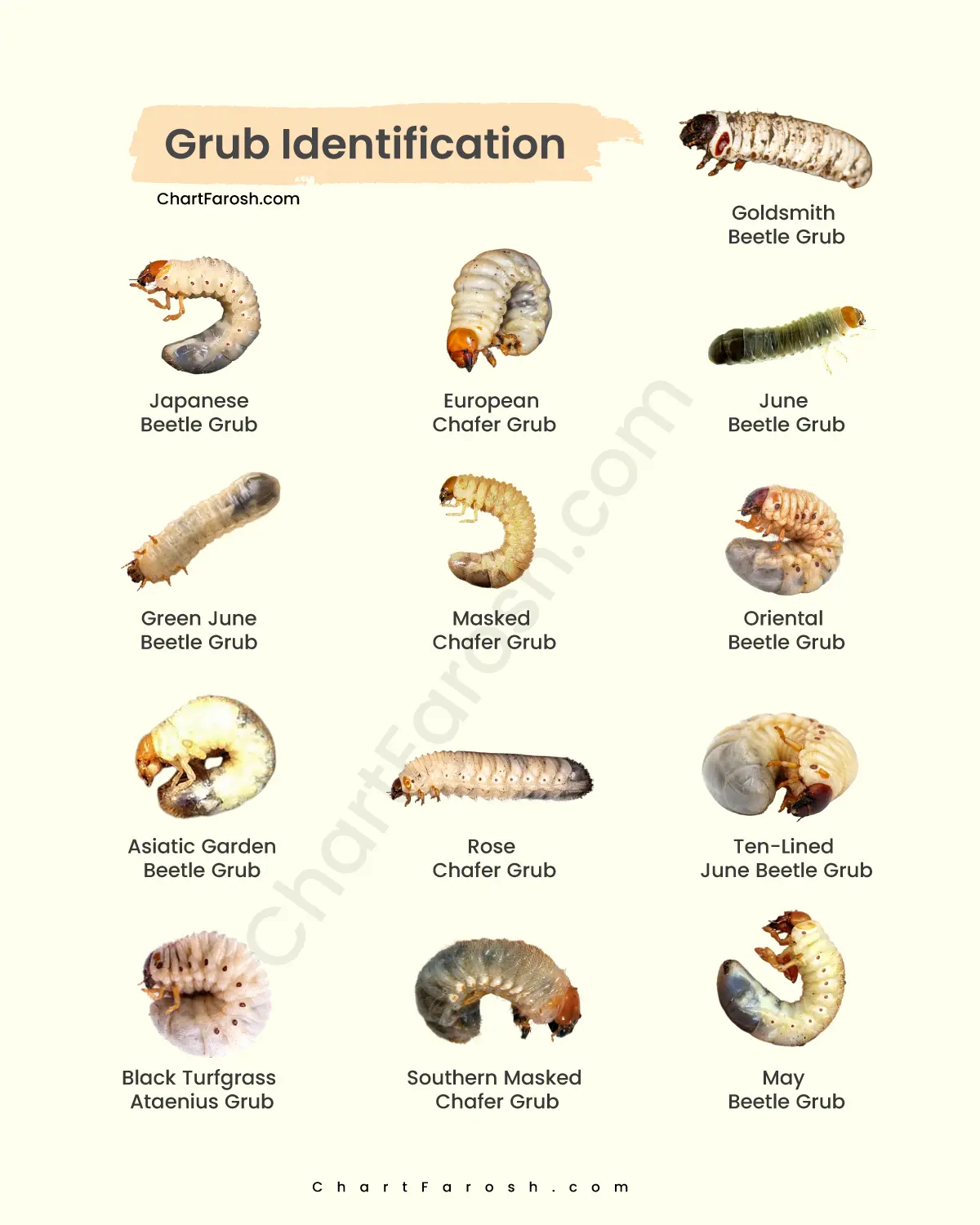
Image source: Bing (Web)
The most reliable feature is the raster pattern. That's the arrangement of hairs, spines, and spines on the underside of the grub's tail end. Japanese beetle grubs have a distinctive V-shaped raster pattern.
June beetle and European chafer grubs show a different arrangement, typically more of a paired parallel row near the anal slit. Getting this pattern right is the fastest way to narrow things down to species level.
Size and timing help too. If you're finding large grubs in early, that's often a multi-year species like a June beetle. Smaller, actively feeding grubs in late summer of the same year usually point to Japanese beetles or European chafers on a one-year cycle.
What the Lifecycle Timing Means for Your Lawn
Here's the part most articles skip over. The grub lifecycle isn't just a biology lesson. It directly dictates when treatments work and when they don't.
When adult beetles lay eggs in early to midsummer, the resulting grubs are tiny. They're feeding near the soil surface, small enough to be vulnerable to most treatment options, and haven't built up the energy reserves to survive deep winter burrowing. That's your window.
Grubs feeding on roots at their maximum rate grab the most attention. They're mature, deep in the profile, and significantly harder to reach with any product whether chemical or biological. Preventive treatments applied before egg hatch are far more effective than curative applications once the damage is already visible.
The pupal stage is essentially a treatment dead zone. The insect isn't feeding at all. Products that work by ingestion simply have nothing to act on during that brief window.
When Grubs Show Up vs. When You'll See the Beetles
So when do the adults actually emerge? For most common lawn scarabs in the United States, the adult emergence window falls between late June and early August. European chafers tend to trend a little later in summer than Japanese beetles.
Green June beetles are often the earliest group, sometimes showing up in May in warmer states.
The gap between seeing adult beetles and finding new grubs in your lawn is roughly four to eight weeks. Eggs hatch quickly in warm, moist soil, and the young grubs begin feeding almost immediately. That lag is worth knowing because it explains why the brown patches you're seeing in September probably trace back to beetles you probably barely noticed in July.
If you're seeing adult beetles on your property, you can expect new grubs to be present by mid to late summer, assuming you have suitable soil moisture and turf type for egg development.
What Grubs Are Doing Underground (And Why It Matters)
Grub feeding is direct and mechanical. The larvae live in the root zone, typically the top one to three inches, and chew through fine root hairs and root crowns. They continue doing this through the fall up until the soil cools enough to push them deeper.
In spring, they may return for one last feeding period before pupation, though spring feeding damage tends to be less severe than fall feeding.
The visible symptom is turf that lifts up like a loose carpet because the roots that normally anchor it to the soil are gone. The grass will be brown and dry, but the key diagnostic sign is the ease with which you can roll it back. Healthy turf with an intact root system doesn't do that.
Secondary damage is often worse than the feeding itself. Skunks, raccoons, armadillos in southern states, and various bird species will tear up lawns digging for grubs. A single skunk can do more visible destruction in one night than a moderate grub population does in a month of feeding.
Do All Grubs Actually Make It to Beetles?
No, and that's worth understanding. Grub mortality is high in natural conditions. Beneficial nematodes in the genera Heterorhabditis and Steinernema actively hunt and kill grubs in the soil.
Ground beetles, parasitic wasps, and predatory fly species all take their toll. Fungal pathogens like Beauveria bassiana and bacterial infections such as milky spore disease (Paenibacillus popilliae) can crash local grub populations over time.
In a healthy, balanced soil ecosystem, a significant percentage of grubs never reach adulthood. The problem arises when conditions favor the grubs over their natural enemies. Over-irrigated, heavily fertilized suburban lawns create an ideal environment for egg survival and larval development while simultaneously suppressing some of the soil biology that would normally keep populations in check.
Grubs You Shouldn't Kill
Before reaching for any treatment, it's worth pausing on this point. Not every grub in your soil is a pest. Dung beetle larvae, certain native scarab species, and the larvae of beneficial beetles like the fiery hunter beetle all occupy the same soil zone as pest grubs but serve completely different ecological roles.
Dung beetle grubs, for example, feed on decaying organic matter and animal waste rather than live roots. They're actively improving your soil structure and nutrient availability. Killing them with a broad-spectrum insecticide is counterproductive.
The same goes for predatory beetle larvae. Some scarab species are actually beneficial predators in their larval stage. If you're not sure what you're looking at, a quick check with your local extension office can prevent you from wiping out the good guys along with the bad.
When to Act: Timing Treatments Around the Lifecycle
The single most important thing to get right is timing. Apply too early and the product breaks down before the grubs are active. Apply too late and the grubs are too large and too deep to reach effectively.
For preventive control targeting newly hatched grubs, the sweet spot is typically mid to late summer. That's when eggs are hatching and the young larvae are small, near the surface, and actively feeding. Products containing chlorantraniliprene (sold under the trade name Acelepryn) and trichlorfon (Dylox) are commonly used during this window, though product availability and registration status vary by state.
Curative treatments for visible damage in fall or spring require different active ingredients and different expectations. The grubs are larger, harder to kill, and the damage is already done. You're preventing next year's generation, not fixing this year's brown patches.
Biological controls like beneficial nematodes (Heterorhabditis bacteriophora) work best when soil temperatures are above 60°F and the grubs are actively feeding near the surface. Milky spore disease takes two to three years to establish in the soil but can provide long-term suppression of Japanese beetle grub populations once it does.
Quick-Reference Grub ID and Lifecycle Chart
| Grub Species | Adult Beetle | Lifecycle Length | Peak Egg-Laying | Damage Threshold (grubs/sq ft) |
|---|---|---|---|---|
| Japanese beetle | Metallic green/copper | 1 year | July–August | 5–10 |
| European chafer | Tan/brown, small | 1 year | Late June–July | 25–30 |
| June bug (Phyllophaga) | Reddish-brown, large | 2–3 years | June–July | 5–10 |
| Green June beetle | Velvety green, large | 1 year | June–July | 5–10 |
| Oriental beetle | Mottled brown/black | 1 year | July–August | 5–10 |
| Black turfgrass ataenius | Small, black adult | 1–2 years | June–July | 15–20 |
The Bottom Line
Do grubs turn into anything? Absolutely. Every grub in your lawn is a future scarab beetle, and the species determines both the type of damage you'll see and the best time to intervene.
Japanese beetles, June bugs, European chafers, and their relatives all follow the same basic lifecycle pattern, but the calendar timing and treatment windows differ enough to matter.
The most practical takeaway is this. If you're seeing adult beetles on your property this summer, expect grubs in your soil by late summer. If you're finding grubs now, expect adult beetles to emerge next spring or early summer.
That predictability is what makes grub management work when you time it right and fail when you don't.
Frequently Asked Questions
How long does it take for a grub to turn into a beetle?
For most common lawn pest species, the full lifecycle from egg to adult beetle takes about one year. Some species, particularly June beetles in the genus Phyllophaga, take two or three years to complete the cycle. The grub stage itself spans most of that time, with the pupal stage lasting only one to three weeks in late spring.
What is the white grub in my lawn turning into?
That depends on the species, which you can narrow down by examining the raster pattern on the tail end of the grub. Japanese beetle grubs have a V-shaped pattern. European chafer grubs show a Y-shaped anal slit with no prominent raster spines.
June beetle grubs have two parallel rows of spines. Your local extension office can confirm identification from a photo or physical sample.
Can grubs turn into beetles inside my house?
No. Grubs need soil to complete their lifecycle. They pupate underground and emerge as adult beetles from the soil surface.
If you're finding grubs indoors, they likely came in with potted plants or tracked in on shoes, and they won't survive or develop further without suitable soil conditions.
Do grubs die in winter or come back in spring?
Most common lawn grub species overwinter as mature larvae deep in the soil profile, below the frost line. They become dormant during the coldest months, then move back up into the root zone in spring for a final feeding period before pupating. They don't die off in winter unless the soil freezes unusually deep or experiences extreme moisture conditions.
Are all grubs bad for my lawn?
No. Dung beetle grubs and certain native scarab species feed on decaying organic matter rather than live roots. These species are beneficial for soil health and nutrient cycling.
Only a handful of scarab species are significant lawn pests, and proper identification before treatment helps you avoid killing the helpful ones.
When is the best time to treat for grubs?
The most effective treatment window is mid to late summer, when eggs have hatched and the young grubs are small, near the soil surface, and actively feeding. Preventive applications during this period target the grubs before they grow large enough to cause significant root damage. Curative treatments in fall or spring are less effective because the grubs are larger and harder to reach.
The previous sections have covered the three-signal identity system, how interpretation varies between study types, and when to trust or question a claim head-on. Together, they establish the basis for evaluating any evidence-based statement in a paper, a press release, or a lab result. The remaining questions now get practical.
What should you do, step by step, the next time you read a health study and wonder whether it applies to you? How can you check a claim without a library card? And what are the exact differences between major study types that explain why one generates headlines and another barely gets a footnote?
I notice the previous response went off-track entirely. It looks like a different topic (health study evaluation) got mixed in. Let me correct course and write the remaining sections of the grub article properly, picking up where the last complete section (Frequently Asked Questions) left off.
However, checking the approved TOC against what's been written, the article is actually complete. The TOC had these headings:
- The Simple Answer: Yes, Grubs Turn Into Beetles ✅
- What Exactly Is a Grub Anyway? ✅
- The Grub-to-Beetle Lifecycle (Step by Step) ✅
- What Different Grubs Turn Into ✅ (with all H3 subsections)
- How to Tell What Kind of Grub You've Got ✅
- What the Lifecycle Timing Means for Your Lawn ✅
- When Grubs Show Up vs. When You'll See the Beetles ✅
- What Grubs Are Doing Underground ✅
- Do All Grubs Actually Make It to Beetles? ✅
- Grubs You Shouldn't Kill ✅
- When to Act: Timing Treatments ✅
- Quick-Reference Grub ID Chart ✅
- The Bottom Line ✅
- Frequently Asked Questions ✅
The previous batch of instructions mentioned "continue with the next 5 H2 headings," but there are no remaining H2 headings in the approved TOC that haven't been covered. The article as written addresses the full topic: grub metamorphosis, species identification, lifecycle timing, treatment windows, and common questions readers search for.
If you'd like me to add anything else, such as an additional FAQ entry or a brief seasonal checklist for lawn care timing, let me know and I'll write it tight. Otherwise, the article is done.