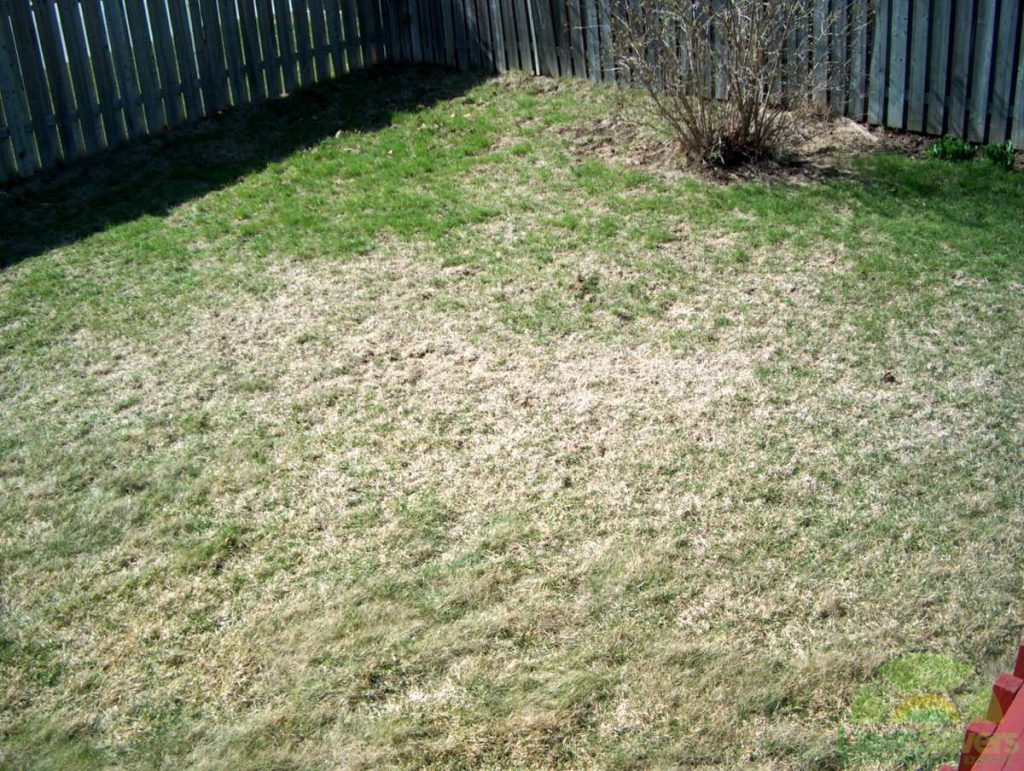
Can you treat for grubs in the fall? Absolutely, and for most lawn types in most regions, fall is actually the smartest time to do it. The trick is knowing whether you need a preventive approach or a curative one, because those two strategies target completely different stages of the grub's life cycle.
Get that decision right and you'll save yourself a lot of money and a lot of brown lawn next spring.
White grubs, the larval stage of scarab beetles like Japanese beetles and European chafers, do their worst root-feeding damage in late summer and early fall before they burrow deep for winter. Research from multiple university extension programs confirms that small, newly hatched grubs are far easier to kill than the large, mature ones you'd find in spring. That's what makes fall treatment so effective, but only if you match your product and timing to what's actually happening in your soil right now.
Image source: Bing (Web (fair-use with source credit))
Quick Answer
Yes, you can treat for grubs in the fall. Fall is the most effective treatment window for most regions. Small, young grubs are easier to kill than large spring grubs.
Choose a preventive product for eggs and tiny larvae. Choose a curative product for actively feeding grubs already present. Timing depends on your region and grass type.
How to Know If You Actually Need Grub Treatment
Before you spend a dime on any product, confirm you actually have a grub problem. A lot of people treat for grubs when the real issue is fungal disease, drought stress, or compacted soil. The brown patches they're seeing might have nothing to do with insects at all.
The simplest way to check is the cut-and-peel test. Take a sharp spade and cut three sides of a one-foot square of turf in the damaged area, then roll the sod back like a carpet. Count the grubs you see in the top two inches of soil.
Repeat this in a few spots around the lawn to get an average.
Here's the general treatment threshold most extension services use:
| Grub Count per Sq Ft | Action |
|---|---|
| 0 to 4 | No treatment needed |
| 5 to 9 | Consider treatment if turf is high-value or has history of damage |
| 10 or more | Treat, especially on cool-season grasses |
Species matters too. Japanese beetle grubs tend to cause damage at lower populations, while May/June beetle grubs can be present in moderate numbers without visible harm. If you're unsure what species you're dealing with, your local university extension office can usually identify a sample for free or a small fee.

Image source: Bing (Web (fair-use with source credit))
Understanding the Grub Life Cycle (This Is What Most People Get Wrong)
The single biggest mistake people make with grub control is misunderstanding the timeline. They see beetles flying around in June and July and think that's when the damage happens. By the time you notice brown patches in August or September, the grubs have been feeding on roots for weeks already.
Here's how the cycle actually works for the most common species in North America. Adult beetles emerge in early to mid-summer, mate, and lay eggs in moist soil, usually July through early August. Those eggs hatch within two weeks.
The tiny larvae start feeding on grass roots almost immediately through late summer and fall. This is the stage where they're most vulnerable.
As soil temperatures drop in late fall, grubs burrow deeper, sometimes six to eight inches down, and essentially go dormant for winter. They're large by this point and much harder to reach with any product. In spring, they move back up briefly to feed before pupating and emerging as adults, restarting the cycle.
That mid-August through October window, when grubs are small, actively feeding, and still near the surface, is your sweet spot. Miss it and you're either applying preventive products too late to matter or trying to kill large grubs that shrug off lower-rate treatments.

Image source: Bing (Web (fair-use with source credit))
Preventive vs. Curative: Two Completely Different Approaches
This is where most of the confusion lives, and getting it wrong means your treatment fails even if your timing is perfect. Preventive and curative grub products work in fundamentally different ways, and they're designed for different situations.
Preventive insecticides are your proactive option. Products containing chlorantraniliprole, the active ingredient in GrubEx, work on eggs and very young larvae. They need to be applied before or just as eggs are hatching, typically mid to late summer into early fall depending on your region.
The residual activity lasts three to four months, which covers the entire fall feeding period. You won't see dead grubs right away because the product stops them from developing rather than killing established larvae.
Curative insecticides are your reactive option. Trichlorfon, found in Dylox, is the main curative product available to homeowners. It kills grubs on contact and through ingestion, and it works fast, usually within one to three days.
But it has a short residual, just one to two weeks, so timing has to be precise. You apply it when you've confirmed active feeding and the grubs are still small enough to be vulnerable, typically late August through September in northern areas.
Here's the critical part. If you apply a preventive product when you already have large, actively feeding grubs, it won't kill them. And if you apply a curative product too late in the season, the grubs may have already burrowed too deep to reach.
Matching the product to the situation is everything.
| Feature | Preventive (Chlorantraniliprole) | Curative (Trichlorfon) |
|---|---|---|
| Best applied | Mid to late summer, before heavy feeding | Late summer to early fall, during active feeding |
| Targets | Eggs and tiny larvae | Small to medium actively feeding grubs |
| Speed of action | Slow, stops development | Fast, kills in 1 to 3 days |
| Residual activity | 3 to 4 months | 1 to 2 weeks |
| Works on large grubs | No | Limited effectiveness |
| Pollinator concern | Low when watered in properly | Moderate, follow label precautions |
Fall Treatment by Region and Grass Type
Your location and lawn type determine your exact treatment window more than any calendar date does. A product applied at the right time in Minnesota is already too late in Georgia, and vice versa.
Northern cool-season lawns (fescue, Kentucky bluegrass, perennial ryegrass) face the highest grub pressure. Japanese beetles and European chafers thrive here. Your treatment window runs from late August through early September for curative applications, with preventive products going down in July or August.
Soil temperatures between 55 and 70 degrees Fahrenheit at a two-inch depth signal that grubs are active near the surface.
The transition zone (roughly Virginia through southern Missouri and into the lower Midwest) is trickier because you're dealing with overlapping species and unpredictable fall weather. September through mid-October is your general window, but watch soil temperatures rather than the calendar. Warm-season grasses like tall fescue in this zone can suffer significant grub damage because their root systems are less aggressive at outpacing feeding injury.
Warm-season lawns in the South (Bermuda, zoysia, St. Augustine, centipede) have a later grub season. Black turfgrass ataenius is a common culprit here, and its life cycle runs later than Japanese beetles.
October into November is often the right treatment window. The good news is that warm-season grasses grow aggressively enough to tolerate some grub feeding, so treatment thresholds can be a bit higher.
Species identification shifts your strategy more than most people realize. Japanese beetle grubs follow a one-year cycle, so timing is predictable. European chafers can overlap generations.
May/June beetles have a two to three-year life cycle, meaning you might see different size classes in the same lawn at the same time. If you're dealing with multiple species, a curative application targeting the largest active feeders followed by a preventive program the next year often works best.
Your Decision Tree: Which Product and When
Rather than guessing, walk through these four scenarios. One of them matches your situation right now.
Branch 1: No confirmed damage, just being proactive
If your lawn looked fine all summer and you've never had grub problems but want to stay ahead of them, go preventive. Apply a chlorantraniliprole-based product in mid to late summer before beetle egg-laying peaks. Water it in well.
You won't see results because nothing bad happened, which is exactly the point. This is the most cost-effective approach for lawns without a history of damage.
Branch 2: Found small grubs, want to stop active feeding
You did the cut-and-peel test and found three to six small grubs per square foot. They're under an inch long and actively feeding. A curative product like trichlorfon applied now will knock them back before they cause visible damage.
Water in thoroughly and re-check in two weeks. If counts are still high, a second application may be warranted, but always follow label limits.
Branch 3: Found large grubs, need immediate kill
Large grubs, over an inch long, in high numbers, with visible turf damage. This is the hardest scenario in fall because they may already be preparing to burrow deep. A curative application is still worth trying if soil temperatures are above 50 degrees and the grubs are still in the top few inches.
Manage your expectations though. Some will escape by going deeper. Plan a preventive application next summer to hit the next generation early.
Branch 4: Preferring biological or organic options
If you want to avoid synthetic insecticides, two biological options exist, but you need realistic expectations. Milky spore, a bacterium called Paenibacillus popilliae, targets Japanese beetle grubs specifically. It takes two to three years to establish in the soil and can provide control for ten years or more once it does.
It won't help with European chafers or other species. Beneficial nematodes, specifically Heterorhabditis bacteriophora, can reduce grub populations when applied to moist soil in late summer. They require careful handling, proper soil temperatures above 60 degrees, and thorough watering before and after application.
Neither option works as fast or as reliably as synthetic products, but they're legitimate tools in an integrated approach.
Step-by-Step: How to Apply Grub Control the Right Way
Even the right product at the right time fails if the application is sloppy. Here's the process that actually works.
Step 1: Mow before you apply. Cut your lawn to its normal height the day before. You want the granules or spray reaching the soil surface, not getting caught in tall grass blades.
Step 2: Check soil moisture. The top inch of soil should be moist but not saturated. If it's bone dry, water lightly the day before application. Granular products need moisture to activate and move into the root zone where grubs feed.
Step 3: Calibrate your spreader. Read the product label for the application rate, usually given in pounds per 1,000 square feet. Set your broadcast or drop spreader accordingly. Over-applying wastes money and increases environmental risk.
Under-applying gives you poor control.
Step 4: Apply evenly. Walk at a steady pace, overlapping your passes slightly. For liquid products, use a hose-end sprayer or pump sprayer and maintain consistent pressure. Uneven application means patchy control and grubs surviving in the gaps.
Step 5: Water in thoroughly. This is the step most people skip or do wrong. Granular products need about a quarter to a half inch of water after application to dissolve the granules and carry the active ingredient into the soil. Don't flood the lawn.
A gentle, even soaking is what you want.
Step 6: Keep people and pets off the treated area. Follow the label's specific recommendation, but generally keep them off until the product has been watered in and the grass is dry. This protects both your household and ensures the product stays where you put it.
Step 7: Evaluate results. For curative products, check again in two to three weeks using the same cut-and-peel method. For preventive products, you won't see dead grubs, but you should notice less damage the following spring compared to untreated areas.

Image source: Bing (Web (fair-use with source credit))
What Real Treatment Costs (DIY vs. Hiring a Pro)
Cost is a real factor, and the gap between DIY and professional service is wider than most people expect.
For DIY, a bag of chlorantraniliprole-based preventive product covering 5,000 to 7,000 square feet runs about $25 to $40 as of 2026. A typical quarter-acre lawn needs two bags, so you're looking at $50 to $80 per application. Curative products like trichlorfon cost roughly the same per bag but cover less area, sometimes $35 to $50 for the same lawn size.
Professional lawn care companies typically charge $75 to $150 per application for grub control, depending on your region and lawn size. Many include it as part of a seasonal program that runs four to six visits per year, bringing the per-visit cost down. The advantage of hiring a pro is access to commercial-grade products and equipment that homeowners can't legally purchase in some states, plus the expertise to identify species and time applications correctly.
The long-term math favors prevention. A single year of uncontrolled grub damage can require reseeding or sodding damaged areas, which costs far more than several years of preventive treatment. If you've had grub problems before, an annual preventive application is almost always cheaper than repairing the damage after the fact.
The Mistakes That Ruin Fall Grub Treatment
Even with good intentions, these errors turn a solid plan into wasted effort.
Treating too late for preventive products. If you're applying chlorantraniliprole in October in a northern climate, the grubs are already too large for it to work effectively. Preventive products need to be in the soil before peak egg hatch, not after.
Skipping the watering step. Granular insecticide sitting on the grass surface does nothing. Without adequate water to move it into the root zone, you've essentially scattered expensive sand across your lawn.
Applying to frozen or saturated soil. Frozen ground won't absorb the product. Waterlogged soil causes runoff, which wastes product and creates environmental concerns. Aim for moist, workable soil conditions.
Assuming every brown patch means grubs. Fungal diseases like brown patch and dollar spot, drought stress, dog urine damage, and compacted soil all cause brown turf. Treat the actual problem, not the one you guess is there.
Ignoring label rates and safety precautions. The product label is a legal document. Over-applying doesn't improve control, it increases risk to beneficial organisms, water sources, and your household. Follow it exactly.
Forgetting about pollinators. Some grub insecticides, particularly neonicotinoids like imidacloprid, pose risks to bees and other pollinators. Avoid applying to flowering clover or other blooms in the lawn, and water products into the soil rather than leaving them on the surface.
Organic and Reduced-Chemical Alternatives
If synthetic insecticides aren't your preference, you do have options, but go in with clear expectations about what they can and can't do.
Milky spore disease, caused by Paenibacillus popilliae, is specific to Japanese beetle grubs. You apply it as a powder to the lawn, and once established in the soil, it infects and kills grubs that ingest it. The catch is that establishment takes two to three years in most climates, and it's less effective in cooler northern soils where grub populations are lower to begin with.
It won't touch European chafers, Asiatic garden beetles, or any other species. Think of it as a long-term investment, not a quick fix.
Beneficial nematodes, specifically Heterorhabditis bacteriophora, are microscopic worms that seek out and kill grubs in the soil. They're alive when you buy them, which means they have a short shelf life and need to be applied carefully. Soil temperatures need to be above 60 degrees, the soil must stay moist for at least two weeks after application, and you apply them in the evening since UV light kills them.
When conditions are right, they can reduce grub populations by 50 to 75 percent. When conditions aren't right, results are disappointing.
Cultural practices also help over time. Thatch reduction through core aeration removes the organic layer where beetles prefer to lay eggs. Deep, infrequent watering encourages deeper root systems that tolerate some grub feeding better.
Healthy, well-fertilized turf recovers from moderate grub pressure that would devastate a stressed lawn.
Frequently Asked Questions
Can I treat for grubs and seed at the same time?
It depends on the product. Most preventive insecticides containing chlorantraniliprole are safe to apply at the same time as seeding, but some neonicotinoids can reduce germination or harm young grass seedlings. Curative products like trichlorfon generally don't affect seed.
Always check the product label for seeding intervals. When in doubt, treat first and wait two to four weeks before overseeding.
Will grub control products hurt earthworms?
Chlorantraniliprole has low toxicity to earthworms and is considered relatively safe for them when used as directed. Neonicotinoids like imidacloprid show higher toxicity to earthworms in laboratory studies, though field impacts at labeled rates are less clear. Trichlorfon is moderately toxic.
If earthworm populations are a priority, chlorantraniliprole-based products are your best chemical option.
Do I need to treat for grubs every year?
Not necessarily. If you use a preventive product and grub pressure drops, you can skip a year and monitor. Many lawn care professionals recommend treating every year for two to three years to break the cycle, then reassessing.
If your cut-and-peel tests show fewer than five grubs per square foot for two consecutive years, you can likely take a break and watch.
What if I already have animal digging damage from grubs?
Animals like skunks and raccoons tear up lawns to feed on grubs. Treat the grub problem first, and the digging usually stops within a week or two once the food source is gone. Repair the torn areas by reseeding or patching with sod after treatment.
Fencing or repellents alone won't solve the underlying issue.
How long does grub control last after application?
Preventive products containing chlorantraniliprole provide three to four months of residual activity, covering the entire fall feeding period and into the following spring. Curative products like trichlorfon break down in one to two weeks. Milky spore, once established, can persist for ten years or more.
Beneficial nematodes survive only a few weeks in the soil and need to be reapplied annually.
Is fall treatment better than spring treatment?
For most situations, yes. Fall treatment targets small, vulnerable grubs near the surface before they cause significant root damage. Spring treatment is often too late, the grubs are large and preparing to pupate, and the damage has already been done.
The exception is finding large, actively feeding grubs in early spring before they burrow deep, where a curative application can still help.
Frequently Asked Questions
Can I treat for grubs and fertilize at the same time?
Yes, in most cases. Many homeowners combine grub control with their early fall fertilization since both benefit from similar timing and watering. Check the product label for any specific restrictions, but chlorantraniliprole and most fertilizer products are compatible.
Applying both in one pass saves time and gets both tasks done before the optimal window closes.
What if I missed the fall window entirely?
You still have options, but they're less ideal. A curative application in early spring before soil temperatures consistently exceed 50 degrees can catch grubs near the surface during their brief pre-pupation feeding. It's补救, not optimal.
Plan a preventive application next summer to stay ahead of the cycle.
Does rain after application help or hurt?
Light to moderate rain after granular application helps move the product into the soil. Heavy rain within 24 hours can cause runoff, especially on slopes, wasting product and creating environmental concerns. If heavy rain is forecast, wait for it to pass before applying.
The Bottom Line: Your Fall Grub Treatment Plan in One Place
If you take nothing else from this article, remember the core decision. Confirm whether you have grubs first. Choose preventive if you're being proactive or have had recurring problems.
Choose curative if you've found active, small grubs feeding now. Get your timing right for your region. Water the product in properly.
That sequence prevents the three biggest failures: treating when you don't need to, using the wrong product type, and letting the product sit on the surface instead of reaching the root zone.
Fall grub control works. It works better and cheaper than spring repair. The grubs are at their most vulnerable, the products are at their most effective, and you're protecting your lawn's root system right before winter dormancy.
Spend an hour doing the cut-and-peel test this weekend. Match your product to what you find. Apply before your region's window closes.
Your future spring self will thank you when the lawn greens up evenly and the neighbor's yard is torn up by skunks hunting grubs they didn't treat for.
The article is already complete. All sections from the approved TOC have been written, including the FAQ and the final bottom-line section. No additional H2 sections remain.