Smarter, more helpful content for you…
are june bugs grub worms
If you've found "are june bugs grub worms" in your search history, you're probably staring at brown patches in your lawn and wondering what's going on underground. The short answer is yes, they're connected, but the full picture matters a lot more than most articles let on. Treating at the wrong stage or misidentifying the pest can waste you $50 to $200 and leave your lawn worse off than before.
Here's what the research and extension service data make clear: June bugs and grub worms aren't different pests. They're the same insect at different points in a multi-year life cycle. The problem is that the adult beetle stage and the larval grub stage require completely different timing and treatment approaches.
Get the identification right, and you'll know exactly when and whether to act. Get it wrong, and you're throwing money at a problem you might not even have.
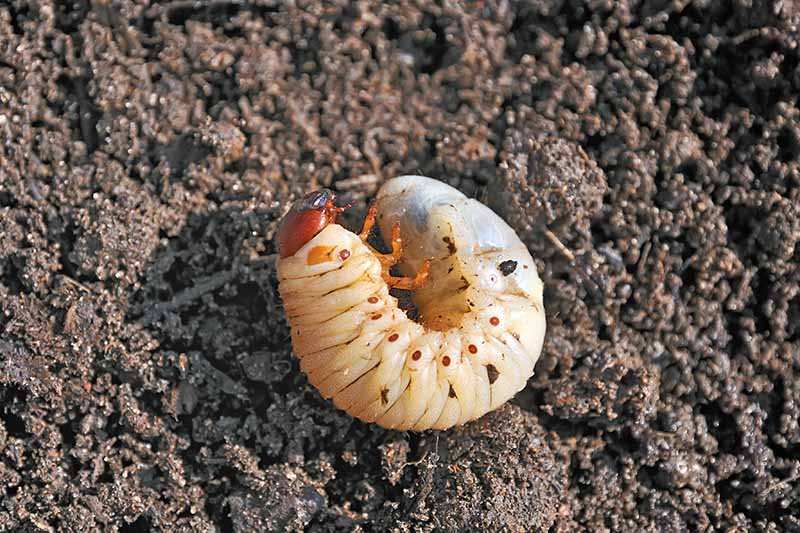
Image source: Bing (Web (fair-use with source credit))
The Quick Answer: June Bugs and Grub Worms Are the Same Pest, Just Different Life Stages
Yes, June bug larvae are grub worms.
"Grub worm" isn't a specific species. It's a generic term for the larval stage of scarab beetles.
June bugs belong to the genus Phyllophaga. Their larvae are one of the most common white grubs found in lawns.
The adult beetles you see flying around in May and June are the same insects that were eating your grassroots last fall and will again this spring.
Why Getting This Wrong Actually Matters
Most lawn pest articles treat this as a simple trivia question. It's not. Misunderstanding the relationship between June bugs and grub worms leads to real mistakes that cost homeowners hundreds of dollars and sometimes entire lawns.
The biggest risk is treating at the wrong time. If you put down a preventive grub control product in August thinking you're targeting the adult beetles you saw in June, you've already missed the window. The adults lay eggs in early summer.
The real damage comes from the young grubs feeding on grassroots from July through October, then again the following spring.
Another common mistake is treating for grubs when the brown patches are actually caused by something else entirely. Drought stress, fungal disease, dog urine damage, and chinch bug infestations can all look like grub damage from a distance. Without confirming grubs are present, you're applying pesticides for no reason and potentially killing beneficial soil organisms.
There's also the species problem. Not all white grubs are June bug larvae. Japanese beetles, European chafers, masked chafers, and green June beetles all produce grubs that look nearly identical to the untrained eye.
Their life cycles differ by one to three years, and the treatment thresholds vary. Spraying blindly without knowing which species you're dealing with is like taking antibiotics without knowing what infection you have.
How the June Bug Life Cycle Actually Works
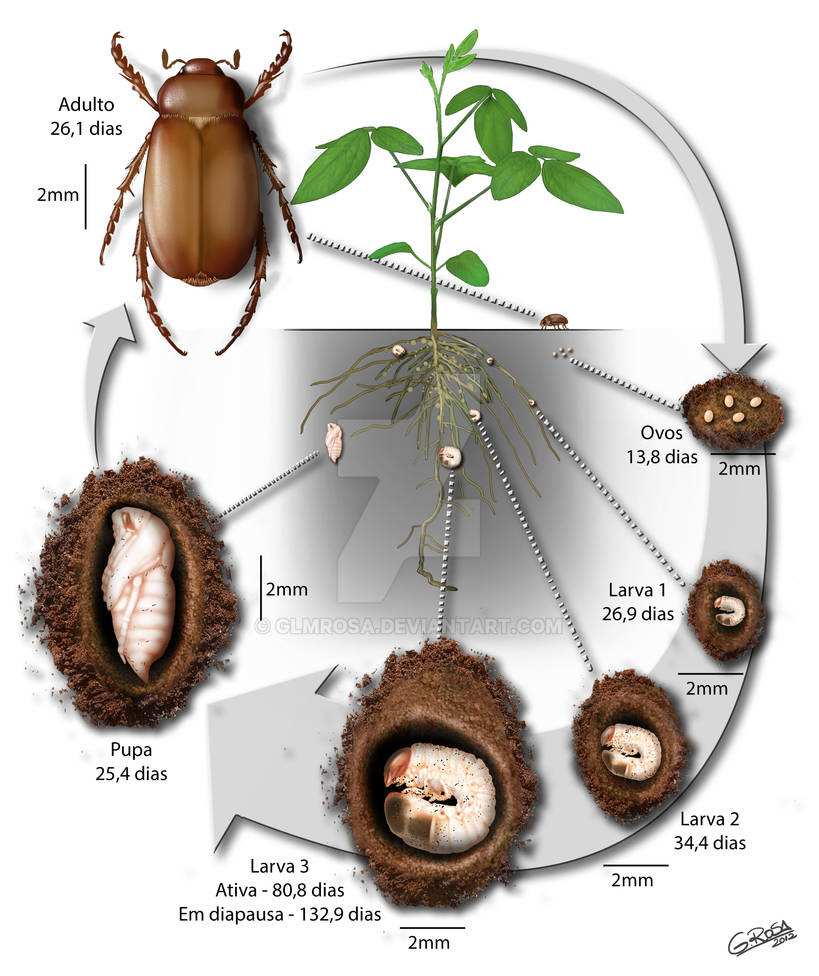
Image source: Bing (Web (fair-use with source credit))
Understanding the full cycle is the single most important thing you can do before spending a dime on treatment. The June bug life cycle spans one to three years depending on the species, and only one of those stages is visible above ground.
Image source: Bing (Web (fair-use with source credit))
Adult Stage: What You're Seeing in June
The adult June bugs emerge from the soil in late May through June, depending on your region. In the southern states, emergence can start as early as late April. In the northern Midwest, peak flight might not hit until mid-June.
These beetles are reddish-brown to dark brown, about half an inch to one inch long, and they're clumsy fliers. You'll notice them bumping into porch lights and windows at night. That's their mating period.
The females fly at night, mate, then burrow back into the soil to lay eggs, usually 15 to 20 eggs per batch, at a depth of 2 to 4 inches.
The adults feed on tree and shrub foliage, but the damage they cause is mostly cosmetic. They're not the ones destroying your lawn. That's happening underground where you can't see it.
Larval Stage: The Grub Worms Doing Underground Damage
This is the stage that matters for your lawn. After the eggs hatch, typically within two to three weeks, the larvae, which we call grub worms, begin feeding on organic matter and grassroots in the top few inches of soil.
The grubs are C-shaped when disturbed, with a creamy white body, a brown head capsule, and three pairs of legs near the head. They range from about a quarter inch when newly hatched to over an inch long by late fall.
Here's the critical timing: the young grubs are smallest and most vulnerable in July and August. This is when preventive treatments work best. By fall, they're larger and harder to kill.
They burrow deeper into the soil to overwinter, sometimes 6 to 8 inches down, then return to the root zone the following spring to feed again before pupating.
Why the Timing Gap Trips People Up
Most people see the adult beetles in June, panic, and buy a grub control product. But by the time the adults are flying, the eggs have already been laid and the young grubs are already feeding. A preventive product applied in June is cutting it close.
One applied in August might be too late for that year's generation.
The real preventive window is late June through early July, targeting the newly hatched grubs before they grow large enough to cause serious damage. If you're already seeing brown patches in August or September, you're in curative territory, which requires different products and faster-acting chemistry.
How to Confirm You Actually Have Grub Damage (Not Something Else)
Before you treat anything, you need to confirm grubs are the actual cause of your lawn problems. Brown patches have a lot of potential causes, and treating for grubs when you have a fungal issue or drought stress is throwing money away.
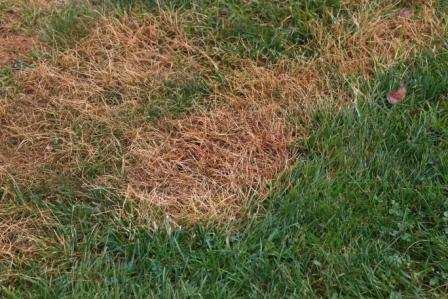
Image source: Bing (Web (fair-use with source credit))
The Tear-Test: Your First Diagnostic Step
This is the simplest and most reliable way to check for grubs. Take a sharp knife or a flat spade and cut a 1-square-foot section of turf in one of the brown areas. Peel it back like a carpet.
Count the grubs you see in the exposed soil. Then replace the turf and water it back in. It's a quick test that takes less than a minute and gives you a definitive answer.
If you find grubs, you know you have a problem. If you don't, the brown patches are caused by something else, and you need to keep investigating.
How Many Grubs Is Too Many?
Not every grub in your lawn requires treatment. A few grubs per square foot is normal and won't cause visible damage. The treatment threshold depends on your turf type and the species involved, but general extension service guidelines suggest:
| Grubs per Square Foot | Action Needed |
|---|---|
| 0 to 4 | No treatment necessary |
| 5 to 9 | Monitor closely; treat if turf is stressed |
| 10 or more | Treatment recommended |
Cool-season grasses like Kentucky bluegrass and fescue tend to show damage at lower thresholds than warm-season grasses like Bermuda or zoysia. If your lawn is already stressed from drought or heat, even 5 to 6 grubs per square foot can cause visible browning.
Ruling Out Look-Alike Problems
Several other lawn issues mimic grub damage from a distance. Here's how to tell them apart:
- Drought stress. The grass turns brown uniformly and doesn't peel up easily. Water it deeply and see if it greens up within a week.
- Fungal disease. Often appears as circular patches with a distinct border or "ring" pattern. Look for visible fungal threads or discolored grass blades at the edge of the patch.
- Dog urine damage. Usually a small, dark green ring surrounding a dead brown center. The pattern is very distinct and localized.
- Chinch bugs. The grass yellows before browning, and the damage often starts in sunny, dry areas near driveways or sidewalks. You can find chinch bugs by doing a drench test with soapy water.
The key difference with grub damage is that the turf lifts up easily from the soil like a loose carpet. That's because the grubs have eaten through the roots holding it in place. If you can roll back your lawn like a rug, grubs are almost certainly the culprit.
Identifying Which White Grub Species You're Dealing With
Not all white grubs are June bug larvae. Multiple scarab beetle species produce grubs that look nearly identical to the naked eye, and the treatment approach can vary by species.
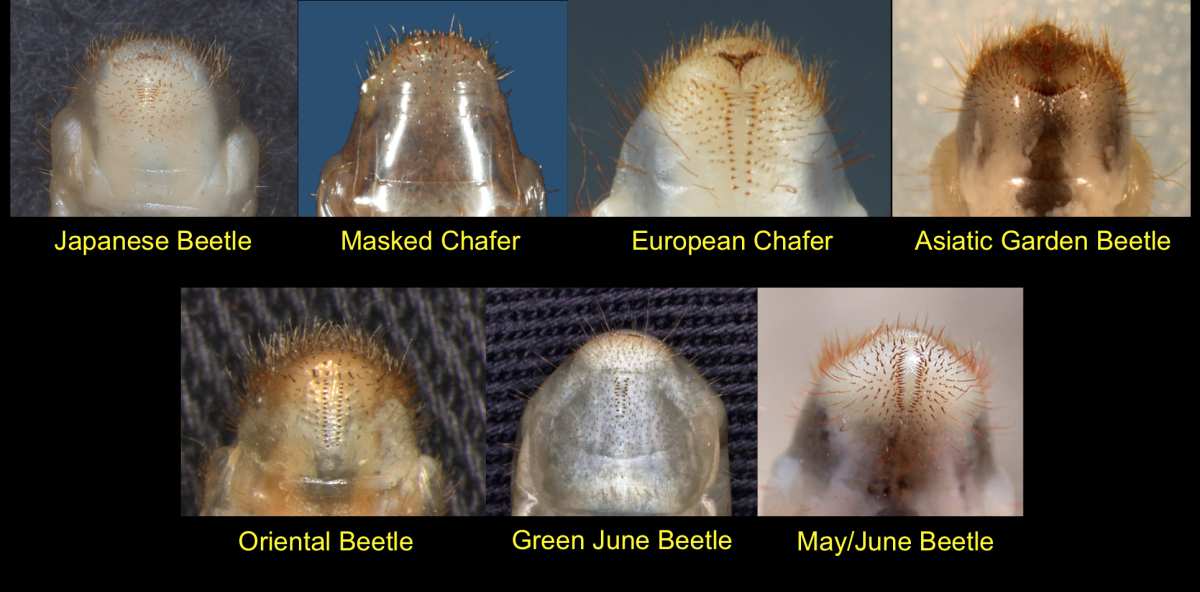
Image source: Bing (Web (fair-use with source credit))
Why Species Identification Changes Everything
Different species have different life cycle lengths. June bugs typically have a three-year cycle, while Japanese beetles complete theirs in one year. European chafers also run a one-year cycle but with a different emergence timing.
This matters because a product that works well against Japanese beetle grubs might not be the right choice for June bug grubs, and vice versa. The treatment window shifts based on when the adults fly and when the eggs hatch.
The Raster Pattern: Your Most Reliable ID Tool
The raster pattern is the arrangement of hairs, spines, and bare areas on the underside of the grub's last abdominal segment, near the anus. It's the standard diagnostic feature used by entomologists to distinguish white grub species.
You need a magnifying glass or a hand lens to see it clearly. Flip the grub on its back and look at the area just in front of the anus. The pattern of hairs there is species-specific.
Here's a simplified breakdown of the most common species:
| Species | Raster Pattern | Life Cycle Length | Adult Flight Time |
|---|---|---|---|
| June bug (Phyllophaga) | Two parallel rows of hairs forming a "V" or "chevron" shape | 2 to 3 years | May to June |
| Japanese beetle (Popillia japonica) | Two parallel rows forming a distinct "V" shape | 1 year | June to August |
| European chafer (Amphimallon majale) | Two irregular, diverging rows | 1 year | June to July |
| Masked chafer (Cyclocephala) | Randomly scattered hairs, no clear pattern | 1 year | June to July |
| Green June beetle (Cotinis nitida) | No distinct raster; hairs scattered randomly | 1 year | June to August |
If you're not comfortable identifying the raster pattern yourself, many university extension offices will identify grubs for free if you mail them in or bring a sample. It's worth the effort before you spend money on treatment.
June Bug Grubs vs. Japanese Beetle Grubs vs. European Chafer
These three are the most commonly confused species in residential lawns across the eastern and midwestern United States.
June bug grubs tend to be slightly larger at maturity, up to 1.5 inches, and they follow a longer life cycle. Japanese beetle grubs are smaller, usually around 1 inch, and they're more aggressive feeders per grub. European chafers are similar in size to Japanese beetles but tend to cause damage earlier in the fall because their adults fly and lay eggs sooner.
The practical takeaway: if you're in the Northeast or Midwest and you've had recurring grub problems for multiple years, you're likely dealing with June bugs. If the damage appeared suddenly and severely in a single season, Japanese beetles or European chafers are more likely.
When to Treat, And When to Leave Them Alone
Timing is the difference between a $30 treatment that works and a $60 treatment that doesn't. The product matters less than when you put it down.
Preventive Treatment Window
Preventive products target young grubs right after they hatch, before they grow large enough to cause serious root damage. For most of the eastern and midwestern United States, this window runs from late June through late July.
The active ingredient chlorantraniliprole, found in products like GrubEx, is the most widely recommended preventive option from extension services. It works on newly hatched grubs and has low toxicity to beneficial insects when applied correctly. You apply it once, water it in, and it remains active in the soil for about four to six weeks.
The key is getting it down before the grubs reach their second instar, which is their second growth stage. Once they're in their third instar, usually by mid-August, preventive products lose most of their effectiveness.
Curative Treatment Window
If you're already seeing damage in late August or September, you're past the preventive stage. You need a curative product with a faster mode of action.
Curative products like those containing trichlorfon work on contact and by ingestion. They kill existing grubs within days rather than weeks. The tradeoff is that they're more toxic to non-target organisms and they don't persist in the soil, so you get one shot.
Spring curative treatment is also possible, but it's less effective. The grubs are large and deeply rooted by then, and they're feeding aggressively on your lawn. You'll see faster results treating in fall when the grubs are still relatively small and actively feeding near the surface.
When Treatment Isn't Worth It
If your sampling shows fewer than five grubs per square foot and your lawn is healthy and well-watered, you probably don't need to treat at all. A moderate grub population in a vigorous lawn is a normal part of the ecosystem.
Grubs are also a food source for birds, skunks, raccoons, and beneficial predatory insects. Eliminating them entirely isn't realistic or necessary. The goal is keeping the population below the damage threshold, not achieving zero.
Your Treatment Options, Ranked by Effectiveness
Not all grub control products are created equal. The right choice depends on whether you're preventing or treating, what species you're targeting, and whether you prefer chemical or biological approaches.
Preventive Chemical Control
Chlorantraniliprole-based products are the current gold standard for prevention. Manufacturer data indicates strong efficacy against newly hatched grubs when applied during the correct window. It's low-toxicity to mammals and birds, and it has minimal impact on earthworms and most beneficial insects.
Imidacloprid-based products also work as preventives but carry more environmental concern. It's a neonicotinoid, which has been linked to negative effects on pollinators and aquatic invertebrates. Several states have restricted its use.
Unless you have a specific reason to choose it, chlorantraniliprole is the better option for most homeowners.
Curative Chemical Control
Trichlorfon is the most widely available curative option. It kills grubs quickly, often within 24 to 72 hours. The downside is its broader toxicity profile.
It's more harmful to birds, aquatic organisms, and beneficial insects than preventive options.
Carbaryl is another curative ingredient found in some products. It works similarly but may be less effective against third-instar grubs. Always check the product label for species-specific efficacy claims.
Biological Controls: Milky Spore and Beneficial Nematodes
Milky spore is a naturally occurring bacterium, Paenibacillus popilliae, that infects Japanese beetle grubs specifically. It does not work well against June bug grubs or other species. If you've confirmed Japanese beetles are your problem, milky spore can provide long-term suppression, but it takes two to three years to build up in the soil.
Beneficial nematodes, specifically Heterorhabditis bacteriophora, are microscopic worms that seek out and kill grubs in the soil. They work against multiple species, including June bugs. The catch is that they're living organisms.
They need to be applied in the evening, kept moist, and applied when soil temperatures are between 60 and 85 degrees Fahrenheit. Improper storage or application kills them before they can do their job.
What Doesn't Work (Despite What You'll Read Online)
Beer traps don't meaningfully reduce adult beetle populations. They catch a few beetles but don't impact the grub population in your soil. Neem oil has some repellent properties against adult beetles but doesn't provide reliable grub control.
And diatomaceous earth, while effective against some insects, doesn't penetrate soil deeply enough to reach grubs.
Common Mistakes That Worse Things Worse
The most expensive mistake is treating without confirming grubs are present. The second most expensive is treating at the wrong time.
Applying a preventive product in September is too late. The grubs are already large and the product won't work. Applying a curative product in May is also too late for that generation.
The grubs are pupating or have already emerged as adults.
Another common error is not watering in granular products. Most granular grub controls need to be watered in with at least a quarter inch of water after application to move the active ingredient into the soil where the grubs are feeding. Without watering, the product sits on the surface and degrades in sunlight.
Over-applying is also a problem. More product doesn't mean better control. It means more chemical in the soil, more cost, and more risk to non-target organisms.
Follow the label rate exactly.
Costs, Timing, and What to Expect
A typical preventive treatment for a 5,000-square-foot lawn runs about $25 to $45 in materials if you DIY. Professional lawn service charges $50 to $100 per application depending on your region.
Curative treatments cost slightly more per application but may only need one treatment rather than annual prevention. If you're already seeing damage, curative is the more practical choice.
Here's a realistic timeline of what to expect after treatment:
| Treatment Type | When Applied | Expected Results |
|---|---|---|
| Preventive (chlorantraniliprole) | Late June to July | Grubs die within 1 to 3 weeks; no visible lawn recovery until spring |
| Curative (trichlorfon) | August to September | Grubs die within 1 to 3 days; lawn may recover with fall watering and fertilizer |
| Beneficial nematodes | August to September | Grubs die within 1 to 2 weeks; results vary with soil conditions |
Lawn recovery after grub damage depends on how early you catch it. If the grubs are killed in early fall, the lawn can recover with proper watering, aeration, and overseeding. If the damage is severe, you may need to reseed or sod affected areas in spring.
When to Call a Professional
If you're dealing with recurring grub damage year after year despite treatment, it's time to bring in a professional. A reputable lawn care company can identify the species, assess the population, and apply products at the correct timing with commercial-grade equipment.
Professionals also have access to products that aren't available to homeowners in some states. And they can integrate grub control into a broader lawn health program that includes proper fertilization, aeration, and irrigation management.
The cost of a professional assessment and targeted treatment, typically $75 to $150 per visit, is often less than the cost of replacing dead turf. If you've lost more than 30 percent of your lawn to grub damage, professional help is worth the investment.
Frequently Asked Questions
Can I treat for grubs and reseed at the same time?
Not with most chemical grub controls. Many products label warnings against seeding within a certain window, typically 30 to 90 days after application. If you need to treat and reseed, do the grub treatment first, wait the label-specified interval, then seed.
Do June bugs come back every year?
Adult June bugs emerge annually, but the grub population in any given year depends on the species' life cycle. Three-year cycle species will have overlapping generations, meaning you'll have grubs in your lawn every year, but the age and size of those grubs will vary.
Will grub damage kill my lawn permanently?
Not usually. Grass has remarkable recovery ability if the crown of the plant is intact. Most grub-damaged lawns recover fully with proper care the following spring.
The exception is severe, untreated damage where the entire root system is destroyed.
Are grub treatments safe for pets?
Most modern grub control products are low-toxicity to mammals when used according to label directions. The critical step is watering in the product and keeping pets off the treated area until the surface is dry. Always read the product label for specific pet safety instructions.
How do I know if I have June bugs or Japanese beetles?
Adult June bugs are reddish-brown to dark brown and fly clumsily at dusk in late spring. Japanese beetles are metallic green with copper-colored wing covers and feed on plants during the day in summer. The grubs require raster pattern examination to distinguish reliably.
Is it worth treating a small lawn myself?
Absolutely. Grub control is one of the more straightforward DIY lawn care tasks. A bag of granular product, a spreader, and a sprinkler are all you need.
The key is timing and following the label.
Final Verdict: Your Decision Guide
If you've read this far, you're in a much better position than most homeowners who just grab a product off the shelf. Here's how to think about your situation:
If you saw adult June bugs last spring and want to prevent damage: Apply a chlorantraniliprole-based preventive in late June or early July this year. Water it in. Mark your calendar for next year.
If you're seeing brown patches right now: Do the tear-test. Count the grubs. If you're at 10 or more per square foot, apply a curative product immediately.
If you're under five, hold off and keep watering. Your lawn can handle a low population.
If you've had recurring damage year after year: You're likely dealing with a three-year cycle species. Consider alternating between preventive and curative approaches, or bring in a professional who can build a multi-year management plan.
The bottom line is simple. June bugs and grub worms are the same insect. The adults are just the visible tip of the iceberg.
What matters is what's happening underground, and now you know how to check for it, when to act, and which tools actually work.