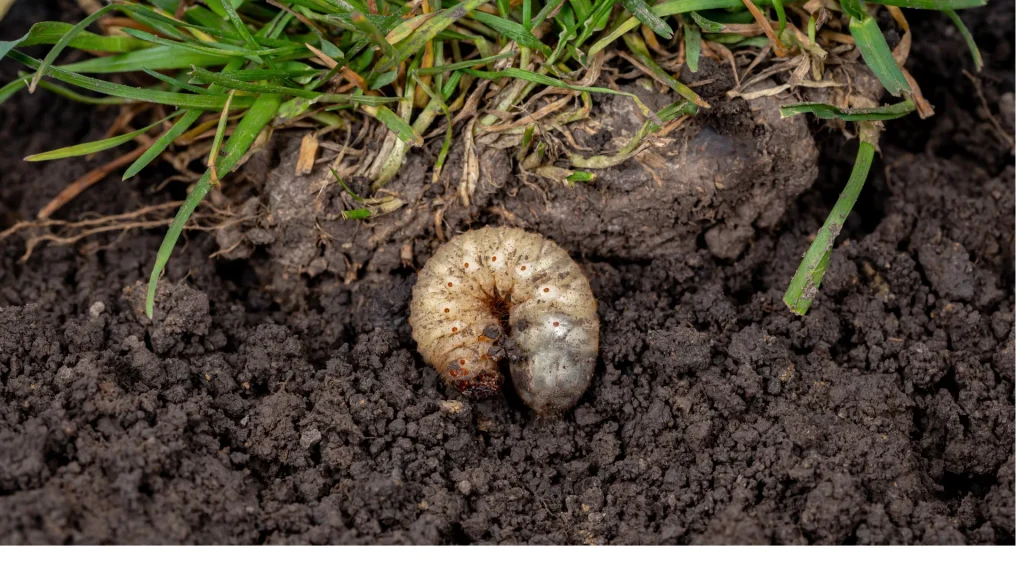
If you've pulled up a patch of dead turf and found fat, C-shaped larvae wriggling in the soil, you've probably asked yourself: "are grub worms june bugs?" It's one of the most common lawn questions out there, and getting the answer wrong can cost you an entire season of grass. The short version is no, they're not the same thing, but they're closely related in a way that matters for treatment.
Here's why this distinction is critical. White grubs are the larval stage of several scarab beetle species, and June bugs (Phyllophaga spp.) are just one of those species. Treating at the wrong time for the wrong beetle is the number one reason lawn treatments fail, and understanding the difference is where we need to start.
Quick Answer
Grubs are not June bugs. Grubs are the larval (immature) stage of scarab beetles. June bugs are the adult form of beetles in the genus Phyllophaga.
Not all grubs come from June bugs. Some come from Japanese beetles, European chafers, or masked chafers. Correct species identification determines your treatment window and method.
Why Getting This Wrong Costs You Your Lawn
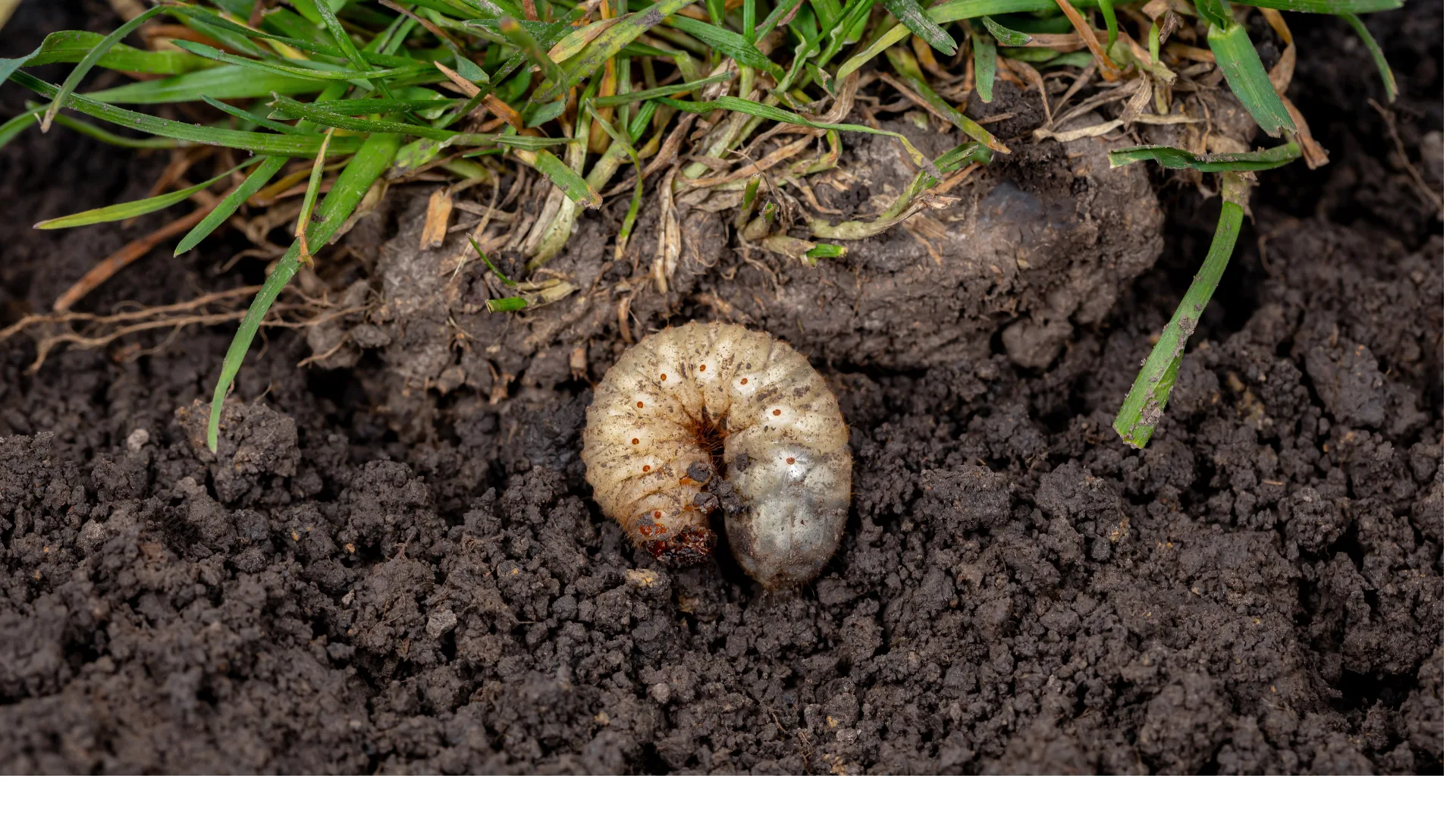
Image source: Bing (Web (fair-use with source credit))
Most homeowners see brown patches in late summer, assume "grubs," and grab whatever product is on the shelf. That approach fails more often than it works. The reason comes down to species-specific life cycles and treatment windows.
June bug grubs (Phyllophaga species) typically follow a two to three year life cycle. Japanese beetle grubs (Popillia japonica) complete their cycle in one year. European chafer grubs (Amphimallon majale) also run on a one-year cycle but emerge as adults earlier in the season.
If you apply a preventive insecticide in August targeting June bug grubs, you've already missed the window for that species and you're too early for others.
The damage itself is easy to misdiagnosis. Grub damage mimics drought stress, fungal disease, dog urine spots, and compacted soil. Without confirming grubs are actually present and above the treatment threshold (typically five to ten per square foot depending on turf type), you might be applying expensive chemicals to solve a problem that doesn't exist.
Then there's the animal factor. Skunks, raccoons, and birds tear up lawns digging for grubs. If you're seeing overnight destruction but finding fewer than five grubs per square foot when you dig, the animals are doing more harm than the insects.
Treat the real problem, not the symptom.
The Quick Answer: Grubs and June Bugs Are Not the Same Thing
Let's settle this clearly. Grubs and June bugs are different life stages of related insects, not interchangeable terms.
A grub is a larval scarab beetle. It lives underground, feeds on roots, and looks like a creamy white, C-shaped worm with a brown head and three pairs of legs near the head. A June bug is an adult beetle, typically brown or reddish-brown, that emerges from the ground in late spring or early summer to mate and lay eggs.
Think of it like caterpillars and butterflies. Calling a grub a "June bug" is like calling a caterpillar a "butterfly." They're the same organism at different stages, but the name matters when you're deciding what to do about them.
The confusion gets worse because people use "grub worm" as a catch-all term for any white larva in the soil. In reality, several different beetles produce grubs that look nearly identical to the untrained eye. June bugs are just one source.
What Grubs Actually Are (And Why the Name Confuses Everyone)
"Grub" isn't a scientific term. It's a common name for the larvae of beetles in the family Scarabaeidae. These larvae share a general body plan: soft, fleshy, C-shaped, cream to white body with a darker head capsule and visible legs.
The name "grub worm" is technically redundant since grubs aren't worms at all. They're insect larvae. But the term sticks because that's what most people call them when they find them in the soil.
Here's what makes identification tricky. White grubs from June bugs, Japanese beetles, European chafers, masked chafers, and several other species all look remarkably similar in the larval stage. They're roughly the same size, same color, same shape.
Telling them apart requires examining the raster pattern, which is the arrangement of hairs and spines on the underside of the abdomen tip near the rear end.
Without that close examination, you're guessing. And guessing wrong means treating at the wrong time or with the wrong product.
What June Bugs Actually Are
June bugs belong to the genus Phyllophaga, commonly called May beetles. There are over 200 species in North America alone, and they're found across most of the continent.
Adult June bugs are stout, oval beetles ranging from half an inch to over an inch long. They're typically brown, reddish-brown, or dark tan. They're clumsy fliers, active at night, and strongly attracted to lights.
If you've ever had a beetle bouncing against your porch light in May or June, there's a good chance it was a Phyllophaga species.
The adults feed on tree and shrub foliage, but the damage is usually minor and cosmetic. The real problem is underground. Females lay eggs in soil during early summer, and those eggs hatch into grubs that begin feeding on grass roots almost immediately.
Phyllophaga grubs are among the largest white grubs you'll find in lawns, sometimes exceeding two inches when fully grown. Their extended life cycle means they can feed on roots for two to three seasons before pupating, which makes them particularly destructive in areas where they're established.
The Life Cycle Connection: How Grubs and June Bugs Relate
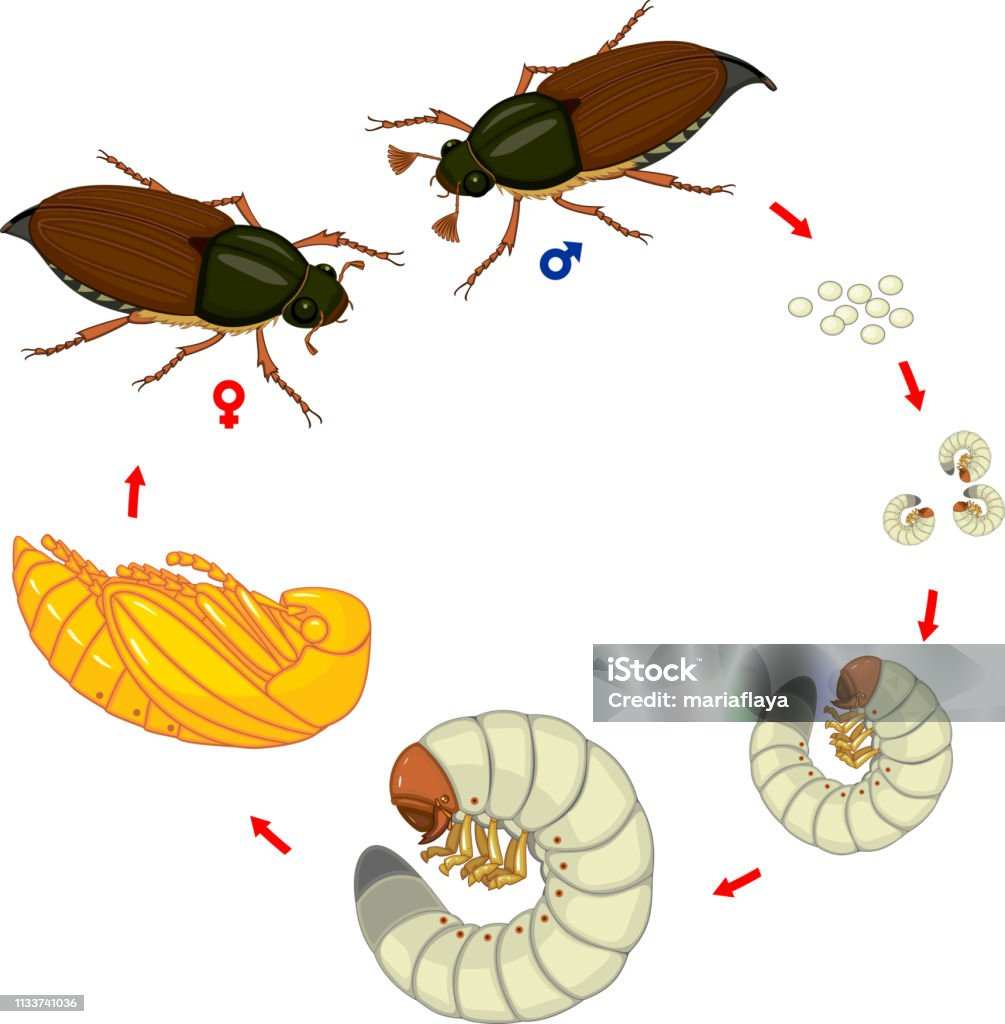
Image source: Bing (Web (fair-use with source credit))
Understanding the life cycle is the key to effective control. All scarab beetles go through complete metamorphosis: egg, larva (grub), pupa, adult.
For June bugs (Phyllophaga), the cycle usually spans two to three years. Adults emerge in late spring, mate, and females burrow into soil to lay eggs. Eggs hatch within a few weeks.
The young grubs feed on roots through their first summer and fall, overwinter deep in the soil, and resume feeding the following spring. In their second or third year, they pupate in the soil, and new adults emerge to start the cycle again.
Japanese beetles compress this into one year. Adults emerge in early summer (June into July), lay eggs, and the grubs feed aggressively through late summer and fall before overwintering. They return to the root zone the following spring for a final feeding period before pupating and emerging as adults the next June.
European chafers follow a similar one-year cycle but with a tighter adult flight window, typically late June into early July in the northern US. Masked chafers are also one-year cycle beetles, with adults active in July.
This timing difference is everything. Preventive insecticides need to be applied just before or during egg hatch, when young grubs are small and vulnerable. For Japanese beetles and European chafers, that's mid to late June through July.
For Phyllophaga species with their longer cycle, the timing is less critical because grubs are present and feeding across multiple seasons, but treatment is most effective when targeting young grubs in mid to late summer.
The Other Beetles People Mistake for June Bugs

Image source: Bing (Web (fair-use with source credit))
June bugs get all the name recognition, but they're far from the only scarab beetle producing grubs in your lawn. Several other species cause identical damage and require different approaches.
Japanese beetles (Popillia japonica) are arguably the most destructive turf pest in the eastern and midwestern US as of 2026. The adults are metallic green and copper, about half an inch long, and they skeletonize leaves on over 300 plant species. Their grubs are the real lawn threat, feeding heavily in late summer and again the following spring before pupating.
European chafers (Amphimallon majale) are a major problem in the Great Lakes region and Northeast. The adults are tan to light brown, smaller than June bugs, and they emerge earlier in the season. Their grubs are particularly cold-tolerant, which means they can continue feeding later into fall and resume earlier in spring than other species.
Masked chafers (Cyclocephala spp.) are common across the eastern and central US. The adults are dark tan with a brown head, about half the size of a typical June bug. They're strongly attracted to lights in July.
Their grubs follow the same one-year cycle as Japanese beetles but tend to be slightly smaller.
Green June beetles (Cotinis nitida) deserve special mention because they break the mold. The adults are large, velvety green, and they fly during the day, which is unusual for scarabs. Their grubs are unique among common lawn pests because they surface frequently, leaving visible trails across sidewalks and driveways in the Southeast.
They're also much larger than other white grubs, sometimes exceeding two inches, and they feed on thatch and organic matter more than roots.
Oriental beetles (Anomala orientalis) round out the major players, particularly in the Northeast. The adults are mottled brown and tan, about a third of an inch long. Their grubs can be confused with small June bug larvae, but their life cycle timing is slightly different.
How to Tell What's Actually in Your Lawn
You need three things to make a proper identification: a shovel, a magnifying glass or phone macro lens, and a flat surface to examine the grub on.
Start by cutting a one-foot square of turf in an affected area. Peel it back like a flap and examine the top three inches of soil where grubs feed. Count what you find.
If you're seeing fewer than five grubs per square foot, treatment usually isn't warranted unless you have high-value turf like a golf green or newly laid sod.
Collect a few specimens and place them on a light-colored surface. Look at the underside of the last abdominal segment, the raster pattern. This is where species identification happens.
The arrangement of hairs, spines, and bare spots on that tip is distinct for each species group.
The Float Test: Confirming Grub Damage vs. Other Problems
Before you even dig, try this. Cut the corners of a one-foot square of damaged turf and fold it back. If the turf lifts easily like a loose carpet, that's a strong indicator of root feeding.
Healthy turf with intact roots resists lifting.
If the turf lifts easily, dig into the exposed soil. Grubs in damaging numbers will be visible in the root zone. If you find none, the brown patch is likely caused by fungal disease (like brown patch or dollar spot), drought stress, or compaction.
Treating for grubs when grubs aren't the problem wastes money and adds unnecessary chemicals to your soil.
Checking Grub Density: When Treatment Is Actually Warranted
The standard treatment threshold for most cool-season turf is five to ten grubs per square foot. Warm-season grasses like Bermuda and zoysia can tolerate slightly higher numbers because of their aggressive growth habit.
Sample multiple areas. Grub populations are rarely uniform across a lawn. Check the edges of damaged patches, not just the centers.
Grubs often move outward from an initial infestation point, so the leading edge of damage is where you'll find the highest concentration.
If you're consistently finding ten or more per square foot, treatment is justified. Below that threshold, beneficial organisms and natural predators usually keep populations in check.
Identifying the Species: Why It Changes Everything
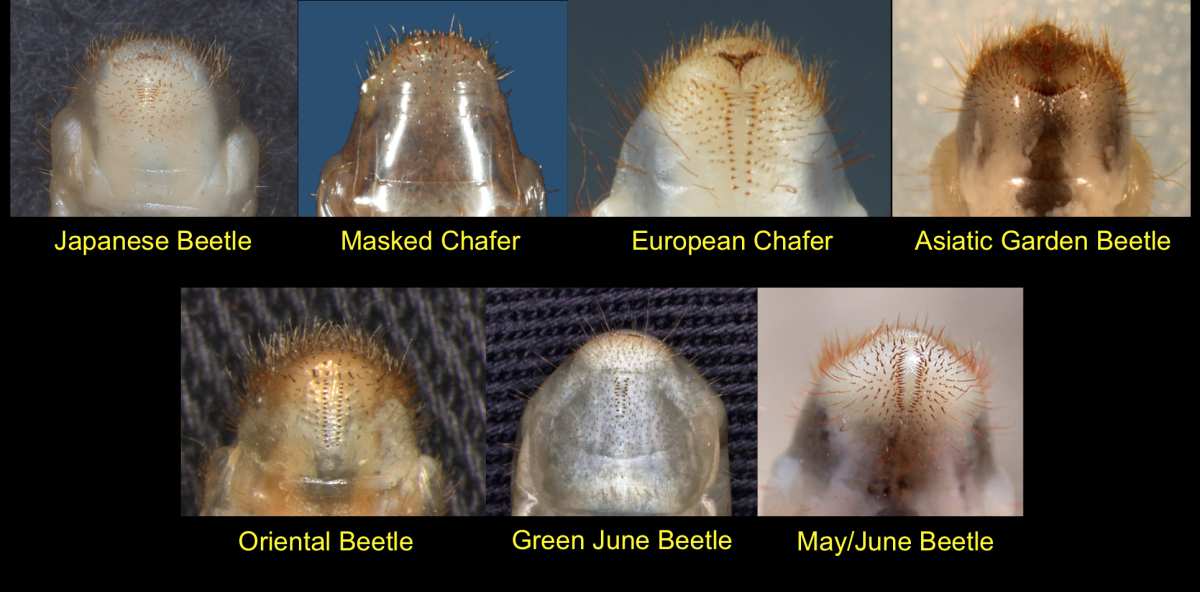
Image source: Bing (Web (fair-use with source credit))
The raster pattern is the gold standard for grub identification. Purdue University Extension and similar programs publish detailed comparison charts showing the distinct hair arrangements for each species group.
Japanese beetle grubs have a V-shaped pattern of spines on the raster. Masked chafer grubs have a straight transverse row of spines. European chafer grubs have two diverging rows that form a Y or irregular pattern.
Phyllophaga (June bug) grubs have a more scattered, less organized arrangement.
If you don't have a reference chart handy, note the time of year and grub size. Large grubs in spring are likely Phyllophaga species in their second or third year of development. Small to medium grubs in late summer are likely Japanese beetles, European chafers, or masked chafers in their first year.
Treatment Timing Based on Species (Not Guesswork)
This is where most people go wrong. They buy a product and apply it whenever they remember, which is almost never the right time.
For one-year cycle species (Japanese beetles, European chafers, masked chafers), preventive treatment targets eggs and newly hatched grubs. The window is mid-June through late July in most of the northern US, shifting earlier in the South. Products containing chlorantraniliprole or imidacloprid work well as preventives because they persist in the soil long enough to catch the hatch.
Curative treatment for these same species targets small, actively feeding grubs in August and September. Trichlorfon and carbaryl are common curative options. They work fast but break down quickly, so timing matters.
Apply when grubs are small and feeding near the surface, not when they've already burrowed deep for winter.
For Phyllophaga species with their two to three year cycle, the approach is different. Because grubs of multiple sizes are present simultaneously, preventive timing is less precise. Curative treatment in late summer or early fall targets the young grubs that will cause the most damage the following year.
Spring treatment can also work on larger grubs before they pupate.
Green June beetle grubs require a different strategy entirely. Because they surface frequently, they're more exposed and vulnerable to surface-applied products. Treatment in May or June, when larvae are actively moving, is most effective.
Chemical vs. Biological Control: What Works for Which Grub
You've got options beyond synthetic insecticides, but each has specific strengths and limitations.
Chemical options:
- Chlorantraniliprole (found in some professional-grade products) is a preventive with low toxicity to mammals and relatively low impact on beneficial insects. It's effective against newly hatched grubs and has good soil persistence.
- Imidacloprid is a neonicotinoid preventive that works well but carries pollinator concerns. Avoid application when clover or other flowering weeds are blooming in the lawn.
- Trichlorfon is a curative option that kills grubs on contact and through ingestion. It breaks down quickly, so it won't provide residual protection, but it's effective for knocking down an active infestation.
- Carbaryl is another curative with broad-spectrum activity. It's effective but also kills beneficial insects and should be used judiciously.
Biological options:
- Milky spore (Paenibacillus popilliae) is a bacterium that specifically targets Japanese beetle grubs. It does not work on June bugs, European chafers, or other species. It takes two to five years to establish in soil, but once established it can persist for a decade or more.
- Beneficial nematodes, specifically Heterorhabditis bacteriophora, are microscopic worms that seek out and kill soil-dwelling grubs. They work on multiple species including Japanese beetles and June bugs. They require soil temperatures above 60°F and moist soil conditions to be effective. Apply in the evening and water thoroughly afterward.
- Steinernema carpocapsae nematodes are less effective against grubs because they hunt near the soil surface. Stick with Heterorhabditis for grub control.
The honest truth is that biological controls require more patience and better conditions than chemical options. They're excellent for long-term management and organic programs, but they won't rescue a lawn that's already being torn apart by a heavy infestation this week.
When to Call a Professional vs. Handle It Yourself
If you're finding fewer than ten grubs per square foot and you're comfortable reading product labels, DIY treatment is straightforward. Most homeowner-grade granular products spread with a standard broadcast spreader and water in with a sprinkler.
Call a professional if the infestation covers a large area, if you can't identify the species, or if you've tried treatment and damage continues the following year. Licensed applicators have access to professional-grade products and the experience to time applications correctly.
Mistakes That Make Grub Problems Worse
The biggest mistake is treating without confirming grubs are present. The second biggest is applying preventive insecticide too late, after grubs are already large and feeding heavily. Watering granular products incorrectly is another common failure.
Most products need half an inch of irrigation to move the active ingredient into the root zone where grubs feed.
Regional Differences: What's Likely in Your Lawn Based on Where You Live
Japanese beetles dominate the eastern and midwestern US. European chafers are concentrated in the Great Lakes and Northeast. Masked chafers are widespread across the central and eastern states.
Phyllophaga species are found nationwide but are especially common in the Midwest and Southeast. Green June beetles are primarily a southeastern pest. Your local cooperative extension service can tell you which species are most prevalent in your specific area.
Frequently Asked Questions
Are all white grubs in lawns June bugs?
No. White grubs can come from June bugs, Japanese beetles, European chafers, masked chafers, green June beetles, and several other scarab species. Each requires slightly different treatment timing.
What is the difference between a grub worm and a June bug?
A grub worm is the larval stage living underground and feeding on roots. A June bug is the adult beetle that emerges to mate and lay eggs. They are the same organism at different life stages, but "grub" and "June bug" are not interchangeable terms.
How do I know if I have grubs or something else damaging my lawn?
Cut a one-foot square of damaged turf and peel it back. If it lifts easily like carpet and you find C-shaped white larvae in the top three inches of soil, grubs are the cause. If the turf is firmly rooted, look for fungal disease, drought stress, or compaction instead.
When is the best time to treat for grubs?
For preventive control of one-year species like Japanese beetles, apply in mid to late June through July. For curative control, treat in August or September when grubs are small and actively feeding. Phyllophaga species can be treated in late summer or early spring.
Will grub damage repair itself?
Minor damage often recovers with proper watering and fertilization once grubs stop feeding. Severe damage where roots are completely severed will not recover on its own and requires reseeding or sodding in fall or spring.
The Bottom Line: What to Do Right Now
If you're seeing brown patches right now, grab a shovel and check. Count the grubs, note their size, and try to identify the species using the raster pattern. If numbers are above threshold, choose a curative product and apply it while grubs are still small and feeding near the surface.
If it's spring and you had damage last fall, plan a preventive application for next June based on the species you identified. Skip the guesswork, and your lawn will thank you.