Image source: Bing (Web (fair-use with source credit))
Figuring out when to apply grub control in Illinois trips up a lot of people, and honestly, it's easy to see why. Two neighbors on the same street can end up with completely different results because one sprayed three weeks too early or used the wrong type of product for the situation.
The timing isn't a single date on the calendar. It depends on which grub species you're dealing with, whether you're trying to prevent damage or stop it that's already happening, and where in the state you live. Let's walk through it so you know exactly when to act.
The Quick Answer: Two Windows, and They're Completely Different
Preventive grub control in Illinois goes down from late May through early July in the southern part of the state. Central Illinois treats from mid-June through late July. Northern Illinois and the Chicago area wait until late June through early August.
Curative treatment, for damage you can already see, happens in late August through October once grubs are actively feeding near the surface.
Most people wait too long for preventive or jump the gun for curative, and either way the product doesn't work. The rest of this article shows you how to match your exact situation to the right window.
Why Grub Control Timing in Illinois Is Tricky (and Why Most People Get It Wrong)
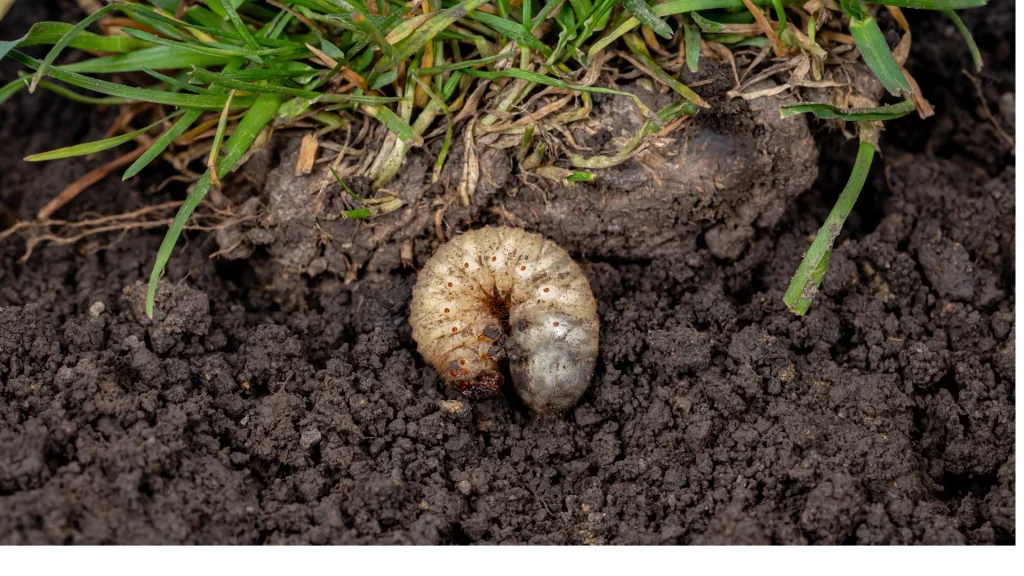
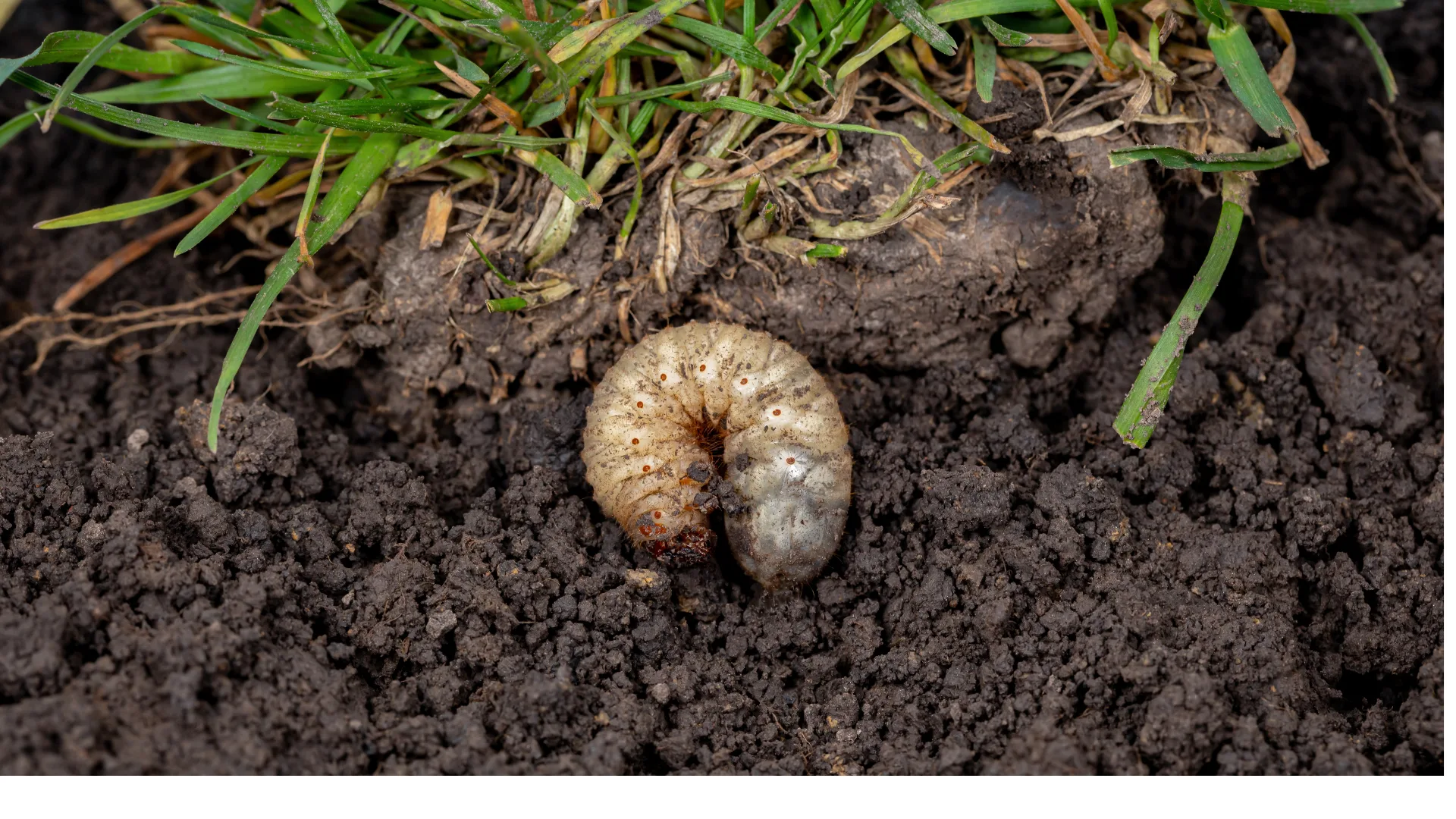
Here's the core problem. White grubs, which is the blanket term for the larval stage of several scarab beetle species, spend most of their life underground. By the time you see brown patches in your lawn, the larvae have already been feeding for weeks and they're fairly large and tough to kill.
The two people who mess this up the most tend to fall into the same habits. One group grabs a preventive product but applies it in late August when they first notice damage. Too late.
The eggs have already hatched and the larvae are past the vulnerable stage that preventive products target. Another group uses a curative product in June hoping to get ahead of the problem. Also wrong.
Curative products have a short residual, so applying them months before grubs are even present means the active ingredient has broken down before it ever contacts a larva.
The timing split comes down to one question: are you preventing or reacting?
The Two Completely Different Strategies
| Preventive Treatment | Curative Treatment | |
|---|---|---|
| Goal | Stop grubs before they cause damage | Kill grubs actively feeding right now |
| Best products | Chlorantraniliprole, imidacloprid | Trichlorfon (Dylox) |
| Timing | Late spring to midsummer | Late summer to early fall |
| How it works | Stops larvae from developing past early instars | Kills on contact with short residual |
| Window length | Several weeks (flexible) | Narrow (grubs must be present and active) |
| Success rate | 90%+ when timed right | 60-80% depending on grub size and species |
Once you know which camp you're in, picking the right week gets a lot easier.
How the White Grub Life Cycle Drives Every Timing Decision
Everything comes back to the biology. You can't time grub control properly without understanding what's happening under the soil surface throughout the year. The life cycle is consistent across species, but the calendar shifts depending on which species dominates your lawn.
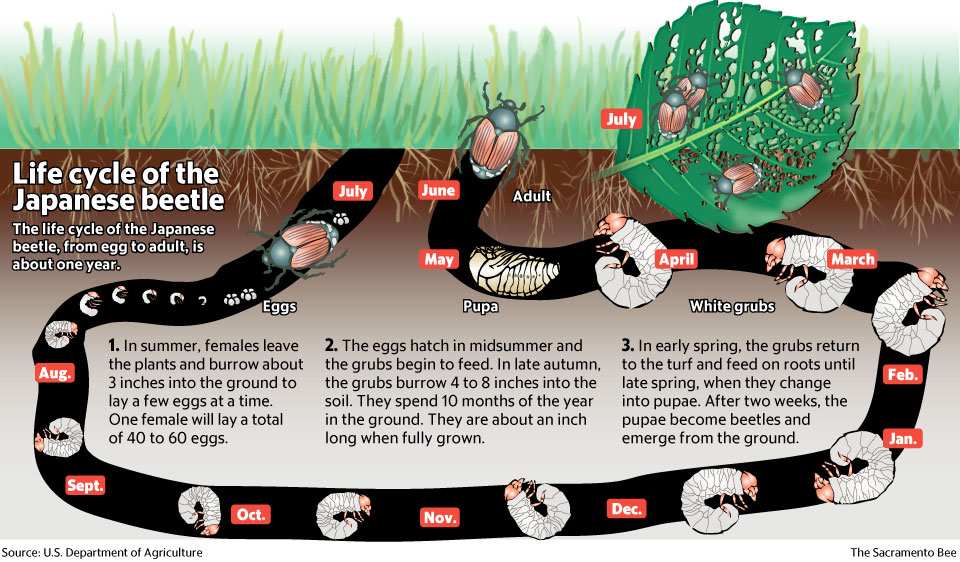
Image source: Bing (Web)
Adult Beetle Flight and Egg-Laying in Illinois
Adult beetles emerge from the soil in late spring and early summer. Japanese beetles, the most common and destructive species across Illinois, typically peak in flight from mid-June through mid July in central parts of the state. European chafers fly a bit earlier in June.
May and June beetles can show up as early as late May in southern Illinois.
The adult beetles feed on trees, shrubs, and garden plants for a few weeks, then females burrow back into moist turf and lay their eggs 2 to 4 inches below the surface. A single female Japanese beetle can lay 40 to 60 eggs over her lifetime. In healthy, well-watered lawns with moist soil, the eggs hatch within about two weeks.
This is the critical link. The adult flight period tells you when eggs are going down, which means it tells you when larvae will start appearing. That's your signal to have preventive product already in the soil.
Egg Hatch and Larval Feeding: When Damage Actually Happens
Once eggs hatch, the tiny first-instar larvae start feeding on grass roots. At this stage they're maybe an eighth of an inch long and relatively vulnerable. This is exactly when preventive insecticides work best, because chlorantraniliprole and imidacliprid disrupt molting and stop the larvae before they reach the larger, more destructive second and third instar stages.
By late July and early August, those larvae have grown substantially. They're now causing visible damage. Brown patches start appearing.
The turf feels spongy underfoot because the roots have been chewed away, and you can often roll carpet-like sections back by hand because there's nothing holding the grass to the soil.
Damage peaks in August and September across most of Illinois. The largest, most resilient grubs are feeding heavily before burrowing deeper into the soil to overwinter. Come the following spring, they stir up briefly, feed for a short period, then pupate and emerge as adults to restart the cycle.
Why Soil Temperature Matters More Than Calendar Date
Calendar dates are a useful starting point, but soil temperature gives you a more precise trigger. Grubs become actively feeding and vulnerable to treatment when soil temperatures hit about 65°F at a 4-inch depth. For homeowners who want to get this right, a basic soil thermometer from any garden center is worth the small investment.
In a typical Illinois spring, soil temps reach that threshold in late May in the southern part of the state and by mid to late June up north. In an unusually cool spring, you might need to wait a week or two beyond the typical window. In a warm spring, things can accelerate.
So if you're the type who wants to nail it precisely rather than going by the calendar, check your soil temperature. When it's consistently hitting 65°F and you're seeing adult beetles flying, that's your window opening.
How the White Grub Life Cycle Drives Every Timing Decision
We've covered the biology above, but let's connect it directly to the product choice because that's where the real mistake happens.
Preventive products like chlorantraniliprole and imidacliprid need to be in the soil before or right as eggs hatch. These aren't contact killers. They work systemically and need the larvae to ingest treated soil or root tissue during their earliest developmental stages. Apply too late, say mid-August, and the grubs are too large and developed to be affected.
The product sits there doing nothing while damage keeps getting worse.
Curative products like trichlorfon work on contact and need grubs to be present and actively feeding. That's why the window is late summer through early fall. You're targeting the larvae that have already hatched and are causing problems. Trichlorfon breaks down fast, sometimes within one to two weeks, so there's no benefit to applying it months in advance.
A lot of the confusion comes from product labels that list a range of application dates. That range exists because the manufacturer can't predict your exact local conditions, so they cover the broadest possible window. Your job is to narrow it down based on the life cycle happening in your specific lawn.
The biology is local, not national. What happens in a lawn in Carbondale is happening a solid three to four weeks ahead of the same cycle in Evanston.
The Decision Tree: Preventive or Curative?
This is where you figure out which path you're on. The answer changes based on your specific situation, so use the branches below to land on the right plan.
Branch 1: You've Had Grub Problems Before (or Your Neighbor Has)
If you've dealt with white grubs in the past two years, treat it as a known risk. The beetles are clearly active in your area and the soil likely has eggs waiting. Go preventive, no question.
The cost of one preventive application is a fraction of what you'd spend on lawn repair, reseeding, or replacing sod.
Recommended timing by region:
- Southern Illinois: late May through mid June
- Central Illinois: mid June through early July
- Northern Illinois: late June through mid July
Apply chlorantraniliprole as the first choice. It's effective, has a long residual, and is safer for non-target organisms than older chemistry. Imidacloprid works well too, but check local ordinances, because a few Illinois municipalities have placed restrictions on neonicotinoid use.
Branch 2: You've Never Had Grubs but Want to Protect Your Lawn
This is the most common scenario for newer homeowners or anyone in a neighborhood where lawns are well-maintained. If your property hasn't had a grub issue confirmed but you've seen Japanese beetles on your plants in summer, there's a moderate risk.
Your options:
- Go preventive, especially if you have Kentucky bluegrass or a mix that's attractive to egg-laying females. Time it the same as Branch 1 based on your region.
- Or skip preventive this year and monitor closely. Check a one-square-foot section of turf in late July by cutting a flap and counting grubs underneath. If you find 10 or more in that single square foot, plan a curative treatment. If you find fewer than 5, you probably don't need treatment this year.
Monitoring costs you nothing and gives you real data. A lot of lawns don't actually need preventive treatment, and knowing your real pressure is worth guessing.
Branch 3: You're Seeing Damage Right Now
Brown patches, spongy turf, sections that peel up like a carpet, or skunks and raccoons tearing up your lawn at night. These are all signs that grubs are already actively feeding and causing harm. You need a curative approach because preventive products won't reverse damage that's underway.
Go with trichlorfon (Dylox). It's the most reliable curative option available to homeowners because it works on contact and targets the larger larvae you're dealing with right now.
Timing for curative treatment:
- Apply as soon as you confirm grubs are present, typically late August through October in Illinois
- Water the lawn lightly before application and water in after, per the label
- Expect to see reduced feeding within a few days
- Reassess the lawn in two to three weeks, because a follow-up application may be needed if pressure is heavy
One thing to be honest about: curative treatment doesn't undo damage that's already done. The grubs will stop feeding, but the brown patches won't green back up until you reseed or the turf recovers naturally. The goal of curative treatment is saving the rest of your lawn and preventing the problem from hitting even harder the following year.
Branch 4: You're Not Sure, Here's How to Check
If you're reading this and honestly don't know whether you have grubs, do a simple check before buying anything. Starting in mid to late July, pick a spot near the edge of a brown area and cut a one-foot square flap of turf. Peel it back and count the grubs you see in the exposed soil.
Threshold guide:
| Grubs per square foot | Action |
|---|---|
| 0 to 4 | No treatment needed. Lawn may have other issues causing the browning. |
| 5 to 9 | Borderline. Consider treatment if damage is spreading or if skunks are digging. Higher-value lawns may justify treating. |
| 10+ | Treat. This is above the damage threshold for most cool-season turfgrasses in Illinois. |
Do this check in three to four spots across the lawn because grub infestations tend to be patchy. If most spots come back with fewer than 5 and you've got one spot with 15, it might be worth treating just that area rather than the whole lawn. Spot treatment is a perfectly valid approach when pressure is uneven.
Choosing the Right Product for Your Situation
Product choice and timing go hand in hand. The right product at the wrong time is useless, and the wrong product at any time is a waste of money.
Preventive Products: Chlorantraniliprole and Imidacloprid
Chlorantraniliprole, sold under the brand name Acelepryn and available in various combination products, is the preferred preventive active ingredient for several reasons. It targets the larvae specifically, has a longer soil residual, and has a much lower impact on earthworms and other beneficial soil organisms compared to older chemistry. Appliance typically runs $50 to $80 per application for an average residential lawn when done by a homeowner.
Imidacloprid, sold as Merit and in many generic granular combination products, also works well as a preventive. It's been around longer and is widely available at hardware stores and big-box retailers. It tends to be slightly less expensive, in the range of $30 to $50 per application.
The trade-off is a shorter residual and broader non-target activity.
Best applied: Late spring through midsummer, depending on your region. Water in granular formulations with at least one-quarter inch of irrigation within 48 hours of application.
Curative Products: Trichlorfon and Its Limitations
Trichlorfon, available as Dylox, is basically the only curative active ingredient that reliably works on larger, late-season grubs. It's a contact insecticide, meaning it needs to reach the larvae directly, either through the soil solution or by direct contact. It has a short residual, typically breaking down within one to three weeks depending on soil conditions.
Best applied: Late August through October, when grubs are actively feeding near the surface. The larvae need to be present and the soil needs to be moist enough for the product to move down into the root zone where grubs are feeding.
The biggest limitation of curative treatment is that it doesn't prevent reinfestation the following year. The beetles will still fly, still lay eggs, and if you don't treat preventively next season, you'll be back in the same spot. A lot of experienced homeowners and lawn professionals end up using curative treatment one year and then switching to preventive the next to break the cycle.
Biological Options: Milky Spore and Beneficial Nematodes
For homeowners looking for non-chemical approaches, there are two main biological control options.
Milky spore disease, caused by the bacterium Paenibacillus popilliae, specifically targets Japanese beetle grubs. It takes one to three years to establish fully in the soil, and once established, it can remain effective for 10 to 15 years or more. The catch is that it only works on Japanese beetle larvae, not on European chafers, masked chafers, or other grub species.
If you confirm Japanese beetles as your primary pest and you're not in a hurry, milky spore is a solid long-term investment. Cost runs around $40 to $70 for a treatment sized for a typical residential lawn, and it's best applied in late summer or early fall when the soil is warm enough for spores to infect feeding larvae.
Beneficial nematodes, specifically Heterorhabditis bacteriophora, are microscopic roundworms that seek out and kill grubs in the soil. They work as a curative treatment and need to be applied when grubs are present and soil temperatures are between 60°F and 90°F. The main challenge with nematodes is handling and application.
They're living organisms, so they need to be kept cool, applied in the evening, and watered in immediately. UV light from sunlight kills them quickly, so early morning or late evening application is essential. They're most effective when grub populations are moderate, and a second application two to three weeks later can improve results in heavier infestations.
Expect to spend $30 to $60 for a package that covers a typical lawn.
Both biological options are worth considering if you're managing a property where chemical use is a concern, like a yard with pets, children, or close proximity to waterways. The trade-off is that neither works as fast or as reliably as synthetic insecticides, and both require more careful handling and timing to get good results in Illinois conditions.
[Images 3 and 4 placed in later sections per the image inventory]
Common Mistakes That Make Grub Control Fail
Even when people pick the right product and roughly the right time, a few recurring mistakes tank the effectiveness. Here are the ones that show up most often.
Applying preventive product after eggs have already hatched. This is the single biggest failure mode. If you're applying chlorantraniliprole in August because you just noticed damage, you've missed the window. The larvae are too developed for the product to work.
Switch to a curative product instead.
Not watering in granular applications. Granular insecticides need to move into the soil where grubs are feeding. Without irrigation within 24 to 48 hours, the granules sit on the surface and degrade. A quarter-inch of water is usually enough.
Set a sprinkler or run the irrigation system right after spreading.
Confusing grub damage with other lawn problems. Brown patches in summer can come from drought stress, fungal disease, dog urine, or fertilizer burn. If you treat for grubs when the real issue is something else, you've wasted money and the lawn still looks bad. Always confirm grubs are present before treating.
Using curative product too early in the season. Trichlorfon breaks down fast. Applying it in June means it's gone before grubs even hatch. Save curative products for when you can actually confirm larvae are present and feeding.
Ignoring the lawn after treatment. Grub control isn't a one-and-done fix if you've got active damage. You'll likely need to reseed bare areas in early fall or the following spring. Treating the grubs stops further harm, but it doesn't repair what's already been chewed away.
Step-by-Step: How to Apply Grub Control the Right Way
Getting the timing right is half the battle. The other half is applying the product correctly so it actually reaches the grubs.
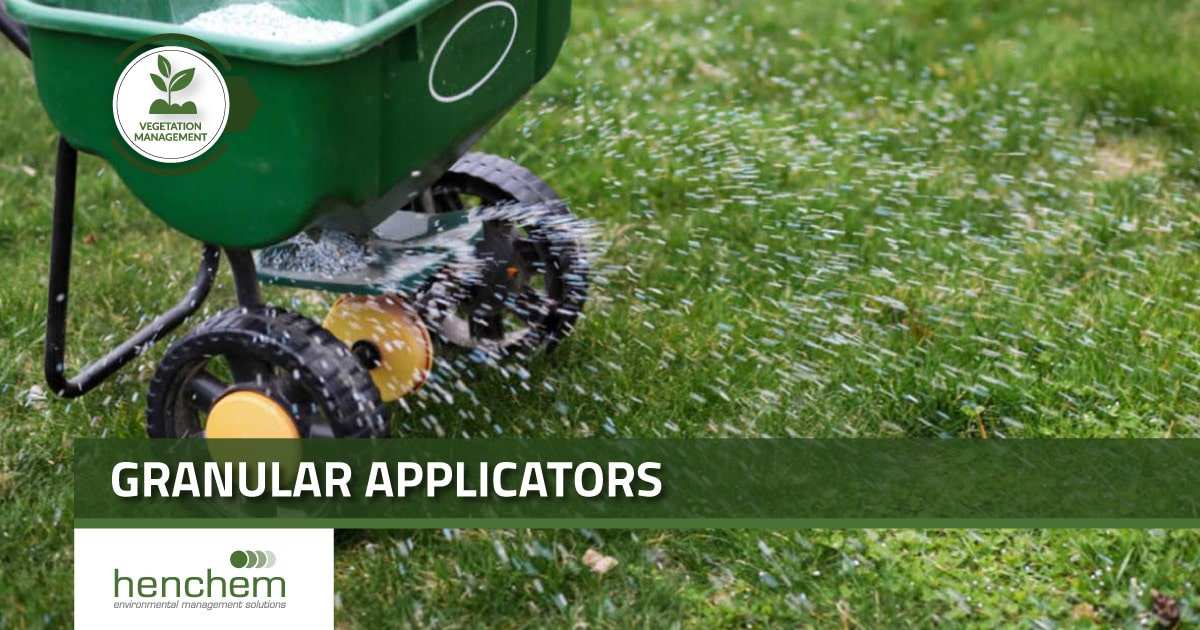
Image source: Bing (Web)
Before Application
- Confirm which product you're using and read the label completely. Application rates, watering requirements, and safety precautions vary by product.
- Mow the lawn a day or two before. Shorter grass lets granules reach the soil surface more easily.
- Check the soil moisture. If the ground is bone dry, water lightly the evening before. Moist soil helps the product move down into the root zone.
- Calibrate your spreader. An uneven application means some areas get too much product and others get too little. The label will specify the spreader setting, but these are starting points. Run a test pass on your driveway or a sidewalk to see the spread pattern before hitting the lawn.
During Application
- Spread granules in a consistent pattern. Overlap each pass slightly to avoid stripes of untreated lawn.
- Apply in the early morning or late afternoon when winds are calm. Wind drift can push granules into garden beds, sidewalks, or waterways.
- For liquid formulations, use a hose-end sprayer or pump sprayer and maintain consistent pressure. Walk at a steady pace to avoid over-applying in some spots.
- Keep pets and children off the lawn during application. Most labels specify they can return once the product has been watered in and the grass is dry.
After Application
- Water the lawn within 24 hours. Aim for one-quarter to one-half inch of irrigation. This moves the active ingredient into the soil where grubs feed.
- Don't mow for at least 48 hours after application. Mowing too soon can remove granular product before it's watered in.
- Mark your calendar. If you applied a preventive product, note the date so you can plan for next year. If you applied curative, plan to reassess the lawn in two to three weeks.
- Watch for results. With curative products, you should see reduced grub activity within a few days. With preventive products, you won't see visible results because the goal is preventing damage that would have happened.
Costs, Expectations, and What Results Look Like
Let's talk numbers so you know what you're getting into.
DIY granular preventive treatment: $30 to $80 per application for a typical 5,000 to 8,000 square foot lawn, depending on the product. Chlorantraniliprole tends to be on the higher end. Imidacloprid-based products are usually cheaper.
Professional preventive application: $75 to $150 per visit from a lawn care company. Most companies include this in a seasonal lawn program, which can bring the per-visit cost down if you're already signed up for fertilization and weed control.
Curative treatment: Similar cost per application, but you may need two treatments in heavy infestations, which doubles the expense.
What to expect: Preventive treatment, when timed correctly, is roughly 90% effective. That means your lawn should show little to no grub damage that season. Curative treatment is less predictable.
If grubs are small and the product reaches them, you might get 70 to 80% control. If grubs are large and the soil is dry, effectiveness drops.
One application per year is the standard for preventive treatment. You don't need to apply twice unless you're dealing with an unusually heavy infestation history or you're using a product with a shorter residual in a high-pressure year.
When to Call a Professional Instead of DIYing It
Most homeowners can handle grub control themselves with a spreader and the right product. But there are situations where a professional is worth the cost.
Call a pro if:
- Your lawn is larger than 10,000 square feet and you don't have a calibrated broadcast spreader.
- You've had repeated grub failures despite treating on time. A professional can identify the species and adjust the product and timing accordingly.
- You're dealing with a mixed-species infestation. Different grub species have slightly different life cycles, and a licensed applicator can tailor the approach.
- You're uncomfortable handling pesticides, especially if you have a well, a pond, or a septic system nearby.
In Illinois, commercial pesticide applicators are licensed through the Illinois Department of Agriculture. If you hire someone, ask for their license number and confirm it's current. A reputable company won't hesitate to provide that.
Frequently Asked Questions
Can I apply grub control and fertilizer at the same time?
Yes. Many combination products pair grub control with granular fertilizer. Just make sure the application rates for both components are correct for your lawn size.
Water in after spreading.
Is grub control safe for pets after application?
Once the product is watered in and the grass is dry, most labels indicate it's safe for pets to return to the lawn. Keep them off during application and watering. Check the specific product label for any additional precautions.
What if I miss the preventive window entirely?
Switch to a curative approach. Apply trichlorfon as soon as you confirm grubs are present. It won't be as effective as preventive treatment would have been, but it's better than doing nothing.
Plan to go preventive the following year.
Do I need to treat for grubs every year?
Not necessarily. If you monitor your lawn and find low grub counts, you can skip treatment. Properties with a history of damage usually benefit from annual preventive treatment for two to three years to break the cycle.
When is it too late in the fall to treat for grubs?
Once soil temperatures drop below 50°F consistently, grubs have burrowed too deep for curative products to reach them. In Illinois, that typically happens in late October to early November. If you're still seeing damage at that point, plan for early next season instead.
Your Decision Guide: What to Do and When
Here's everything from this article boiled down to a simple action plan based on your situation.
If you've had grub damage before: Apply a preventive product with chlorantraniliprole in late spring or early summer. Southern Illinois treats in late May to mid June. Central Illinois treats in mid June through early July.
Northern Illinois treats in late June through mid July. Water in within 24 hours.
If you've never had grubs and want to monitor: Check a one-square-foot section of turf in late July. Count the grubs. If you find fewer than five per square foot, skip treatment.
If you find ten or more, apply trichlorfon as a curative. If you find five to nine, treat if damage is spreading or if skunks are digging.
If you're seeing damage right now: Apply trichlorfon immediately. Water in after application. Plan to reseed damaged areas in early fall or next spring.
Switch to preventive treatment next year to break the cycle.
If you're hiring a professional: Ask for their Illinois Department of Agriculture pesticide license number. Confirm they're using a preventive product with appropriate timing for your region. Get a written guarantee or retreatment policy in case damage occurs despite treatment.
The single most important takeaway is this. Match your product type to your situation. Preventive products prevent.
Curative products react. Using one when you need the other is why most grub control fails in Illinois, and it has nothing to do with the product itself. It's all about timing.
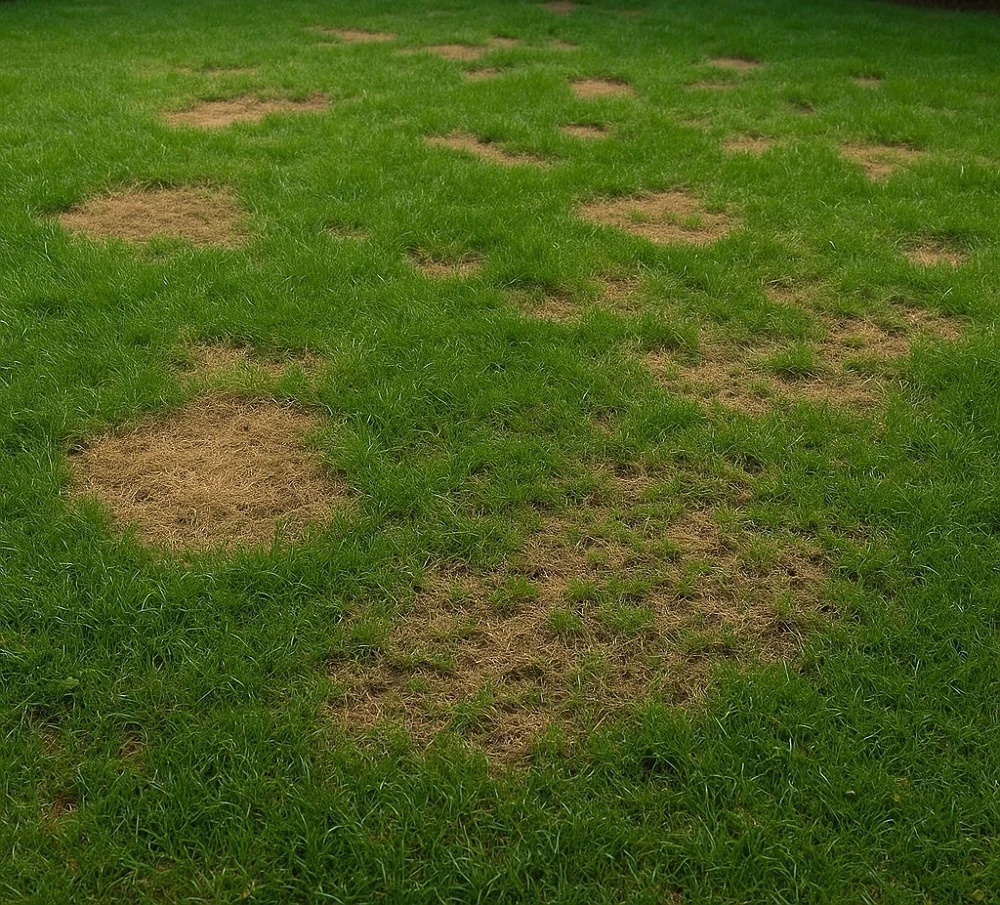
Image source: Bing (Web (fair-use with source credit))