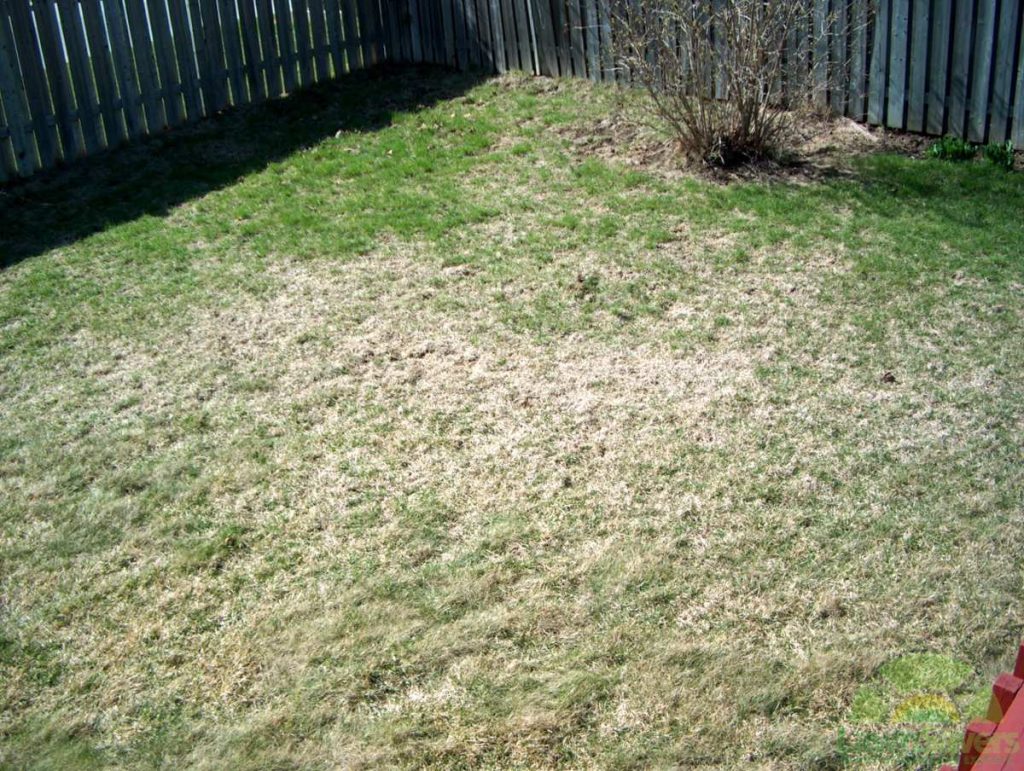
If you've ever stared at a bag of grub control in your garage and wondered whether it's too early, too late, or just right, you're not alone. Figuring out when to apply grub control in Illinois trips up a lot of homeowners because the answer isn't a single date on the calendar. It depends on what's happening underground in your lawn right now.
The timing comes down to two distinct windows: a preventive window and a curative window. Get the timing right and one application protects your lawn all season. Get it wrong and you've wasted money while grubs keep chewing through your roots.
Let's walk through exactly how to figure out which window applies to your situation and when to act.
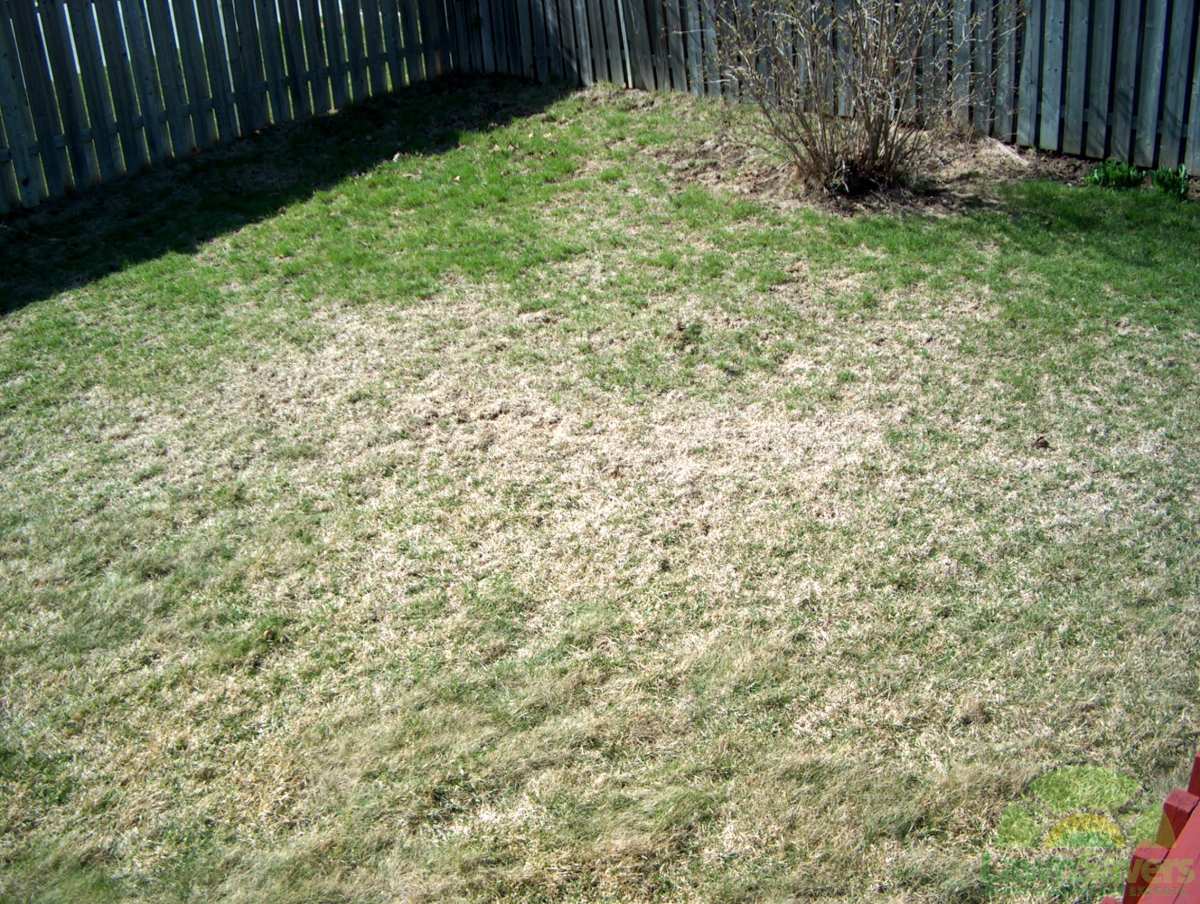
Image source: Bing (Web (fair-use with source credit))
Quick Answer
Apply preventive grub control in Illinois between late June and late July, before beetle eggs hatch. Apply curative grub control from mid-August through September when young grubs are small and actively feeding. Southern Illinois should lean toward the earlier end of each window.
Northern Illinois can push slightly later. Always water in granular products immediately after application.
Why Grub Timing in Illinois Is Trickier Than You Think
Most grub problems in Illinois start above ground. Beetles fly around in early to mid-summer, mate, and lay eggs in the soil. Those eggs hatch into larvae, and those larvae are what we call white grubs.
They feed on turfgrass roots from summer through fall, then burrow deep into the soil to overwinter. In spring, they pupate and emerge as adult beetles, starting the cycle over.
Here's where timing gets complicated. The adult beetles that cause the damage are already gone by the time you see brown patches in your lawn. What you're seeing in August or September is the result of grubs feeding for weeks.
If you wait until damage is visible to apply a preventive product, you've already missed the window. Preventive products work by creating a zone of protection in the soil before eggs hatch. Once grubs are actively feeding and growing, you need a completely different type of product.
Illinois spans multiple climate zones, which shifts the timing by a couple of weeks depending on where you live. Southern Illinois sees beetle activity and egg hatch earlier than the Chicago suburbs or northern counties. Soil temperature drives the whole cycle, so a warm spring accelerates things and a cool spring pushes everything back.
The Two Windows That Actually Matter: Preventive vs. Curative
Understanding the difference between these two approaches is the single most important thing you can get right. They use different active ingredients, target different life stages, and have completely different timing requirements.
Preventive grub control targets eggs and newly hatched grubs before they can do significant root damage. The most common active ingredients are chlorantraniliprole and imidacloprid. These products need to be in the soil and active before eggs hatch, which in Illinois means applying in late June through late July.
Chlorantraniliprole has a wider application window and can sometimes be applied as early as late May in southern parts of the state. Imidacloprid needs to go down closer to the egg hatch period for best results.
Curative grub control targets grubs that are already feeding. The go-to active ingredients here are trichlorfon and carbaryl. These work fast but have a narrow window of effectiveness.
They work best when grubs are small and actively feeding near the soil surface, which in Illinois typically means mid-August through September. Once grubs get large and stop feeding in late fall, curative products lose most of their effectiveness.
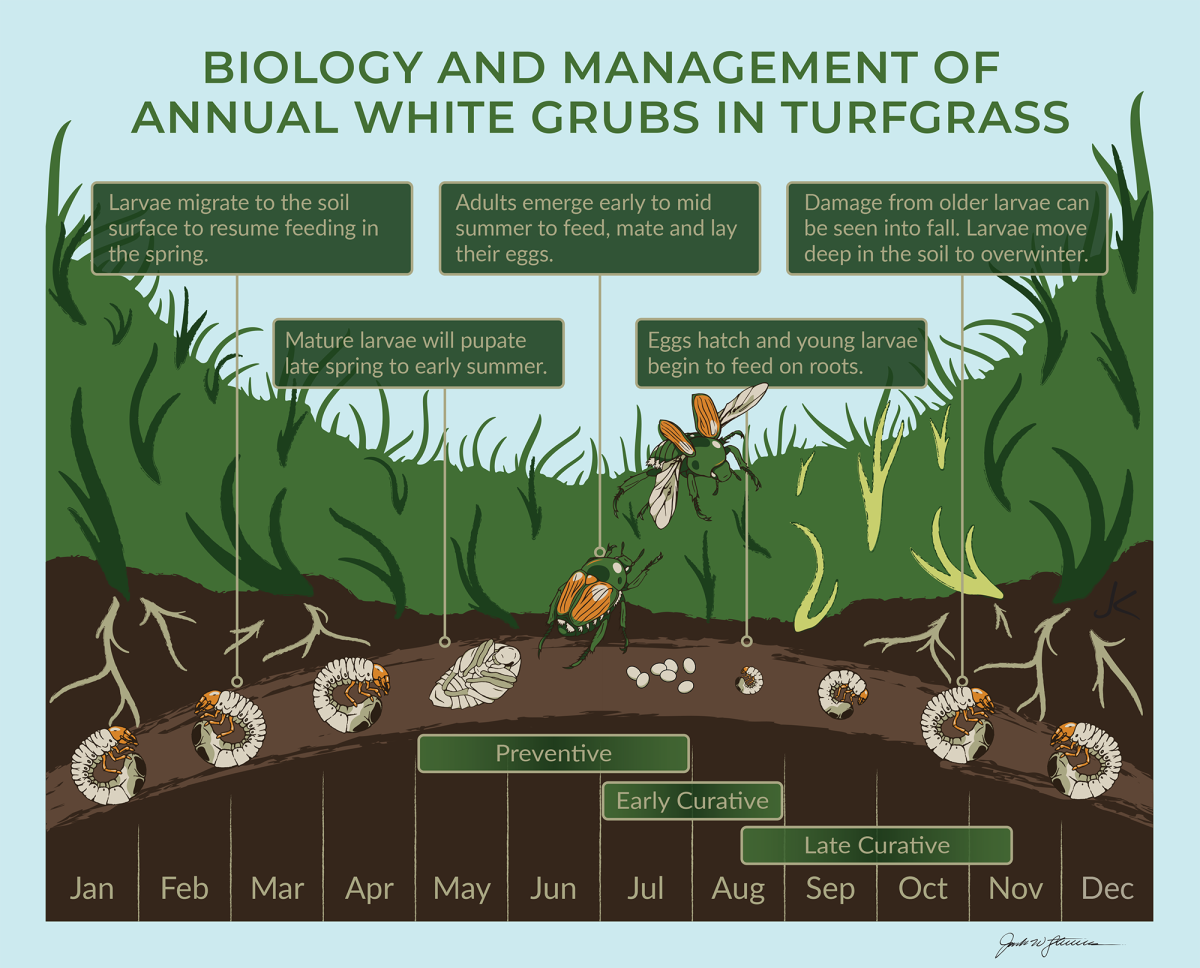
Image source: Bing (Web (fair-use with source credit))
The life cycle diagram above shows why timing matters so much. The preventive window targets the egg and early larval stages. The curative window targets the small to medium larval stage.
Miss both windows and you're left with large grubs that are very difficult to control with any product.
What's Eating Your Lawn? Identifying the Grub Species in Your Region
Not all grubs are the same, and the species in your lawn affects both the timing and the product choice. Illinois is home to several common grub species, each with slightly different life cycles.
Japanese beetle grubs are the most notorious. The adult beetles are metallic green and copper, and they feed on over 300 plant species before laying eggs in turf. Their grubs are the most damaging species in many Illinois lawns.
Egg hatch typically begins in late June in southern Illinois and stretches into mid-July in northern areas.
European chafer grubs are common in the Chicago metropolitan area and northern Illinois. Adults are tan-colored beetles that fly in June. Their egg hatch can be slightly earlier than Japanese beetles, which means the preventive window may open a week sooner in affected areas.
Northern masked chafer grubs are widespread across the state. Adults are dark brown to black beetles that fly in early to mid-summer. Their life cycle is similar to European chafers, and they often overlap in the same lawn.
May and June beetle grubs (Phyllophaga species) have a longer life cycle, sometimes taking two to three years to complete. They're more common in rural and wooded areas of Illinois. Their extended cycle means you may see grubs of multiple sizes in the same lawn at the same time.
Bluegrass billbug larvae aren't technically grubs, but they cause similar damage in Kentucky bluegrass lawns. Their life cycle is different enough that standard grub control products may not be effective. Proper identification matters here.
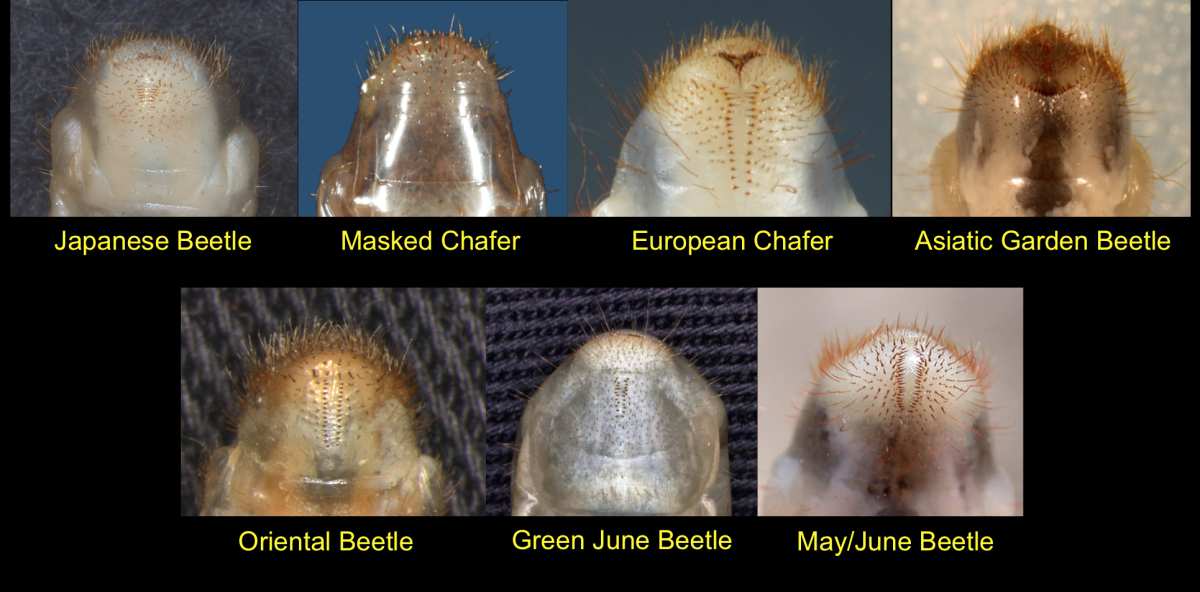
Image source: Bing (Web (fair-use with source credit))
To identify what's in your lawn, cut a one-square-foot plug of sod and peel it back. Count the grubs you find. Five to ten grubs per square foot is the general threshold for cool-season turf before visible damage occurs.
If you're seeing more than that, treatment is warranted. The pattern of damage also helps. Grub damage creates irregular brown patches that peel back like loose carpet because the roots have been severed.
This is different from drought stress, which tends to show up in a more uniform pattern across the lawn.
How to Decide: Should You Go Preventive or Curative This Year?
This is the decision point that determines everything else. Your choice depends on what you know about your lawn's history, what you're seeing right now, and how you prefer to manage risk.
Go preventive if:
- You've had grub damage in the past two to three years
- You live in an area with known Japanese beetle or European chafer pressure
- You want to make one application and be done for the season
- You're not sure what species is in your lawn but want protection regardless
- You're managing a lawn you can't afford to lose, like a newly sodded yard
Go curative if:
- You scout your lawn and find active grubs in late summer
- You missed the preventive window and want to address the problem now
- You prefer to confirm a problem exists before applying any product
- You're dealing with a one-time issue and don't expect recurring pressure
Skip treatment entirely if:
- You scout and find fewer than five grubs per square foot
- Your lawn is healthy and can tolerate minor root feeding
- You're seeing brown patches caused by something other than grubs
The honest truth is that preventive control is usually the smarter play for most Illinois homeowners. It's cheaper, uses less active ingredient, and avoids the visible damage that comes with waiting. Curative control is your backup plan when prevention didn't happen or didn't work.
The Preventive Timeline: When to Apply for Season-Long Control
Here's the specific timing breakdown for preventive grub control across Illinois.
Southern Illinois (Springfield southward): Apply from late May through early July. Chlorantraniliprole products can go down at the earlier end of this window. Imidacloprid products should target late June to early July.
Beetle flight and egg hatch start earlier in this region, so don't wait until late July.
Central Illinois (Peoria, Champaign, Bloomington areas): Apply from mid-June through mid-July. This is the sweet spot for most preventive products. Soil temperatures are consistently warm enough to trigger egg hatch by early to mid-July.
Northern Illinois (Chicago suburbs, Rockford, northwest Illinois): Apply from late June through late July. The cooler spring temperatures delay beetle activity and egg hatch. You have a bit more flexibility here, but don't push past late July or you'll miss the window entirely.
The key with preventive products is getting them watered in. Granular products need at least a quarter inch of irrigation or rainfall after application to move the active ingredient into the soil where eggs and young grubs are. If you apply and then experience a dry spell, the product sits on the surface and does nothing.
This is one of the most common reasons preventive applications fail.
Chlorantraniliprole has become the preferred preventive active ingredient for good reason. It's effective at lower rates, has a more favorable environmental profile, and provides reliable season-long control when applied within the proper window. Imidacloprid still works but requires more precise timing and has more restrictions around pollinator concerns since it can be taken up by flowering weeds in the lawn.
The Curative Timeline: When to Hit Active Grubs for Fast Results
If you missed the preventive window or you're seeing damage right now, curative control is your next move. The timing here is tighter and less forgiving.
Mid-August through September is the curative sweet spot across most of Illinois. Grubs are small, actively feeding near the soil surface, and vulnerable to contact insecticides. Trichlorfon and carbaryl work on contact and through ingestion, so they kill grubs quickly once applied.
You'll typically see results within a few days to a week.
Application steps for curative products:
- Mow the lawn a day or two before application to remove thatch and improve soil contact.
- Apply the product according to label rates using a broadcast spreader for granules or a hose-end sprayer for liquids.
- Water lightly after application, about a quarter inch, to move the product into the root zone.
- Keep foot traffic off the lawn for 24 to 48 hours if possible.
Why October and November are too late for curative products:
By late October, grubs in Illinois begin moving deeper into the soil to overwinter. They stop feeding and become nearly impossible to reach with contact insecticides. You might kill a few near the surface, but the majority will survive and emerge as beetles the next summer.
If you're seeing damage in fall, your best bet is to note it and plan for a preventive application the following June.
Regional adjustments for curative timing:
| Region | Curative Window Opens | Curative Window Closes |
|---|---|---|
| Southern Illinois | Early August | Late September |
| Central Illinois | Mid-August | Late September |
| Northern Illinois | Late August | Early October |
What Happens If You Miss the Window (or Apply at the Wrong Time)
Timing mistakes with grub control are expensive. Here's what actually goes wrong.
Applying preventive products in September or October: The eggs have already hatched and the grubs are too large for preventive chemistry to work effectively. You've spent money on a product designed for a life stage that's already passed. The grubs keep feeding and you see the same damage you would have seen with no treatment at all.
Applying curative products in June or July: The grubs from last year have already pupated and emerged as beetles. There's nothing in the soil to kill. Meanwhile, this year's eggs haven't hatched yet.
The product breaks down before the new grubs arrive. You get zero control and wasted money.
Applying any product without watering it in: Granular products sit on the soil surface. Rain never reaches them. The active ingredient never makes it to the root zone where grubs are feeding.
The product stays inert until it degrades from UV exposure. This is probably the number one reason grub control fails in Illinois, more than bad timing or wrong product choice.
Applying preventive products during a drought with no irrigation plan: Same problem as not watering in. Without soil moisture, the active ingredient can't move into the root zone. If you're in a drought and can't irrigate, skip the preventive application and scout in late August for curative treatment instead.
Common Mistakes That Waste Your Money on Grub Products
Beyond timing issues, several other mistakes show up repeatedly.
Treating the whole lawn when only one area has grubs. Grub damage is often patchy. Scout multiple areas before deciding to treat everything. If only one section has high grub counts, spot-treat that area and save money.
Using the same active ingredient year after year. Resistance development is a real concern with any pest management product. Rotate between chlorantraniprole, imidacloprid, and carbaryl across seasons to reduce resistance pressure.
Confusing grub damage with other problems. Fungal diseases, dog urine spots, and drought stress all cause brown patches. Peel back the sod. If it lifts easily like a carpet and you see C-shaped white grubs, you've got a grub problem.
If the roots are intact, look elsewhere for the cause.
Buying based on brand name alone. Many store-brand products contain the exact same active ingredients as premium brands. Check the label for the active ingredient and concentration. That's what determines effectiveness.
Skipping the spreader calibration. Uneven application means some areas get too much product and others get too little. Follow the spreader settings on the product label and do a test pass on a small area first.
Preventive vs. Curative: Side-by-Side Comparison
| Factor | Preventive | Curative |
|---|---|---|
| Best timing | Late June to mid-July | Mid-August to September |
| Active ingredients | Chlorantraniliprole, imidacloprid | Trichlorfon, carbaryl |
| Target life stage | Eggs and newly hatched grubs | Small to medium grubs |
| Speed of control | Slow (works as grubs feed) | Fast (kills in days) |
| Duration of protection | Season-long with one application | Short-term, may need retreatment |
| Environmental impact | Lower (chlorantraniliprole) to moderate | Moderate to higher |
| Best for | Lawns with history of grub issues | Active infestations discovered late |
| Pollinator concern | Moderate with imidacloprid, low with chlorantraniliprole | Low (short residual) |
Real Scenarios: What Illinois Homeowners Actually Face Each Year
Scenario 1: The proactive homeowner in Chapplied. You had Japanese beetle grubs two years ago and don't want a repeat. You apply a chlorantraniliprole product in early July, water it in the same evening, and monitor the lawn through August. No visible damage appears.
One application, done for the season.
Scenario 2: The reactive homeowner in the Chicago suburbs. You didn't treat preventively. In late August, you notice brown patches in the front yard. You dig up a square foot and find eight grubs.
You apply a trichlorfon product immediately, water it in, and see the patches stabilize within a week. The lawn recovers with fall rain and cooler temperatures.
Scenario 3: The late responder in southern Illinois. You see skunks tearing up the lawn in October. By this point, the grubs are large and deep in the soil. Curative products won't reach them effectively.
You mark your calendar for the following June and plan a preventive application. In the meantime, you repair bare spots with seed or sod after the grubs have moved deep for winter.
Scenario 4: The mistaken diagnosis. You see brown patches in July and assume grubs. You buy and apply a curative product. The patches keep spreading.
You finally call your local University of Illinois Extension office and learn the damage is from necrotic ring spot fungus, not grubs. The product did nothing because the problem was never insects. Proper scouting would have saved time and money.
Expert Tips for Getting It Right Every Season
Scout before you spend. Spend ten minutes checking your lawn in late July. Cut a few small plugs and count the grubs. If you find fewer than five per square foot in a healthy lawn, skip treatment this year.
Thresholds exist for a reason.
Track soil temperature. Egg hatch accelerates when soil temperatures at a four-inch depth reach around 65 to 70 degrees Fahrenheit consistently. This typically happens in late June for southern Illinois and early July for northern areas. Soil thermometers are cheap and give you a better trigger than guessing by calendar date alone.
Coordinate with your mowing schedule. Mow before you apply granular products. Shorter grass lets the granules reach the soil surface instead of getting caught in long grass blades thatch. Water after mowing, not before, so granules don't stick to wet foliage.
Read the label every time. Product labels are legally binding documents. They tell you the exact rate, the timing, the safety precautions, and the watering requirements. Ignoring the label voids any guarantee of performance and may violate state pesticide regulations.
Consider beneficial nematodes as a supplement. Heterorhabditis bacteriophora and Steinernema glaseri are nematode species that actively hunt and kill grubs in the soil. They work best in the same curative window as chemical products and can be used alongside or instead of them for homeowners who prefer biological options. They need consistent soil moisture and warm soil temperatures to be effective.
Don't forget about next year's plan. Grub problems tend to recur in the same lawns year after year. Use your scouting results and product performance this year to build a plan for next season. A simple log of what you applied, when, and how well it worked makes next year's decision much easier.
Frequently Asked Questions
Can I apply grub control in spring in Illinois?
Spring applications are not recommended. By spring, grubs from the previous year are either pupating or have already emerged as adult beetles. Preventive chemistry targets eggs and newly hatched grubs, which aren't present in spring.
Curative chemistry can't reach grubs effectively at this stage. Plan your preventive application for June or July instead.
How long does preventive grub control last?
Chlorantraniliprole provides reliable season-long control from a single application when applied in the proper window. Imidacloprid also provides season-long protection but requires more precise timing relative to egg hatch. Neither product will carry over to the next year, so annual applications are necessary in areas with consistent grub pressure.
What if it rains right after I apply?
Rain is actually ideal for granular products, as long as it's not so heavy that it washes granules off the lawn. A quarter inch of rainfall or irrigation is the target. If you get a heavy downpour within hours of application, check for granule movement and reapply only to areas where granules appear displaced.
Do I need to treat my whole yard?
Not necessarily. Grub damage is often concentrated in specific areas, typically south-facing slopes and full-sun sections of the lawn. Scout multiple areas.
If only one section has high grub counts, spot-treat that area. Widespread infestations across the entire lawn justify full-yard treatment.
Is grub control safe for pets when applied correctly?
When applied at labeled rates and watered in as directed, most grub control products have low risk to pets once the treated area is dry. Keep pets off the lawn during application and until granules are watered in and the lawn is dry. Always read the product label for specific re-entry intervals and pet safety instructions.
What's the difference between GrubEx and professional-grade products?
Consumer retail products typically contain chlorantraniliprole or imidacloprid at concentrations suitable for homeowner use. Professional-grade products may include the same active ingredients at different formulations or concentrations, or include active ingredients like trichlorfon that aren't available in retail packaging. The most important factor is applying the right active ingredient at the right time, regardless of whether it's a retail or professional product.
Step-by-Step: How to Apply Grub Control the Right Way
Proper application technique matters as much as timing. Follow these steps whether you're using preventive or curative products.
Prepare the lawn first. Mow to normal height a day before application. Remove clippings if they're heavy so granules can reach the soil surface. Check that your irrigation system is working or that rain is in the forecast within 24 hours.
Calibrate your spreader. Every spreader throws granules differently. Set the dial according to the product label, fill the hopper halfway, and test on a concrete driveway. Walk at a steady pace.
Check the spread pattern for even coverage. Adjust the setting if you see gaps or heavy bands.
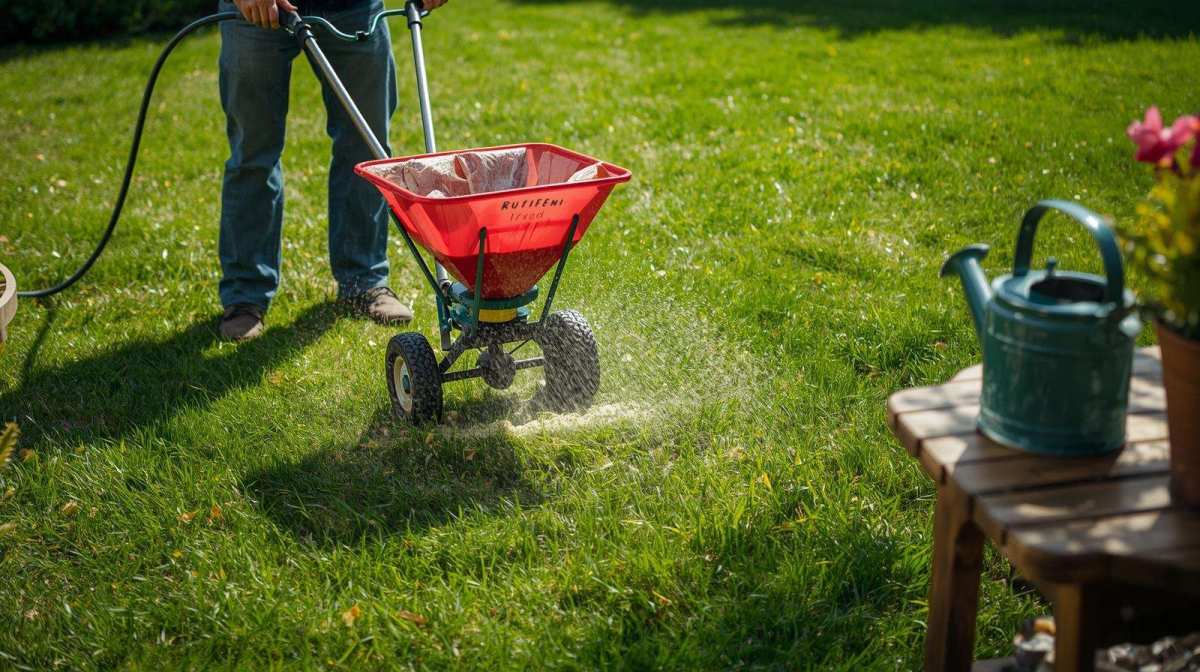
Image source: Bing (Web (fair-use with source credit))
Apply at the right rate. Don't guess or eyeball it. Use a bathroom scale to weigh out enough product for one pass. Weigh again after the pass to confirm you're applying the advertised rate per square foot.
Under-application wastes money through poor control. Over-application wastes money and increases environmental risk.
Water in promptly. Apply at least a quarter inch of irrigation immediately after granules hit the soil surface. This moves the active ingredient into the root zone where grubs feed. If you're applying a hose-end sprayer product, the spray itself provides the water-in step.
Granules without water are just expensive mulch.
Your Decision Guide: Which Approach and Timeline Fits Your Lawn
Here's the short version to take into this season.
If your lawn has had grub problems before and you want peace of mind, choose preventive control with chlorantraniliprole. Apply in late June if you're in southern Illinois, early July if you're central, late July if you're north. Water it in the same day.
If you're seeing brown patches right now in August or September, scout immediately. Find more than five grubs per square foot and apply a curative product with trichlorfon or carbaryl. Water in and expect results within a week.
If you're reading this in October or later, put a note in your calendar for next June. There's nothing useful to apply right now. Focus on fall overseeding to repair this year's damage and start fresh planning for the next season.