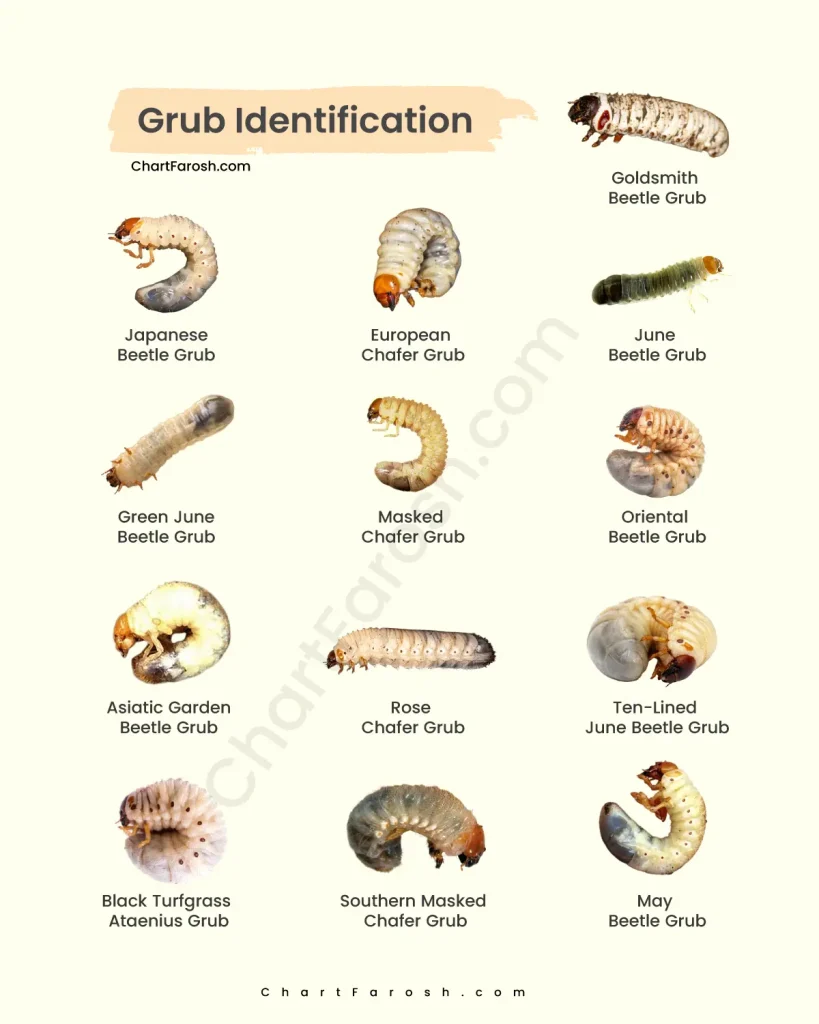
Right now, you're probably staring at a patch of dead grass or a handful of weird C-shaped larvae and wondering what you're actually dealing with. "What is grub worm" is one of those questions that sounds simple but opens up a whole chain of decisions that can save or wreck your lawn depending on how you answer it.
Here's the thing. Not every white larva in your soil is a destructive pest, and not every brown patch on your lawn is caused by grubs. Getting this wrong means you either spray chemicals you don't need or ignore a problem until skunks tear up your yard looking for a snack.
The threshold that matters for most cool-season turf is 6 to 10 grubs per square foot, according to turfgrass entomology research from land-grant universities. Below that, your grass can usually outgrow the damage. Above it, you've got a real problem on your hands.
Quick Answer
A grub worm is the larval stage of scarab beetles, including Japanese beetles, European chafers, and June bugs. These C-shaped, cream-colored larvae live underground and feed on grass roots. They range from ¼ inch to over 1 inch long depending on species and age.
Not all grubs in your soil are harmful. The key is identifying the species and counting how many you have before deciding on treatment.
Why Getting Grub Identification Right Actually Matters
Most people treat "grub" like it's one single pest. It's not. There are multiple species, and they behave differently, show up at different times, and respond to different treatments.
If you blanket your lawn with a preventive insecticide every spring without knowing what's actually down there, you're wasting money and killing beneficial organisms for no reason.
The real cost of misidentification goes beyond wasted product. Apply a preventive too late and it won't work. Apply a curative too early and the larvae are too big to kill.
Use milky spore for a species it doesn't target and you've spent money on a biological control that does absolutely nothing in your soil.
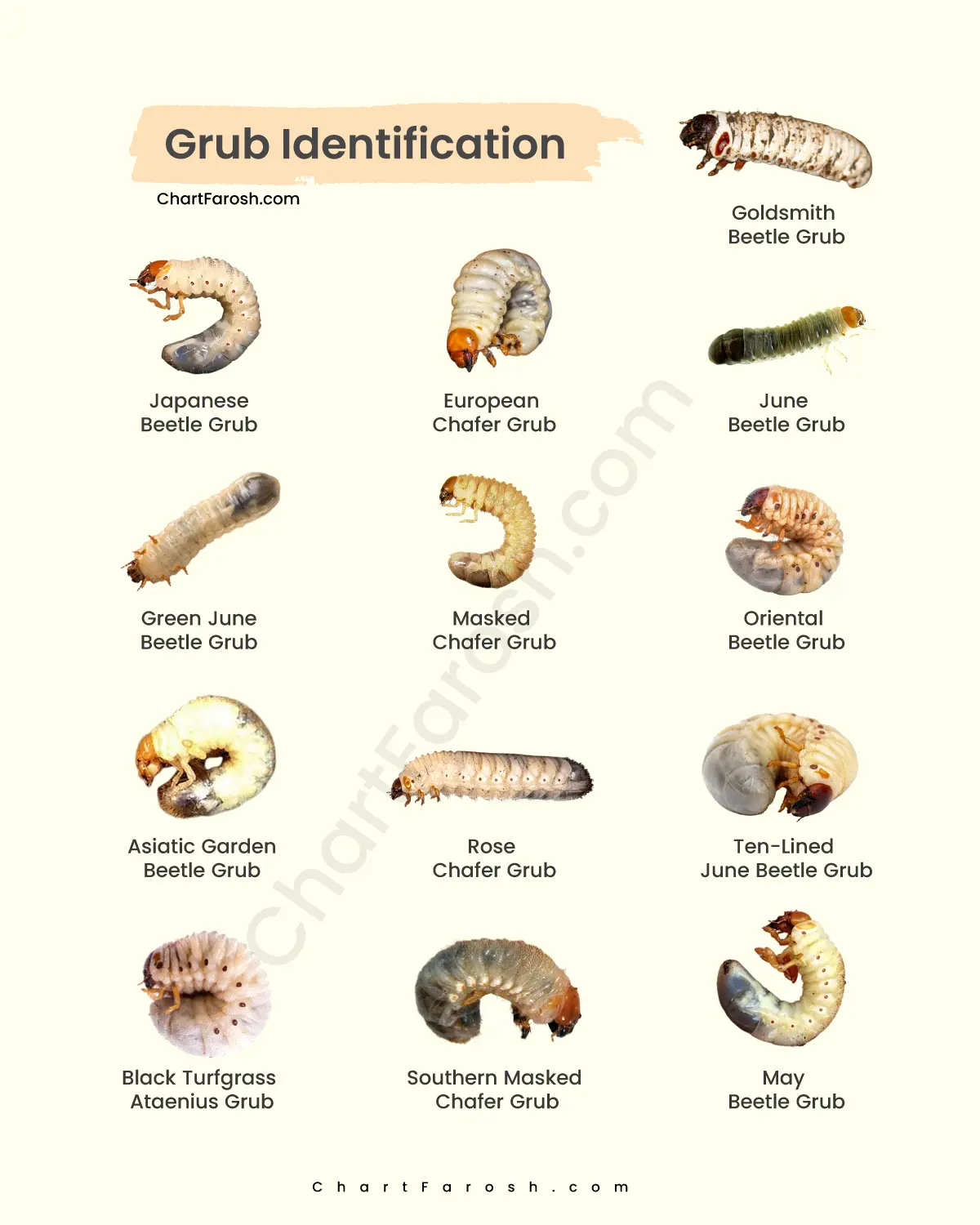
Image source: Bing (Web (fair-use with source credit))
Then there's the animal factor. Raccoons, skunks, and armadillars don't care about your treatment timing. They care that your lawn is full of protein-rich larvae.
Secondary digging damage often ends up costing more than the grubs themselves would have. A single skunk can tear up 100 square feet of turf in one night looking for grubs.
The good news is that proper identification isn't hard. You just need to know what to look for and when to look for it.
What a Grub Worm Really Is (And What It Isn't)
A grub worm is the larval form of beetles in the family Scarabaeidae. After adult beetles lay eggs in soil, typically in mid to late summer, those eggs hatch into larvae that live underground feeding on organic matter and plant roots. The larval stage is the one that damages lawns and turf.
Grubs share a few consistent physical traits across species. They have a cream or white body with a distinct brown head capsule. They sport three pairs of true legs near the head.
Their body curls into that characteristic C-shape when disturbed. Most species range from about ¼ inch when newly hatched to a full inch or more when mature.
What grubs are not is just as important. Sod webworms are caterpillars that live above ground in thatch tunnels, not below the soil line. Armyworms feed on grass blades, not roots.
Cutworms are night-feeding caterpillars that chew through stems at the soil surface. If you're pulling a C-shaped larva out of the root zone, you've got a grub. If it's crawling on the grass blades or living in a silk-lined tunnel in the thatch, you're dealing with something else entirely.
Billbug larvae also get confused with grubs, but they're actually weevil larvae. They're legless and white, which distinguishes them from true grubs. Billbugs are also primarily stem and crown feeders rather than root feeders, so the damage pattern looks different.
The Species You're Actually Dealing With
Not all grubs are created equal. The species in your lawn determines when they're active, how much damage they cause, and which treatments will actually work.
Japanese Beetle Grub
Japanese beetle grubs are probably the most widely recognized species in the United States. The adult beetles are metallic green and copper, and they feed on over 300 species of plants above ground. Below ground, the grubs are major turf pests across the Northeast, Midwest, and parts of the Southeast.
Japanese beetle grubs have a distinctive V-shaped raster pattern on the underside of the abdomen tip. This pattern is the most reliable way to distinguish them from other species. They follow a one-year life cycle, meaning eggs laid in late summer hatch quickly, feed through fall, move deep for winter, return in spring, then pupate and emerge as adults in early summer.
European Chafer Grub
European chafers are a serious problem in the Northeast and parts of the Midwest. The adult beetles are tan to light brown, smaller than Japanese beetles, and they fly in large numbers in mid to late June. The grubs can tolerate cooler soil temperatures than other species, which means they feed longer into the fall and start earlier in the spring.
Their raster pattern is made up of two parallel rows of spines forming a Y-shaped or open pattern. European chafer grubs are particularly damaging because they often occur in high populations and their extended feeding window gives them more time to destroy root systems.
Green June Beetle Grub
Green June beetles are a different animal entirely. The adults are large, metallic green, and they fly during the day, which is unusual for scarab beetles. Their grubs are also larger than most other species, sometimes reaching 2 inches in length.
What makes green June beetle grubs stand out is their behavior. Unlike other grubs that stay below the soil line, green June beetle grubs frequently crawl on the surface at night, leaving distinct trails in the soil. They feed on organic matter in the thatch layer more than on roots, so the damage is often less severe than their size would suggest.
They also create noticeable surface tunneling that can make lawns feel spongy and uneven.
May/June Beetle Grub
May beetles and June beetles, both in the genus Phyllophaga, are common across much of the United States. The adults are dark brown to reddish brown and they're strongly attracted to lights in late spring and early summer. Their grubs have a two to three year life cycle, which means they're feeding underground for multiple seasons before emerging as adults.
These grubs have a raster pattern with two parallel rows of spines, similar to European chafers, but the arrangement differs under close inspection. Because of their multi-year life cycle, you'll often find multiple sizes of Phyllophaga grubs in the same lawn at the same time. They're capable of causing severe root damage, especially in the second and third years of their development.
How to Tell If Those Larvae Are Actually Grubs
You can't treat what you haven't identified. Before you spend a dollar on any product, you need to confirm you actually have grubs, figure out which species they are, and determine whether the population is high enough to justify action.
The Flap Test: How to Sample Your Lawn
The simplest way to check for grubs is the flap test. Cut a 1-foot by 1-foot square of turf with a spade, about 2 to 3 inches deep. Peel it back like a flap and examine the root zone and the underside of the sod piece.
Count every grub you see in that square foot.
Do this in multiple spots, especially in areas where the grass looks stressed or where you've seen animal digging. Grubs aren't evenly distributed across a lawn. They cluster in favorable spots, so one sample might show zero while another ten feet away shows twenty.
The threshold for most cool-season turfgrasses is 6 to 10 grubs per square foot. Warm-season grasses like Bermuda and zoysia can often tolerate slightly higher numbers because of their aggressive growth habit. If you're finding fewer than that, treatment usually isn't necessary.
Using the Raster Pattern to Identify Species
Once you've got grubs in hand, flip them over and look at the underside near the tip of the abdomen. The raster pattern, the arrangement of hairs, spines, and bare spots, is the most reliable way to identify grub species without sending samples to a lab.
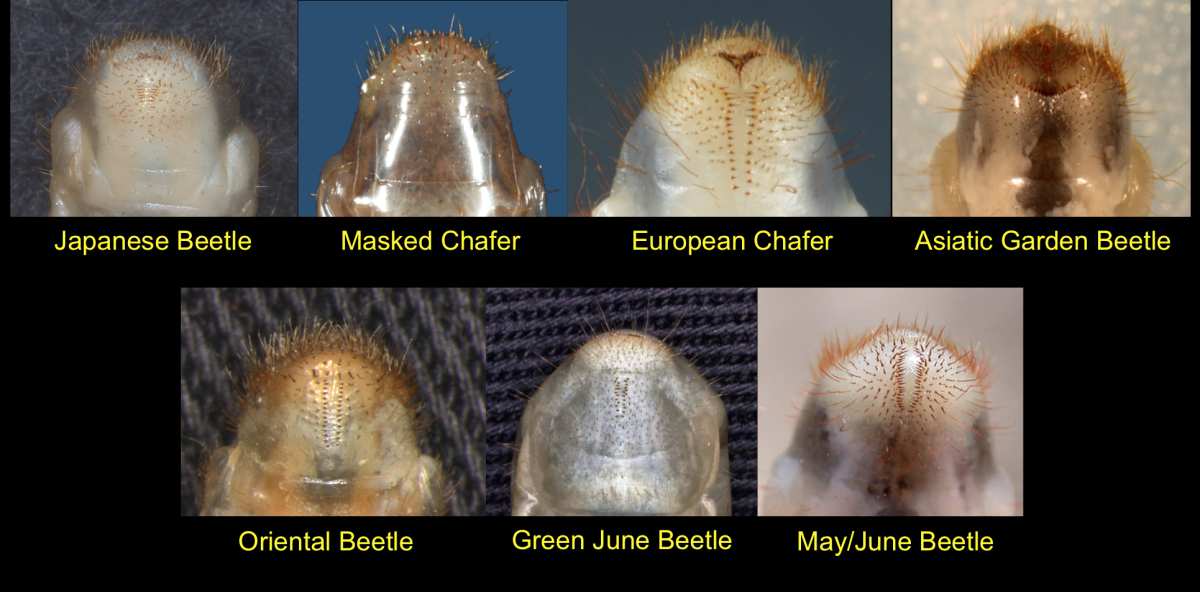
Image source: Bing (Web (fair-use with source credit))
Japanese beetle grubs show a V-shaped pattern of spines. European chafers and May/June beetle grubs have two roughly parallel rows that open into a Y or irregular pattern. Green June beetle grubs have a distinctive pattern of two rows of spines that converge toward the rear.
A hand lens or magnifying glass helps here. The differences are subtle but consistent. If you're unsure, your local Cooperative Extension office can often identify species from clear photos or physical samples.
What People Mistake for Grubs
Several other soil organisms get misidentified as grubs by homeowners every year. Ground beetle larvae are elongated, fast-moving, and have prominent jaws. They're actually beneficial predators that feed on other insect larvae, including grubs.
Millipedes are round-bodied with many legs and they feed on decaying organic matter, not roots. Earthworms are segmented and obviously not insects at all.
The most common confusion is between grubs and billbug larvae. Both are white and found in the root zone, but billbug larvae are legless. If you can't see three pairs of small legs near the head, you're not looking at a true grub.
When Grubs Actually Cause Damage (And When They Don't)
Finding a few grubs in your soil doesn't automatically mean you have a problem. Healthy turf with a deep root system can tolerate a surprising amount of root feeding without showing visible symptoms. The grass simply outgrows the damage.
The Threshold That Matters
For most cool-season lawns, the action threshold sits at 6 to 10 grubs per square foot. Below that number, your grass is likely fine. Above it, you'll start seeing irregular brown patches that don't respond to watering or fertilizer.
Warm-season grasses like Bermuda and zoysia can often handle slightly higher counts because their aggressive stolon and rhizome growth fills in damaged areas faster.
The threshold isn't universal, though. Newly established lawns, drought-stressed turf, and grass growing in heavy shade all have less tolerance. In those situations, even 4 to 5 grubs per square foot can cause noticeable damage.
What Real Grub Damage Looks Like
Grub damage shows up as irregular brown patches that start small and expand over weeks. The key characteristic is that the affected turf lifts easily from the soil like a loose carpet. That's because the roots have been chewed away and nothing anchors the sod to the ground anymore.
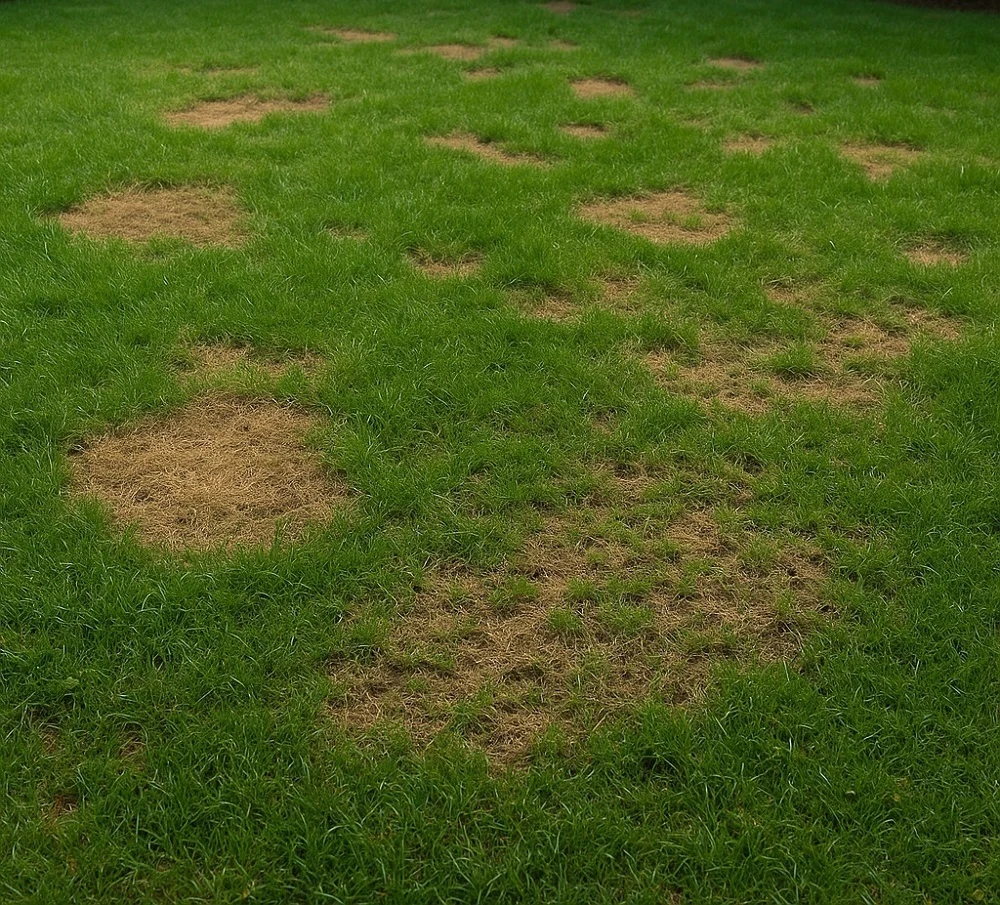
Image source: Bing (Web (fair-use with source credit))
This is different from drought stress, where the grass stays firmly rooted but turns uniformly brown or gray. It's also different from fungal diseases, which often show distinct patterns like rings, patches with defined borders, or visible fungal growth on the blades.
Grub damage typically appears in late summer and fall when larvae are largest and feeding most aggressively. Spring damage can happen too, especially with European chafers that start feeding early, but it's often less severe because the grubs are smaller at that point.
Secondary Damage from Animals Digging
Sometimes the animals cause more destruction than the grubs themselves. Skunks, raccoons, and birds all dig for grubs, and they're not gentle about it. A skunk can roll back sections of sod overnight, leaving torn-up patches that look far worse than the original grub damage.
If you're seeing cone-shaped holes or rolled-back turf, that's animal activity, not direct grub feeding. The grubs are still the root cause, but the visible damage comes from above. This secondary damage often pushes homeowners into action even when grub counts are borderline.
Treatment Options: What Works and Not All of Them Make Sense
Once you've confirmed you have a grub problem that exceeds the threshold, you've got two main approaches. The choice between them depends on timing, species, and whether you're trying to prevent damage or stop it that's already happening.
Preventive Treatments (Applied Before Damage)
Preventive products target young grubs shortly after they hatch, before they grow large enough to cause serious root damage. The most widely used active ingredient for prevention is chlorantraniliprole, found in products like GrubEx. It's applied in late spring to early summer, timed to when adult beetles are flying and laying eggs.
Chlorantraniliprole has a favorable safety profile for pollinators and pets when used according to label directions. It works by affecting the grub's muscle function, and it's effective at very low application rates. One application typically provides season-long control.
The catch is timing. Apply too early and the product degrades before eggs hatch. Apply too late and the grubs are already too large for preventive chemistry to work.
The window varies by region, but generally falls between May and early July depending on your location and the target species.
Curative Treatments (Applied After You Find Grubs)
Curative products are designed to kill grubs that are already present and actively feeding. The most effective curative active ingredient is trichlorfon, found in products like Dylox. It works fast, often killing grubs within one to three days of application.
The tradeoff is that trichlorfon is a broad-spectrum organophosphate with a shorter residual. It breaks down quickly in soil, which means it's less likely to affect non-target organisms, but it also means you need to apply it when grubs are actively feeding near the surface. That window is typically late July through September for most species.
Imidacloprid, a neonicotinoid, has been used for both preventive and curative purposes, but its status is changing. Several states have restricted or banned neonicotinoid lawn products due to concerns about pollinator exposure. As of 2026, check your state's regulations before purchasing any product containing imidacloprid.
Biological Controls: Nematodes and Milky Spore
If you'd rather avoid synthetic insecticides, biological controls offer an alternative. They require more precise timing and realistic expectations about effectiveness.
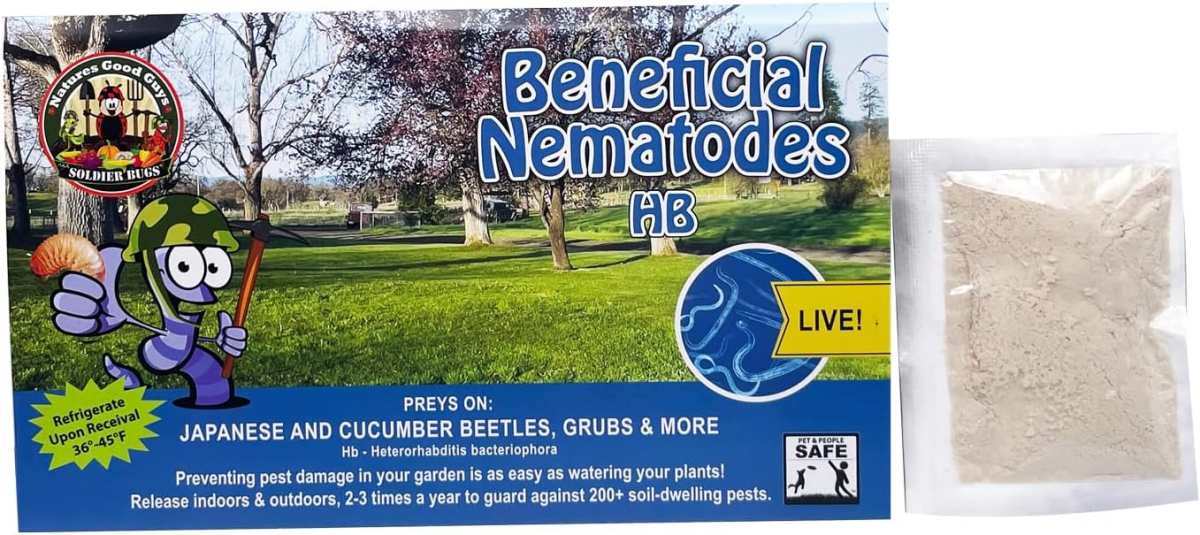
Image source: Bing (Web (fair-use with source credit))
Beneficial nematodes, specifically Heterorhabditis bacteriophora, are microscopic roundworms that seek out and kill grubs in the soil. They're applied as a liquid drench and need to be watered in immediately. The nematodes carry bacteria that kill the grub within 24 to 48 hours of infection.
Nematodes work best when soil temperatures are between 60 and 85 degrees Fahrenheit and the soil is moist. They're sensitive to UV light, so apply them in the evening or on overcast days. They also have a short shelf life, so buy from a reputable source and use them quickly after purchase.
Milky spore disease, caused by the bacterium Paenibacillus popilliae, targets Japanese beetle grubs specifically. It doesn't work on European chafers, May beetles, or other species. When it does work, it can persist in the soil for years, providing long-term suppression.
The downside is that it takes two to three years to establish and reach full effectiveness.
The Timing Mistake That Wastes Most People's Money
The single most common mistake in grub management is applying preventive products in the fall. By fall, grubs are large, mature, and nearly finished feeding for the season. Preventive chemistry doesn't work on large larvae.
You're paying for a product that can't do what it's designed to do.
Preventive products need to be in the soil when eggs are hatching and larvae are tiny. That's late spring to midsummer, not September. If you missed that window and you're finding grubs in fall, switch to a curative product or wait until the following spring to reassess.
Another timing error is treating every year regardless of grub counts. If your lawn had grubs last year doesn't mean it has them this year. Populations fluctuate.
Sample your soil before you treat. If counts are below threshold, skip the application and save your money.
How to Choose the Right Approach for Your Situation
Your decision tree starts with identification and counting. If you've got fewer than 6 grubs per square foot, you probably don't need to do anything. If you're above threshold, the next question is timing.
If it's late spring to early summer and you had grubs last year, a preventive application makes sense. If it's late summer and you're finding active damage, go with a curative product. If you're committed to organic methods and you've confirmed Japanese beetle grubs, milky spore is a long-term investment worth considering.
For mixed species infestations, nematodes offer the broadest biological control. They're not species-specific the way milky spore is. Just remember they need proper storage, timely application, and adequate soil moisture to work.
If you're seeing animal digging but your grub counts are borderline, address the grub problem first. Once the food source goes away, the animals move on.
When to Call a Professional Instead of DIY
Most grub treatments are straightforward enough for a handy homeowner. There are situations where a licensed pesticide applicator is worth the cost.
If your grub counts are extreme, say 25 or more per square foot, or if you're dealing with a large property over half an acre, professional equipment provides more uniform coverage. Pros also have access to restricted-use products that aren't available to homeowners.
If you've tried DIY treatments for two consecutive years and the grubs keep coming back, something about your timing or product choice is off. A professional can assess your specific situation and adjust the approach. They can also identify secondary issues like poor drainage or soil compaction that make your lawn more susceptible to grub damage in the first place.
If you're dealing with a mixed species infestation and you're not confident in your identification skills, misidentification leads to wrong treatment. A licensed applicator or your local Cooperative Extension service can confirm what you're dealing with before you spend money on the wrong product.
Frequently Asked Questions
How do I know if I have grubs or something else?
Cut a 1-foot square of turf and peel it back. If you see C-shaped, white larvae with brown heads and three pairs of legs near the head, those are grubs. If the larvae are legless, elongated, or living above ground in tunnels, you're dealing with a different pest.
What time of year should I treat for grubs?
Preventive treatments go down in late spring to early summer, typically May through July depending on your region. Curative treatments work best in late July through September when grubs are small and actively feeding near the surface.
Will grub damage repair itself?
If the damage is minor and the root system is still partially intact, yes. Water and fertilizer can help grass recover. If the roots are completely destroyed, you'll need to reseed or resod those areas in fall.
Are grub treatments safe for pets and kids?
Most modern grub products, including chlorantraniliprole-based preventives, have low mammalian toxicity when applied according to label directions. Keep pets off the lawn until the product has been watered in and the grass has dried. Always read the specific product label for safety instructions.
Can I apply grub prevention and fertilizer at the same time?
Many commercial products combine chlorantraniliprol with granular fertilizer for convenience. If you're using separate products, you can apply them together as long as you water them in properly. Just make sure the spreader settings are calibrated for each product's application rate.
How long do grub treatments last?
Preventive products like chlorantraniliprole typically provide one full season of control from a single application. Curative products like trichlorfon work fast but break down quickly, so they don't provide residual protection. Milky spore, once established, can persist in soil for 10 years or more.