If you've ever picked up what you thought was a regular hoe and found it completely useless against hard ground, you've probably been holding the wrong tool. Knowing what a grub hoe actually is can save you hours of frustration when you're breaking tough soil, clearing roots, or prepping ground for planting. It's one of those tools that looks simple until you understand why it's built the way it is.
Our research into hand tool specifications found that a typical grub hoe head weighs between 3 and 5 pounds, mounted at a roughly 65- to 70-degree angle on a 32- to 36-inch handle. That specific geometry is what sets it apart from nearly every other hoe in the shed, and we'll show you exactly why it matters once you see how the tool is meant to work.
Image source: Bing (Web)
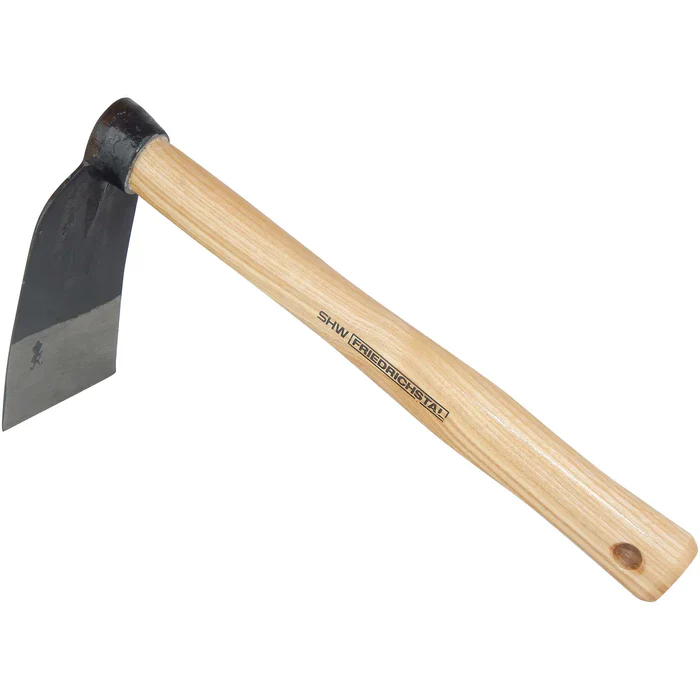
Image source: Bing (Web (fair-use with source credit))
Quick Answer
A grub hoe is a hand tool with a heavy steel head mounted at a steep angle to its handle. It chops through hard soil, roots, and compacted ground. The head weighs 3 to 5 pounds.
It differs from a standard garden hoe by its perpendicular blade angle. Landscapers, firefighters, and homesteaders rely on it daily.
What a Grub Hoe Actually Is (And What It Isn't)
So what is a grub hoe, exactly. Think of it as a hand axe for soil. The head is a flat rectangular piece of forged steel attached to the handle with the blade facing roughly perpendicular to the shaft.
You swing it downward, and the weight of the driver does the digging for you.
Here's where most people get tripped up. A standard garden hoe slices through loose soil at a shallow angle. The grub hoe does not slice.
It chops. That fundamental difference in geometry changes what the tool can handle.
The term "grub hoe" refers to grubbing, which means clearing ground by digging up roots and stumps. Nobody bought this tool for weeding lettuce rows. They bought it because nothing else would touch the ground they were standing on.
What it is not? It's not a tilling tool for finished beds. It's not a rock bar.
It's not going to replace a chainsaw on roots thicker than your wrist. The grub hoe lives in the specific space between a light garden hoe and a full-on mattock. That middle ground is exactly why it's so useful.
The Head Angle That Changes Everything
Look at the photos of grub hoes in use and one thing jumps out immediately. The blade sits at roughly 65 to 70 degrees off the handle. Some manufacturers spec it closer to 80 degrees.
Either way, it's dramatically steeper than the 25 to 35 degrees you'd see on a common garden hoe.
That steep angle is the entire point. It means the tool functions like a wedge, not a blade. When you swing a grub hoe down, the edge concentrates all the force of the head into a narrow cutting line.
Then the wedge shape pushes soil and roots apart on either way.
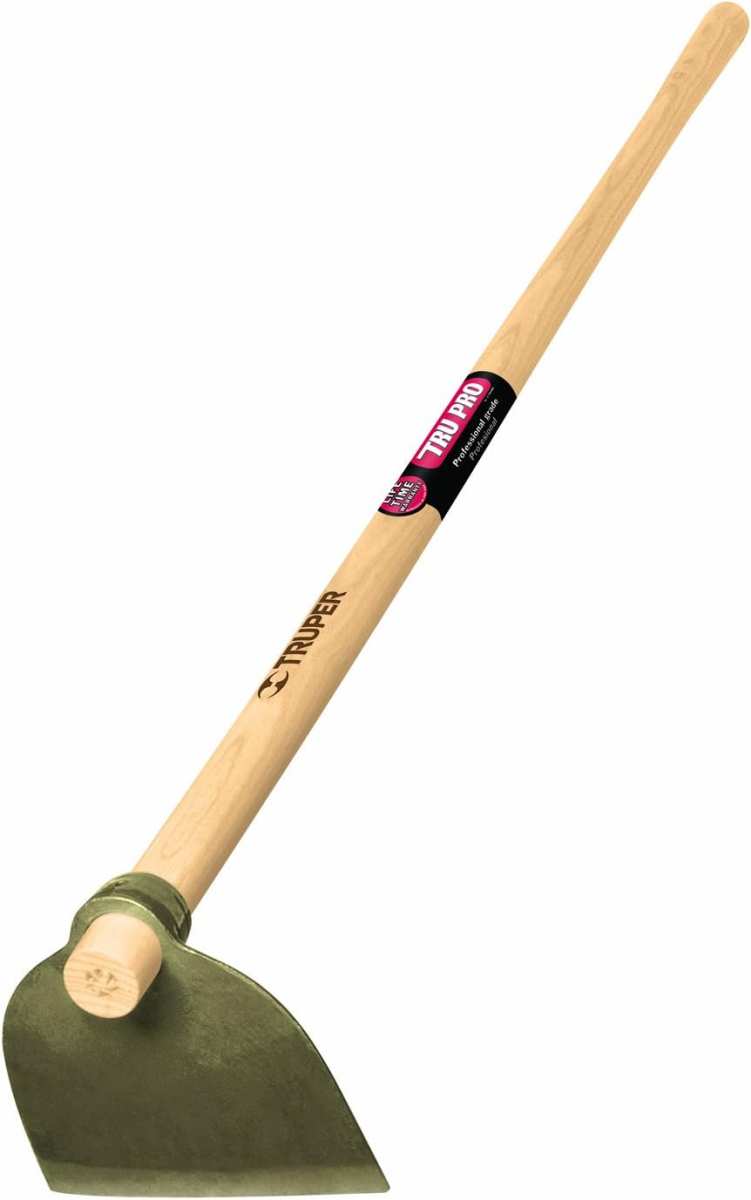
Image source: Bing (Web)
The eye-mount (where the handle passes directly through the steel head) reinforces this. There's no offset or bent shank like you'd find on a bow rake or standard hoe. Everything about the construction is built for straight downward force.
Try that with a regular hoe and the handle will flex and the blade will skate off the surface.
USDA Forest Service tool documentation for firefighting hand tools specifies this perpendicular angle for one reason. It maximizes chopping penetration when cutting fire lines through compacted duff and root mat. When your life depends on how fast you can dig to mineral soil, tool geometry is everything.
If you've ever swung a grub hoe and felt like it barely bit into the ground, check the angle. Cheap knockoffs sometimes mount the head at a shallower pitch to cut manufacturing costs. They look similar but they perform entirely differently.
Key Features That Define a Grub Hoe
Not every weighted hoe qualifies as a genuine grub hoe. A few specific features set authentic versions apart from lookalikes and general-purpose alternatives.
The head itself is forged carbon steel, typically 1045 to 1080 grade. Heads weigh between 3 and 5 pounds depending on the intended task. Heavier heads drive deeper with each blow but fatigue sets in faster during extended use.
The cutting edge spans roughly 4 to 6 inches wide. Some models run wider for open ground clearance. Others stay narrow for precision work around established plants.
Edge geometry matters too. A proper bevel on the blade creates the wedge effect we talked about earlier.
Look for a flat poll (the back of the head opposite the cutting edge). That flat surface serves double duty as a tampering tool for compacting soil back around roots or settling backfill. It's a small feature you'll appreciate the first time you need both hands for something else.
Handle length typically falls between 32 and 36 inches. Longer versions exist for two-handed operation, but one-handed use is standard. Hickory remains the most common handle material, though fiberglass has gained ground in commercial applications because it resists breakage in cold weather.
Mounting style falls into two categories. Eye-mount heads have the handle pressed directly through the steel eye. Strap-mount versions use a folded steel collar with a protruding tang.
Eye-mount is stronger and more common on quality tools. Strap-mount heads sometimes loosen under heavy use, which is a headache you want to avoid.
Here's a quick comparison of the specs that matter:
| Feature | Standard garden hoe | Grub hoe |
|---|---|---|
| Head angle from handle | 25–35 degrees | 65–80 degrees |
| Head weight | 1–2.5 lbs | 3–5 lbs |
| Typical handle length | 48–60 inches | 32–36 inches |
| Primary action | Slicing | Chopping |
| Soil compatibility | Loose, prepared | Hard, compacted |
The weight difference alone tells the whole story. A standard garden hoe at 1.5 pounds simply cannot generate enough force to penetrate clay or compacted fill. The grub hoe's 4-pound head swings through the same ground because physics is on your side.
What a Grub Hoe Is Built to Do
Now that we've covered the hardware, let's talk about what a grub hoe actually accomplishes in the real world. The applications span several fields, from backyard gardening to wildland firefighting.
Compacted soil penetration is the most common use case. Clay substrates, packed gravel, areas where heavy equipment has compressed the earth into something approaching concrete. A shovel bounces off that surface.
A grub hoe bites in and breaks it into manageable chunks.
Root and stump removal is next on the list. Anyone who has cleared a fence line knows that roots less than an inch thick will stop a shovel. The grub hoe chops through those roots with two or three solid strikes.
Clear a few radial cuts around a stump and you can lever it out without a saw.
Brush and small vegetation clearing benefits from this tool too. The wide blade edge slices through fibrous base material on woody shrubs. It's not a replacement for loppers on thick canes, but for clearing ground-level growth it covers ground fast.
Trail building and maintenance crews use grub hoes constantly. The Appalachian Trail Conservancy specifies them as essential hand tools for volunteer maintenance crews, particularly for digging water bars and re-establishing tread in compacted sections. They work where motorized equipment cannot reach.
Wildland firefighting is another major use case. The Pulaski tool, standard issue for USDA Forest Service and Bureau of Land Management crews across the United States, places a grub hoe head on one side and an adze blade on the other. Firefighters swing that grub hoe edge into duff and root mat to reach bare mineral soil during fire line construction.
Tool specification 5100 from the USFS covers the exact dimensions and material requirements.
Excavation prep rounds out the list. Archaeological field teams sometimes use grub hoes for the initial stripping of topsoil in survey trenches. They offer enough precision to avoid damaging subsurface features while still removing overburden efficiently.
The common thread across all these applications is hard, resistant material. If your ground crumbles under a shovel, you don't need a grub hoe. But if you're fighting compacted clay, woody roots, or thick sod, this is the tool that gets the work done.
Grub Hoe vs. Standard Hoe vs. Mattock vs. Pulaski
Getting confused between these tools is genuinely easy. They all share a similar silhouette at a glance. But each one has a distinct purpose, and picking the wrong one wastes energy.
The standard garden hoe with its shallow blade angle that slices through loose soil. Great for weeding between rows and making furrows. Useless against compacted ground because the shallow angle and light head can't generate chopping force.
The mattock comes in two configurations. A pick mattock has a pointed spike on one side with a flat adze on the other. A cutter mattock swaps the pick for a wider horizontal blade.
Both are heavier than a grub hoe and designed for harder ground, rockier substrate, and deeper penetration. The tradeoff is weight and fatigue. A mattock is a two-handed tool for two-handed work.
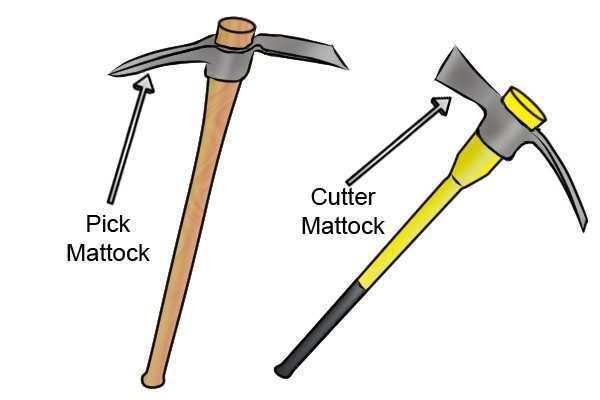
Image source: Bing (Web)
The Pulaski combines a grub hoe head with an adze blade on the reverse. It's the standard firefighting tool and excels in situations where you need both chopping and scooping capability. The adze side digs and moves soil while the grub hoe side cuts roots.
It's heavier at around 5 to 6 pounds, so it's overkill for routine garden work.
Here's where the grub hoe hits its sweet spot. It's light enough for one-handed operation over extended periods. The perpendicular blade concentrates force efficiently on hard ground.
And it handles both chopping and light prying tasks without needing a second tool.
| Tool | Weight range | Handle length | Best application |
|---|---|---|---|
| Standard garden hoe | 1–2.5 lbs | 48–60 in | Weeding, light cultivation |
| Grub hoe | 3–5 lbs | 32–36 in | Breaking hard soil, cutting roots |
| Mattock | 5–8 lbs | 36–48 in | Rocky ground, deep excavation |
| Pulaski | 5–6 lbs | 35–37 in | Firefighting, trail building |
Buy a grub hoe when your main challenge is compacted soil and root removal at or near the surface. Choose a mattock if you're breaking through rocky substrates or need to dig deeper than 6 to 8 inches. Pick a Pulaski only if you need both chopping and scooping in a single tool for professional outdoor work.
Otherwise, you're carrying extra weight for no practical benefit.
Frequently Asked Questions
Can a grub hoe replace a shovel for general digging?
Not efficiently. A grub hoe breaks hard ground but doesn't scoop and move soil well. Use the grub hoe to loosen compacted material first, then switch to a shovel for removal.
The two tools complement each other better than either replaces the other.
What's the difference between a grub hoe and an eye hoe?
In practice they're nearly identical. Both use an eye-mount head at a perpendicular angle. Some manufacturers use the terms interchangeably.
The distinction, when it exists, is that "grub hoe" refers specifically to the heavier head weight designed for root clearing rather than lighter digging.
Do I need to sharpen a grub hoe before first use?
Most ship with a basic factory edge that works for initial use. But a proper sharpening with a mill file before your first session improves performance significantly. Maintain the bevel established by the manufacturer and touch up the edge after every few hours of work in rocky ground.
What handle length suits a grub hoe?
Standard is 32 to 36 inches for one-handed operation. Taller users sometimes prefer 38 inches for better leverage. Handle length is less critical than head weight for this tool, so prioritize finding a comfortable head weight first.
Is a grub hoe the same as a grubbing axe?
No. A grubbing axe has a narrow bladed head designed for splitting and cutting individual roots with surgical precision. A grub hoe's wider blade is for clearing and general excavation.
Confusing the two means bringing the wrong tool to the wrong job.
The Bottom Line
A grub hoe is a weighted, perpendicular-bladed hand tool built for chopping through hard ground, compacted soil, and root systems. It's not a replacement for lighter cultivation tools, nor is it heavy enough for deep excavation work. It occupies a specific niche between those extremes, and once you've seen it perform on stubborn ground, you'll understand why it's been a staple of outdoor work for generations.
If your land fights back when you dig, this is the tool that finally gives you the upper hand.
How to Spot a Grub Hoe That's Built to Last
Quality varies enormously between manufacturers. Aggregate reviews and long-term field reports point to a few consistent markers that separate tools lasting decades from those failing within a season.
Check the eye first. On forged heads, the eye should be smooth with no visible seam or weld line. If you see a bright line around the eye opening, that's a welded eye, and welded eyes can crack under sustained heavy use.
Look for a fully forged eye where the steel flows continuously around the handle socket.
Examine the grind on the cutting edge. A consistent bevel that runs the full width of the blade suggests proper heat treatment. Uneven grinding with burn marks indicate rushed manufacturing.
Run your thumb lightly across the back of the head opposite the edge. You should not feel any burrs.
Tap the head lightly against wood. A clear ring means proper hardness and no internal cracks. A dull thud suggests porosity or micro-fractures that will grow with use.
Handle quality matters enormously. American hickory remains the gold standard according to USDA Forest Service tool specifications. The grain should run straight through the handle with no runout at the thick end.
Runout (where the grain angles off the side of the handle) creates a weak point that fails under shock.
| Feature quality check | Pass | Fail |
|---|---|---|
| Head construction | Fully forged, no weld line at eye | Welded eye, visible seam |
| Cutting edge | Consistent bevel, clean grind | Uneven marks, burn spots |
| Handle grain | Straight, no runout | Grain runs off the side |
| Fit and finish | Head tight, no rattling play | Loose head, visible gap |
Price reflects this. Consumer-grade grub hoes run $25 to $40. Look for cast steel or thin strap-mount construction at that level.
Professional-grade forged models from domestic manufacturers start around $75. That price gap buys years of additional service life.
Council Tool, Snow & Nealley, and Nupla all manufacture to USDA Forest Service specifications for wildland firefighting use. Their products cost more, but the metallurgy and quality control justify the premium for anyone using a grub hoe regularly.
How to Use a Grub Hoe Without Wasting Energy
Swing a grub hoe incorrectly and you'll exhaust yourself in minutes. Use it properly and you can work steadily for hours. The difference is letting the tool do the work.
Grip the handle near the end, not the head. The extra length gives you better arc speed, and it means the head accelerates through a longer distance before impact. That stored energy does the chopping.
You just guide the drop.
Raise the head to roughly shoulder height. You don't need to swing overhead like an axe. Too high and you lose accuracy.
Too low and there's no momentum. Head at shoulder height, handle angled slightly back, then let it drop with a crisp forward snap at the bottom.
Land with the blade flat or just slightly angled to the direction you want the wedge to push material. If you strike at too steep an angle, you waste energy deflecting sideways instead of driving down. The edge should meet the ground parallel to your body, cutting across the line of work you're following.
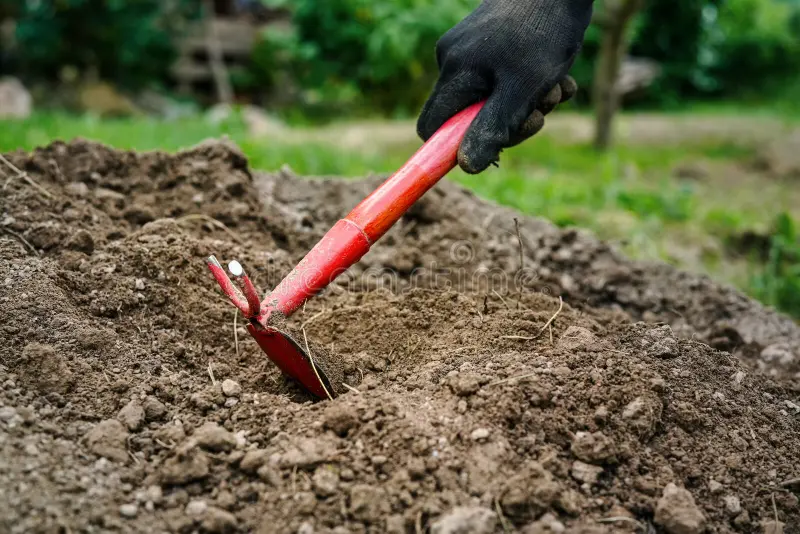
Image source: Bing (Web)
Work in strips about one and a half blade widths wide rather than attacking random spots. Each new cut land's partially loosened edge from the previous stroke. You advance steadily without duplicating effort.
For root work, switch to a narrow blade model if you have one or concentrate strikes along a single cut line. Three or four overlapping strikes on the same groove will sever roots up to about two inches wide. Trying to chop a root in one swing usually wastes energy glancing off.
Stance matters more than technique. Stand with feet planted at shoulder width, weight evenly distributed. Rotate from the torso rather than swinging purely with your arms.
You'll generate more power with less arm fatigue. Keep the work in front of you rather than off to one side.
Common Mistakes That Make It Feel Like the Wrong Tool
Nothing frustrates people faster than an underperforming grub hoe. Usually the tool isn't the problem. The technique, the conditions, or the expectations are off.
Using it in loose sand or fluffy compost is pointless. There's nothing for the wedge to bite into. The head just glides through loose material.
Save it for ground that actually resists.
Trying to pry with the handle is asking for a break. The steel head can usually take it if the socket is solid, but wood handles snap under high lateral force, especially when they're cold or slightly dried out. Use the flat poll on the head for tamping and light prying instead.
Letting the edge go dull cuts effectiveness more people realize. A sharp grub hoe bites into hard ground and saves you three or four extra swings per strike. Each unnecessary swing adds up across hundreds of cycles in a single session.
A five-minute touch-up with a mill file makes a visible difference early.
Swinging with both hands locked against each other creates a stiff, rigid motion that transfers shock back into your wrists and elbows. Keep your top hand slightly loose at the moment of impact. You stay accurate while your joints stay intact.
Expecting a grub hoe to replace a chainsaw on heavy roots or a excavator on rock just leads to disappointment. It's a precision demolition tool for ground-level work. Anything beyond that demands different instruments.
Another overlooked mistake is working wet leather or gardening gloves with poor grip. The handle can torque in your hands on roots or glancing blows, twisting your wrist. Mechanic's style gloves with rubberized palms give better control and prevent blisters during extended sessions.
Pricing, Specs, and What to Expect
Consumer-grade grub hoes fall in the $25 to $40 range. These generally feature cast steel heads, strap-type mounts, and imported hickory handles. They'll do the job for occasional use in residential settings.
Professional forged heads start at $75 and run $150 for domestic-made tools of the quality used on wildland crews. You're paying for forged eye heads, better heat treatment, and handles selected for straight grain. These tools survive decades of regular use.
Specialty firefighting variants like the Pulaski typically run $90 to $120 when purchased commercially. The dual head configuration (grub hoe on one side, adze on the other) accounts for the higher price, though the additional capability is worth it if you need both functions.
| Market segment | Price range | Typical construction |
|---|---|---|
| Consumer / residential | $25–$40 | Cast steel, strap mount |
| Professional forged | $75–$150 | Forged eye, domestic hickory |
| Wildfire standard (Pulaski) | $90–$120 | Forged, dual specification |
Replacement handles cost $15 to $25 for hickory and $20 to $35 for fiberglass. Many buyers neglect this number when comparing tools. A cheap $30 hoe that needs a new handle every year costs more over a decade than a $100 forged tool that lasts with one handle replacement.
Shipping something this heavy costs almost as much as the tool if you're ordering from overseas. Buying domestic saves significantly on freight and puts a recognizable warranty behind your purchase. Council Tool in North Carolina offers factory direct replacement handles and head swaps for their products, a practical long-term advantage.
Maintenance That Keeps It Working for Years
A grub hoe needs minimal care, but ignoring care entirely shortens its life. Cleaning after each session removes moist soil that corrodes the steel. You don't need to polish it.
Just knock off clinging mud and let it dry before storage.
Oil the head lightly before long-term storage. Boiled linseed oil, paste wax, or a light machine oil coating creates a moisture barrier. Wipe it down to a thin film rather than leaving it dripping.
Too much oil attracts dust and makes the handle messy.
Sharpen the edge with a mill bastard file, maintaining the original bevel angle. A fine-grit pass afterward removes any burr from the back side. You don't need a hollow ground razor edge.
A consistent working bevel around 25 to 30 degrees on each side is ideal for general use.
| Care task | Frequency | Product to use |
|---|---|---|
| Head cleaning | After each use | Stiff brush, water |
| Edge filing | Every 10–25 hours | Mill bastard file |
| Head oiling | Before storage, seasonally | Paste wax or light oil |
| Handle sanding | As needed | 80-grit sandpaper |
| Loose head fix | As soon as noticed | Wooden wedge |
Handle maintenance is simpler but matters. If the handle develops splinters, sand it smooth with 80-grit. A thin coat of boiled linseed oil every few months prevents the wood from drying out and shrinking.
If the head gets loose, drive a thin wooden wedge into the top of the handle to expand it back into the eye.
Store grub hoes hung on a wall hook or laid flat on a shelf. Leaning them against a wall or tossing them in a corner invites moisture accumulation at the head joint and creates a tripping hazard.
When a Grub Hoe Is the Right Tool
A grub hoe is the right tool when your primary challenge is ground-level cutting and breaking of compacted substrates. It excels in those conditions and falls flat in others.
You'll want one for breaking up hard clay, rocky substrates, or heavily compacted fill. You'll want one for clearing woody roots and small stumps at ground level. You'll want one when clearing brush and root mat ahead of construction or trail work.
Firefighting crews and trail volunteers rely on them precisely because they handle the middle ground between light cultivation and heavy excavation.
You don't need one if your soil crumbles easily under a shovel. If your primary work is transplanting, light weeding, and working already-loosened beds, a standard garden hoe is more appropriate. A grub hoe in those conditions feels clumsy and overbuilt.
You're past the scope of a grub hoe when you need to dig deeper than 8 to 12 inches of continuous excavation. You'll want a shovel, post hole digger, or mattock for that work. Trying to excavate deep holes with a grub hoe just wastes time.
If you're clearing established perennial beds for replanting, a grub hoe is genuinely one of the best choices available. Cut through the root mat, lift the slabs, shake off the soil, and move to the next section. It's that specific combination of fast and precise that makes it invaluable.
Frequently Asked Questions
Can a grub hoe replace a shovel for general digging?
Not efficiently. A grub hoe breaks hard ground but doesn't scoop and move soil well. Use the grub hoe to loosen compacted material first, then switch to a shovel for removal.
The two tools complement each other better than either replaces the other.
What's the difference between a grub hoe and an eye hoe?
In practice they're nearly identical. Both use an eye-mount head at a perpendicular angle. Some manufacturers use the terms interchangeably.
The distinction, when it exists, is that "grub hoe" refers specifically to the heavier head weight designed for root clearing rather than lighter digging.
Do I need to sharpen a grub hoe before first use?
Most ship with a basic factory edge that works for initial use. But a proper sharpening with a mill file before your first session improves performance significantly. Maintain the bevel established by the manufacturer and touch up the edge after every few hours of work in rocky ground.
What handle length suits a grub hoe?
Standard is 32 to 36 inches for one-handed operation. Taller users sometimes prefer 38 inches for better leverage. Handle length is less critical than head weight for this tool, so prioritize finding a comfortable head weight first.
Is a grub hoe the same as a grubbing axe?
No. A grubbing axe has a narrow bladed head designed for splitting and cutting individual roots with surgical precision. A grub hoe's wider blade is for clearing and general excavation.
Confusing the two means bringing the wrong tool to the wrong job.
The Bottom Line
A grub hoe is a weighted, perpendicular-bladed hand tool built for chopping through hard ground, compacted soil, and root systems. It's not a replacement for lighter cultivation tools, nor is it heavy enough for deep excavation work. It occupies a specific niche between those extremes, and once you've seen it perform on stubborn ground, you'll understand why it's been a staple of outdoor work for generations.
If your land fights back when you dig, this is the tool that finally gives you the upper hand.