Figuring out how to get rid of grubs in your garden starts with understanding what you're actually dealing with under the soil. Those fat, white, C-shaped larvae chewing through your roots aren't going away on their own once they number more than about eight to ten per square foot. The good news is you've got effective options, both biological and chemical, that work well when you apply them at the right time and in the right way.
The threshold according to turfgrass research programs is roughly five to ten grubs per square foot before treatment becomes necessary for cool-season grasses. Anything below that and your lawn can typically tolerate the damage. Let's walk through what actually works based on your specific situation.

Image source: Bing (Web (fair-use with source credit))
Quick Answer
To eliminate grubs in your garden, apply beneficial nematodes (Heterorhabditis bacteriophora) in late summer when soil temperatures are between 60 and 80°F. For heavy infestations, use chlorantraniliprole (GrubEx) as a preventive in late spring or trichlorfon (Dylox) as a curative on active grubs. Confirm you have more than 5 grubs per square foot before treating.
Water the lawn immediately after any application to move the product into the root zone.
What Grubs Actually Are and Why They're in Your Garden
"Grub" is the common name for the larval stage of several beetle species, and they're feeding on the roots of your grass and garden plants right below the surface. These aren't worms. They're beetle larvae with distinct brown heads and six legs near the thorax.
The most common culprits include:
- Japanese beetle (Popillia japonica)
- European chafer (Rhizotrogus majalis)
- June beetle (Phyllophaga species)
- Masked chafer (Cyclocephala borealis)
- Asiatic garden beetle (Maladera castanea)
The adult beetles lay eggs in your lawn typically between June and August, depending on species and region. Those eggs hatch within a few weeks, and the tiny larvae start feeding on grass roots almost immediately. By late summer and early fall, they're doing the most damage, right when your lawn is trying to store energy for winter.
Here's the frustrating part. You might not see the grubs themselves until significant damage has already occurred. The first sign is usually irregular brown patches of grass that peel back easily from the soil because the roots have been severed.
By that point, you're looking at a moderate to heavy infestation.
Skunks, raccoons, and birds tearing up your lawn at night? That's a secondary indicator. They're hunting grubs, and while they're doing you a small favor by eating some, the digging damage they cause is often worse than what the grubs were doing themselves.
How Bad Is the Damage? A Simple Threshold Test
Before you spend any money or time on treatment, you need to confirm whether your grub population actually warrants intervention. Not every grub in your yard is a problem. A small number won't cause visible damage to a healthy lawn.
Here's the test. Take a sharp shovel and cut a 1-foot-square section of turf about 2 to 3 inches deep in a damaged area. Peel it back and count the grubs you see.
Multiply that count across multiple spots to get an average.
| Grubs per Square Foot | Severity | Recommended Action |
|---|---|---|
| 0–5 | Low | Monitor; treatment usually unnecessary |
| 6–10 | Moderate | Consider treatment if damage is visible |
| 11–20 | Heavy | Treat with biological or chemical control |
| 20+ | Severe | Treat immediately; consider curative insecticide |
Check in a few different locations because grubs tend to cluster in patches. Sunny, south-facing slopes and areas near outdoor lighting often have higher populations since adult beetles prefer to lay eggs in those conditions.
If you're finding more than ten per square foot in multiple spots, it's time to act. If you're under five across the board, hold off. Your lawn can handle that load, and beneficial organisms in the soil may keep things in check naturally.
Image source: Bing (Web (fair-use with source credit))
Identifying Your Grubs: Not All Species Respond the Same Way
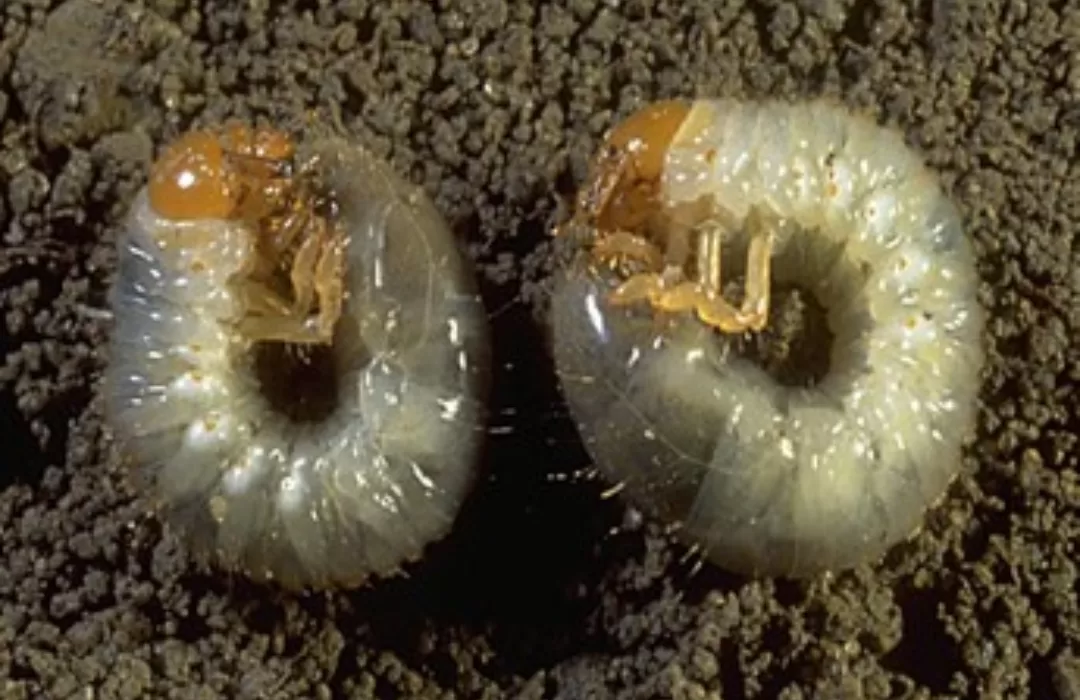
Image source: Bing (Web (fair-use with source credit))
The treatment you choose depends partly on which species you're dealing with. Different grubs have different life cycles, and timing your application wrong is one of the biggest wastes of money in lawn care.
Japanese beetles are the most common and the most destructive. Their larvae are white with a brown head, about 1 inch long when fully grown, and you'll find them in a characteristic C-shape. Adults are metallic green and copper, roughly 3/8 inch long, typically feeding on garden plants from late June through August in most regions.
European chafers look similar to Japanese beetle grubs but tend to be slightly smaller and more active. They're a major problem in the Northeast and Midwest, and their adults are tan or light brown rather than metallic.
June beetles are the largest grubs you'll encounter, sometimes exceeding 1.5 inches long. They have a three-year life cycle, which means they're feeding underground much longer than Japanese beetles or chafers before pupating.
Here's where it matters for treatment. The annual species, Japanese beetles and European chafers, have a single generation per year. Their grubs are most vulnerable in late summer and early fall when they're small and actively feeding near the soil surface.
June beetles, with their longer cycle, can be larger and tougher to kill by the time they cause visible damage.
If you're seeing adult beetles on your garden plants in midsummer, that's your signal. Egg-laying is happening now, and the larvae will be hatching in the next two to three weeks. That window is when preventive treatments are most effective.
Choosing the Right Treatment Based on Your Situation
This is where most people either overthink it or underthink it. The right choice depends on your infestation level, the time of year, and whether you're comfortable using synthetic chemicals around your property.
The Biological Controls That Actually Work (If You Time Them Right)
Beneficial nematodes, specifically Heterorhabditis bacteriophora, are microscopic worms that hunt and kill grubs from the inside out. They're the go-to biological option, and they work well when conditions are right.
When to apply: Late August through early October, when soil temperatures are between 60 and 80°F and grubs are small and actively feeding.
How to apply: Mix the nematodes with water according to the package directions and apply with a hose-end sprayer or watering can. Water the lawn before and after application. Keep the soil moist for at least two weeks.
Nematodes need moisture to move through the soil and locate hosts.
The catch: Nematodes are alive. They have a shelf life, need to be kept cool until application, and won't survive in hot, dry soil. Order them from a reputable supplier that ships with cold packs.
Northern Gardens and several university extension programs recommend applying in the evening since UV light kills nematodes on the surface.
Milky spore (Paenibacillus popilliae) is another biological option, specifically for Japanese beetle grubs. It's a bacterium that infects and kills grubs, and once established in your soil, it can remain effective for 10 to 15 years. The downside is it takes two to three years to build up to full effectiveness, and it only targets Japanese beetle grubs, not other species.
Best for: Gardeners who prefer a chemical-free approach, have moderate infestations, and can commit to proper timing and soil moisture management.

Image source: Bing (Web (fair-use with source credit))
Chemical Insecticides: Use Only When You Need Them
Chemical controls fall into two categories, and confusing them is a common mistake.
Preventive insecticides stop grubs from developing. They work best when applied before grubs hatch, targeting newly hatched larvae when they're most vulnerable. The most widely available preventive active ingredient is chlorantraniliprole, sold as GrubEx.
| Active Ingredient | Trade Names | Type | Best Application Window | Notes |
|---|---|---|---|---|
| Chlorantraniliprole | GrubEx | Preventive | May–June (before egg hatch) | Low toxicity to humans and pets; needs irrigation |
| Trichlorfon | Dylox (Dylox 6.2 Granules) | Curative | Late summer/early fall (active grubs) | Fast-acting; apply when grubs are feeding |
| Clothianidin | Arena | Preventive | May–June | Restricted use in some states; check local regulations |
| Imidacloprid | Merit | Preventive | May–June | Neonicotinoid; bee toxicity concerns during bloom |
| Chlorantraniliprole + bifenthrin | Scotts Grub B Gon MAX | Preventive | May–June | Broad-spectrum; kills beneficial insects too |
Curative insecticides kill existing grubs that are already feeding. Trichlorfon is the primary curative option available to homeowners. It works fast, typically killing grubs within one to three days, but it breaks down quickly in the soil.
That means timing matters even more.
Applying curative products. Water the lawn lightly before application to bring grubs closer to the surface. Apply the granules evenly with a spreader and water immediately with at least 1/4 to 1/2 inch of water to move the active ingredient into the root zone where grubs are feeding.
What to avoid: Don't apply preventive insecticides like chlorantraniliprole after grubs have already matured. They won't kill large, established larvae effectively. You'll spend money and get minimal results.
The "Do Nothing" Option — When Light Infestation Resolves Itself
If your threshold test showed fewer than five grubs per square foot and you're not seeing significant lawn damage, you may not need to do anything this season. A healthy lawn with a robust root system can tolerate low grub populations.
Natural predators help too. Ground beetles, parasitoid wasps, and certain soil-dwelling fungi all prey on or infect grubs. Broad-spectrum insecticides will kill these beneficial organisms and can actually make future grub problems worse by eliminating the natural controls.
Seasonal Timing: Why When You Apply Matters More Than What You Apply
The biggest reason grub treatments fail isn't the product. It's the timing. Apply a preventive insecticide in September and you've wasted your money because the grubs are already too large to be affected.
Apply curative nematodes in July during a heat wave and they'll die before they find a host.
Here's the annual grub cycle for the most common species, Japanese beetles and European chafers, across most of the United States.
June through August. Adult beetles feed on garden plants and lay eggs in moist turfgrass soil. Each female can lay 40 to 60 eggs over her lifetime, usually in clusters a few inches below the surface.
Late July through August. Eggs hatch into tiny larvae, first instar stage. This is when grubs are smallest and most vulnerable to all treatment methods. They're feeding on fine root hairs and organic matter near the surface.
September through October. Second and third instar grubs do the most visible damage. They're larger, eating more, and moving deeper as soil temperatures cool. This is the prime window for curative treatments like trichlorfon and beneficial nematodes.
Late October through March. Grubs move deep into the soil to overwinter, below the frost line. They're inactive and nearly impossible to treat during this period.
April through May. Grubs return to the surface and resume feeding briefly before pupating. A second narrow window for curative treatment exists here, but it's less reliable because grubs are large and feeding less aggressively.
June. Adults emerge and the cycle repeats.
The sweet spot for preventive insecticides like chlorantraniliprole is mid-May to late June, before eggs hatch. The sweet spot for curative treatments is mid-August through October, when grubs are small, active, and near the surface. Get either window wrong and you'll be disappointed with the results.
Step-by-Step Treatment Workflow by Season
Follow this timeline based on what you found during your threshold test.
Late Spring (May through June): Apply Preventive Control
Use this approach if you had a confirmed problem last year or if neighboring properties reported heavy beetle activity in the season prior.
- Mow the lawn to 2 to 3 inches one day before application.
- Apply chlorantraniliprole granules with a rotary or drop spreader at the rate specified on the label, typically 2.8 to 3.2 pounds per 1,000 square feet.
- Water immediately with at least 1/4 inch of irrigation to activate the granules and move the active ingredient into the soil.
- Keep foot traffic off the treated area for 24 hours.
Preventive treatments don't kill eggs. They create a toxic zone in the soil that kills newly hatched larvae within hours of their first feeding. You need the product in place before those larvae start eating, which means June at the latest for most of the United States.
Late Summer through Early Fall (August through October): Apply Curative Control
Use this approach if your threshold test revealed more than 10 grubs per square foot and you're seeing active damage.
- Water the lawn lightly the evening before to bring grubs closer to the surface.
- Apply trichlorfon granules according to label rates. Spread evenly across the entire damaged area plus a buffer of at least 10 feet beyond visible damage.
- Water immediately with 1/4 to 1/2 inch of water. This step matters more than most people realize. The active ingredient must reach the root zone where grubs are feeding.
- Expect to see reduced grub activity within 24 to 72 hours.
If you're using beneficial nematodes instead:
- Water the lawn thoroughly in the afternoon.
- Apply nematodes in the evening using a hose-end sprayer or watering can. Remove fine mesh filters from your sprayer; nematodes will clog them.
- Water again immediately after application.
- Keep soil consistently moist for 14 days. Irrigate lightly every other day if rainfall doesn't cooperate. Nematodes can't move through dry soil and will die on the surface in direct sun.

Image source: Bing (Web (fair-use with source credit))
Common Mistakes That Make Grub Problems Worse
The most frequent error is treating at the wrong time of year. Applying preventive insecticide in September when grubs are already large wastes your money completely. Those mature larvae are tolerant of chlorantraniliprole and won't be killed by preventive rates.
Another common mistake is skipping the watering step after granule application. Without irrigation to move the active ingredient into the root zone, granules sit on the surface and break down without reaching grubs. Extension programs consistently cite improper watering as the top reason for treatment failure.
Don't treat during winter dormancy. Grubs are deep in the soil, inactive, and unreachable by any product you apply to the surface. Save your money and wait.
Broad-spectrum insecticides like bifentharin products kill beneficial beetles, parasitoid wasps, and soil microbes that naturally suppress grub populations. You'll solve today's problem but make next year's worse. Reserve broad-spectrum options for severe infestations only.
Costs and What to Expect From Each Approach
Beneficial nematodes run roughly $30 to $55 per treatment for a 5,000-square-foot lawn. You'll need to reorder each year since they don't overwinter reliably in most climates.
Preventive granules cost $25 to $50 for the same coverage and typically last the full season. Curative trichlorfon is $20 to $35 per application.
Milky spore powder averages $40 to $75 per 2,000-square-foot application, but its multi-year residual effect lowers the per-season cost over time. The tradeoff is that two to three year establishment period.
Professional lawn care services charge $75 to $150 per treatment for residential properties. This makes sense if your infestation is severe or you want guaranteed results.
Prevention: How to Stop Grubs Coming Back Next Year
Cultural practices matter more than most people expect. Shorter irrigation cycles during egg-laying season make the soil surface less hospitable for beetle eggs. Letting the top inch dry out between waterings in July and August significantly reduces successful egg hatch.
Mow at 3 to 3.5 inches. Taller grass shades the soil surface and reduces the warm, moist conditions beetles prefer for egg-laying. Overseed thin or damaged areas in early fall so dense root systems can tolerate minor grub feeding.
Less outdoor lighting during peak beetle flight in June and July helps too. Adult Japanese beetles are strongly attracted to light. Switching to yellow or sodium-vapor bulbs, or simply turning off unnecessary landscape lighting during the flight period, reduces egg-laying pressure on your property.
Organic matter management through light compost topdressing supports soil microbial communities that naturally suppress grubs. This is not a quick fix. It works over multiple seasons as soil biology improves.
Plan preventive insecticide application for late May through June if your lawn has a documented problem history. Mark your calendar based on the life cycle data for your region.
When It's Time to Call a Professional
Call a licensed pest management professional if your threshold test shows more than 20 grubs per square foot and the damage is spreading rapidly despite treatment. If skunks, raccoons, or birds are regularly tearing up your lawn at night, the infestation is likely severe enough that DIY curative methods may not work fast enough to prevent total turf loss.
Professionals have access to commercial-grade application equipment and products not available to homeowners. They can also accurately identify grub species and apply targeted treatments with the right timing and rates.
Frequently Asked Questions
How do I know if grubs are causing lawn damage?
Cut a square foot of turf and peel it back. Severed or sparse roots with 5 or more C-shaped grubs confirm the diagnosis.
Are grub treatments safe for pets?
Chlorantraniliprole has low mammalian toxicity and is considered safe for pets once watered in. Trichlorfon requires keeping pets off the lawn for 24 to 48 hours per label instructions.
Can I just let the grubs go?
If you find fewer than 5 grubs per square foot and no visible damage, natural predator populations and healthy turf can manage the population without treatment.
What is the single best month to treat active grubs?
Mid-September across most northern and mid-Atlantic U.S. regions targets second-instar larvae at peak vulnerability.
Do grub treatments earthworms?
Beneficial nematodes and milky spore have minimal impact on earthworm populations, which is a significant advantage over broad-spectrum chemical insecticides that broadly disrupt soil ecosystems.
How long do grub treatments last?
Preventive treatments provide one full season of control. Curative treatments kill active grubs within weeks but provide no residual protection against new infestations the following year.