You've dug up a pale, squishy larva in your garden or lawn and you're wondering what it becomes. That's a fair question, and the answer matters more than you might think. Knowing what a grub worm turns into helps you decide whether you've got a pest problem, a beneficial insect, or just a harmless critter doing its thing underground.
Here's the thing though. "Grub worm" isn't a scientific term. It's a catch-all name homeowners use for several completely different insect larvae.
Some turn into destructive beetles. Others become moths. And a few aren't even close to what entomologists consider a true grub.
Getting the identification wrong can mean wasting money on the wrong treatment or killing something that was helping your yard. Let's break it down properly.

Image source: Wikimedia Commons / Tim Gage (CC BY-SA)
The Quick Answer: It Depends on Which "Grub" You're Looking At
Most true grubs turn into scarab beetles. The specific species depends on your region and the grub's physical features. Some "grubs" people find are actually moth larvae called sod webworms.
Others are armyworms or cutworms, which look similar but become entirely different insects. You need to check the body shape, head capsule, and leg placement to know for sure.
Why Getting This Wrong Actually Matters
You might think it doesn't really matter what that little white larva becomes. But it matters a lot when it comes to your lawn, your garden, and your wallet.
Here's why. True white grubs, the larvae of scarab beetles, feed on grassroots. A heavy infestation can destroy sections of your lawn, and the damage looks like drought stress until you peel back the sod and see the grubs underneath.
But treating for grubs when you don't actually have them, or when the grubs aren't the real problem, wastes money and dumps unnecessary chemicals into your yard.
Then there's the confusion with sod webworms. People find these caterpillars in their turf and assume they're grubs. Sod webworms are moth larvae, not beetle larvae.
They feed on grass blades at the surface, not on roots underground. The treatment timing, the products that work, and the damage pattern are completely different. If you grab a grub killer for sod webworms, you'll miss the window and the product won't work well.
There's also the beneficial insect problem. Some beetle larvae in your garden soil are helping break down organic matter. Others are food for birds, ground beetles, and parasitic wasps.
Blanket-treating with broad-spectrum insecticides wipes out those beneficial organisms along with any pests. You end up with a less healthy soil ecosystem and potentially more problems down the road.
The bottom line is simple. Identify first, then decide if you even need to act. That's the approach that saves you money and keeps your yard healthier in the long run.
What People Actually Mean When They Say "Grub Worm"
The term "grub worm" gets thrown around loosely, and that's where most of the confusion starts. Let's clarify what's actually going on when someone finds a "grub" in their yard.
True White Grubs: Scarab Beetle Larvae
When entomologists talk about white grubs, they're referring to the larval stage of beetles in the family Scarabaeidae. These are the classic C-shaped, pale-bodied larvae with brown heads and six legs near their thorax. They live underground and feed on plant roots.
The adults are the beetles people recognize: Japanese beetles, June bugs, European chafers, and similar species.
True white grubs go through complete metamorphosis. That means they have four distinct life stages: egg, larva (the grub), pupa, and adult beetle. The grub stage is the one that causes lawn damage and the one most people encounter when they're digging in their garden or peeling back dead sod.
Sod Webworms: The Moth Larvae Everyone Confuses With Grubs
Sod webworms are the larvae of small tan or gray moths in the family Crambidae. They're caterpillars, not grubs in the entomological sense. But they live in turfgrass, they're roughly the same size, and homeowners find them in the same places.
So they get called grubs all the time.
The key difference is where they feed and what they look like up close. Sod webworms live in silk-lined tunnels at the soil surface and feed on grass blades and stems. They have a spotted or striped appearance and lack the thick, C-shaped body of true grubs.
When you disturb them, they wriggle actively. True grubs tend to curl into that characteristic C-shape and stay put.
Armyworms and Cutworms: More Lookalives That Aren't Grubs at All
Armyworms and cutworms are also moth larvae. They're caterpillars that feed on grass blades and plant foliage, usually at night. During the day they hide in thatch or soil, which is why people find them when they're working in the garden and assume they've got grubs.
These caterpillars have smooth bodies without the distinct head capsule of true grubs. They also have prolegs along their midsection, which white grubs don't have. If you see a larva with fleshy legs along the middle of its body, you're looking at a caterpillar, not a scarab grub.
The Complete Grub Life Cycle: From Egg to Adult Beetle
Understanding the life cycle is the key to knowing when grubs are a threat and when treatments actually work. Most common white grub species in the United States follow a one-year cycle, though some take two or three years to complete development.
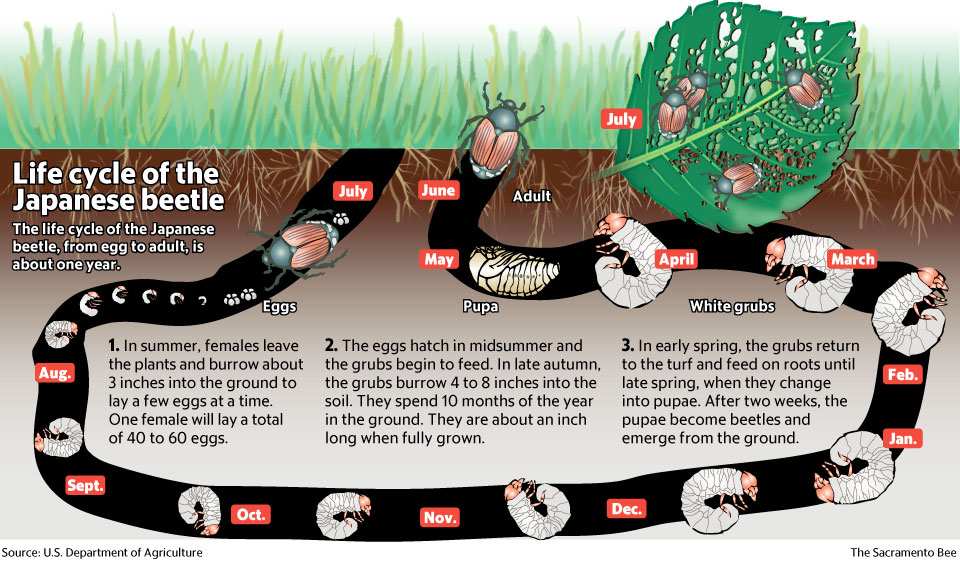
Image source: Bing (Web (fair-use with source credit))
Stage 1: Egg
Adult female beetles emerge from the soil in late spring to early summer, typically between May and July depending on the species and your region. After mating, they burrow back into the lawn and lay eggs in the upper layer of soil. A single female Japanese beetle can lay 40 to 60 eggs over her lifetime, depositing them in small clusters a few inches below the surface.
The eggs are tiny, white, and roughly oval. They hatch within one to two weeks when soil temperatures are warm and moisture is adequate. This is the stage most people never see because the eggs are underground and easy to overlook.
Stage 2: Larva (The Grub You're Seeing)
This is the stage that causes all the problems. The newly hatched grubs are tiny, maybe 1/8 inch long, and they immediately start feeding on grassroots and organic matter in the soil. As they grow, they go through three developmental stages called instars.
Each instar is larger and more voracious than the last.
Young grubs are hard to spot and do relatively little damage. It's the third instar, the largest and final larval stage, that does the most harm. These grubs can be over an inch long and consume significant amounts of root tissue.
By the time you see brown patches in your lawn from grub damage, you're usually looking at third instar grubs that have been feeding for weeks.
The grub stage lasts several months. For most species, grubs are actively feeding from late summer through early fall. As temperatures drop in autumn, the grubs burrow deeper into the soil to overwinter.
They return to the root zone the following spring for a brief feeding period before pupating.
Stage 3: Pupa
In late spring, the mature grub stops feeding and transforms into a pupa. The pupal stage is a resting phase where the insect reorganizes its body structure completely. The pupa looks like a dormant, non-feeding version of the adult beetle.
It's encased in a small earthen cell a few inches below the soil surface.
This stage typically lasts one to two weeks. The pupa doesn't feed and doesn't cause any plant damage. It's essentially waiting for the right conditions to emerge as an adult.
Stage 4: Adult Beetle
The adult beetle chews its way out of the pupal cell and up through the soil. Timing varies by species. Japanese beetles typically emerge in June and July.
June bugs (Phyllophaga species) often emerge in May and June. European chafers come out in June and July as well.
Once above ground, the adult beetles feed on foliage, flowers, and fruit of various plants. Japanese beetles are particularly notorious for skeletonizing leaves on roses, lindens, and fruit trees. The adults mate, the females return to turf to lay eggs, and the cycle starts all over again.
How to Identify What's Actually in Your Yard
Before you do anything about the larvae you've found, you need to know what you're dealing with. Identification doesn't require a microscope, but it does require looking at a few specific features.
Check the Body Shape and Posture
True white grubs have a distinct C-shaped body posture. When you pick one up or disturb it, it curls into a C or crescent shape. The body is thick and fleshy, usually white or cream-colored, sometimes with a grayish or brownish tint depending on what it's been eating.
Sod webworms, armyworms, and cutworms don't curl into that tight C-shape. They're more elongated and tend to wriggle or move quickly when disturbed. If the larva you found is actively crawling away from you, it's probably a caterpillar, not a true grub.
Look for the Brown Head Capsule
White grubs have a distinct brown or tan head capsule. It's clearly defined and darker than the rest of the body. This is one of the most reliable features for distinguishing true grubs from other larvae.
Caterpillars like sod webworms and armyworms have head capsules too, but they're usually less distinct or the same color as the body. If the head is clearly brown and the body is pale white, you're almost certainly looking at a scarab grub.
Examine the Raster Pattern
This is the feature that separates grub species from each other, and it's what extension entomologists use for definitive identification. The raster pattern is the arrangement of hairs, spines, and bare areas on the underside of the grub near the rear end.
To see it, flip the grub onto its back and look at the last abdominal segment with a magnifying glass or your phone's macro camera. Different species have distinct patterns. Japanese beetle grubs have a V-shaped arrangement of hairs.
June beetle grubs have two parallel rows. European chafer grubs have a random, scattered pattern.
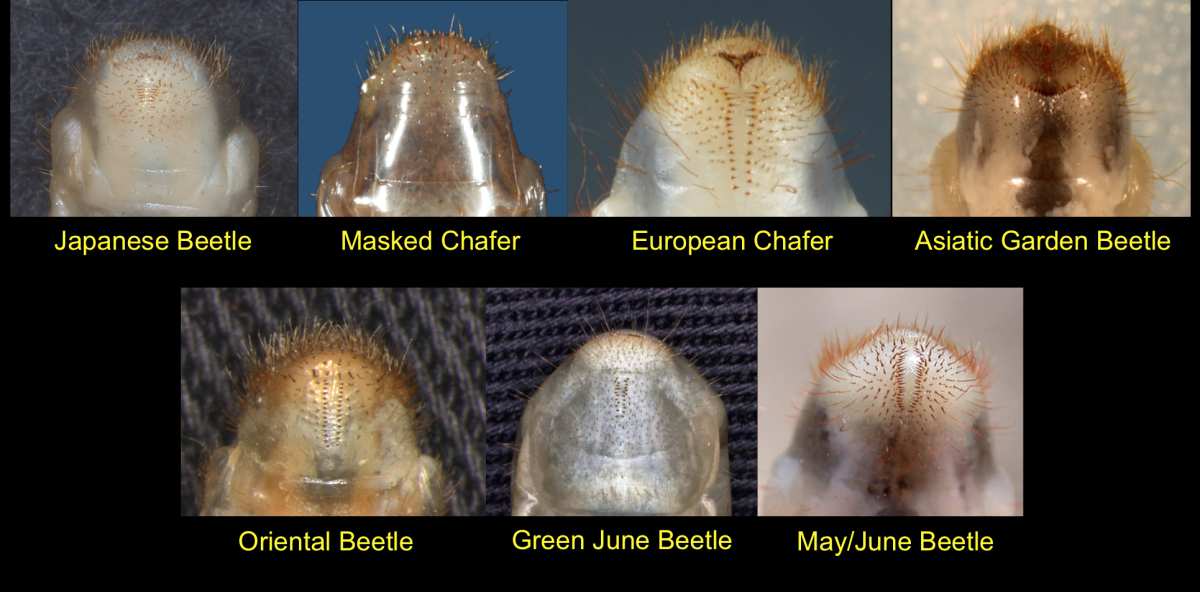
Image source: Bing (Web (fair-use with source credit))
You don't need to memorize every pattern. But if you can photograph the raster pattern and compare it to reference images from your local extension service, you can usually get a solid identification.
Note the Size and Color
Size gives you a clue about the grub's age and how close it is to pupating. Tiny grubs, less than 1/4 inch, are newly hatched and not yet causing significant damage. Grubs around 1/2 inch are mid-stage.
Anything approaching 3/4 to 1 inch is a mature third instar that's been feeding for a while.
Color can vary. Most white grubs are creamy white with a grayish rear end where soil has passed through their digestive system. Green June beetle grubs have a bluish-green tint.
If the larva you found is dark brown, striped, or spotted, it's probably not a true white grub.
Which Grub Species Are You Dealing With?
Not all grubs are created equal. Some species are more destructive than others, and the treatment approach can vary. Here are the most common species you're likely to encounter in lawns across the United States.

Image source: Wikimedia Commons / Zech Smith (CC BY-SA)
Japanese Beetle Grubs
Japanese beetles (Popillia japonica) are one of the most widespread and destructive grub species in the eastern and midwestern United States. The adults are metallic green and copper, about 3/8 inch long, and they feed on over 300 species of plants. But it's the underground larvae that damage lawns.
Japanese beetle grubs have a distinctive V-shaped raster pattern on their underside. They're one of the easier species to identify for that reason. The grubs are most damaging in late summer and early fall when they're in their third instar and feeding heavily before winter.
A lawn with 10 or more Japanese beetle grubs per square foot typically shows visible damage.
European Chafer Grubs
European chafers (Amphimallon majale) are another major lawn pest, particularly in the Northeast and Midwest. The adult beetles are tan or light brown, smaller than Japanese beetles, and they don't feed much on foliage. The grubs, however, can be extremely destructive.
European chafer grubs have a scattered, random raster pattern that distinguishes them from the organized patterns of other species. They tend to be a bit smaller than Japanese beetle grubs at the same stage. One notable thing about European chafers is that their grubs can continue feeding later into the fall and earlier into the spring than other species, which extends the damage window.
June Beetle Grubs
June bugs, also called May beetles, belong to the genus Phyllophaga. There are over 200 species in North America, and they're found across most of the country. The adults are the large, clumsy beetles that bang against porch lights in late spring and early summer.
June beetle grubs are often larger than Japanese beetle grubs, sometimes exceeding 1 inch in length. They have two parallel rows of hairs on their raster pattern. Their life cycle is longer, often two to three years, which means grubs of different sizes can be present in the same lawn at the same time.
This complicates treatment timing because you've got multiple generations overlapping.
Green June Beetle Grubs
Green June beetles (Cotinis nitida) are common in the southeastern United States. The adults are large, metallic green beetles that feed on ripening fruit. The grubs are distinctive because they have a bluish-green tint and they're more active on the surface than most other grub species.
Unlike other white grubs that stay underground, green June beetle grubs sometimes crawl across the soil surface at night. They can leave raised, pencil-diameter tunnels in the lawn as they move around. Their damage pattern is different from other grubs, and they're often found in combination with their castings, which look like small mounds of soil.
When Grubs Become a Real Problem
A few grubs in your lawn isn't cause for concern. In fact, a moderate population suggests your soil is healthy and supporting a functioning ecosystem. The trouble starts when numbers climb past the point where grass can recover from the root feeding.
How Many Grubs Is Too Many?
Entomologists generally use a threshold of about 10 grubs per square foot for cool-season grasses like Kentucky bluegrass, fescue, and ryegrass. Warm-season grasses such as Bermuda, zoysia, and St. Augustine can tolerate more, and damage often doesn't appear until you're seeing 15 or more per square foot.
But the threshold isn't the same across all situations. Stressed lawns, drought conditions, or newly established turf show damage at lower numbers. A thick, well-maintained lawn can handle a heavier grub population without visible symptoms.
Signs of Active Grub Damage
Grub damage shows up as irregular brown patches that peel back easily from the soil. It looks a lot like drought stress, but the key difference is that dead grass with grub damage lifts up like a loose carpet because the roots have been chewed away. If the sod doesn't stay anchored when you tug on it, grubs are likely the culprit.
You'll typically see this damage from late August through October when third instar grubs are feeding most aggressively. Damage can also appear in spring when overwintered grubs return to the root zone for a short feeding period before pupating.
Another clue is animal activity. Skunks, raccoons, and armadillos dig up lawn sections to feed on grubs. If you're finding patches of torn-up turf overnight, that's often a more reliable indicator of a heavy grub infestation than the grass itself.
Grub Damage vs. Other Lawn Problems
Brown patches in a lawn come from many causes. Fungal diseases like brown patch and dollar spot can look similar. Drought stress creates uniform browning rather than irregular patches.
Dog urine causes brown spots with a green ring around the edges.
The peel-back test is the quickest way to rule grubs in or out. Grab a handful of brown grass and pull. If it lifts away from the soil with little resistance, grubs have likely been feeding on the roots.
If the grass stays firmly rooted, look at irrigation, drainage, or disease as the cause.
What to Do About Grubs Based on What You Find
Your response should depend on what you're dealing with, how many grubs you've counted, and how much damage you're seeing. There's no single answer that works for every situation.
If You Have Fewer Than 10 Grubs Per Square Foot
At this level, you don't need chemical treatment. Your lawn can handle the feeding pressure, and natural predators like birds, parasitic wasps, and ground beetles are likely keeping the population in check. Focus on maintaining a healthy lawn through proper watering, mowing, and fertilization.
Deep, infrequent watering encourages deeper root growth that's more tolerant of grub feeding.
If You Have a Moderate Infestation (10-15 Grubs)
This is the gray zone. You'll probably start seeing some damage, especially during dry spells. Biological controls work reasonably well at this stage.
Beneficial nematodes, specifically Heterorhabditis bacteriophora, can be applied to the soil where they seek out and kill grubs. Milky spore disease, caused by Paenibacillus popilliae, targets Japanese beetle grubs specifically and can provide long-term suppression.
Both biological options work best when soil temperatures are between 60 and 80 degrees and the soil is moist. Apply them in late summer or early fall when grubs are small and vulnerable. Water the lawn before and after application to help the organisms move through the soil.
If You Have a Heavy Infestation (15+ Grubs)
At this point, you're likely seeing active lawn damage and may need faster-acting intervention. Curative insecticides containing trichlorfon or carbaryl can knock down existing grubs within days. These are contact and stomach poisons that work on contact with the grub's body or when ingested with plant material.
The timing matters a lot. Curative products work best when grubs are actively feeding near the soil surface. In most regions, that window falls between August and October for fall treatment, and April to May for spring treatment.
Applying when grubs are deep in the soil for winter won't be effective.
For next year's prevention, products containing chlorantraniliprole (commonly sold as GrubEx) are applied in late spring before beetle egg-laying season. This is a preventive approach, not a curative one. You apply it in May or June, and it stays active in the soil long enough to kill newly hatched grubs as they appear in late summer.
Treatment Options Compared
Not all grub control products work the same way. Some prevent future infestations, others kill existing grubs, and a few are strictly biological. Choosing the wrong one for your situation wastes money and doesn't solve the problem.
| Treatment Type | Active Ingredient | When to Apply | Works Best For |
|---|---|---|---|
| Preventive | Chlorantraniliprole | Late May through June | Stopping next year's grubs |
| Curative | Trichlorfon | August through October | Killing existing active grubs |
| Curative | Carbaryl | August through October | Killing existing active grubs |
| Biological | Milky spore | Anytime soil is warm | Japanese beetle grubs only |
| Biological | Beneficial nematodes | Late August through October | Multiple white grub species |
Preventive products like chlorantraniliprole have a long residual in the soil and are most cost-effective when you know you have a recurring grub problem year after year. They do nothing for grubs already present, so don't expect them to stop damage you're seeing right now.
Curative products work fast but have a short window of effectiveness. You need to apply them when grubs are actively feeding near the surface. If you miss that window, you're better off waiting and using a preventive approach for the following year.
Biological controls are slower acting but more environmentally friendly. Milky spore can take two to three years to build up effective levels in the soil, but once established it can persist for a decade or more. Beneficial nematodes provide quicker kill within a few weeks but need to be reapplied if the problem persists.
Both are safe for humans, pets, and beneficial insects.
Common Mistakes People Make With Grub Control
The most expensive mistake is treating for grubs without confirming they're actually present. Countless homeowners apply insecticides because their lawn is brown, only to find out later it was drought stress or disease. A simple soil sample takes five minutes and saves you the cost of unnecessary treatment.
Another common error is applying preventive products when you need curative action. GrubEx and similar chlorantraniliprole products prevent grubs. They don't kill existing ones.
If your lawn is showing active damage right now, you need a curative product, not a preventive one.
Timing is where most people go wrong. Applying curative insecticides too early or too late in the season means the product sits in the soil while grubs are too small to be affected or too deep to contact it. The sweet spot is when grubs are actively feeding in the upper soil layer, typically late summer through early fall.
Overwatering after application is another problem. Some products need watering in to activate, but flooding the treatment area dilutes the active ingredient and pushes it below the root zone. Follow the product label's watering instructions precisely.
Finally, ignoring the threshold. Not every grub needs to be killed. Your lawn can tolerate a moderate grub population without any intervention.
Save treatment for when numbers actually warrant it.
When to Call a Professional
If you've sampled your lawn and found more than 20 grubs per square foot with visible spreading damage, a pest control professional may be your best option. Heavy infestations can be difficult to control with consumer products, especially if multiple grub species overlap in the same lawn.
Professionals have access to commercial-grade products that aren't available to homeowners. They can also identify the exact species and apply treatment at the most effective point in that species' life cycle. This level of precision matters when you're dealing with mixed populations of Japanese beetle grubs, European chafers, and June beetle grubs all in the same yard.
A good lawn care company will also help you distinguish grub damage from other problems. They deal with lawn issues daily and can quickly identify whether grubs, disease, drought, or something else is causing your brown patches. This diagnostic expertise alone can be worth the service call if you're unsure what you're looking at.
If you prefer to handle it yourself but want expert guidance, your local university extension service is a free resource. Many extension offices will identify grubs from a physical or photo sample and provide region-specific management recommendations. This is especially helpful because grub species and treatment timing vary significantly across different parts of the country.
Frequently Asked Questions
How long does it take for a grub to turn into a beetle?
Most common white grub species complete their life cycle in one year. The grub stage itself lasts several months, with the full cycle from egg to adult beetle taking about 12 months. Some species, particularly certain June beetles, take two or three years to complete development.
Are grubs harmful to humans?
White grubs are not harmful to humans. They don't bite, sting, or carry diseases that affect people. They're purely plant feeders.
You can handle them without any risk of injury.
Do all grubs turn into beetles?
True white grubs, the larvae of scarab beetles, all turn into beetles. However, many insects that people call grubs, like sod webworms and armyworms, are actually caterpillars that turn into moths. The term "grub" gets applied loosely, so the answer depends on what species you're actually looking at.
When is the best time to treat for grubs?
For curative treatment, late summer through early fall (August through October) is the most effective window in most regions. This is when grubs are small, actively feeding near the soil surface, and vulnerable to insecticides. Preventive products are applied in late spring (May through June) before adult beetles lay their eggs.
Can I just let grubs be and not treat them?
If you have fewer than about 10 grubs per square foot and your lawn looks healthy, no treatment is necessary. Your grass can tolerate moderate grub feeding, and natural predators help keep the population balanced. Treatment only becomes worthwhile when damage appears or grub counts exceed the threshold.
What animals eat grubs?
Birds are the most visible grub predators. Starlings, robins, grackles, and blackbirds all feed on lawn grubs. Skunks and raccoons dig up turf to eat them.
Ground beetles, parasitic wasps, and parasitic flies also attack grubs naturally. These predators provide significant free pest control if you avoid broad-spectrum insecticides that kill them along with the grubs.
The Bottom Line: What Your Grub Will Turn Into and Whether You Should Care
The grub you found in your yard is almost certainly a scarab beetle larva if it's C-shaped with a brown head capsule and six legs. It will eventually pupate and emerge as a Japanese beetle, June bug, European chafer, or similar species. The exact beetle depends on your region and the grub's identifying features.
Whether you should care comes down to a simple question. How many are there? A handful of grubs per square foot is normal and not worth treating.
Your lawn handles that pressure without help. Once you're past 10 grubs per square foot and seeing brown patches that peel back like loose carpet, it's time to act.
If you do need to act, match your treatment to the problem. Use curative products when grubs are already damaging your lawn. Choose preventive products when you know you have a recurring annual problem.
Consider biological controls when you want an approach that's safer for beneficial organisms and the broader yard ecosystem.
The worst thing you can do is guess. Spend five minutes on a soil sample. Identify what you're looking at.
Count what's there. Then decide if intervention is actually needed. That simple process saves money, protects your lawn, and keeps unnecessary chemicals out of your yard.
The article is already complete. All H2 sections from the approved TOC have been fully written, including the FAQ section. The previous batch covered the final remaining sections: "When Grubs Become a Real Problem," "What to Do About Grubs Based on What You Find," "Treatment Options Compared," "Common Mistakes People Make With Grub Control," "When to Call a Professional," and "Frequently Asked Questions." No further sections remain.