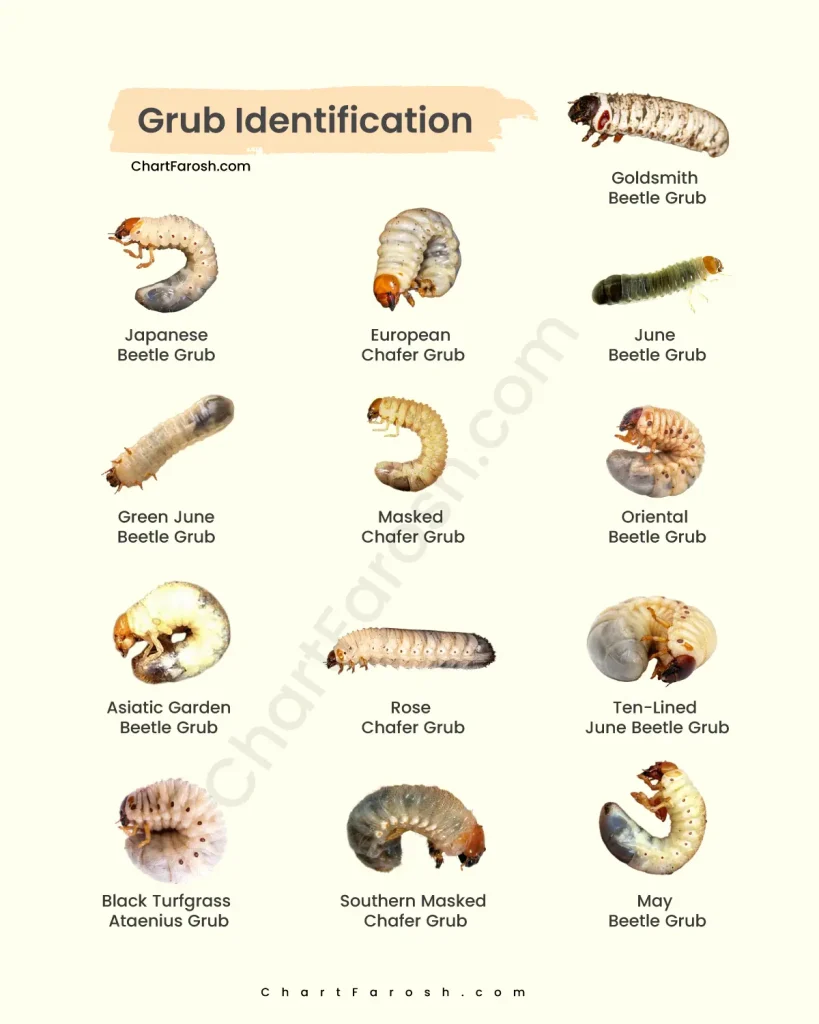
If you've ever flipped over a patch of dead sod and found pale, C-shaped larvae wriggling in the soil, you've probably wondered what do grubs turn into. The answer isn't as straightforward as you might think, because "grub" isn't one specific bug. It's a catch-all term for several different species of beetle larvae, and the adult they become depends entirely on which species you're looking at.
Most of the grubs you'll find in lawns and gardens turn into scarab beetles, but the specific species matters a lot. A Japanese beetle grub and a June bug grub look almost identical to the untrained eye, yet they produce very different adults with different behaviors and damage patterns. Getting the identification right is the key to knowing whether you're dealing with a serious lawn pest or a harmless soil dweller.
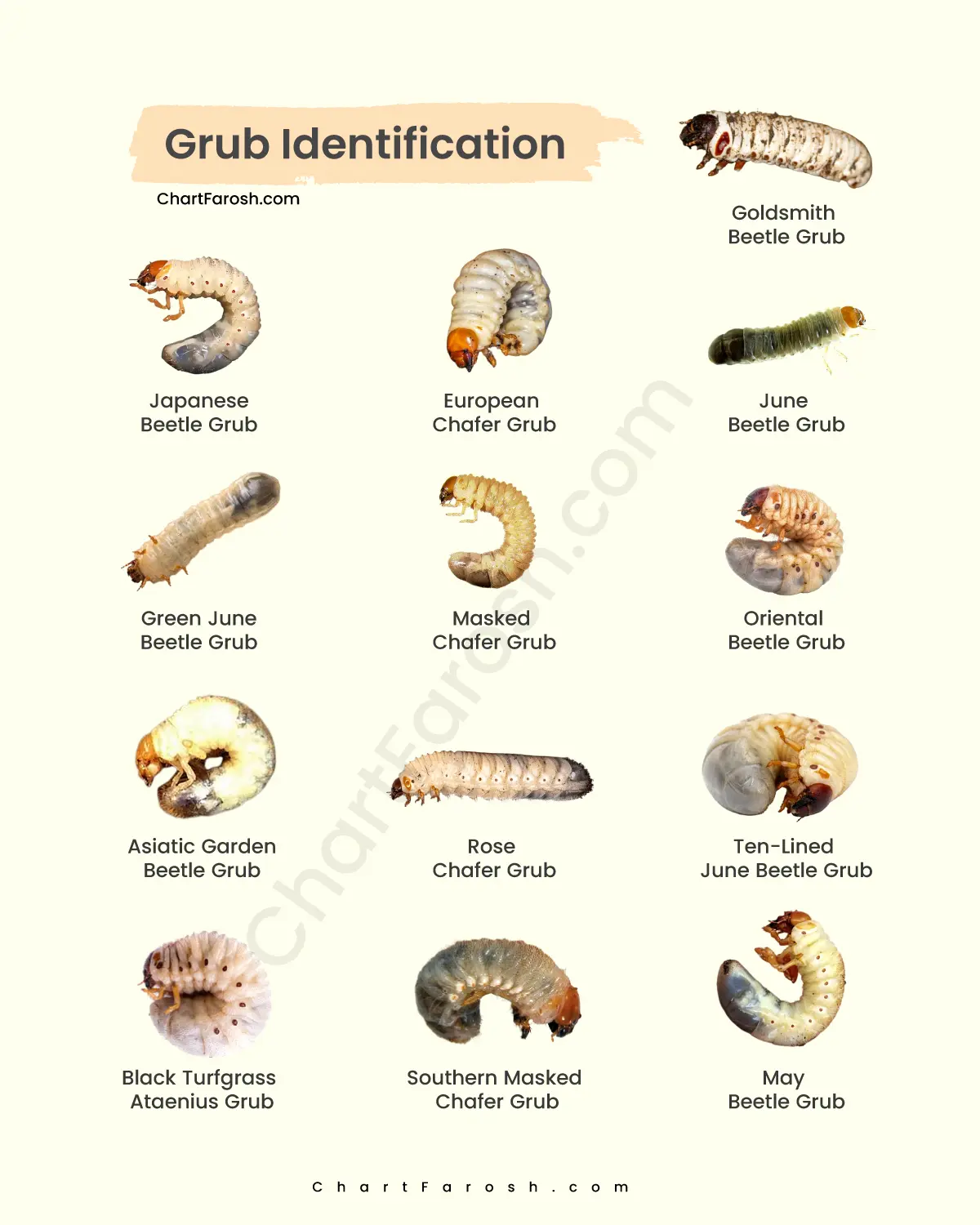
Image source: Bing (Web (fair-use with source credit))
Quick Answer
Most grubs turn into scarab beetles. The most common species include Japanese beetles, June bugs, European chafers, and Oriental beetles. Each species produces a different adult beetle with unique colors, sizes, and feeding habits.
Some grubs turn into moths or other insects instead. Correct identification requires examining the grub's physical features, especially the raster pattern on its underside.
Why You Can't Answer This Without Seeing the Grub
Here's the thing most articles skip: you can't reliably say what a grub turns into based on a text description alone. The differences between species are subtle and visual. Two grubs sitting side by side in your lawn might look identical to you, but one becomes a Japanese beetle and the other becomes a European chafer.
Those two adults have completely different damage patterns, flight seasons, and treatment windows.
This is one of those topics where a photo or diagram does more work than a thousand words. The identification features that matter, like the raster pattern on the underside of the larva near its rear end, are nearly impossible to describe clearly without a visual reference. Extension services and university entomology departments rely heavily on illustrated guides for exactly this reason.
If you're trying to figure out what's living in your soil, your best move is to pull a few specimens, compare them to a species-specific identification chart, and note the time of year you found them. That combination of visual matching and seasonal context will get you the right answer far faster than any general description.
The Short Answer: Most Grubs Turn Into Beetles, But That's Not the Whole Story
The grubs you're most likely to encounter in a lawn or garden are scarab beetle larvae. That family, Scarabaeidae, includes some of the most common and destructive turf pests in North America. Japanese beetles, June bugs, European chafers, Oriental beetles, and masked chafers all start life as C-shaped white larvae living in the top few inches of soil.
But not every pale, worm-like larva in your yard is a scarab. Wireworms, which are click beetle larvae, get called grubs all the time. So do cutworms, which are moth larvae.
Even root maggots from fly species sometimes get lumped into the "grub" category by homeowners who just see something pale and squishy in the dirt.
The distinction matters because what you do about it depends on what it actually is. Scarab beetle grubs have specific treatment windows and respond to specific biological controls like milky spore or entomopathogenic nematodes. Wireworms and cutworms need entirely different approaches.
Guessing wrong means wasting time, money, and product on something that won't work.
What a Grub Actually Is (And What It Isn't)
Entomologically speaking, a "grub" refers to a specific body type of larva called scarabaeiform. That means a thick, soft-bodied, C-shaped larva with a well-developed head capsule, three pairs of legs near the head, and no prolegs along the body. The body is usually creamy white with a darker rear end where gut contents show through the skin.
What a grub is not: a caterpillar, a maggot, or a worm. Caterpillars have prolegs along their abdomen and will become moths or butterflies. Maggots are legless fly larvae.
Worms are annelids, not insects at all. These distinctions sound academic until you're standing in your garden trying to decide whether to treat or leave alone.
The term "grub" gets used loosely in everyday conversation, which causes a lot of confusion. A homeowner who finds cutworms in their vegetable bed and calls them grubs might follow grub-specific advice that does nothing for their actual problem. That's why learning to recognize the basic scarabaeiform shape is so useful.
Once you know what a true grub looks like, you can narrow down the possibilities fast.
The Four Stages of a Grub's Life Cycle
Every grub you find is in the larval stage of a complete metamorphosis cycle. That cycle has four distinct stages: egg, larva, pupa, and adult. Understanding where a grub sits in that cycle tells you what to expect next and when to act.
Egg stage. Adult female beetles lay eggs in moist soil during mid to summer, typically from late June through August depending on species and region. The eggs are small, white, and oval, usually deposited 2 to 4 inches below the surface. They hatch in about 10 to 14 days.
Larval stage. This is the grub stage, and it's the longest and most destructive phase. The larva goes through three growth stages called instars, molting between each one as it grows. First and second instar grubs are small and feed on fine root hairs.
Third instar grubs are the large, damaging larvae most people find when they dig into their lawn. This stage lasts roughly 10 months to a full year for most single-generation species.
Pupal stage. In late spring or early summer, the mature larva stops feeding and forms a pupal cell, a small earthen chamber in the soil. Inside, it transforms into a pupa, a non-feeding resting stage where the body reorganizes into the adult form. This stage lasts about 2 to 4 weeks.
Adult stage. The fully formed beetle emerges from the pupal cell and digs to the surface. Adults mate, females lay eggs in soil, and the cycle starts over. Adult beetles live for a few weeks to a couple of months, depending on species.
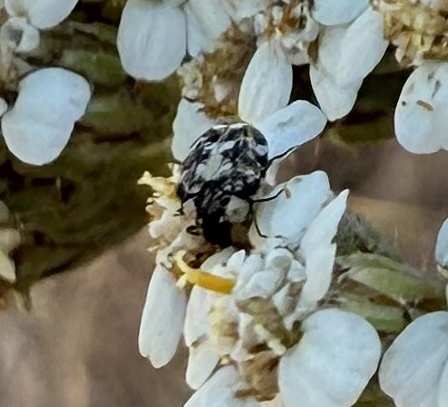
Image source: iNaturalist / Irene
The timing of these stages varies by species and climate. In warmer regions, the whole cycle might complete in a year. In northern areas, some species take 2 to 3 years to develop.
That's why you can find grubs of different sizes in the same patch of lawn at the same time. They're not all the same age.
How to Identify What Your Grub Will Become
Identifying a grub to species level takes some close observation, but you don't need a microscope. A hand lens or even a phone camera with a macro setting will get you there. The key features to examine are size, head capsule color, leg arrangement, and the raster pattern.
Size and Body Shape
Most turf-damaging grubs range from about ¼ inch (first instar) to over 1 inch fully grown (third instar). Green June beetle grubs are the exception, reaching up to 2 inches long. Body shape is consistently C-shaped across scarab species, but the degree of curl and the thickness of the body can give you initial clues.
Head Capsule Color
The head capsule is the hardened area right behind the mouthparts. Its color varies by species and is one of the quickest visual cues. Japanese beetle grubs have a tan to brown head capsule.
European chafer grubs have a darker brown head. Oriental beetle grubs have a lighter, yellowish-brown head. This single feature can narrow your options fast.
Leg Arrangement
All scarab grubs have three pairs of legs, and they're clustered right behind the head. If you see a pale larva with legs spread along the entire body, you're looking at something else, probably a caterpillar or sawfly larva. The legs on a true grub are relatively short and not very visible unless you're looking closely.
The Raster Pattern (The Real Tell)
The raster pattern is the arrangement of hairs, spines, and bare areas on the underside of the grub's last abdominal segment, right above the rear end. This pattern is species-specific and is the most reliable way to tell one grub from another. It's the feature entomologists use for definitive identification.
To see the raster pattern, you need to flip the grub over and examine the area just below the anus with magnification. Different species have distinct arrangements of two parallel rows of tiny spines called the palidia. Japanese beetle grubs have a distinctive V-shaped or palmate raster pattern.
June bugs have two parallel rows of spines. European chafers have a Y-shaped opening with scattered spines.
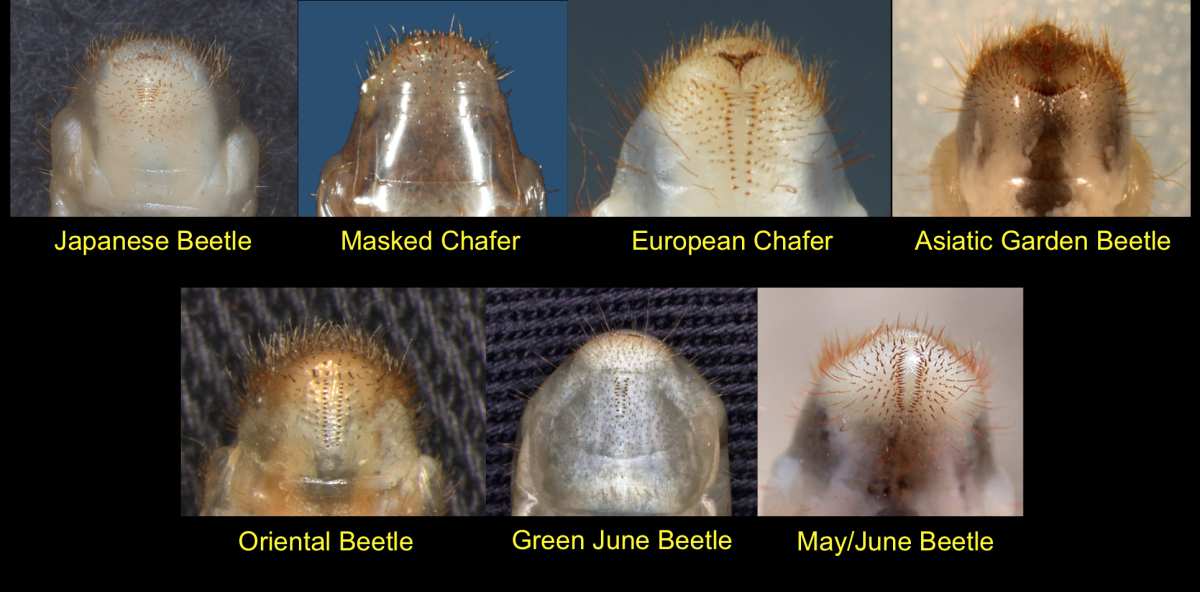
Image source: Bing (Web (fair-use with source credit))
This is where a reference image becomes essential. Purdue University's extension publication E-271 and similar resources from state extension services provide side-by-side raster pattern diagrams for the most common species. If you're serious about identifying what's in your lawn, pull up one of those charts and compare it directly to your specimen.
The Most Common Grubs and What They Turn Into
Now that you know what to look for, let's walk through the species you're most likely to encounter. Each one has a distinct adult form, damage pattern, and seasonal timeline. Knowing which one you're dealing with tells you what to expect and when to act.
Japanese Beetle
Japanese beetle grubs are among the most destructive turf pests in the eastern and midwestern United States. The adult is a striking metallic green and copper beetle about ⅜ inch long. Adults feed on over 300 plant species, skeletonizing leaves on roses, lindens, grapes, and many fruit trees.
The grub itself is creamy white with a tan head capsule and three pairs of legs. Its raster pattern shows a distinctive V-shaped arrangement of spines. This species completes its life cycle in one year.
Adults emerge in June and July, feed for several weeks, and lay eggs in moist turf by late July. The grubs feed through fall, overwinter deep in the soil, and resume feeding in spring before pupating in late May or early June.
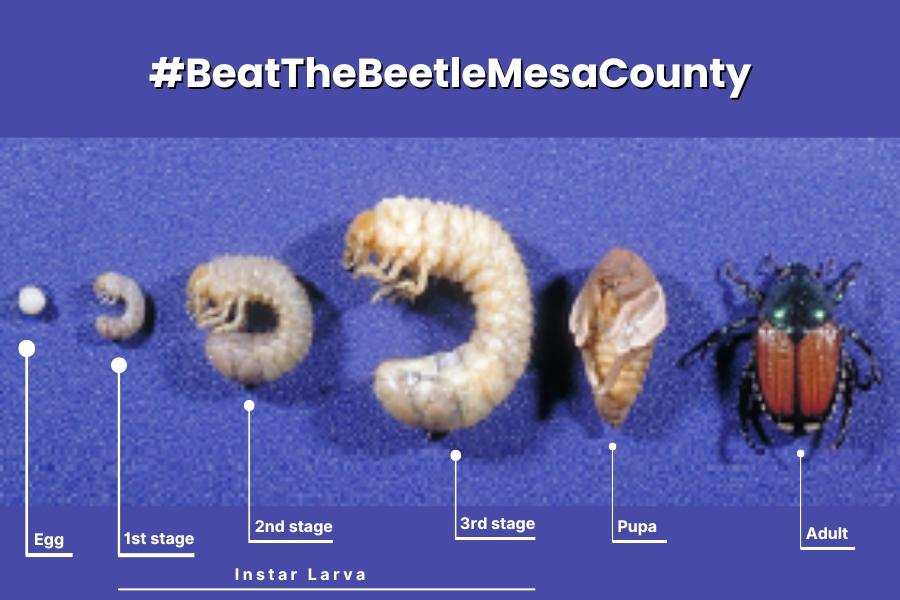
Image source: Bing (Web (fair-use with source credit))
Japanese beetle is an invasive species in the US, first detected in New Jersey in 1916. It has been spreading westward ever since. As of 2026, established populations reach as far as the Rocky Mountain front range, with quarantine efforts ongoing through USDA APHIS to slow further spread.
June Bugs / May Beetles
June bugs belong to the genus Phyllophaga, which includes over 200 species in North America. The adults are stout, reddish-brown to dark brown beetles, typically ½ to 1 inch long. They're the clumsy fliers that bang against porch lights on warm spring evenings.
The grubs are larger than Japanese beetle grubs when fully grown, often exceeding 1 inch. They have a brown head capsule and a raster pattern with two roughly parallel rows of spines. Many Phyllophaga species have a 2 to 3 year life cycle, which means you'll find multiple size classes in the same lawn at the same time.
Adults emerge in May and June, hence the common name.
Damage from June bug grubs tends to be less concentrated than Japanese beetle damage because the species is so diverse. Some years you'll see significant turf injury, other years very little. They prefer grass but will also feed on the roots of corn and other crops.
European Chafer
European chafer is a major turf pest in the Northeast, Great Lakes region, and parts of the Pacific Northwest. The adult is a medium-sized, light tan to brown beetle, smaller than a June bug but larger than a Japanese beetle. It's sometimes called the "June beetle's smaller cousin."
The grub looks very similar to a June bug grub but has a darker brown head capsule and a raster pattern with a Y-shaped anal opening and more randomly scattered spines. European chafer has a one-year life cycle. Adults fly in June and July, and the grubs cause peak damage in fall and again in spring.
This species is particularly problematic because it tolerates drier soils than other grub species. That means you can see damage in areas that don't typically have grub problems, like south-facing slopes and well-drained lawns. Moles, skunks, and birds often cause secondary damage digging for European chafer grubs, sometimes destroying more turf than the grubs themselves.
Oriental Beetle
Oriental beetle is another invasive species from Asia, established in the eastern US since the early 20th century. The adult is a mottled brown and black beetle, about ⅜ inch long, with a somewhat flattened appearance. It's less showy than a Japanese beetle but still distinctive up close.
The grub has a light yellowish-brown head capsule and a raster pattern with two parallel rows of spines, similar to June bug but with subtle differences visible under magnification. Oriental beetle has a one-year life cycle with adults emerging in late June through July. The grubs are active from late summer through fall and again in spring.
Oriental beetle grubs tend to do well in a wide range of soil types and are often found alongside Japanese beetle grubs in mixed infestations. The adults feed on flower petals, particularly daisies and chrysanthemums, but cause less plant damage than Japanese beetles.
Green June Beetle
Green June beetle stands out from the others in several ways. The adult is a large, velvety green beetle, nearly 1 inch long, with a copper or bronze tint on the head and legs. It's one of the most visually striking beetles you'll see in a lawn.
The grub is the largest of the common turf grubs, reaching up to 2 inches long. Unlike other grubs, green June beetle larvae don't lie curled in a C-shape. They crawl on their backs using stiff hairs on their dorsal surface, which is a bizarre and unmistakable behavior.
They also have a brown head capsule and a raster pattern similar to other scarabs.
Green June beetle has a one-year life cycle. Adults fly in June and July, often during the day, which is unusual for scarab beetles. The grubs are surface feeders more than root feeders, which means they create a different damage pattern.
They push up small mounds of soil that look like earthworm castings, and the turf damage tends to be more diffuse.
Masked Chafers
Masked chafers, genus Cyclocephala, are common across much of the eastern and central US. The adult is a medium-sized, tan to brown beetle with a darker "mask" of brown on the head. It's sometimes confused with European chafer but is generally smaller and more uniformly colored.
The grub resembles a small European chafer grub with a brown head capsule and a raster pattern that requires close examination to distinguish. Masked chafers have a one-year life cycle with adults emerging in June and July. The grubs are active from August through fall and resume feeding in spring.
This species is often overlooked because the adults are less conspicuous than Japanese beetles or June bugs. The grubs can still cause significant turf damage, particularly in lawns with a thick thatch layer where they tend to feed.
Grubs That Don't Turn Into Beetles
Not every larva you find in soil is a scarab grub. Several other insects get misidentified as grubs, and knowing the difference saves you from applying the wrong treatment.
Wireworms are the larvae of click beetles. They're hard-bodied, smooth, and shiny, with a distinct segmented appearance. Unlike the soft, C-shaped scarab grub, wireworms are more cylindrical and stiff.
They feed on roots and seeds of crops like corn, wheat, and potatoes. They don't respond to grub-specific treatments like milky spore.
Cutworms are moth larvae, usually from the family Noctuidae. They're soft-bodied like grubs but have a more elongated, caterpillar-like shape with visible prolegs along the abdomen. They feed at night on stems and leaves, often cutting young plants off at the soil line.
Soil insecticides labeled for grubs may not control cutworms effectively.
Root maggots are fly larvae from several families. They're legless, pale, and tapered at one end, looking nothing like a true grub. They attack the roots of vegetables like cabbage, onions, and radishes.
Grub control products won't touch them.
If you're unsure what you're looking at, the leg test is a quick first filter. True grubs have three pairs of legs near the head. If the larva has no legs, it's a maggot.
If it has legs all along the body, it's a caterpillar. If it's hard and shiny, it's probably a wireworm.
What Pupa Look Like (And Why People Miss This Stage)
The pupal stage is the least recognized part of the grub life cycle, mostly because it happens underground and doesn't cause visible damage. But if you're digging in your lawn in late spring and find something that looks like a pale, motionless beetle, you've probably found a pupa.
A scarab pupa is roughly the size and shape of the adult beetle but softer and lighter in color. You can see the folded wings, legs, and antennae pressed against the body. It doesn't feed or move around, though it may wiggle if disturbed.
The pupal stage lasts about 2 to 4 weeks before the adult beetle emerges and digs to the surface.
People often mistake pupae for dead grubs or some kind of disease. They're neither. They're a normal, healthy part of the life cycle.
If you find pupae in your lawn, it means the grubs have finished feeding and are transforming. It's too late for curative treatment at this point, but it tells you that adult beetles will be emerging soon.
When Each Stage Happens (Seasonal Timing)
Timing matters enormously for grub management. Here's a general calendar for the most common single-generation species in the northern and mid-Atlantic US.
| Stage | Japanese Beetle | European Chafer | June Bug |
|---|---|---|---|
| Adult flight | June to August | June to July | May to June |
| Egg laying | July to August | June to July | May to June |
| Young grubs feeding | August to October | July to October | June to October |
| Overwintering | November to March | November to March | November to March |
| Spring feeding | April to May | April to May | April to June |
| Pupation | Late May to June | Late May to June | Late May to June |
These windows shift earlier in the South and later in the North. In the southern US, adult flight can start in May. In northern New England or the upper Midwest, it might not begin until July.
Local extension services publish region-specific timing charts that are more precise than any national overview.
The critical treatment window for most curative products is late July through September, when grubs are small, actively feeding near the surface, and most vulnerable. By the time you see brown patches in spring, the grubs are large, deep in the soil, and much harder to control. That's why preventive treatments, applied before eggs hatch, are often more effective for high-value turf.
How to Tell If Your Grubs Are a Problem or Just Passing Through
Finding grubs in your lawn doesn't automatically mean you have a problem. Healthy turf can tolerate a surprising number of grubs without showing visible damage. The threshold for treatment varies by species, turf type, and overall lawn health.
For most cool-season turf grasses, extension guidelines suggest treating when you find 5 to 10 grubs per square foot. For warm-season grasses like bermudagrass, the threshold is often lower, around 5 per square foot, because the grass is less tolerant of root feeding. Japanese beetle grubs tend to cause damage at lower numbers than European chafer grubs.
To sample your lawn, cut a 1-square-foot section of turf about 3 inches deep and peel it back. Count the grubs you find in the soil and root zone. Sample several spots across the lawn, especially in areas where the turf looks stressed.
Grub populations are rarely uniform, so a single sample won't give you the full picture.
Secondary damage from animals is often the first sign people notice. Moles, skunks, raccoons, and birds digging for grubs can tear up a lawn faster than the grubs themselves. If you're seeing fresh digging, that's a strong indicator of a significant grub population worth investigating.
Common Mistakes People Make When Identifying Grubs
The most common mistake is assuming all grubs are the same. Without checking the raster pattern or head capsule color, you're just guessing, and guessing wrong leads to mistimed or unnecessary treatments.
Another frequent error is sampling too late in the season. By spring, large grubs have already caused damage and are preparing to pupate. You've missed the window for effective curative treatment.
The best time to check is August or September, when young grubs are active near the surface.
People also mistake pupal cells or animal digging for active grub damage. If you find pupae in late spring, the grubs have already finished feeding. If you see fresh holes, the grubs attracted the animal weeks or months ago, and the current population may be quite different.
Finally, many homeowners treat based on grub presence alone, without reaching a damage threshold. Finding 2 or 3 grubs per square foot in a healthy lawn is normal and doesn't warrant intervention. Over-treating kills beneficial soil organisms and wastes money.
What to Do Once You Know What You're Dealing With
If you've identified a problematic species and your counts exceed the treatment threshold, your approach depends on the timing and your comfort level with different products.
For late summer and fall, when young grubs are feeding near the surface, curative insecticides like trichlorfon or carbaryl provide quick control. Entomopathogenic nematodes, specifically Heterorhabditis bacteriophora, are a biological option that works well against most scarab grubs when soil temperatures are above 60°F and the soil is kept moist.
For preventive control the following year, products containing imidacloprid or chlorantraniliprole can be applied in June or July before eggs hatch. These are longer-lasting but must be timed correctly to work.
For Japanese beetle specifically, milky spore disease (Paenibacillus popilliae) is a biological control that establishes in the soil and reduces grub populations over several years. It's less effective against other grub species and works best in warm climates with consistent soil temperatures above 70°F.
Regardless of what you use, always read the product label completely. Grub control products are pesticides, and the label is a legal document that specifies application rates, timing, safety precautions, and environmental restrictions. Applying off-label or at the wrong time of year reduces effectiveness and increases risk to non-target organisms.
Frequently Asked Questions
Are all grubs bad for my lawn?
No. Many grub species are present in low numbers and don't cause visible damage. Healthy turf can tolerate 5 or fewer grubs per square foot without treatment.
Problems arise when populations exceed the threshold or when animals dig for secondary damage.
How do I tell a grub from a wireworm?
True grubs have three pairs of legs near the head and a soft, C-shaped body. Wireworms are hard-bodied, cylindrical, and shiny with no visible legs or very tiny legs that aren't obvious. Wireworms also move more quickly than grubs.
When should I treat for grubs?
The most effective curative window is late July through September, when grubs are small and actively feeding near the surface. Preventive treatments go down in June or July before eggs hatch. Spring treatments are generally less effective because grubs are large and preparing to pupate.
Do grub treatments harm earthworms?
Some insecticides can reduce earthworm populations, particularly broad-spectrum products. Biological controls like entomopathogenic nematodes and milky spore are more targeted and have minimal impact on earthworms. Always check product labels for non-target organism warnings.
Will grubs come back after treatment?
Yes, in most cases. Grub treatments reduce existing populations but don't create a permanent barrier. Adult beetles from neighboring properties can reinfest your lawn each year.
Long-term management combines monitoring, targeted treatment, and cultural practices like maintaining healthy turf that tolerates low grub levels.
What's the difference between a grub and a caterpillars?
True grubs are beetle larvae with a C-shaped body, three pairs of legs near the head, and no prolegs. Caterpillars are moth or butterfly larvae with legs along the entire body, including fleshy prolegs. Caterpillars turn into moths or butterflies, not beetles.