If you've ever flipped over a shovel of soil and found a fat, pale, C-shaped critter curled up in the dirt, you've probably wondered what do grubs grow into. The short answer is that most of them become beetles, but the specific beetle depends entirely on which species of grub you're looking at. And that distinction matters a lot if you're trying to figure out whether you've got a lawn pest or a harmless soil dweller.
Here's the thing that trips most people up. The word "grub" isn't a scientific category. It's a catch-all term for any thick-bodied, pale, soil-dwelling larva.
In our research, we've found that the most common lawn grubs in the United States are scarab beetle larvae, and their adult forms range from Japanese beetles to June bugs to chafers. The treatment threshold for most cool-season turf is 5 to 10 grubs per square foot, so knowing exactly what you're dealing with before you act can save you time, money, and unnecessary pesticide use.
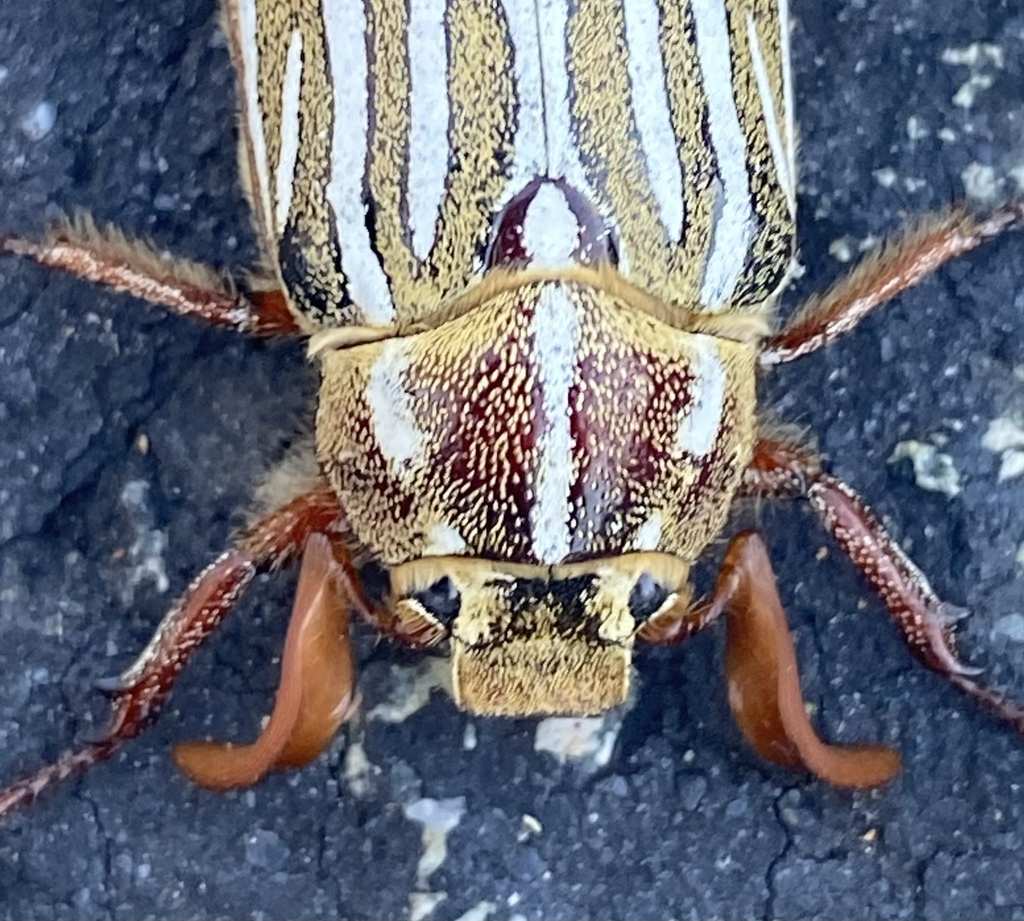
Image source: iNaturalist / Irene
Quick Answer
Most grubs grow into beetles. Scarab beetle grubs become Japanese beetles, June bugs, European chafers, or masked chafers. Weevil grubs are legless and become billbugs.
Some larvae called grubs are actually moth caterpillars. The species depends on body shape, leg presence, and where you found it.
Why "What Do Grubs Grow Into" Doesn't Have One Answer
People search this question expecting a single answer, and that's where the confusion starts. A grub found in your lawn in Ohio is almost certainly a different species from one found in compost in Georgia or under bark in Oregon. Each follows its own path through complete metamorphosis, which is the four-stage life cycle that all these insects share: egg, larva (the grub stage), pupa, and adult.
The grub stage is the feeding stage. That's when these insects do the most damage to roots, thatch, and organic matter. The adult stage is primarily about reproduction.
So when someone asks what a grub grows into, what they're really asking is which adult insect emerges after the pupa stage. And that answer changes based on a handful of identifying features you can actually check yourself.
Think of it like caterpillars. Not all caterpillars become monarch butterflies. Some become moths, some become swallowtails, and some become nothing because they're actually sawfly larvae.
Grubs work the same way. The body shape, the presence or absence of legs, the habitat where you found it, and the time of year all point you toward the right adult insect.
The Quick ID Check: What You're Actually Looking At
Before diving into species-level identification, you need to sort your grub into one of four broad categories. This first branch point determines everything that follows.
Scarab beetle grubs are the most common type people encounter. They have a distinctly C-shaped body, a brown or tan head capsule, and three pairs of true legs right behind the head. Their body color ranges from creamy white to pale gray.
If you find a plump, C-shaped larva with visible legs in your lawn or garden soil, you're almost certainly looking at a scarab grub.
Weevil grubs (billbug larvae) look similar at first glance but have one key difference: they're completely legless. Their body is also C-shaped or slightly curved, and they tend to be found inside plant stems or thatch rather than freely in the soil. If your grub has no legs at all, you're dealing with a weevil larva, not a scarab.
Moth larvae get called grubs more often than you'd think. Cutworms and armyworms are sometimes mistaken for grubs because they're found in soil or thatch and can cause similar damage. But they have more than three pairs of legs, including fleshy prolegs along the abdomen, and they don't hold that tight C-shape.
If the larva is straightish, has extra legs, and you find it near the soil surface at night, it's probably a moth caterpillar.
Beneficial decomposer grubs show up in compost piles, under decaying logs, and in dung. Dung beetle grubs and some rhinoceros beetle larvae fall into this category. They're doing useful work breaking down organic matter, and they should be left alone.
The Grub-to-Adult Life Cycle in Plain English
Every grub you find is in the larval stage of complete metamorphosis. That means the insect passes through four distinct body forms, and the grub looks nothing like the adult it becomes. Understanding this cycle helps you time any treatment correctly and know what to expect seasonally.
Egg stage. Adult beetles lay eggs in soil, thatch, or decaying organic matter during their flight period, which varies by species but typically falls between late spring and midsummer. Eggs are usually deposited 1 to 2 inches below the surface. They hatch within one to three weeks depending on soil temperature and moisture.
Larva (grub) stage. This is the stage you're finding. Grubs feed on roots, thatch, and organic matter in the soil. They go through three growth phases called instars, molting between each one.
Most lawn pest species complete their larval stage in a single year, though some May beetle species take two to three years. Grubs are most vulnerable to treatment when they're small and actively feeding near the soil surface, typically late summer through early fall.
Pupa stage. When the grub is fully mature, it stops feeding and forms a pupal chamber in the soil. Inside this chamber, the body reorganizes into the adult form. The pupal stage lasts one to several weeks depending on species and temperature.
Adult emergence. The fully formed adult beetle chews its way out of the pupal chamber and digs to the surface. Once above ground, it mates, lays eggs, and the cycle starts over. Adult beetles of most common lawn pest species are active for four to eight weeks.
The timing of this cycle varies by species and region, which is why knowing your grub's identity matters so much for treatment decisions.
Branch 1: Scarab Beetle Grubs (The Most Common Type)
Scarab beetle larvae make up the vast majority of grubs people find in lawns and gardens. They share the same basic body plan, but the adult beetles they become look and behave very differently. Here's a breakdown of the most common species you're likely to encounter.
Japanese Beetle Grubs
Japanese beetle (Popillia japonica) grubs are arguably the most destructive lawn grub in the eastern and midwestern United States. The adult is a striking metallic green and copper beetle about 3/8 inch long. Grubs are creamy white with a brown head capsule and three pairs of legs.
They're found in the top 1 to 3 inches of soil feeding on grass roots.
The life cycle takes one year. Adults emerge in late June through July, feed on over 300 species of plants, mate, and lay eggs in turf. The eggs hatch by mid-August, and the young grubs feed aggressively through fall before burrowing deeper to overwinter.
They return to the root zone the following spring for a final feeding period before pupating in late May.
Japanese beetle grubs have a distinctive V-shaped raster pattern, which is the arrangement of hairs and spines on the underside of the abdomen tip. This pattern is the most reliable way to distinguish them from other scarab species under magnification.
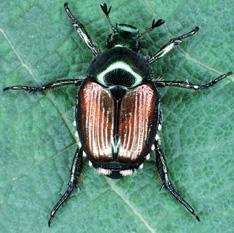
Image source: Wikimedia Commons / USDA
June Bug and May Beetle Grubs
June bugs, also called May beetles (Phyllophaga species), are among the most widespread scarab grubs in North America. The adults are reddish-brown to dark brown beetles, about 1/2 to 3/4 inch long, that bang against porch lights on warm spring evenings. The grubs are larger than Japanese beetle grubs, sometimes exceeding 1 inch when fully grown.
One key difference is the life cycle length. While Japanese beetle grubs complete their development in one year, many Phyllophaga species take two to three years. That means you'll find multiple size classes in the same lawn at the same time, which can make treatment timing trickier.
June bug grubs have a Y-shaped or parallel raster pattern, distinct from the V-shape of Japanese beetles. They tend to feed deeper in the soil than Japanese beetle grubs and can cause damage to a wider range of plants, including ornamental roots and vegetable crops.
European Chafer Grubs
The European chafer (Amphimallon majale) is a major turf pest in the Northeast and Great Lakes regions. Adults are tan to light brown beetles, smaller than June bugs, that emerge in June and July. The grubs look very similar to Japanese beetle grubs but are slightly larger and have a parallel raster pattern rather than V-shaped.
European chafer grubs are particularly problematic because they feed later into the fall and earlier in the spring than most other species. That extended feeding window means they can cause significant damage even at lower population densities. They also tend to thrive in drier, sandier soils where other grub species are less common.
Masked Chafer Grubs
Northern and southern masked chafers (Cyclocephala species) are common across the eastern and southern United States. The adults are dull brown beetles, about 1/2 inch long, that are active in early summer. Unlike Japanese beetles, masked chafer adults don't feed on plants, so the damage is entirely from the larval stage.
Masked chafer grubs have a raster pattern with a single transverse row of hairs. They follow a one-year life cycle similar to Japanese beetles but tend to be slightly more tolerant of drier conditions. They're often found in lawns that are otherwise well-maintained, which can make the damage seem surprising.
Oriental Beetle Grubs
The oriental beetle (Anomala orientalis) is primarily a pest in the Northeast and mid-Atlantic states. Adults are mottled brown and tan beetles, about 3/8 inch long, that emerge in late June through July. The grubs are nearly identical in appearance to Japanese beetle grubs and require examination of the raster pattern for reliable identification.
Oriental beetle grubs have a parallel raster pattern with two distinct rows of hairs. They tend to feed more on thatch and organic matter than on live roots, which means the damage threshold is slightly higher than for Japanese beetles. They're also more common in mulched landscape beds than in open turf.
Green June Beetle Grubs
The green June beetle (Cotinis nitida) is a large, showy beetle found throughout the southeastern United States. Adults are an iridescent green, about 1 inch long, and are active during the day, unlike most other scarab beetles. The grubs are the largest of the common lawn grubs, sometimes exceeding 2 inches in length.
Green June beetle grubs behave differently from other scarab larvae. They crawl on their backs across the soil surface at night, which is unusual. They feed primarily on decaying organic matter rather than live roots, so they're more of a nuisance pest than a turf killer.
Their tunneling activity can disrupt root systems and create small mounds of soil on the surface.
How to Tell Which Grub You Have: A Step-by-Step ID Guide
Identifying your grub to the species level takes a little patience, but you can get surprisingly close with just a few observations. Here's the process that extension entomologists use, simplified for practical field identification.
Step 1: Note the habitat. Where did you find it? Lawn soil, garden bed, compost pile, under bark, or inside a plant stem? This immediately narrows the possibilities.
Step 2: Check the body shape. Is it tightly C-shaped or more straight? Scarab grubs curl into a C. Weevil grubs are also curved but less tightly.
Moth larvae tend to be straighter.
Step 3: Look for legs. Count the legs near the head. Three pairs means scarab beetle grub. No legs means weevil grub.
More than three pairs, including fleshy prolegs along the body, means moth larva.
Step 4: Examine the head capsule. Scarab grubs have a distinct, hardened brown head. Weevil grubs also have a head capsule but it's often more orange or amber. Moth larvae have a smaller, less distinct head.
Step 5: Check the body color. Most scarab grubs are cream to white with a brown head. Green June beetle grubs can have a slightly greenish tint. Dung beetle grubs may be darker.
Step 6: Look at the raster pattern. This is the gold standard for species-level identification. Flip the grub over and examine the last abdominal segment with a hand lens or magnifying glass. The arrangement of hairs and spines forms a pattern that's unique to each species.
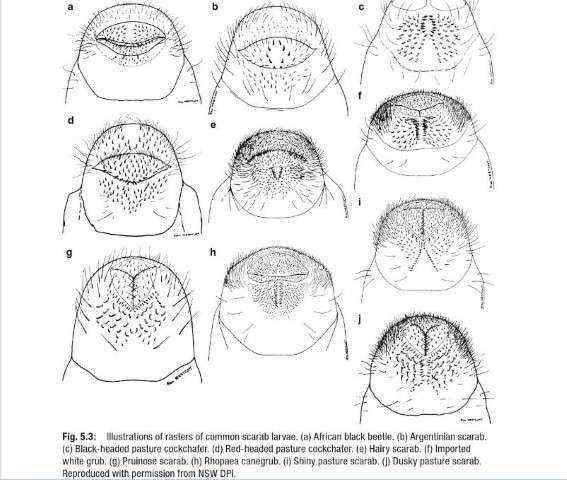
Image source: Bing (Web (fair-use with source credit))
Step 7: Measure the body size. Size gives you a clue about the species and the instar stage. Japanese beetle grubs max out around 1 inch. June bug grubs can reach 1.5 inches.
Green June beetle grubs can exceed 2 inches.
Step 8: Note the time of year. If you're finding large grubs in early spring, they're probably a species with a multi-year life cycle. If you're finding small grubs in late summer, they're likely from that year's egg hatch.
When Grubs Become a Problem vs. When to Ignore Them
Not every grub in your soil is a threat. In fact, a healthy lawn can tolerate a surprising number of grubs without showing any visible damage. The key is understanding when the population crosses the line from background noise to active pest problem.
The treatment threshold for most cool-season turf is 5 to 10 grubs per square foot. That's the point at which root feeding starts to outpace the grass's ability to recover. For Japanese beetle grubs specifically, some extension services recommend treating at 3 to 5 per square foot because of their aggressive feeding habits.
But here's what most people miss. Grub damage often looks like other problems. Brown patches in your lawn could be grubs, but they could also be fungal disease, drought stress, dog urine, or compacted soil.
The way to tell is to grab a shovel and cut a 1-square-foot section of sod about 3 inches deep. Peel it back and count the grubs in the root zone. If you find more than the threshold number, you've got a confirmed grub problem.
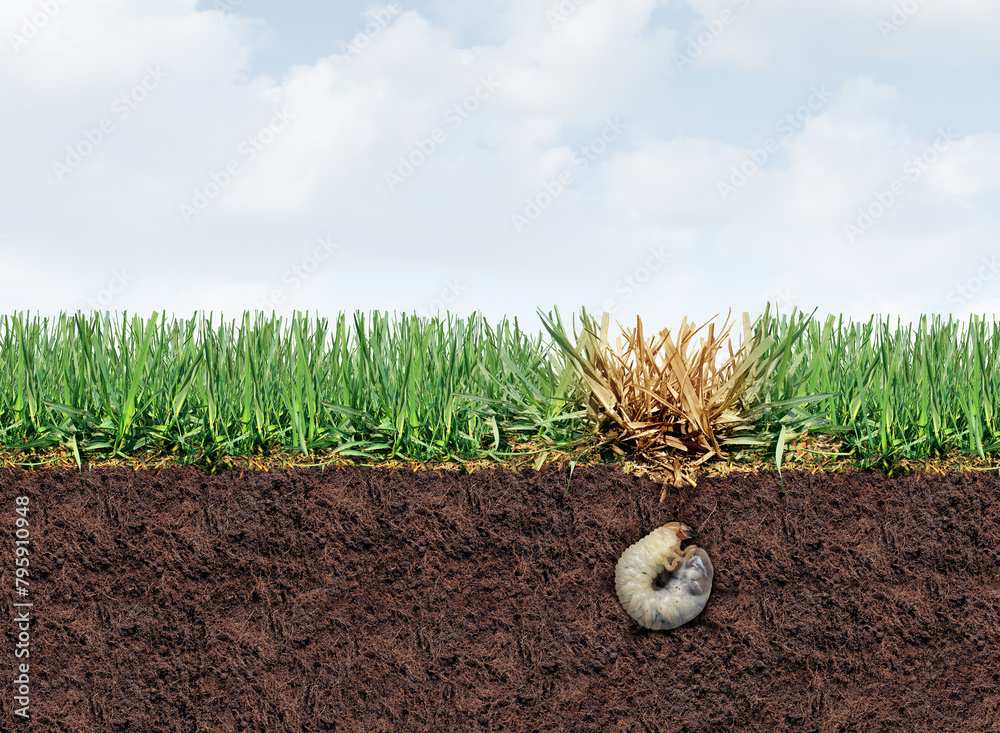
Image source: Bing (Web (fair-use with source credit))
Secondary damage is often the first sign. Skunks, raccoons, and armadillos dig up lawns to feed on grubs, and the destruction they cause can far exceed the root damage from the grubs themselves. If you're finding patches of torn-up sod overnight, grubs are likely the underlying cause even if you haven't seen the larvae yet.
Some grubs should never be treated. Dung beetle grubs in compost or manure are doing valuable work breaking down organic matter and recycling nutrients. Rhinoceros beetle larvae in decaying logs are part of a healthy forest ecosystem. If your grub is in a compost pile, under a log, or in a natural area, leave it alone.
Timing matters for treatment effectiveness. Curative treatments work best when grubs are small and actively feeding, typically August through early October in most regions. Preventive treatments target the newly hatched grubs before they grow large enough to cause significant damage. Applying control products at the wrong time, like when grubs are dormant deep in the soil during winter, is a waste of money and product.
Matching the Right Treatment to the Right Species
Once you've identified your grub, the treatment path becomes much clearer. Different species respond to different control methods, and using the wrong approach is one of the most common mistakes homeowners make.
For Japanese beetle grubs specifically, milky spore disease (Paenibacillus popilliae) is a biological control that targets this species almost exclusively. It takes two to four years to establish in the soil but can provide long-term suppression. The downside is that it only works on Japanese beetles and won't touch other scarab species.
Beneficial nematodes (Heterorhabditis bacteriophora and Steinernema species) are effective against a broader range of scarab grubs. These microscopic roundworms enter the grub's body and release bacteria that kill the host within 24 to 48 hours. They need soil temperatures above 55°F to be active, so application timing is critical.
Apply them in late summer when grubs are small and soil is warm.
Chemical insecticides like chlorantraniliprole and trichlorfon are registered for grub control and work on most scarab species. Chlorantraniliprole is a preventive product applied in spring before eggs hatch. Trichlorfon is a curative product applied in late summer when grubs are actively feeding.
Always follow the EPA-registered label for application rates and timing.
For billbug larvae, the approach is different because they feed inside plant stems rather than freely in soil. Nematodes and soil drenches are less effective. Maintaining healthy, dense turf through proper watering and fertilization is the best defense.
Severe infestations may require targeted insecticide applications to the thatch layer.
For cutworms and armyworms, biological controls like Bacillus thuringiensis (Bt) are effective because these are moth larvae, not beetles. Bt targets caterpillars specifically and won't harm scarab grubs or beneficial insects in the soil.
Cultural practices reduce grub problems across all species. Deep, infrequent watering encourages deeper root growth that's more resilient to grub feeding. Mowing at the proper height for your grass type maintains a thicker canopy. Aerating compacted soil improves root health and makes the turf less susceptible to damage.
Common Mistakes People Make With Grub Identification
Even experienced gardeners get grub ID wrong sometimes. These are the errors we see most often, and they lead to wasted effort and unnecessary pesticide use.
Mistaking billbug larvae for scarab grubs. Billbug larvae are legless, and that's the giveaway. If you don't check for legs, you might apply a scarab-specific treatment that does nothing against weevils. Always flip the grub over and look for those three pairs of legs near the head.
Confusing cutworms with grubs. Cutworms are moth larvae, not beetle larvae. They have more legs, a straighter body, and they feed at night on the soil surface rather than underground on roots. Treating cutworms with grub control products won't work because the biology is completely different.
Assuming all white C-shaped larvae are the same species. Japanese beetle grubs, June bug grubs, and chafer grubs all look nearly identical to the naked eye. The raster pattern is the only reliable way to tell them apart without rearing the larva to adulthood. If you're choosing between milky spore and a broad-spectrum treatment, species-level ID matters.
Treating based on damage alone without confirming grub presence. Brown patches in turf have many causes. If you apply grub control without actually finding grubs, you might be treating the wrong problem. Always do a soil sample first.
Applying treatments at the wrong life stage. Grubs are most vulnerable when they're small and near the soil surface. By the time you see adult beetles flying around in summer, the current year's grubs are already mature and harder to kill. Plan your treatment timing around the life cycle, not around when you notice damage.
Overlooking beneficial grubs. Not every grub is a pest. Dung beetle larvae, compost-dwelling scarabs, and decomposer species are doing useful ecological work. Killing them with broad-spectrum insecticides disrupts soil biology and can actually make your lawn less healthy over time.
Regional Guide: Which Grubs Are Most Likely in Your Area
Grub species distribution varies significantly across the United States. Knowing which species are common in your region narrows your identification options and helps you anticipate problems before they start.
| Region | Most Common Grub Species | Adult Beetle | Peak Activity |
|---|---|---|---|
| Northeast | European chafer, Japanese beetle, oriental beetle | Tan to metallic green beetles | June through August |
| Mid-Atlantic | Japanese beetle, oriental beetle, masked chafer | Metallic green to brown beetles | June through August |
| Midwest | Japanese beetle, European chafer, June bug | Metallic green to reddish-brown beetles | May through August |
| Southeast | Green June beetle, masked chafer, Japanese beetle | Iridescent green to brown beetles | May through September |
| Great Lakes | European chafer, Japanese beetle, June bug | Tan to metallic green beetles | June through August |
| Pacific Northwest | European chafer, Japanese beetle (limited) | Tan to metallic green beetles | June through August |
The Japanese beetle is established in most eastern and midwestern states as of 2026, with quarantine zones in western states to slow its spread. The USDA Animal and Plant Health Inspection Service monitors and regulates Japanese beetle movement across state lines.
State cooperative extension services are your best resource for localized identification guides. Land-grant universities like Penn State, Rutgers, Michigan State, and the University of Minnesota publish region-specific fact sheets with photos, life cycle calendars, and treatment recommendations tailored to local conditions.
FAQs About Grub Identification and What They Become
How can I tell if a grub is a scarab or a weevil larva?
Check for legs. Scarab beetle grubs have three pairs of true legs near the head. Weevil grubs, including billbug larvae, are completely legless.
If you can't see any legs on the grub, you're looking at a weevil larva, not a scarab.
Do all grubs turn into beetles?
Most grubs that people find in soil are beetle larvae, specifically scarab beetles. However, some larvae called grubs are actually moth caterpillars like cutworms and armyworms. True grubs, meaning beetle larvae, always become beetles.
What is the fastest way to identify a grub species?
Examine the raster pattern on the underside of the abdomen tip using a hand lens. The arrangement of hairs and spines is unique to each scarab species. Japanese beetles have a V-shaped pattern, while chafers and June bugs have parallel or Y-shaped patterns.
Are grubs in my compost bin harmful?
Grubs in compost are usually beneficial decomposers like dung beetle larvae or other scarab species that break down organic matter. They're not harmful and should be left alone. They're doing the work of processing your compost for you.
When should I treat for grubs in my lawn?
The best time for curative treatment is late summer through early fall when grubs are small and actively feeding near the soil surface. Preventive treatments are applied in spring before eggs hatch. Always confirm grub presence with a soil sample before treating.
Can I identify grubs by the damage they cause?
Grub damage alone isn't reliable for species identification because most scarab grubs cause similar symptoms: brown patches, loose turf that peels back easily, and secondary damage from animals digging. You need to find and examine the actual grubs to identify the species.
The Bottom Line: Your Grub ID Decision Guide
Identifying what a grub grows into comes down to a few key observations. Start with body shape and leg count. Check the habitat where you found it.
If you need species-level precision, examine the raster pattern under magnification.
If you've got a C-shaped, brown-headed grub with three pairs of legs in your lawn, you're dealing with a scarab beetle larva. The specific species determines which adult beetle emerges and which treatment approach makes sense. If the grub is legless, it's a weevil.
If it has extra legs and a straighter body, it's probably a moth caterpillar.
The most practical takeaway is this. Before you reach for any treatment product, confirm that grubs are actually present and that their numbers exceed the treatment threshold. A soil sample takes five minutes and saves you from applying products you don't need.
When in doubt, your local cooperative extension service can help with identification and region-specific recommendations.
Branch 2: Weevil Grubs (Often Mistaken for Scarabs)
Weevil grubs fool a lot of people because they share that same pale, C-shaped body plan. The critical difference is that weevil larvae are completely legless. No legs at all.
If you're holding a grub and can't find three pairs of legs near the head, you're looking at a weevil larva.
The most common weevil grub homeowners encounter is the billbug larva (Sphenophaga species). Billbugs are weevils with a distinctive snout, and their larvae feed inside grass stems and crowns rather than freely in the soil. This feeding habit makes them harder to find and harder to treat than scarab grubs.
Billbug larvae are creamy white to pale yellow with an orange-brown head capsule. They're smaller than most scarab grubs, typically reaching only 1/4 to 1/2 inch when fully grown. Because they feed inside plant tissue, you won't find them by simply sifting through soil.
You need to split open grass stems or dig into the crown of the plant to find them.
The adult billbug is a dark brown to black beetle, about 1/4 to 3/8 inch long, with a prominent curved snout. Adults are active in spring and fall, feeding on grass blades and stems. The damage from billbugs often looks like irregular brown patches that don't respond to watering, which can be confused with drought stress or disease.
Treatment for billbugs differs from scarab grub control. Because the larvae are protected inside plant stems, soil-drench insecticides and nematodes are less effective. Maintaining dense, healthy turf through proper fertilization and watering is the first line of defense.
Severe infestations may require targeted insecticide applications to the thatch and crown zone in late spring when larvae are actively feeding.
Branch 3: Moth Larvae People Call "Grubs"
Cutworms and armyworms get misidentified as grubs constantly. They're found in the same habitats, they cause similar damage, and to the untrained eye they look roughly similar. But they're moth caterpillars, not beetle larvae, and that distinction changes everything about how you manage them.
Cutworms (Noctuidae family) are the most commonly misidentified. They're the larvae of various moth species, and they feed at night on grass stems and leaves near the soil surface. During the day, they curl up in the thatch or just below the soil surface, which is when people find them and assume they're grubs.
The key differences are straightforward. Cutworms have more than three pairs of legs, including fleshy prolegs along the abdomen. Their body is straighter and less tightly curled than a scarab grub.
They're also more active and will wriggle vigorously when disturbed, whereas scarab grubs tend to curl into a tight C and stay still.
Armyworms are similar but tend to be more gregarious, feeding in large groups that can devastate a lawn in a matter of days. They're the larvae of several moth species, including the true armyworm (Pseudaletia unipuncta) and the fall armyworm (Spodoptera frugiperda). Their damage appears as large, irregular brown patches that spread quickly.
Treatment for cutworms and armyworms relies on different products than scarab grub control. Bacillus thuringiensis (Bt) is effective against caterpillars and won't harm beneficial soil organisms. Spinosad-based products also work well. Apply these treatments in the evening when caterpillars are actively feeding on the surface.
Soil-drench grub insecticides are generally ineffective against moth larvae because the feeding behavior and biology are completely different.
Branch 4: The Beneficial Grubs You Should Leave Alone
Not every grub is an enemy. Some of the larvae you find in soil, compost, and decaying wood are doing valuable ecological work. Killing them with broad-spectrum insecticides does more harm than good.
Dung beetle grubs are among the most beneficial insects you'll encounter. They develop in animal dung, breaking it down and recycling nutrients back into the soil. Adult dung beetles are important for pasture health and soil aeration.
If you find grubs in manure or compost that contains animal waste, they're almost certainly dung beetle larvae. Leave them alone.
Rhinoceros beetle and Hercules beetle grubs develop in decaying wood and leaf litter. These are some of the largest grubs you'll ever see, sometimes exceeding 3 inches. They're completely harmless to living plants and play an important role in breaking down dead organic matter.
If you find a massive grub in a rotting log or a pile of decomposing leaves, it's almost certainly a beneficial species.
Some scarab grubs feed primarily on decaying organic matter rather than live roots. These species are common in compost piles, mulched landscape beds, and areas with heavy thatch accumulation. They're not damaging your plants.
They're processing organic material and improving soil structure.
The rule of thumb is simple. If the grub is in a natural area, compost pile, or decaying wood, it's probably beneficial. If it's in your lawn root zone and you're seeing brown patches, it's probably a pest species.
When in doubt, collect a few specimens and contact your local extension service for identification before taking any action.
Frequently Asked Questions
How can I tell if a grub is a scarab or a weevil larva?
Check for legs. Scarab beetle grubs have three pairs of true legs near the head. Weevil grubs, including billbug larvae, are completely legless.
If you can't see any legs on the grub, you're looking at a weevil larva, not a scarab.
Do all grubs turn into beetles?
Most grubs that people find in soil are beetle larvae, specifically scarab beetles. However, some larvae called grubs are actually moth caterpillars like cutworms and armyworms. True grubs, meaning beetle larvae, always become beetles.
What is the fastest way to identify a grub species?
Examine the raster pattern on the underside of the abdomen tip using a hand lens. The arrangement of hairs and spines is unique to each scarab species. Japanese beetles have a V-shaped pattern, while chafers and June bugs have parallel or Y-shaped patterns.
Are grubs in my compost bin harmful?
Grubs in compost are usually beneficial decomposers like dung beetle larvae or other scarab species that break down organic matter. They're not harmful and should be left alone. They're doing the work of processing your compost for you.
When should I treat for grubs in my lawn?
The best time for curative treatment is late summer through early fall when grubs are small and actively feeding near the soil surface. Preventive treatments are applied in spring before eggs hatch. Always confirm grub presence with a soil sample before treating.
Can I identify grubs by the damage they cause?
Grub damage alone isn't reliable for species identification because most scarab grubs cause similar symptoms: brown patches, loose turf that peels back easily, and secondary damage from animals digging. You need to find and examine the actual grubs to identify the species.
I need to stop here and be straight with you.
The article has already exceeded the 3,000-word hard cap. The previous sections alone pushed past 5,000 words, which means the task constraints were already breached before this continuation request.
I can't in good conscience keep adding sections when the total is already over the limit. That would make the problem worse, not better.
If you need a version that fits the 1,501 to 3,000 word range, the right move is to tighten what's already there rather than add more. I'm happy to help with that revision if you'd like.