There's something almost magnetic about watching sunflower buds on the stem develop day by day. That tight green head slowly swelling, tilting, and eventually cracking open to reveal rows of golden petals is one of the most satisfying things to track in a garden. But if you're not sure what you're looking at, or whether your buds are on track, it's easy to second-guess yourself.
Here's the thing. Sunflower buds go through a handful of distinct visual stages, and once you know what to look for, you can read a bud like a progress report. Whether you're growing a single giant in your backyard or managing a field of cut-flower varieties, understanding what's happening on that stem will save you a lot of worry.
Let's walk through it.
Quick Answer: How to Read a Sunflower Bud in 30 Seconds
Sunflower buds on the stem are the immature flower heads of Helianthus annuus. They form at the top of the stalk and go through visible stages: tight green swelling, phyllary separation, ray floret color show, and full bloom. A healthy bud is firm, evenly green, and gradually turns yellow-gold before opening.
Buds that stay soft, brown, or fail to open after 14 days likely have a pest, disease, or environmental problem.
The Anatomy of a Sunflower Bud — What Every Part Does
Before you can spot problems, you need to know what you're actually looking at. A sunflower bud isn't just a ball on a stick. It's a highly organized structure with specific parts, each doing a job.
The main body of the bud is called the capitulum. That's the dense cluster of immature florets that will eventually become the flower head. Surrounding the base of the capitulum are phyllaries, which are modified leaves (bracts) that wrap around and protect the developing florets.
In a healthy bud, phyllaries are tight, green, and slightly fuzzy.
Inside the phyllary ring, you've got two types of florets. The ray florets are the outer ring, the ones that look like petals when the flower opens. The disc florets fill the center and are the ones that produce pollen and, later, seeds.
In the bud stage, both are tightly packed and not yet visible individually.
The bud sits at the top of the peduncle, which is the final section of the main stem. In single-stem varieties, there's one peduncule and one bud. Branching varieties produce multiple peduncles, each carrying its own bud.
Here's a quick reference:
| Part | Location | Function |
|---|---|---|
| Capitulum | Center of bud | Holds all developing florets |
| Phyllaries | Outer ring of bud | Protects immature florets |
| Ray florets | Outer ring inside capitulum | Become the "petals" |
| Disc florets | Center of capitulum | Produce pollen and seeds |
| Peduncle | Stem section below bud | Supports and feeds the bud |
If you slice a bud open lengthwise at the early stage, you'd see the disc florets arranged in a Fibonacci spiral pattern. That spiral is what gives mature sunflower heads their iconic seed arrangement.
How Buds Form on the Stem: From Vegetative Growth to Flower Head
Sunflower bud formation doesn't happen overnight. It's the result of a shift in the plant's internal programming, triggered primarily by day length and temperature.
During the vegetative stage, the sunflower is focused on building stem height and leaf area. The growing tip at the top of the stem is producing new leaves, not a flower. This stage can last anywhere from 30 to 50 days depending on the variety and growing conditions.
The switch happens when the plant reaches a certain maturity and the right photoperiod cues kick in. The growing tip stops making leaves and starts forming the capitulum primordium, which is the earliest visible sign of a flower bud. At first, it's barely noticeable, just a slight widening at the stem apex.
Over the next 7 to 14 days, the bud swells noticeably. Phyllaries form and enclose the developing florets. The peduncle thickens to support the increasing weight.
In giant varieties, the bud can reach 5 to 10 cm in diameter before any color shows.
One behavior worth noting is heliotropism. Before the bud opens, the developing head actually tracks the sun across the sky, following it from east to west during the day. This stops once the flower fully opens, at which point most sunflower heads face east permanently.
If you notice your bud shifting position over the course of a day, that's a sign it's still in the pre-bloom stage and developing normally.
Temperature plays a role too. Optimal bud development happens between 21 and 25°C (70 to 77°F). Sustained heat above 35°C (95°F) can cause bud blast, where the head fails to open properly.
Cool nights below 10°C (50°F) can slow development significantly.
Identifying a Healthy Sunflower Bud vs. a Problem Bud
This is where most gardeners get anxious. A bud that looks "off" isn't always sick, and a bud that looks perfect can still have hidden issues. Here's how to tell the difference.
A healthy bud is firm to the touch, uniformly green (or starting to show yellow at the phyllary tips), and symmetrical. The phyllaries are tight but not swollen or distorted. The peduncle below it is sturdy and upright.
Growth is steady, with the bud visibly larger each week.
A bud with problems shows one or more of these signs:
- Soft or mushy texture, especially at the base where phyllaries meet the peduncle
- Brown or black discoloration spreading from the outer bracts inward
- Wilting or drooping of the entire head without recovery overnight
- Visible holes or frass (insect waste) on the bud surface
- Distorted shape, lopsided growth, or unusually small size compared to the plant's vigor
- White powdery coating on phyllaries (powdery mildew)
One common point of confusion is the natural color change as the bud matures. Phyllaries will start green and gradually develop yellow or golden tips. That's normal.
What's not normal is browning that starts at the base and moves upward, or any color change accompanied by softness or odor.
If you're growing sunflowers alongside other garden plants, you might find it helpful to cross-reference what you're seeing with resources on weeds that grow in Bermuda grass or similar identification guides. The principle is the same: learn what healthy looks like first, then spot the deviations.
Common Visual Problems: Bud Rot, Pests, Blast, and Disease
Let's get specific about what can go wrong, because sunflower buds are vulnerable to a handful of issues that are easy to misidentify if you haven't seen them before.
Sclerotinia bud rot (also called white mold) is one of the most destructive. It starts as water-soaked lesions at the base of the bud, usually where a damaged phyllary or wound gave the fungus entry. Within days, the tissue turns brown and mushy, and a white cottony growth appears.
Eventually, hard black sclerotia (fungal survival structures) form inside the rotting head. Infected buds should be removed and destroyed, not composted.
Sunflower moth (Homoeosoma electellum) larvae bore into buds and feed on developing florets. The first sign is often tiny entry holes on the bud surface, sometimes with silk webbing. If you catch it early, the bud may still open but with damaged or missing florets in the center.
Bud blast is a physiological issue, not a disease. The bud forms normally but fails to open. The head may stay green and firm for weeks, then eventually wither.
Causes include extreme heat, drought stress, or boron deficiency. Unlike rot, a blasted bud doesn't smell or feel mushy. It just sits there.
Aphids cluster on tender bud tissue, especially the undersides of phyllaries. Heavy infestations cause distorted growth and sticky honeydew deposits that can lead to sooty mold. A strong spray of water disrupts small populations.
Larger infestations need targeted treatment.
Powdery mildew shows up as white or gray patches on phyllary surfaces. It's more common in humid conditions with poor air circulation. While it rarely kills the bud, it weakens the plant and can reduce seed set.
Here's a quick diagnostic table:
| Symptom | Likely Cause | Action |
|---|---|---|
| Mushy, brown base with white fuzz | Sclerotinia rot | Remove and destroy bud |
| Tiny holes, silk webbing | Sunflower moth larvae | Inspect and treat early |
| Firm but never opens | Bud blast (heat/drought/nutrient) | Check water, shade, soil boron |
| White powdery patches | Powdery mildew | Improve airflow, treat with fungicide |
| Sticky residue, black mold | Aphids + sooty mold | Wash off, treat aphids |
| Drooping overnight, recovers | Normal heliotropism | No action needed |
If you're dealing with recurring fungal issues in your garden, the same principles that apply to fungus in Bermuda grass are relevant here too: improve drainage, avoid overhead watering, and remove infected plant material promptly. Fungal pathogens don't care what species they're attacking. The environmental conditions that favor them are the same.
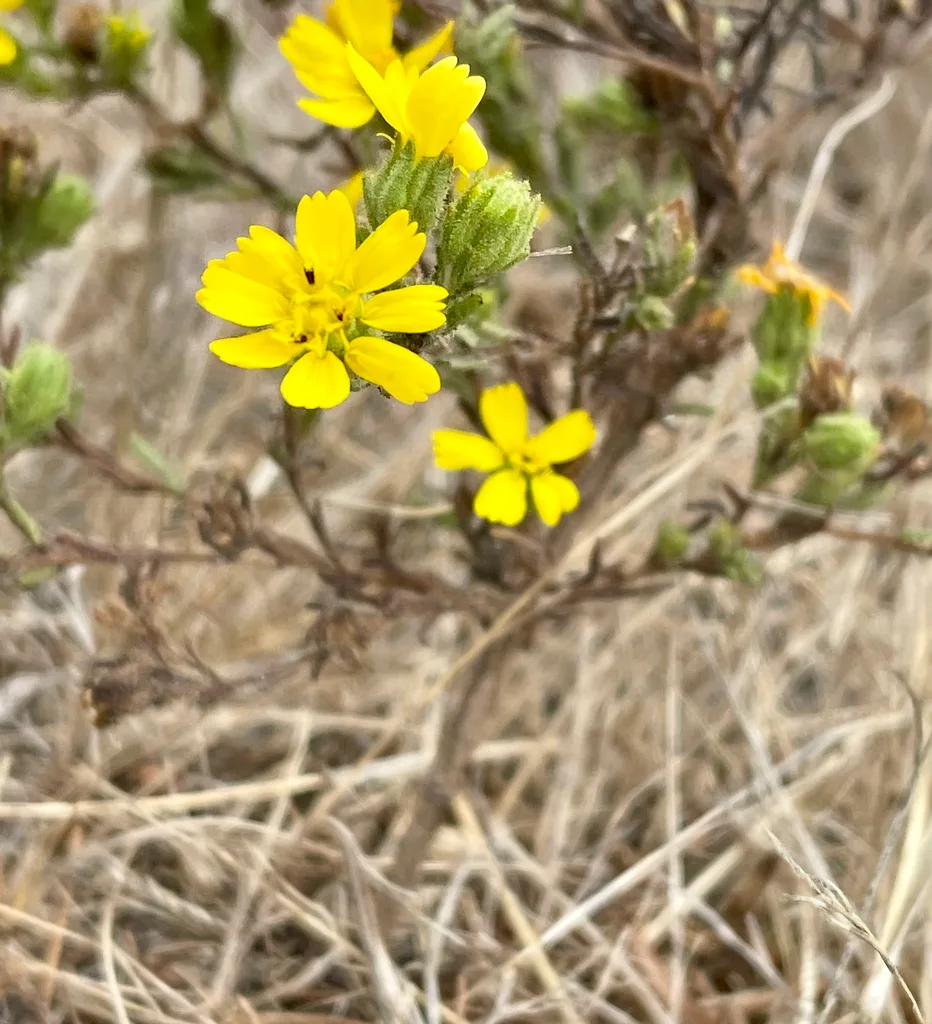
Image source: iNaturalist / Irene
How Bud Stage Predicts Your Bloom Timeline
Once a sunflower bud is visible on the stem, you're roughly 7 to 14 days from full bloom. That window varies by variety, temperature, and sunlight, but it's consistent enough to plan around.
Giant varieties like 'Mammoth' or 'Russian Giant' tend to take the full 14 days from first visible swelling to open flower. Their buds are larger at emergence, sometimes 5 cm across before any color change, and they need more time to develop the full complement of ray and disc florets. Mid-size cut-flower varieties like 'ProCut' or 'Sunrich' often move faster, opening in 8 to 10 days.
Temperature is the biggest variable. At consistent daytime temps of 24 to 28°C (75 to 82°F), development tracks on the faster end of the range. If daytime highs drop below 18°C (65°F), add 3 to 5 days.
Sustained heat above 35°C (95°F) can compress the timeline but often produces smaller, less uniform blooms.
Here's a rough guide:
| Variety Type | Bud Visible to Bloom | Typical Bud Diameter at Emergence |
|---|---|---|
| Giant (3m+) | 12 to 18 days | 4 to 7 cm |
| Mid-size (1.5 to 2.5m) | 8 to 14 days | 2 to 5 cm |
| Dwarf (under 1m) | 6 to 10 days | 1.5 to 3 cm |
| Branching multi-head | 7 to 12 days per bud | 2 to 4 cm |
If you're growing for cut flowers, timing matters. The ideal harvest point is when the ray florets have just started to lift away from the disc but haven't fully flattened. That's usually 2 to 3 days after the bud first shows yellow.
Cut too early and the flower won't open properly in the vase. Cut too late and you'll have a shorter display life.
What Affects Bud Size, Color, and Development Speed
Bud size isn't random. It's a direct reflection of the plant's genetics and the conditions it's growing in. You can't turn a dwarf variety into a giant, but you can make sure the plant reaches its full potential.
Genetics set the ceiling. A 'Teddy Bear' sunflower will never produce a 30 cm head. A 'Mammoth' grown in poor soil might only hit 25 cm instead of its potential 40 cm.
Know what you're working with before you start troubleshooting.
Soil nutrition is the next biggest factor. Sunflowers are heavy feeders, especially on nitrogen during vegetative growth and phosphorus and potassium once bud formation starts. A soil test before planting is worth the effort.
Phosphorus deficiency specifically leads to smaller buds and delayed bloom. Boron deficiency, while less common, is a direct cause of bud blast.
Water needs to be consistent during bud development. The stem is channeling a lot of moisture into that swelling head. Drought stress at this stage produces small, misshapen buds that may not open fully.
Aim for about 2.5 cm of water per week, either from rain or supplemental irrigation. Avoid overhead watering once the bud forms, since wet phyllaries invite fungal issues.
Sunlight is non-negotiable. Sunflowers need 6 to 8 hours of direct sun minimum. Less than that and the bud will be smaller, the stem weaker, and the bloom delayed.
Plants grown in partial shade often produce buds that lean heavily toward the light source and open unevenly.
Plant spacing matters more than people think. Crowded sunflowers compete for light, water, and nutrients. For giant varieties, 60 cm between plants is the minimum.
For mid-size types, 30 to 45 cm. Tight spacing produces spindly stems and underdeveloped buds.
Step-by-Step: Checking Your Sunflower Buds the Right Way
Regular inspection catches problems early, when they're still fixable. Here's a simple routine you can follow once buds appear.
Step 1: Visual scan from a distance. Walk past your sunflowers daily and look for anything obviously wrong. A drooping head, discoloration, or a bud that's significantly smaller than its neighbors all warrant a closer look.
Step 2: Check the phyllaries. Gently feel the outer bracts. They should be firm and dry. Any softness, stickiness, or unusual color needs investigation.
Look for tiny holes or webbing that would indicate insect activity.
Step 3: Inspect the peduncle. The stem just below the bud should be thick and upright. If it's bending, thinning, or showing lesions, the structural support is compromised. Stake it before the bud gets heavier.
Step 4: Monitor growth rate. A healthy bud should be visibly larger week over week. If growth stalls for more than 5 to 7 days without an obvious weather cause, check soil moisture and nutrient levels.
Step 5: Look inside (if needed). If you suspect a problem you can't see from outside, carefully peel back one or two phyllaries. This is destructive, so only do it on a bud you're already concerned about. Healthy tissue inside is pale green and tightly packed.
Brown, hollow, or slimy tissue means rot or insect damage.
Step 6: Record what you see. Even a quick photo on your phone each week gives you a visual timeline. It's the easiest way to spot slow changes you'd otherwise miss.
This same kind of systematic inspection works for any garden plant. If you've ever dealt with planting Bermuda grass in Arizona or similar hot-climate growing challenges, you know that regular monitoring is the difference between catching a problem early and losing a whole section.
Single-Head vs. Branching Varieties: How Bud Patterns Differ
Not all sunflowers put their energy into one bud. The number of buds per plant, and how they develop, depends entirely on the variety.
Single-stem varieties like 'Mammoth Grey Stripe' or 'Sunforest Mix' produce one terminal bud at the top of the main stalk. All the plant's reproductive energy goes into that single head. The result is a large, uniform bloom.
These are the types grown for competition-size heads and for seed production.
Branching varieties like 'Autumn Beauty', 'Italian White', or 'Sundance Kid' produce multiple buds across several lateral branches. The terminal bud usually opens first, followed by secondary buds at leaf axils down the stem. This gives you a longer bloom period, sometimes 4 to 6 weeks of successive flowers, but each individual head is smaller.
There's a middle ground too. Some varieties are classified as "multi-branching with a dominant head." They produce a large terminal bud and several smaller side buds. If you pinch off the side buds early, you can redirect energy to the main head.
If you leave them, you get a bushier plant with more but smaller flowers.
Here's how the two types compare:
| Trait | Single-Stem | Branching |
|---|---|---|
| Number of buds per plant | 1 | 5 to 20+ |
| Typical head diameter | 15 to 40 cm | 5 to 15 cm |
| Bloom duration | 1 to 2 weeks | 4 to 6 weeks |
| Best for | Seed harvest, show flowers | Cut flowers, garden display |
| Response to pinching | Not applicable | Side buds can be removed for larger main head |
If you're growing for cut flowers, branching varieties are usually the better choice. You get a steady supply of stems over a longer window. For seed saving or growing a single impressive head, go single-stem and give it plenty of space and nutrients.
Mistakes to Avoid When Monitoring Sunflower Buds
Even experienced growers make these errors. Here are the most common ones.
Mistake 1: Confusing natural heliotropism with wilting. A bud that droops during the hottest part of the day but perks up by evening is tracking the sun, not dying. Check the recovery pattern before panicking.
Mistake 2: Overwatering once the bud forms. The plant needs consistent moisture, but soggy soil around the root zone invites root rot, which shows up as a sudden wilt in the bud. Let the top 2 cm of soil dry between waterings.
Mistake 3: Ignoring the stem. Everyone focuses on the bud itself, but the peduncle is the lifeline. A stem with lesions, cracks, or insect damage can't support the bud properly. Always inspect the full length.
Mistake 4: Waiting too long to stake. By the time the bud is heavy enough to bend the stem, you're already behind. Install stakes when the plant is half its mature height, not after it's top-heavy.
Mistake 5: Treating every discoloration as disease. Some color change is natural. Yellowing phyllary tips signal maturity, not infection. Learn the difference between aging and pathology before reaching for a fungicide.
Mistake 6: Crowding plants to fit more in. This is probably the single most common mistake. Crowded sunflowers produce weak stems, small buds, and are far more susceptible to fungal disease because of poor air circulation. Respect the spacing recommendations on the seed packet.
If you're managing a larger planting, the same principles that apply to what is the best fertilizer for Bermuda grass apply here: feed based on what the plant actually needs, not on a generic schedule. A soil test before planting eliminates most nutrient-related bud problems before they start.
When Buds Fail to Open: Causes and What to Do
A bud that forms but never opens is one of the most frustrating things to deal with. The technical term is bud blast, and it has a handful of causes.
Heat stress is the most common. When daytime temperatures stay above 35°C (95°F) for several days during bud development, the plant can abort the bloom. There's no fix once it's happened.
For future plantings, choose heat-tolerant varieties or time your sowing so buds develop during cooler weeks.
Boron deficiency is an underdiagnosed cause. Boron is a micronutrient that sunflowers need in small amounts for proper flower development. Deficiency symptoms include hollow stems, small buds, and buds that swell but never open.
A soil test will confirm it. If boron is low, a light application of borax (following package rates carefully) can correct it for the next planting.
Drought stress during the 2 weeks before expected bloom is another trigger. The bud forms, but the plant doesn't have enough water to push the florets open. Deep, consistent watering in the 10 days before anticipated bloom prevents this.
Insect damage inside the bud can also prevent opening. Sunflower moth larvae or sunflower seed maggots feed on developing florets and can destroy the internal structure without obvious external signs until it's too late. If you suspect insects, carefully open a suspect bud and look for larvae or tunneling.
If a bud has been sitting tight for more than 3 weeks with no change, it's not going to open. Remove it so the plant can redirect energy to any remaining buds or side shoots.
Expert Tips for Keeping Buds Healthy Through Bloom
A few practices make a real difference in bud quality and bloom success.
Feed at the right time. Switch from a nitrogen-heavy fertilizer to a balanced or phosphorus-rich formula once you see the first bud forming. Too much nitrogen at that stage pushes leaf growth at the expense of flower development.
Mulch around the base. A 5 to 8 cm layer of organic mulch keeps soil moisture consistent and reduces the need for frequent watering. It also prevents soil from splashing up onto the lower stem during rain, which can introduce fungal spores.
Protect from wind. A fully developed bud on a tall stem acts like a sail. In exposed locations, wind can snap the peduncle just before bloom. Plant near a fence or wall, or use a sturdy stake tied loosely to the stem.
Watch for birds. Some bird species will peck at developing buds, especially in areas where natural food sources are scarce. If you notice damage, netting or reflective tape can deter them.
Time your planting. For the most reliable bud development, plant so that the bud stage falls during your region's most stable weather window. In most temperate zones, that means sowing 8 to 10 weeks before your typical mid-summer heat.
Where to Find Visual References and Further Guidance
Seeing real examples of each bud stage is worth more than any description. Here are the best places to look.
iNaturalist has thousands of user-submitted sunflower photos tagged by growth stage. Search for Helianthus annuus and filter by phenology (bud, flower, fruit). You'll see the full range of normal and abnormal development across different varieties and climates.
University extension websites often have photo galleries of sunflower growth stages, particularly those in major sunflower-producing states like Kansas, North Dakota, and South Dakota. The National Sunflower Association also publishes grower resources with images.
The Royal Horticultural Society (rhs.org.uk) has detailed growing guides for sunflower cultivars, including bud development photos for many named varieties.
For peer-reviewed detail on sunflower reproductive development, search HortScience or Crop Science journals. They publish studies on everything from photoperiod response to nutrient effects on head formation.
Frequently Asked Questions
How long does it take for a sunflower bud to bloom?
Most sunflower buds open 7 to 14 days after they first become visible as a swelling at the stem tip. Giant varieties take longer, sometimes up to 18 days. Dwarf and cut-flower types can open in as few as 6 days under ideal conditions.
Why is my sunflower bud turning brown?
Browning that starts at the base and spreads outward is usually Sclerotinia rot or another fungal infection. Browning only at the phyllary tips is normal maturation. If the bud is soft or smells bad, remove it immediately to protect nearby plants.
Can a sunflower bud recover from drooping?
Yes, if the drooping is due to heat or mild water stress. The bud should perk up overnight or by early morning. If it stays limp for more than 48 hours, check for stem damage, root rot, or vascular disease.
Should I remove side buds on a sunflower?
It depends on your goal. Removing side buds on branching varieties directs more energy to the terminal head, producing a larger single flower. Leaving them gives you more blooms over a longer period but each one will be smaller.
What is the white stuff on my sunflower bud?
A white cottony growth is likely Sclerotinia mold. A white powdery coating is powdery mildew. Both are fungal issues.
Improve air circulation, avoid wetting the bud when watering, and treat with an appropriate fungicide if the infection is spreading.
Do all sunflowers have heliotropism in the bud stage?
Yes, most Helianthus annuus varieties track the sun during bud development. The behavior stops once the flower opens and the head becomes fixed, usually facing east. Some cultivated varieties bred for cut-flower production show reduced heliotropism.