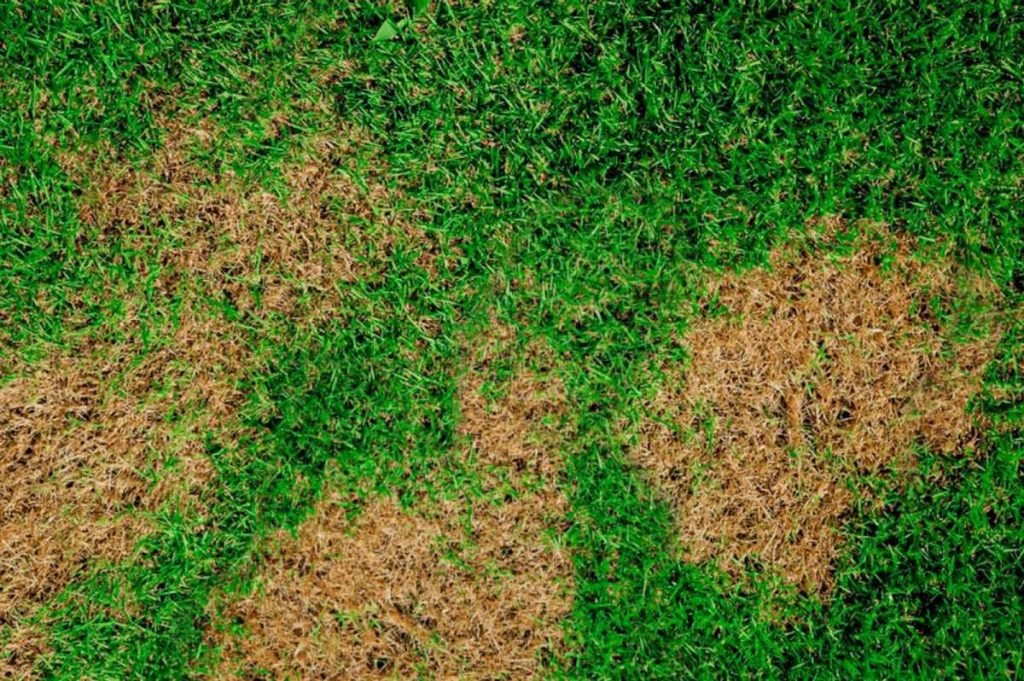
You've noticed brown patches spreading through your lawn, and watering isn't fixing them. You're probably wondering how to know if you have grubs, and you're right to be suspicious. Grub damage is one of those problems that looks like almost everything else until you actually check the soil.
The good news is there's a straightforward way to confirm whether those C-shaped larvae are behind your lawn troubles. I'll walk you through exactly what to look for above ground, how to inspect below the surface, and what the numbers actually mean once you start counting.
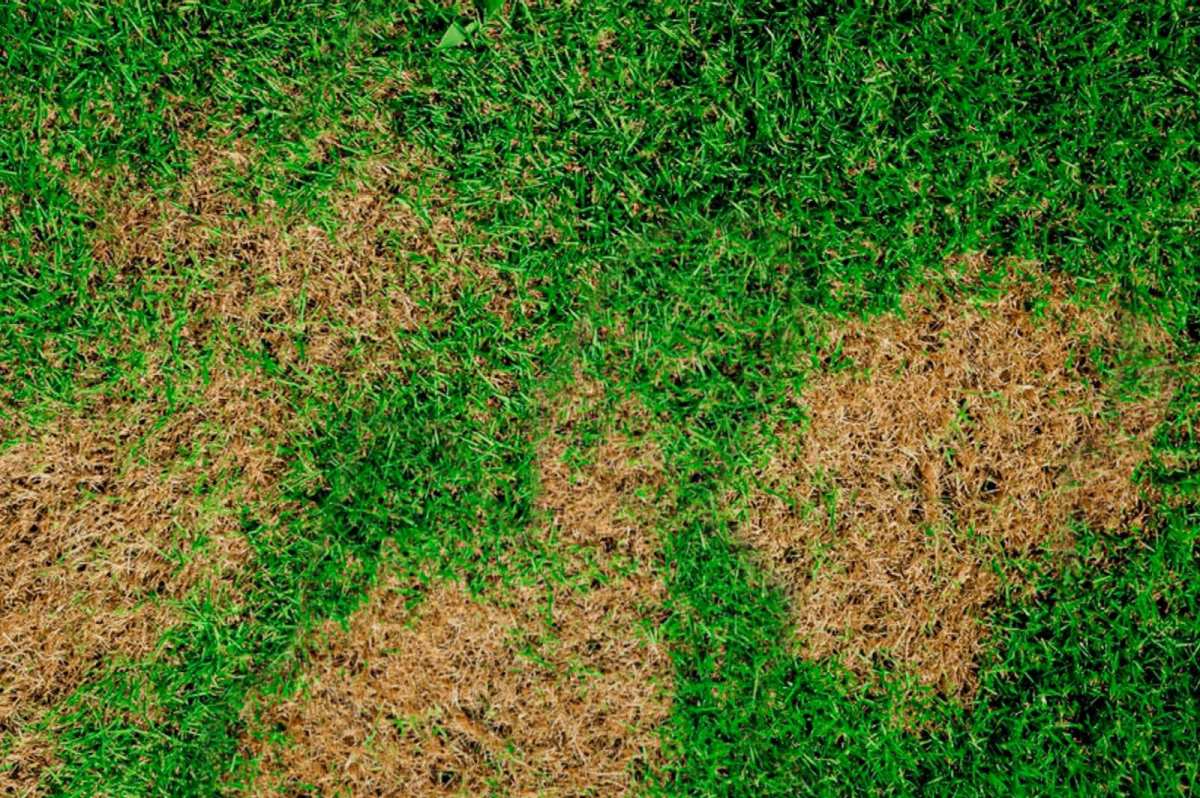
Image source: Bing (Web (fair-use with source credit))
Quick Answer
You have grubs if you find C-shaped, creamy-white larvae in the top 2 to 3 inches of soil under damaged turf. Cut a 1-square-foot section, peel it back, and count. More than 5 to 10 grubs per square foot in cool-season grass means you've crossed into treatment territory.
Spongy turf that lifts easily and animal digging are strong supporting clues.
The Signs That Point to Grubs — And How to Know for Sure
Grubs are the larval stage of scarab beetles, and they feed on turfgrass roots just below the soil surface. The adult beetles, Japanese beetles, European chafers, June bugs, and masked chafers, among others, lay eggs in your lawn during summer. Those eggs hatch into small larvae that start feeding on roots almost immediately.
By late summer and early fall, the damage they've been doing underground finally shows up above the surface.
Here's where it gets tricky. Grub damage doesn't announce itself clearly. It builds gradually, and the first visible sign is usually irregular brown patches that don't respond to watering.
People often assume they're dealing with drought stress, a fungal disease, or even dog urine spots. So the signs alone aren't proof. They're clues that point you toward the real test: getting your hands in the soil and counting what's down there.
There's a pattern to how grub damage unfolds, though, and recognizing it early gives you a real advantage. The patches start small and scattered. They don't follow irrigation lines or slope the way water-stress patterns do.
They feel spongy underfoot because the root system has been severed from the soil. And if you grab a handful of the brown grass and pull, it lifts away easily, almost like peeling back a carpet.
What Grub Damage Actually Looks Like in Your Lawn
Grub damage presents as irregular, roughly circular patches of brown or dying grass scattered across the lawn. Unlike the uniform browning you'd see during a dry spell, these patches are random and discontiguous. They might be near each other at first, but as grub populations grow, the patches merge into larger dead zones.
The key visual giveaway is that the dead grass doesn't just look dry. It looks disconnected from the ground. If you walk across the damaged area and your feet sink slightly or the turf feels loose and bouncy, that's a strong indicator the root system has been compromised.
Healthy turf anchors firmly. Grub-damaged turf doesn't.
Color progression matters too. At first, the grass takes on a dull, yellowish-green hue before turning straw-brown. This early stage is easy to miss if you're not looking closely.
By the time the patches are obviously dead, the grub population has been feeding for weeks, sometimes months. Early detection, which means inspecting as soon as you see off-color patches that don't improve with water, makes treatment far more effective.
Seasonal timing is another clue. Grub damage typically becomes visible from August through October in most temperate regions, though it can show up earlier in the South. If your lawn looked healthy in June and suddenly developed brown patches in late summer, grubs should be high on your suspect list.
Why Drought Stress and Disease Can Trick You Into Missing Grubs
This is the single biggest reason homeowners misdiagnose grub problems. Drought-stressed grass and grub-damaged grass look nearly identical from a distance. Both turn brown.
Both appear in patches. Both worsen during hot, dry weather, which is exactly when grub feeding peaks.
The difference is what happens when you water. Drought stress responds to irrigation within a few days. The grass greens up, the patches shrink, and the lawn recovers.
Grub damage doesn't respond to water at all because the roots are gone. You can run your sprinklers every morning and the patches will keep expanding.
Fungal diseases like brown patch and dollar spot can also mimic grub damage. Brown patch creates circular rings of dead grass with a darker border. Dollar spot produces smaller, silver-dollar-sized spots.
But fungal diseases usually show visible signs of the pathogen, like mycelium in the morning dew or distinct lesion patterns on individual grass blades. Grub damage has none of that. The grass just dies from the roots up.
Dog urine spots are another common lookalike. They're smaller, more concentrated, and often surrounded by a ring of dark green grass where the excess nitrogen fertilized the surrounding turf. Grub patches don't have that green halo.
The bottom line: if you've ruled out drought, disease, and pet damage, and the brown patches are still spreading, it's time to dig.
The Telltale Clues: Spongy Turf, Lifting Carpet, and Wildlife Digging
Before you grab a shovel, there are three above-ground signs that strongly suggest grubs are present. None of them alone is definitive, but together they build a compelling case.
Spongy or soft turf underfoot. Walk across the damaged areas. If the ground feels loose, bouncy, or like you're walking on a mattress, the root system has been severed. This happens because grubs chew through the fine feeder roots that anchor grass to the soil.
The turf is essentially sitting on top of the ground with nothing holding it down.
Turf that lifts away like carpet. Grab a corner of the brown grass and pull upward. If it peels back easily, revealing bare soil underneath, that's a near-certain sign of grub feeding. Healthy grass resists pulling because the roots grip the soil tightly.
Grub-damaged grass comes up with almost no effort.
Increased animal activity. Skunks, raccoons, birds, and armadillos all dig for grubs. If you notice patches of torn-up lawn, small cone-shaped holes, or sections of sod flipped overnight, animals are likely feeding on the grubs beneath. This secondary damage can be more destructive than the grubs themselves.
Raccoons in particular will roll back sections of turf to get at the larvae.
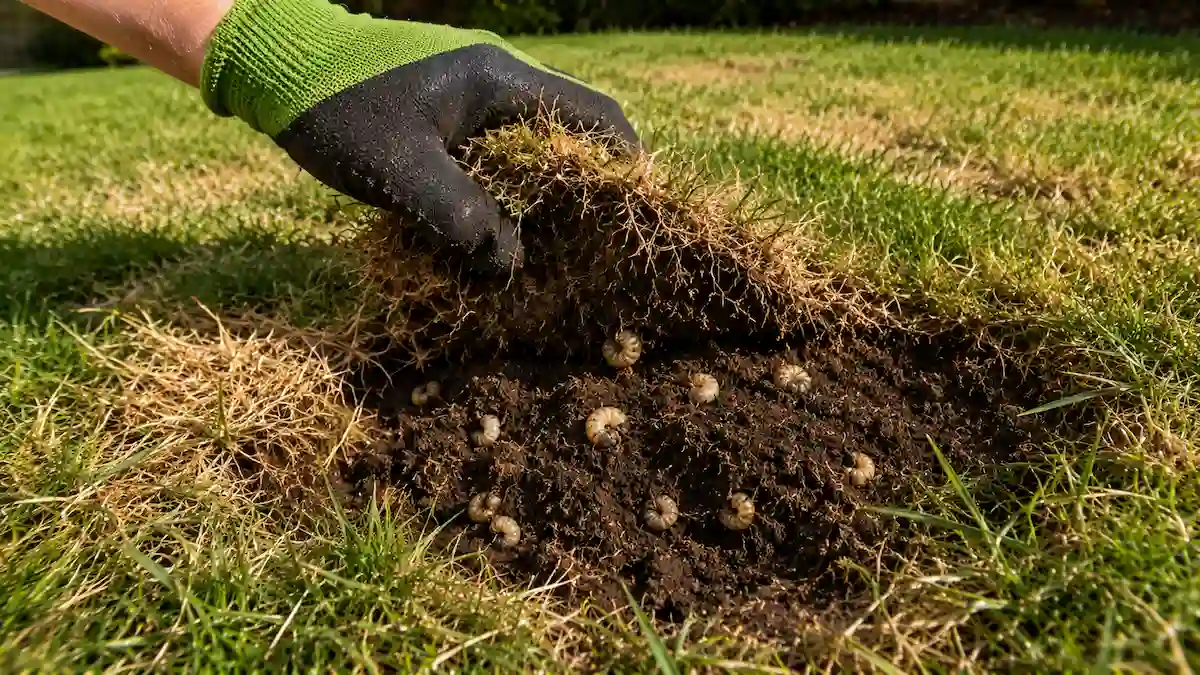
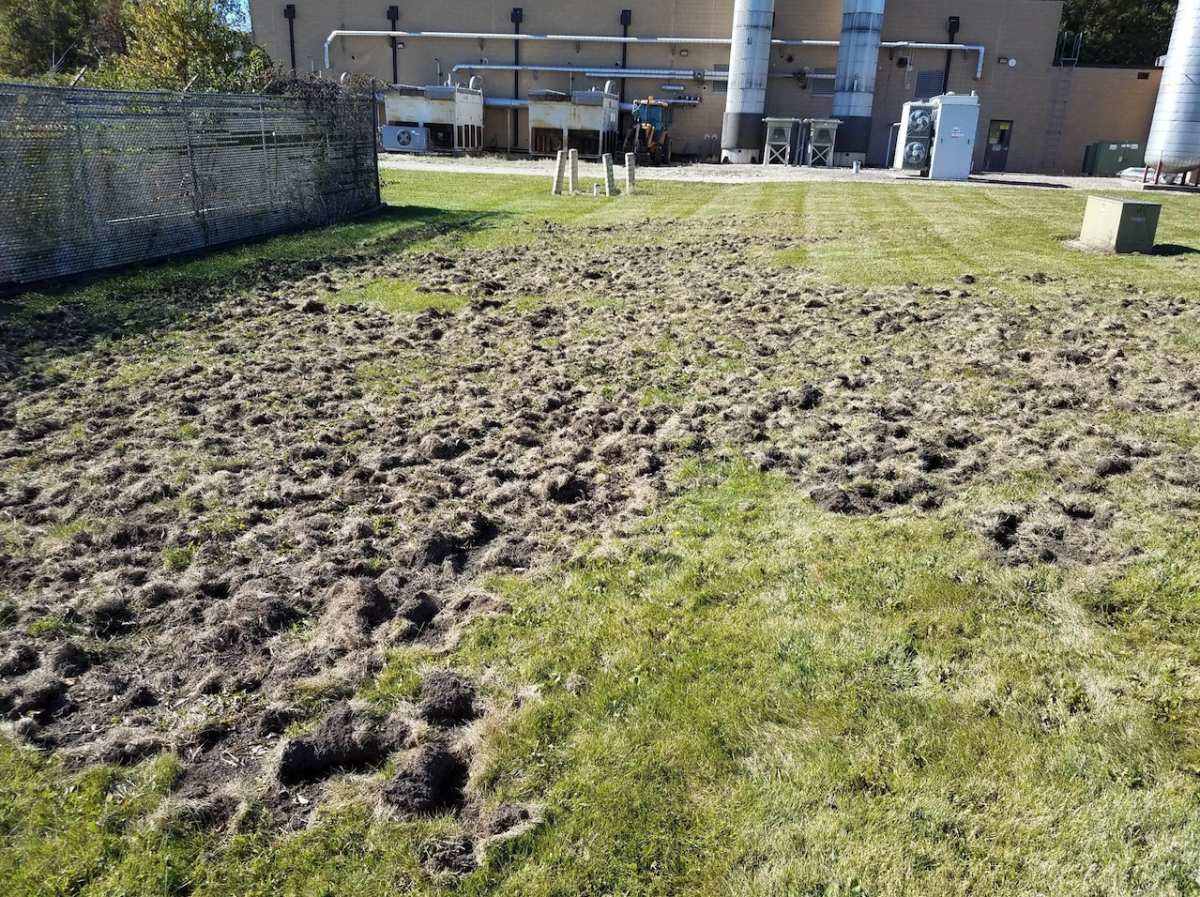
If you're seeing two or three of these signs together, the odds are high you have a grub infestation. But you still need to confirm by inspecting the soil. Guessing based on surface symptoms alone leads to wasted treatments and continued damage.
How to Test Your Lawn for Grubs (The 10-Minute Inspection)
This is the step that separates a confident diagnosis from a hunch. The process is simple, takes about 10 minutes, and requires nothing more than a flat shovel or spade.
Step 1: Choose your sample locations. Pick three to four spots in the damaged areas. If the damage is widespread, sample from different sections of the lawn. Avoid sampling right at the edge of a patch where healthy and damaged turf meet.
Go into the center of the affected zone.
Step 2: Cut a 1-square-foot section. Use your spade to cut a square about 1 foot by 1 foot, going about 2 to 3 inches deep. You're cutting through the turf and into the root zone. Don't dig a deep hole.
You just need the top layer where grubs feed.
Step 3: Peel back the turf. Fold the square of grass back like opening a book. The underside of the turf and the top of the soil are where you'll find the grubs.
Step 4: Count what you see. Look for C-shaped, creamy-white larvae with brown heads and three pairs of legs near the head. Count every grub you find in that square foot. Then check the soil underneath where the turf was.
Grubs often burrow slightly deeper when disturbed.
Step 5: Replace the turf. Press the square back into place and water it. It'll re-root within a week or two if the damage isn't too severe.
Step 6: Repeat at your other sample locations. Average the counts across all your samples. This gives you a more accurate picture than a single spot check.
The whole process is minimally invasive and gives you a definitive answer. No guesswork, no speculation. Just numbers you can act on.
What You'll Find Underground: Identifying White Grubs and Knowing the Count That Matters
When you peel back that square of turf, you're looking for larvae that are unmistakable once you know what to expect. White grubs have a characteristic C-shaped body, creamy white to grayish in color, with a distinct brown head capsule and three pairs of legs clustered near the front. They range from about a quarter inch long in early summer to over an inch by late fall, depending on the species and how long they've been feeding.
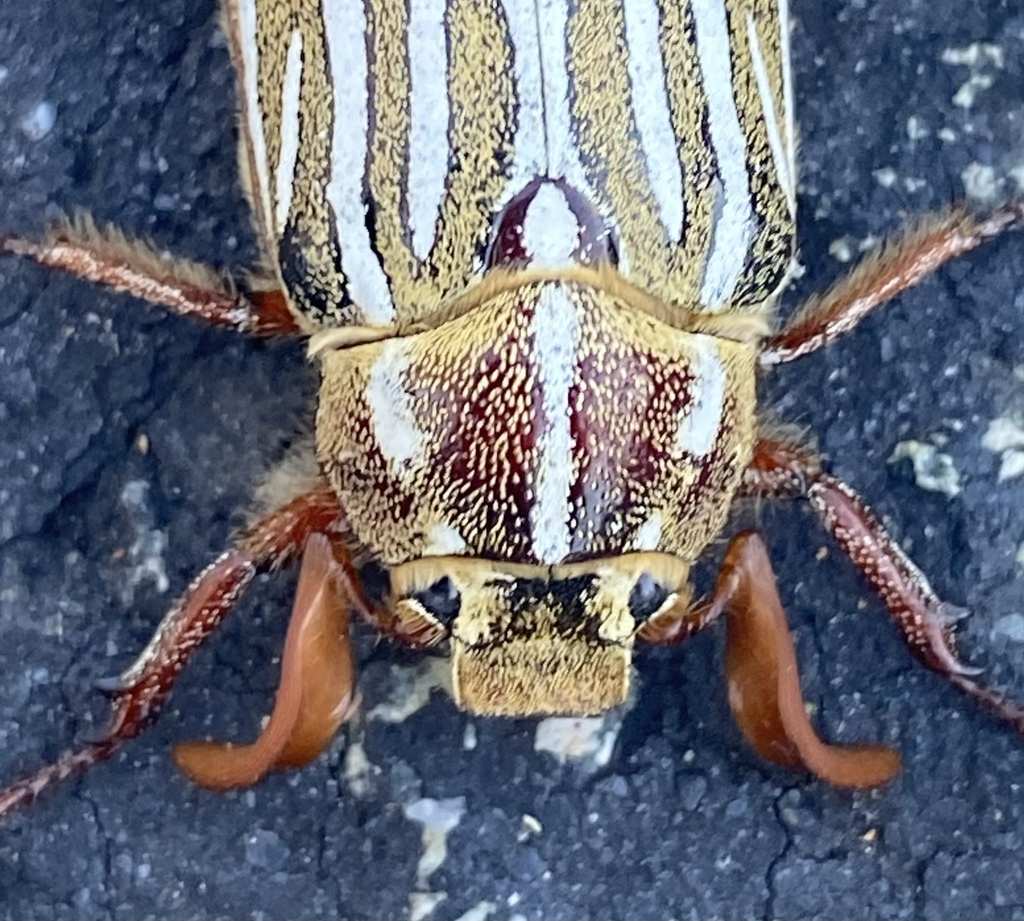
Not every white larva in your soil is a turf-damaging grub. Ground beetles and other beneficial insects can look similar at a glance. The key identifiers are the C-shape, the brown head, and the legs near the front end.
If it's legless, pale, and wormlike, it's probably an earthworm or a different insect larva entirely. Earthworms are beneficial and you should leave them alone.
Size gives you a rough idea of timing. Small grubs, under half an inch, are early-stage larvae that have recently hatched. These are the easiest to control with either chemical or biological treatments.
Large grubs, approaching an inch or more, are mature larvae that have been feeding for months. They've already done significant root damage and are harder to kill because they're nearing the pupation stage.
The species matters too, though you don't need to identify every grub down to the species level to make a treatment decision. Japanese beetle grubs, European chafer grubs, and masked chafer grubs are the most common lawn pests across the United States. If you want to get precise, entomologists use the raster pattern, which is the arrangement of hairs and spines on the grub's underside near the rear end.
University extension services publish identification guides with photos of these patterns for each species.
How Many Grubs Per Square Foot Means You Actually Have a Problem
Finding a few grubs doesn't automatically mean you need to treat. Healthy soil naturally contains some beetle larvae, and low populations don't cause visible damage. The question is whether the count crosses the threshold where feeding pressure exceeds the grass's ability to recover.
For cool-season grasses like Kentucky bluegrass, tall fescue, and perennial ryegrass, the widely accepted treatment threshold is 5 to 10 grubs per square foot. Below that range, the grass can typically outgrow the root damage with normal watering and fertilization. Above it, you'll see progressive browning and turf loss without intervention.
Warm-season grasses like Bermuda, St. Augustine, and Zoysia are more sensitive. Their thinner root systems and different growth patterns mean even 1 to 3 grubs per square foot can cause noticeable damage.
If you're growing warm-season turf, your tolerance for grubs should be lower.
Here's a quick reference:
| Grass Type | Treatment Threshold (grubs per sq ft) | Notes |
|---|---|---|
| Kentucky bluegrass | 5–10 | Tolerates moderate feeding |
| Tall fescue | 5–10 | Deep roots provide some buffer |
| Perennial ryegrass | 5–10 | Recovers well if damage is caught early |
| Bermuda grass | 1–3 | Thin roots, low tolerance |
| St. Augustine grass | 1–3 | Very sensitive to root loss |
| Zoysia grass | 2–4 | Slow to recover once damaged |
If your average count falls below the threshold for your grass type, you can monitor the situation without treating. If it's at or above the threshold, it's time to consider your control options.
Grub Species You're Most Likely Dealing With (And Why It Matters)
The species of grub in your lawn affects when they're most vulnerable to treatment and how much damage they can do. While you don't need a PhD to manage them, knowing which type you're dealing with helps you time your approach correctly.
Japanese beetle grubs are the most widespread lawn pest in the eastern and midwestern United States. The adult beetles are metallic green and copper, about half an inch long, and they feed on over 300 species of plants. The grubs are the real lawn threat, though.
They follow a one-year life cycle: eggs laid in July and August, heavy feeding in fall, downward migration to overwinter, then a second feeding period in spring before pupating in June.
European chafer grubs are common in the northeastern US and Great Lakes region. The adult beetles are tan or light brown, slightly smaller than Japanese beetles. Their grubs are particularly damaging because they feed later into the fall and earlier in the spring than other species, extending the window of root damage.
Masked chafer grubs are found across much of the US, especially in the transition zone where cool-season and warm-season grasses overlap. The adults are small, dull brown beetles that don't feed on plants, so you might never notice them. The grubs, however, can reach high populations and cause significant turf loss.
June beetle grubs are more common in the southern and western US. They're larger than other species, sometimes exceeding an inch and a half, and they have a longer life cycle, taking two to three years to mature. This means you can have multiple age classes feeding in your lawn at the same time.
The practical takeaway is that most of these species share a similar vulnerability window: late summer and early fall, when the grubs are small, actively feeding near the surface, and haven't yet burrowed deep for winter. That's your sweet spot for treatment.
When to Inspect and When to Treat — Timing Changes Everything
Timing is arguably the most important factor in grub management. Inspect at the wrong time and you'll miss them. Treat at the wrong time and you'll waste your effort.
The best window for inspection is August through October in most temperate regions. By August, eggs have hatched and the young grubs are feeding in the top few inches of soil, right where you can find them. They're small enough to count accurately but large enough to see without magnification.
If you wait until November, many species have already migrated below the frost line and your soil samples will come up empty even if grubs are present.
Spring inspection is less reliable. Grubs that overwintered deep in the soil move back up to the root zone in April and May, but they're large and close to pupation by then. They've already done most of their damage, and treatments are less effective against mature larvae.
Spring is better for assessing the damage that occurred the previous fall than for making treatment decisions.
For preventive treatment, the target window is June to July, before the adult beetles lay eggs. Products containing imidacloprid or chlorantraniliprole work best when applied during this period because they create a residual barrier in the soil that kills young grubs as they hatch. If you missed the preventive window, curative treatments in August and September using products with trichlorfon can still be effective against small, actively feeding grubs.
Biological controls like beneficial nematodes (Heterorhabditis bacteriophora) need to be applied when soil temperatures are above 60°F and the soil is moist. Late summer and early fall are ideal. Milky spore disease, which targets Japanese beetle grubs specifically, takes two to four years to establish in the soil, so it's a long-term strategy rather than a quick fix.
Other Pests and Problems That Mimic Grub Damage
Before you commit to a grub treatment, make sure you're not chasing the wrong culprit. Several other lawn problems produce symptoms that overlap with grub damage, and treating for grubs won't fix any of them.
Chinch bugs are tiny sap-sucking insects that cause irregular brown patches, primarily in St. Augustine grass and Kentucky bluegrass. Unlike grubs, chinch bugs feed on the above-ground portions of the grass, injecting toxins that cause the blades to wilt and die.
The damage often appears first in sunny, dry areas near driveways or sidewalks. You can confirm chinch bugs by pushing a coffee can with both ends cut out into the soil, filling it with water, and watching for bugs that float to the surface within 10 minutes.
Sod webworms are the larval stage of small, tan moths. They feed on grass blades at night, creating thin, brown patches that look like scalped turf. The key difference from grub damage is that webworm damage is above ground.
You'll see chewed blades and small green fecal pellets in the thatch layer. The turf doesn't lift away easily because the roots are intact.
Fungal diseases like brown patch, dollar spot, and Pythium blight create circular or irregular dead patches. Brown patch often shows a dark gray-purple border called a "smoke ring" in the early morning. Dollar spot produces small, distinct spots about the size of a silver dollar.
These diseases thrive in humid conditions and often respond to fungicides, not insecticides.
Fertilizer burn creates streaks or patches of dead grass that follow the pattern of your spreader. If you recently applied fertilizer and the damage appeared within days, over-application is the likely cause. The grass will eventually recover from the edges inward.
If you've inspected the soil and found no grubs, or the count is well below threshold, one of these other issues is probably responsible. Treating for grubs when the real problem is a fungal disease or chinch bugs wastes money and lets the actual problem get worse.
Should You Treat or Leave Them Alone? Making the Call With Real Numbers
Once you've got your grub count in hand, the decision comes down to a simple comparison: are the numbers above the treatment threshold for your grass type, and is the damage progressing?
If your count is below threshold and you're seeing only mild browning, hold off. Monitor the lawn through fall and into spring. Many lawns recover from light grub feeding with proper watering, fertilization, and overseeding in September.
Grub populations also fluctuate naturally from year to year, and a low count this season doesn't guarantee a problem next season.
If your count is at or above threshold, or if the damage is actively spreading, treatment makes sense. You've got two paths: preventive or curative. Preventive products containing chlorantraniliprole applied in June through July target newly hatched grubs before they cause significant damage.
Curative products with trichlorfon work in late summer but must be watered in immediately and have a short window of effectiveness.
Biological controls are worth considering if you prefer to avoid synthetic chemicals. Beneficial nematodes (Heterorhabditis bacteriophora) actively hunt and kill grubs in the soil. They need moist conditions and soil temperatures above 60°F, so late summer application is critical.
Milky spore (Paenibacillus popilliae) targets only Japanese beetle grubs and takes years to establish, making it a long-term investment rather than a quick solution.
The Biggest Mistakes Homeowners Make When Checking for Grubs
Most missteps come down to timing and assumptions. Inspecting too late in the season, after grubs have migrated deep, gives false negatives. Treating based on brown patches alone, without confirming grub presence, wastes money on the wrong product.
Applying preventive treatments in fall, when grubs are already large, misses the window entirely.
Another common error is sampling only one spot. Grub populations cluster unevenly across a lawn. A single square-foot sample might miss hot spots entirely.
Always sample three to four locations and average the counts.
Expert Tips for Accurate Grub Detection and Smart Next Steps
Water the lawn lightly the evening before you plan to inspect. Grubs move toward the surface in moist soil, making them easier to find. Count quickly and replace the sampled turf promptly to minimize root exposure.
Keep a simple log of counts by location and year. This builds a history that helps you spot trends and time treatments more precisely.
If animal damage is your first clue, address the grub problem first. Skunks and raccoons will keep returning as long as the food source remains.
Frequently Asked Questions
What time of year is best to check for grubs?
August through October in most regions. The grubs are small, actively feeding near the surface, and haven't yet migrated deep for winter.
Can my lawn recover from grub damage on its own?
Yes, if the grub count is below threshold and the grass has intact crowns and some remaining roots. Watering and fall overseeding help significantly.
How deep in the soil should I look for grubs?
Check the top 2 to 3 inches. That's where most feeding occurs during the active season.
Are all white grubs harmful to lawns?
No. A small number is normal and doesn't warrant treatment. Problems start when populations exceed the threshold for your grass type.
Do grub treatments harm earthworms and beneficial insects?
Some chemical products can affect non-target organisms. Beneficial nematodes and milky spore are more selective and pose minimal risk to earthworms and beneficials.