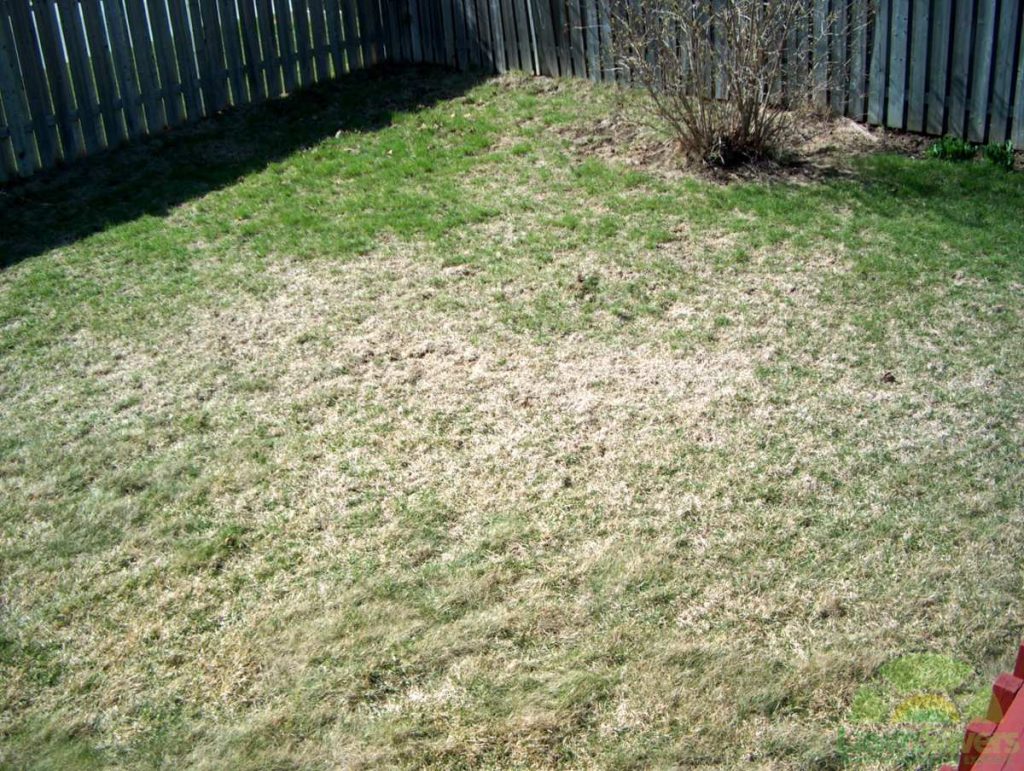

Figuring out how to get rid of grubs in your grass starts with one uncomfortable truth. You probably don't actually know what's killing your lawn right now. Brown patches, spongy turf, animals digging up your yard at night… these symptoms all point to grubs, but they also show up with fungal disease, drought stress, dog urine, and a handful of other lawn problems.
Jumping straight to treatment without confirming grubs are the culprit is how most people waste money on products that sit in the soil doing nothing useful.
In our research of grub management recommendations from university extension programs across the U.S., the single most emphasized step is always the same. Cut a square of sod, peel it back, and count what's underneath. The treatment threshold most extension specialists use is 6 to 10 white grubs per square foot.
Below that, you're usually fine. Above that, you've got a decision to make, and timing is everything once you confirm the problem.
Quick Answer
To get rid of grubs in your grass, confirm they're the problem first. Cut a 1-square-foot section of damaged turf and count the grubs underneath. If you find more than 6 to 10 per square foot, treat immediately.
Use a curative product containing trichlorfon or beneficial nematodes if it's late summer or early fall. If you're planning ahead for next year, apply a preventative product in mid-June to late July before new eggs hatch.
How to Tell If Grubs Are Actually Killing Your Lawn
Grub damage has a signature look once you know what to watch for. The turf feels spongy and loose underfoot because the larvae have chewed through the root system holding the sod in place. You can often roll a grub-damaged patch back like a carpet.
The grass turns a dull tan or brown in irregular patches, usually starting in sunny areas of the lawn first since those warm up faster.
But here's where homeowners go wrong. Drought stress, chinch bugs, fungal diseases like brown patch, and even buried construction debris can cause brown spots that look almost identical to grub damage. The only way to know for sure is physical confirmation.
Secondary pests make for another reliable clue. If skunks, raccoons, armadillos, or birds are tearing up your lawn overnight, they're after the grubs living just below the surface. Multiple animals converging on the same area is a strong indicator you've got a heavy grub population underground, even if the turf damage itself still looks mild.
The 60-Second Grub Confirm (Cut, Count, Decide)
Here's the step that separates effective treatment from guessing.
Grab a flat shovel or a sharp knife. Cut three sides of a square roughly 1 foot by 1 foot along the edge where healthy grass meets the damaged area. Peel back the sod carefully.
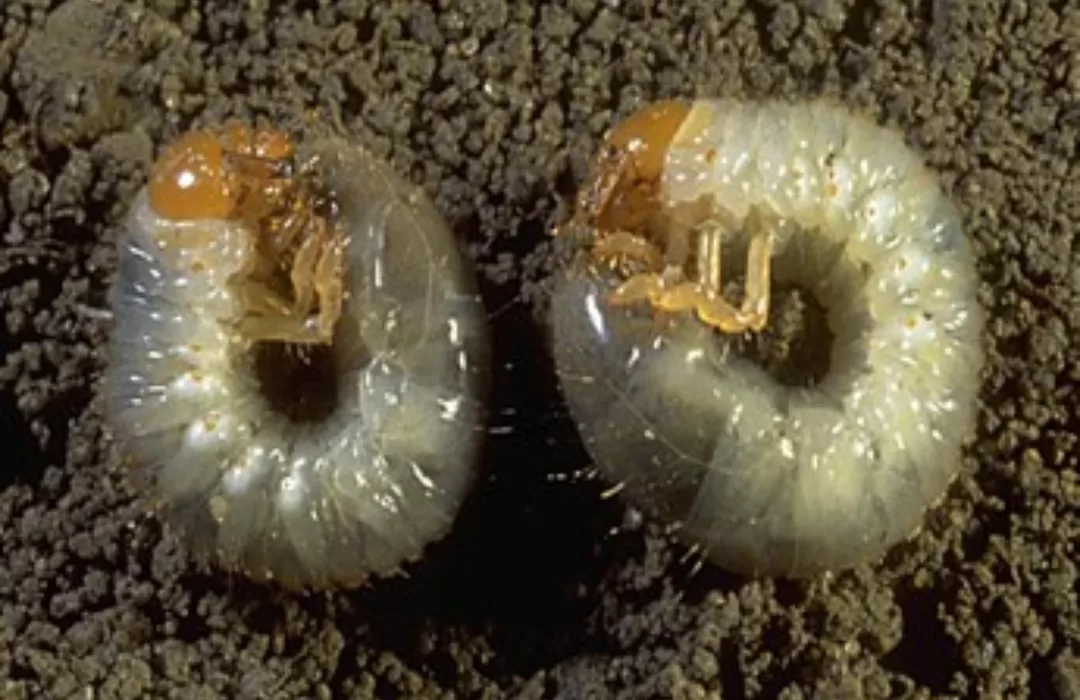
What you're looking for are C-shaped, creamy white larvae with brown heads and six legs near the front. They range from about a quarter inch to over an inch long depending on species and age.
Count every grub you find in that square foot. If you count fewer than six, your turf can usually outgrow the damage with normal watering and a light fertilizer application. Six to ten grubs per square foot means you're in the action zone.
Detecting 10 or more and you're looking at significant root destruction happening right now, with visible damage spreading fast.
If the first spot you check comes up empty, don't assume you're clear. Try another damaged patch, especially one closer to trees, fences, or garden beds since adult beetles often lay eggs near those features. Grub populations are rarely uniform across a lawn, so checking three or four representative spots gives you a realistic picture.
One more tip while you're down there. If the grubs are large, over an inch long, and you're checking in late August or September, they're mature. That changes which product you should reach for.
More on that in the timing section below.
When to Treat: The Timing Window That Makes or Breaks Results
This is the single most important decision in the entire grub treatment process. Apply the right product at the wrong time and you'll get almost zero control. University extension research consistently shows that proper timing matters more than which product you choose.
Grubs have a predictable life cycle that drives everything. Adult beetles emerge from the soil in early to mid-summer, mate, and lay eggs in moist turf. Those eggs hatch into small larvae within two to three weeks.
The larvae feed on grass roots through late summer and into fall, growing larger and deeper as soil temperatures drop. They overwinter deep below the frost line and move back up to the root zone in spring before pupating and emerging as adults to repeat the cycle.
The magic window targets that first few weeks after eggs hatch, when the larvae are young, small, and feeding right at the surface. That's when every treatment option works its best.
Preventative treatment (mid-June – late July depending on your region)
If you had grubs last year, or neighbors nearby are dealing with beetle activity, preventative treatment stops new larvae before they ever reach your roots. Products containing imidacloprid (often sold as Merit-based formulations), chlorantraniliprole (Acelepryn), or spinosad-based alternatives are designed for this window.
The exact timing shifts by region. In the northern U.S. and southern Canada, target late June through mid-July. In the southern states, you'll want to move earlier, often mid-June.
The goal is to have the product established in the soil just as adult beetles are laying eggs and larvae are hatching. State university extension soil temperature tracking tools are the most reliable way to pinpoint your local window.
Curative treatment (August – September)
If you're reading this in late summer and already seeing damage, you need a curative approach. The larvae are bigger now and harder to kill, so your product choice narrows. Trichlorfon (Dylox) is the go-to curative option because it acts fast against mature larvae.
Beneficial nematodes (specifically Heterorhabditis bacteriophora) also work as a curative treatment if you prefer a biological route, provided soil temperatures are still above 60°F.
Preventative products won't work well at this point. Imidacloprid and chlorantraniliprole target newly hatched, small larvae. Applying them to mature grubs in September is largely ineffective.
This is the most common mistake we see in homeowner grub control efforts. The right chemistry matched to the wrong life cycle stage gets you nowhere.
Chemical Options: Which Active Ingredient Fits Your Situation
Not all grub control products do the same thing. The active ingredient determines whether the product is preventative, curative, or somewhere in between. Here's how the main options break down.
| Product Type | Active Ingredient | Best Timing | Residual Control | Speed of Kill |
|---|---|---|---|---|
| Preventative | Imidacloprid (Merit) | Late June – mid-July | Full season (4+ months) | Slow (works as larvae feed) |
| Preventative | Chlorantraniliprole (Acelepryn) | Late June – mid-July | Full season (4+ months) | Slow (stops feeding, larvae die) |
| Preventative | Spinosad-based | Late June – mid-July | Varies by formulation | Moderate |
| Curative | Trichlorfon (Dylox) | August – September | Short (days to 1–2 weeks) | Fast (kills within 1–3 days) |
Imidacloprid (Merit / Grub Killer Plus — long-residual preventative)
Imidacloprid is a neonicotinoid that works systemically. Larvae ingest it while feeding on treated roots and die. It's the most widely used preventative grub treatment for residential lawns and delivers reliable full-season control with a single application.
State regulations vary, and many municipalities now restrict neonicotinoid use due to pollinator concerns. Check your local rules before purchasing. Apply it with a broadcast spreader, water it in thoroughly, and you're set for the season.
Chlorantraniliprole (Acelepryn — bee-friendly preventative)
Chlorantraniliprole works similarly to imidacloprid as a preventative but with a significantly lower toxicity profile for bees and other pollinators. For homeowners in areas with neonicotinoid restrictions, this is usually the best alternative. It provides the same full-season residual control and covers other lawn pests like sod webworms and armyworms at the same time.
The downside is availability. It's more commonly sold through professional lawn care suppliers and may be harder to find on store shelves compared to imidacloprid-based products.
Trichlorfon (Dylox / Bayer Grub Killer — fast-acting curative)
When you need grubs dead in a matter of days, trichlorfon is the answer. It's the only widely available curative chemical that reliably kills large, mature white grubs. You apply it when you've confirmed active damage in late summer or early fall, water it in, and expect results within 48 to 72 hours.
It doesn't have long residual activity, which is fine. You're not trying to protect the lawn through winter. You're trying to stop the current feeding damage before the larvae head deep for cold season.
One application is usually enough unless your infestation is extreme.
Spinosad (spinosad-based merit alternatives)
Spinosad-based products offer another preventative option that's derived from a soil bacterium rather than synthetic chemistry. They're approved for organic lawn care under the USDA National Organic Program. They work well against young larvae when timed correctly but may require more precise application and watering to get them into the root zone effectively.

How to Apply Grub Control Products So They Actually Work
Buying the right product is half the job. How you put it on the lawn determines whether it actually reaches the grubs or just sits on top of the soil doing nothing. Manufacturer labels give specific instructions, but there are a few universal steps that every application depends on.
Start with mowing your lawn a day or two before application. Grass that's been freshly cut allows granules to reach the soil surface instead of getting trapped in tall blades. Remove any thatch layer thicker than half an inch first since dense thatch acts like a sponge and prevents the product from reaching the root zone where grubs feed.
Use a broadcast spreader for granular products. Drop spreaders work too but require more passes and overlapping patterns to get even coverage. Calibrate the spreader according to the product label's rate per square foot.
Most labels specify something like 2.5 to 3 pounds per 1,000 square feet, but the exact rate varies by formulation. Uneven coverage creates pockets of untreated turf where grubs survive and repopulate.
Watering in after application is the step people skip most often, and it's the one that kills your results most reliably. Granular grub control needs about a quarter to half inch of water to dissolve the granules and carry the active ingredient down to the root zone. If rain isn't in the forecast, run sprinklers for 20 to 30 minutes after spreading.
Liquid formulations applied with a hose-end sprayer also need watering in to push the material past the thatch layer.
One important note on product storage. Biological controls like beneficial nematodes are living organisms. Keep them refrigerated until application day and use them quickly after opening.
Exposing them to heat or letting them sit on a garage shelf for weeks before using them will kill the nematodes before they ever hit the soil.
Common Mistake: Treating at the Wrong Time
This bears repeating because it's the single biggest reason grub control fails for homeowners.
Applying a preventative product like imidacloprid or chlorantraniliprole in September when you're already seeing damage is too late. Those products target newly hatched larvae first thing after egg hatch in early summer. By September, grubs are mature and much harder to kill with that chemistry.
You've spent money and effort for almost zero result.
The reverse mistake is just as common. Applying a fast-acting curative product like trichlorfon in June wastes the product's strength. You're killing a population that hasn't established yet, and the short residual means the product breaks down before the main hatch period even arrives.
Then the larvae that do hatch in late July and August feed completely unchecked.
Here's the simple decision rule. If you're asking the question right now, in summer, and you haven't confirmed grubs yet, put a reminder in your calendar for late August to check. If you're asking in August or September and you're finding grubs, reach for a curative product immediately.
If you're planning ahead for next year, mark early June on your calendar and apply a preventative when adult beetles start flying in your area.
Some homeowners go the extra mile and contact a local university extension office to ask when adult Japanese beetle or European chafer activity peaks in their county. Those regional beetle flight timings shift by a few weeks depending on latitude and elevation, and fine-tuning your schedule to match can push success rates well beyond what a generic date range delivers.
After the Kill: Repairing Grub-Damaged Lawn Areas
Killing the grubs is step one. Getting your lawn back to looking like a lawn is step two, and plenty of people forget it.
Damaged areas won't recover on their own once the root system is destroyed. The turf is already dead, and grass won't regrow from roots that aren't there. The fix is straightforward.
Remove the dead sod, loosen the soil underneath about an inch deep, add a thin layer of compost or topsoil if the ground is compacted, then reseed or lay new sod.
Early fall is the best time for reseeding in most regions. Cooler air temperatures and warm soil create ideal germination conditions for cool-season grasses like Kentucky bluegrass, perennial ryegrass, and tall fescue. Warm-season grasses like Bermuda and zoysia should be repaired in late spring instead.
Keep the repaired areas consistently moist for the first two to three weeks. Seeds need constant surface moisture to germinate, so light watering twice a day for short durations works better than one heavy soak. Once the new grass reaches mowing height, you can taper back to a normal watering schedule.
Fertilize lightly about four to six weeks after germination with a starter fertilizer that's higher in phosphorus to encourage root development. Then get back on your normal lawn feeding schedule the following season.

When to Skip Treatment Entirely
Not every brown patch needs a chemical response. If your grub count comes back below six per square foot, your lawn can almost always outgrow the damage with basic maintenance.
Deep, infrequent watering encourages grass roots to grow deeper into the soil where grub feeding is lighter. Light, frequent watering keeps roots shallow and makes any grub presence more damaging. Adjusting your irrigation schedule alone often turns a struggling lawn around without any product applied at all.
A moderate application of nitrogen-rich fertilizer in the active growing season can push new root growth fast enough to offset mild grub feeding. The key word is moderate. Over-fertilizing to compensate for grub damage burns the grass and can create a whole new set of problems.
There's also a biological reality worth knowing. A low-level grub population supports a healthy soil ecosystem. Spiders, ground beetles, and predatory wasps all feed on grubs as part of the natural food web.
Maintaining a small population of grubs actually sustains predators that help suppress future outbreaks. Zero tolerance is neither practical nor necessary for a healthy lawn.
DIY vs. Hiring a Pro: What's the Right Call
Most homeowners can handle grub control themselves. The products are available at garden centers, the tools are simple, and the application process isn't technically complicated. Costs typically run between fifteen and forty dollars per 1,000 square feet for a DIY granular preventative application, depending on the product you choose.
Professional lawn care services charge more, usually between one hundred and three hundred dollars for a standard residential treatment, but they bring calibrated equipment, professional-grade products, and the experience to spot problems you might miss. Some pros have access to chlorantraniliprole formulations that aren't sold at retail.
A pro makes sense when the infestation is widespread, when you're seeing damage across multiple zones of the lawn, or when you've tried DIY and the grubs came back year after year. Professionals can also perform a more thorough inspection and identify species-specific patterns that change which product and timing they recommend.
DIY makes sense for spot treating a few hundred square feet of damaged turf, for homeowners comfortable with basic lawn maintenance, or when budget is the primary concern. The products available at stores are effective when applied at the right time. The difference between pro and residential products is often more about concentration and label restrictions than about fundamental effectiveness.
Year-Round Grub Management Calendar for Your Region
A simple seasonal calendar keeps you ahead of the problem instead of reacting to damage after it shows up.
Late spring (May to early June): Watch for adult beetle activity. Japanese beetles, European chafers, and May beetles start emerging and laying eggs in moist soil. This is your cue to plan preventative treatment.
Mid to late June: Apply preventative grub control if you had issues last year or if adult beetles are active in your area. Water it in thoroughly within 24 hours.
July: Monitor lawn health. If you applied preventative treatment, you should see minimal grub activity. If you skipped treatment, this is your last window to apply before eggs hatch.
August: Check grub populations by cutting test squares in damaged areas. If counts exceed the threshold, apply a curative product immediately.
September to October: Continue curative treatment if needed. Begin repairing damaged areas by reseeding or sodding once grub activity stops.
November through April: No treatment needed. Grubs are deep underground and dormant. Use this time to plan next year's preventative strategy.
Safety and Environmental Considerations
Every chemical grub control product carries a label with specific safety instructions, and those labels are legally binding documents, not suggestions. Read them before you open the bag.
Keep children and pets off treated turf until the product has been watered in and the grass has dried. Most labels specify a waiting period, often 24 to 48 hours, before allowing foot traffic on the lawn. Granules left on the surface can stick to paws and shoes, so thorough watering in is both an effectiveness requirement and a safety step.
Neonicotinoid products like imidacloprid have drawn regulatory scrutiny due to their impact on pollinators. Several states and municipalities have restricted or banned residential neonicotinoid use as of 2026. Check with your state department of agriculture before purchasing.
Chlorantraniliprole and spinosad-based alternatives offer effective grub control with a lower pollinator risk profile.
Never apply grub control products near water features, storm drains, or areas where runoff could reach streams or ponds. The active ingredients in these products can be toxic to aquatic organisms at concentrations well below what's used in lawn treatment.
Frequently Asked Questions
How long does it take for grub control products to work?
Curative products like trichlorfon typically kill grubs within one to three days. Preventative products work more slowly since larvae die as they feed on treated roots, which can take one to two weeks. Biological controls like nematodes need three to seven days depending on soil temperature.
Can I apply grub control and fertilizer at the same time?
Yes, and many homeowners do exactly that. Some combination products pair grub preventative with fertilizer in a single application. If using separate products, apply the grub control first, water it in, then spread fertilizer a day later to avoid washing either product too deep too fast.
Will grub damage come back next year if I treat this year?
Not necessarily. A properly timed preventative application stops the current cycle. However, adult beetles can fly in from neighboring properties and lay new eggs each summer.
Annual monitoring is the only way to know whether you need to treat again.
Is milky spore a good option for all grub types?
No. Milky spore specifically targets Japanese beetle grubs and won't control European chafers, May beetles, or other common species. It also takes two to four years to build up enough population in the soil to be effective, so it's a long-term strategy, not a quick fix.
What's the best time of day to apply grub control products?
Early morning or late afternoon works best. Avoid applying during peak heat since granular products can stress already dry turf. Watering in is the critical step regardless of time of day, so pick a window where you can irrigate within a few hours after spreading.
Bottom-Line Recommendation Based on What You're Dealing With Right Now
If you're reading this in June or July and you had grubs before, apply a preventative product now. Chlorantraniliprole if you want the lowest environmental impact, imidacloprid if it's available in your area and you want proven long residual control.
If it's August or September and you're finding grubs, grab a curative product with trichlorfon and apply it this week. Water it in well, then plan to reseed any dead patches in early fall.
If you're finding fewer than six grubs per square foot, skip the chemicals. Adjust your watering, fertilize lightly, and let your lawn outgrow the damage. Check again next year before the adult beetles start flying.
The whole process comes down to three things. Confirm the problem, match the product to the right timing, and water it in. Get those three right and you'll solve the grub problem in a single season.