

Image source: Wikimedia Commons / Сарапулов (CC BY)
Most people don't realize they have grubs until the birds and skunks start tearing up the yard to get at them. Figuring out how to get rid of grubs in garden or lawn settings means understanding their life cycle and hitting them at the right stage, rather than spraying randomly when you finally notice the damage.
Our research into entomology extension resources and integrated pest management programs shows that timing and identification are absolutely critical to success. Applying a product in the wrong season wastes both effort and money.
Quick Answer
How do you get rid of grubs in a garden? Count the grubs per square foot to confirm a real problem. Then apply treatments during the window when feeding is active.
Use biological methods like beneficial nematodes in late summer. Always water the lawn after applying granular products.
Why You're Seeing Grubs in Your Lawn Right Now
Grubs are the larval stage of several species of scarab beetles that lay eggs in the soil of lawns and turf areas. The eggs hatch into larvae that immediately begin feeding on grassroots, and this underground feeding is what causes the visible damage above.
They're most active during periods when soil moisture is adequate and temperatures are warm but not extreme. That's typically late spring through early summer for egg laying, and late summer through early fall for the most damaging feeding period.
The beetles are attracted to healthy, well-watered lawns for egg laying. Ironically, a lawn that's been well maintained becomes a prime target.
What Grubs Actually Are and Why They Show Up
White grubs is the common name for the larvae of multiple beetle species, including the Japanese beetle, the European chafer, the May or June bug, and a few others. They're typically C-shaped, white to cream-colored, with six distinct legs near the head and a brown head capsule.
Different species have slightly different life cycles, but most follow the same basic pattern in US and UK climates.
Here's the annual grub cycle:
| Stage | Timing | What's Happening |
|---|---|---|
| Adult beetles emerge | Late spring to mated summer | Beetles fly, feed on ornamental plants, lay eggs in soil |
| Eggs hatch | Mid to late summer | First instar grubs begin feeding on fine root hairs |
| Peak feeding period | Late summer through fall | Grubs grow rapidly, devour larger roots, cause visible damage |
| Overwintering | Late fall through winter | Grubs burrow deep into soil below the frost line |
| Return to root zone | Early to mid spring | Grubs resume light feeding before pupating |
| Pupation | Late spring | Grubs transform into adult beetles in soil |
The most destructive phase is late summer through fall, when grubs are large and feeding aggressively to store energy for winter. This is also the window where most visible turf damage appears.
A few grubs living in your lawn won't cause trouble. Healthy turf can handle minor feeding without showing symptoms. The problem shows up when populations exceed what the root system can tolerate.
How to Tell If Grubs Are the Real Problem
Before treating, confirm that grubs are genuinely the cause of the damage you're seeing. Many lawn problems get misdiagnosed as grub damage.
The square-foot count method
This is the standard assessment technique recommended by most university extension programs. Here's how to do it:
- Choose a spot where damaged turf meets healthy turf. That boundary zone tends to show active feeding.
- Cut a square of turf about 12 inches on each side, going down about 3 inches into the soil.
- Peel back the turf flap and examine the soil and root zone. Count every grub you see.
- Replace the turf flap and water it back into place.
- Repeat this in three or five different lawn areas for a realistic average.
The general treatment thresholds that researchers identify:
- One to five grubs per square foot → Keep monitoring. Most lawns tolerate this without visible damage and no treatment is needed.
- Six to ten grubs per square foot → You're in a gray zone. Treat if you're seeing visible damage or if you had a problem last year.
- Ten or more grubs per square foot → Treat. You'll see thinning, yellowing, and turf that pulls up easily.
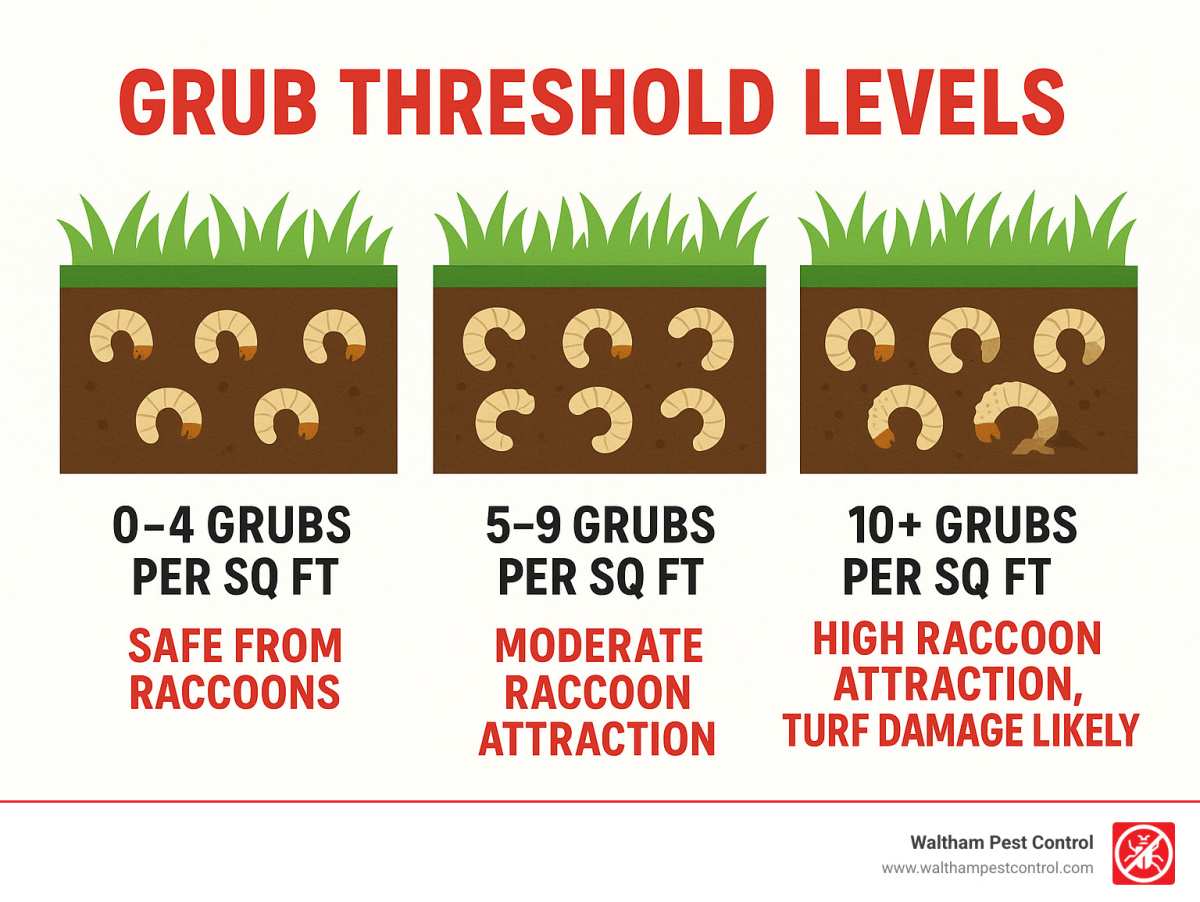
Image source: Bing (Web (fair-use with source credit))
Grub damage vs. other common lawn problems
Grub damage has a few distinctive features that help separate it from other issues:
- The roll-back test. Grub-damaged turf lifts away from the soil almost like a carpet. The roots have been severed, so there's nothing holding it down. Drought-stressed or diseased turf stays firmly rooted.
- Irregular, spreading patches. Grub damage tends to start in scattered spots and expand outward. It rarely appears in perfect circles or geometric patterns.
- Timing of appearance. Grub damage typically shows up in late summer and fall, or in spring as the lawn greens up unevenly. Summer drought stress appears during the hottest, driest weeks.
- Animal activity. Skunks, raccoons, and crows digging small cone-shaped holes or peeling back turf sections are often the first real sign of a grub problem. They're after the larvae.
If your lawn is browning in a pattern that doesn't match these characteristics, consider other causes like fungal disease, compacted soil, irrigation problems, or pet urine damage before spending money on grub control.
The Single Factor That Changes of Treatment
The single most important factor in successful grub control is when you treat. Get the timing right and even modest products work well. Get it wrong and even the best products fail.
Late summer to early fall: the curative window
This is the prime treatment window for most situations. Here's why it works so well:
- Grubs are small, recently hatched, and feeding near the soil surface.
- They haven't yet burrowed deep for winter, so surface-applied products reach them.
- They're actively feeding, so they ingest treated soil and plant material.
- The damage they're causing is still repairable before winter sets in.
The ideal curative treatment window runs from roughly late July through mid-September in most temperate regions. This can shift earlier in warmer southern climates and later in cooler northern areas.
Products that work well during this window include trichlorfon-based insecticides for fast knockdown, and beneficial nematodes for a biological approach. Both need to reach the grubs in the upper soil layer, which is why this timing is so effective.
Spring treatment: why it usually disappoints
Many homeowners see damaged lawns in spring and rush to treat. This almost never works well, and here's why:
By spring, the grubs from the previous year have already done their damage and are preparing to pupate. They've stopped feeding or are feeding very lightly. Insecticides work best on actively feeding larvae, so a spring application hits them when they're least vulnerable.
The grubs you find in spring are also large and mature, making them harder to kill than the small, tender larvae of late summer. You'd need a stronger product at a higher rate to get the same kill percentage.
The better spring strategy: Assess the damage, overseed thin patches, and plan to treat preventively the following summer. Mark the areas that were hit hardest so you know where to focus next year.
Early summer: the preventive window
If you had grubs last year, a preventive application in early summer can stop the next generation before it starts. Products containing chlorantraniliprole, the active ingredient in Scotts GrubEx and similar formulations, are designed for this purpose.
The preventive approach works by creating a treated zone in the soil that kills young grubs as soon as they hatch and begin feeding. It doesn't need to kill large, mature grubs because it's applied before they exist.
The preventive window typically runs from mid-May through early July, depending on your region and when adult beetles are laying eggs. Check with your local cooperative extension service for timing specific to your area.

Image source: Bing (Web (fair-use with source credit))
How to Choose the Right Grub Treatment
Not every grub problem calls for the same solution. The right choice depends on your timing, your tolerance for synthetic chemicals, the severity of the infestation, and whether you have pets or children using the lawn.
Biological and organic options
Beneficial nematodes are microscopic roundworms that seek out grubs in the soil and enter their bodies. Once inside, they release bacteria that kill the grub within 24 to 48 hours. The species Heterorhabditis bacteriophora is the one most commonly used for grub control.
Nematodes work best when soil temperatures are above 60°F and the soil is consistently moist. They're a good fit for late summer applications in moderate infestations. They're also safe around pets, children, and beneficial insects.
The downside is that nematodes are living organisms. They can die if they're stored improperly, exposed to heat, or applied in direct sunlight. They need to be mixed and applied in the evening, and the lawn needs to be kept moist for at least two weeks after application.
Milky spore is a bacterial disease that specifically targets Japanese beetle grubs. The product contains spores of Paenibacillus popilliae, which germinate inside the grub and kill it. It's applied to the soil and builds up over multiple years.
Milky spore is a long-term solution, not a quick fix. It can take two to four years to establish fully in the soil. It also only works on Japanese beetle grubs, so if your problem is European chafers or another species, it won't help.
Neem oil is a natural extract from the neem tree that disrupts insect feeding and hormone function. It has some grub-suppressing activity but isn't strong enough to eliminate a serious infestation on its own. It works best as a supplemental treatment or for very light pressure situations.
Synthetic chemical options
Chlorantraniliprole is the active ingredient in several preventive grub control products, including Scotts GrubEx. It works by affecting the grub's muscle function, causing it to stop feeding and die. It's classified as a reduced-risk insecticide by the US Environmental Protection Agency and has low toxicity to mammals, birds, and bees.
This is a preventive product. Apply it in early summer before grubs hatch. It won't rescue a lawn that's already being destroyed by large grubs in September.
Trichlorfon, sold under the brand name Dylox,ative insecticide that works on contact and by ingestion. It kills grubs quickly, including larger, more mature larvae that preventive products can't touch. It's the go-to choice for late summer curative treatments when you've confirmed a serious infestation.
Trichlorfon has higher toxicity than chlorantraniliprole. Keep pets and children off the treated lawn until the product has been watered in and the grass has dried, following the specific label directions.
Side-by-side comparison
| Treatment | Type | Best Timing | Speed of Kill | Pet Safety | Long-Term Prevention |
|---|---|---|---|---|---|
| Beneficial nematodes | Biological | Late summer | 2-3 days | Excellent | Moderate (seasonal) |
| Milky spore | Biological | Spring through fall | Weeks | Excellent | High (after 2-4 years) |
| Neem oil | Organic | Late summer | Slow | Excellent | Low |
| Chlorantraniliprole | Synthetic preventive | Early summer | Days (stops feeding) | Very good | High (seasonal) |
| Trichlorfon (Dylox) | Synthetic curative | Late summer | 1-3 days | Good (after dry) | Low (single application) |
How to Apply Grub Products the Right Way
Even the best product fails if it's applied incorrectly. Most grub control failures come down to application mistakes rather than product ineffectiveness.
Granular insecticide application
Granular products like chlorantraniliprole-based preventives and some curative formulations are applied with a broadcast spreader or drop spreader.
Here's the correct sequence:
- Mow the lawn first. Short grass lets the granules reach the soil surface instead of getting trapped in tall grass blades.
- Water the lawn lightly about a day before application if the soil is very grubs closer to the surface and activates their feeding.
- Calibrate your spreader to the rate specified on the product label. Too little product won't control the grubs. Too much wastes money and increases environmental load.
- Apply evenly using a broadcast spreader for large lawns or a drop spreader for smaller areas. Overlap your passes slightly to avoid streaks.
- Water immediately after application. This is the step most people skip or do incorrectly. The granules need to be washed off the grass blades and into the top inch of soil where grubs are feeding. Apply about a quarter to half inch of water.
- Keep foot traffic off the lawn until the grass has dried completely.
Beneficial nematode application
Nematodes require more care than chemical products because they're living organisms.
- Buy from a reputable supplier and check the expiration date. Nematodes stored at room temperature or exposed to heat may already be dead.
- Refrigerate immediately if you're not applying them the same day.
- Mix the nematodes with cool, non-chlorinated water according to package directions. Chlorine kills them, so if your tap water is heavily chlorinated, let it sit out for a few hours first or use collected rainwater.
- Apply in the evening or on an overcast day. UV light from direct sunlight kills nematodes within minutes.
- Water the lawn before application so the soil is already moist.
- Apply with a sprayer or watering can, keeping the mixture stirred constantly so the nematodes stay suspended in the water.
- Water again after application to wash the nematodes into the soil.
- Keep the soil moist for at least 10 to 14 days after application. Light daily watering is better than one heavy soaking.

Image source: Bing (Web (fair-use with source credit))
Liquid treatment application
Liquid insecticides and neem oil products are applied with a hose-end sprayer or pump sprayer.
- Dilute according to label directions. More concentrated is not better.
- Apply evenly across the affected area, extending a few feet beyond the visible damage since grubs spread outward.
- Water lightly after application to move the product into the root zone.
- Avoid applying before heavy rain, which washes the product away before it can penetrate.
What to Do After Treatment
Killing the grubs is only half the job. The damaged turf still needs attention, and the lawn needs support to recover.
Assessing treatment success
With curative treatments like trichlorfon, you should see grubs dying within a few days. They'll turn from creamy white to yellowish or brown. If you're using nematodes, the grubs may turn reddish or brown as the bacteria multiply inside them.
About a week after treatment, you can do another square-foot count in the treated area to see if the population has dropped below the damage threshold.
Repairing grub-damaged turf
Damaged areas won't recover on their own if the root system has been severely compromised. Here's how to repair them:
- Rake out the dead, loose turf. Remove any grass that pulls up easily with no root attachment.
- Loosen the top inch of soil in the bare areas with a garden rake or hand cultivator.
- Apply grass seed appropriate for your region and lawn type. Cool-season grasses like tall fescue and Kentucky bluegrass are common in northern lawns. Warm-season grasses like Bermuda and zoysia dominate in the south.
- Cover the seed with a thin layer of compost or topsoil, about a quarter inch. This protects the seed and improves germination.
- Keep the area consistently moist until the new grass is established. Light watering once or twice a day works better than one heavy soaking.
- Avoid foot traffic on the repaired areas for at least three to four weeks.
Fall is the best time for overseeding cool-season lawns because soil temperatures are still warm enough for germination but air temperatures are cooler, reducing heat stress on young grass. Spring works too, but you'll be competing with weed pressure.
Long-term lawn practices that reduce grub vulnerability
A thick, healthy lawn tolerates minor grub feeding without showing symptoms. These practices build that resilience:
- Mow at the proper height. For most cool-season grasses, that's 3 to 3.5 inches. Taller grass develops deeper roots that can withstand some root feeding.
- Water deeply and infrequently. An inch of water once a week encourages deep rooting. Light daily sprinkles produce shallow roots that grubs can devastate.
- Aerate compacted areas. Compacted soil stresses grass and makes it more susceptible to grub damage. Core aeration in fall or spring improves root growth.
- Fertilize appropriately. A well-fed lawn grows faster and recovers from feeding damage more quickly. Soil test before fertil-applying.
How to Prevent Grubs from Returning
If you've had a significant grub problem once, there's a good chance it'll come back. Adult beetles are attracted to the same lawns year after year for egg laying.
Preventive treatment schedule
For lawns with a history of grub damage, an annual preventive application is the most reliable way to keep populations in check.
- Apply a chlorantraniliprole-based product in early summer, typically May through early July depending on your region.
- Reapply annually for at least two to three years to break the cycle.
- After that, you can monitor with square-foot counts each year and treat only when counts exceed the threshold.
Milky spore for long-term Japanese beetle control
If Japanese beetles are your primary problem, milky spore can provide lasting control once it's established. Apply it in late summer or early fall, and be patient. It takes time to build up in the soil, but once established, it can remain effective for 10 to 15 years.
Encouraging natural predators
Several organisms naturally suppress grub populations:
- Ground beetles prey on grubs and other soil-dwelling insects.
- Parasitic wasps lay eggs on or inside grubs.
- Birds like starlings, grackles, and robins feed on grubs they find near the surface.
You can't rely on natural predators alone to control a serious infestation, but avoiding broad-spectrum insecticides that kill beneficial organisms helps maintain this natural balance.
Mistakes That Make Grub Problems Worse
Some common errors turn a manageable grub problem into a recurring nightmare.
Treating without confirming the problem
Not every brown lawn has grubs. Applying insecticide to a lawn that's actually suffering from drought, disease, or nutrient deficiency wastes money and adds unnecessary chemicals to the environment. Always do a square-foot count first.
Treating at the wrong time
Spring applications of curative products are almost always wasted. The grubs are too large, too deep, and too close to pupation for the product to work effectively. Save your curative treatments for late summer when small, vulnerable grubs are feeding near the surface.
Skipping the post-application water-in
Granular products that sit on the grass surface without being watered in will not reach the grubs. The active ingredient needs to move into the top inch of soil. This is the single most common application failure.
Using the same product every year
Repeated use of the same active ingredient can lead to reduced effectiveness over time. Rotate between different product types, or alternate between preventive and curative approaches based on what the monitoring counts tell you.
Ignoring lawn health
A thin, stressed lawn shows grub damage at much lower populations than a thick, healthy one. Focusing only on killing grubs without addressing the underlying lawn health is like treating a symptom while ignoring the disease.
When It Might Be Worth Bringing In a Pro
Most grub problems are manageable with the right product and timing. But there are situations where professional help makes sense.
- Recurring severe infestations that don't respond to multiple treatment attempts may indicate a species or soil condition that requires professional identification and a customized approach.
- Large properties where calibration and even application across thousands of square feet is difficult with consumer-grade equipment.
- Situations where multiple pest problems overlap, such as grubs combined with fungal disease or chinch bugs, requiring an integrated treatment plan.
- If you're uncomfortable using synthetic insecticides and want a professional assessment of biological and organic options.
Licensed lawn care professionals have access to commercial-grade products and application equipment that may provide more consistent results than consumer products. They can also identify grub species accurately, which matters for choosing the right treatment.
Quick Grub Decision Guide
Use this branching guide to figure out your next step based on your current situation.
If it's late July through September and you're seeing damage:
- Count grubs per square foot.
- If over 10 per square foot, apply a curative treatment like trichlorfon or beneficial nematodes.
- Water in thoroughly after application.
- Plan to overseed damaged areas in early fall.
If it's spring and you're seeing damage:
- The damage is from last year's grubs. They've already pupated.
- Don't treat for grubs now. It won't help.
- Overseed damaged areas and focus on lawn health.
- Plan a preventive application for early summer.
If you had grubs last year and want to prevent them this year:
- Apply a chlorantraniliprole-based preventive product in early summer.
- Water in after application.
- Monitor with square-foot counts in late summer to confirm effectiveness.
If you prefer organic methods and have moderate pressure:
- Apply beneficial nematodes in late summer when soil is warm and moist.
- Keep soil consistently moist for two weeks after application.
- Consider milky spore for long-term Japanese beetle control.
- Accept that organic methods may not eliminate every grub, but can keep populations below damaging levels.
If you're unsure whether grubs are the problem:
- Do the roll-back test. If turf lifts easily with no roots attached, grubs are likely involved.
- Do a square-foot count to confirm population size.
- Rule out drought, disease, and other causes before treating.
Frequently Asked Questions
What is the fastest way to kill grubs?
Trichlorfon-based products kill grubs within one to three days of application. They work best on small, actively feeding grubs in late summer. Apply in the evening and water in thoroughly for best results.
Can I treat grubs in the fall?
Yes, early fall is actually one of the best times to treat. Grubs are still feeding near the surface before they burrow deep for winter. Apply curative products by mid-September for the best results in most regions.
Are grub control products safe for pets?
Chlorantraniliprole-based products have low toxicity to mammals and are considered pet-safe once the treated area has been watered in and the grass has dried. Trichlorfon requires keeping pets off the lawn longer. Always read and follow the specific product label.
How long does it take for grub damage to heal?
Minor damage can recover in a few weeks with proper watering and fertilization. Severely damaged areas need overseeding and four to six weeks of growth before they fill in. Fall overseeding of cool-season lawns typically shows full recovery by the following spring.
Do I need to treat my entire lawn or just the damaged areas?
Grubs often cluster in patches, so spot-treating the damaged areas and a buffer zone around them can be effective. However, if counts are high across multiple sample sites, a full-lawn treatment gives more consistent results.
Will grubs come back after treatment?
They can, especially if adult beetles return to lay eggs the following summer. Annual preventive treatments for two to three years, combined with good lawn care practices, are the most reliable way to break the cycle.