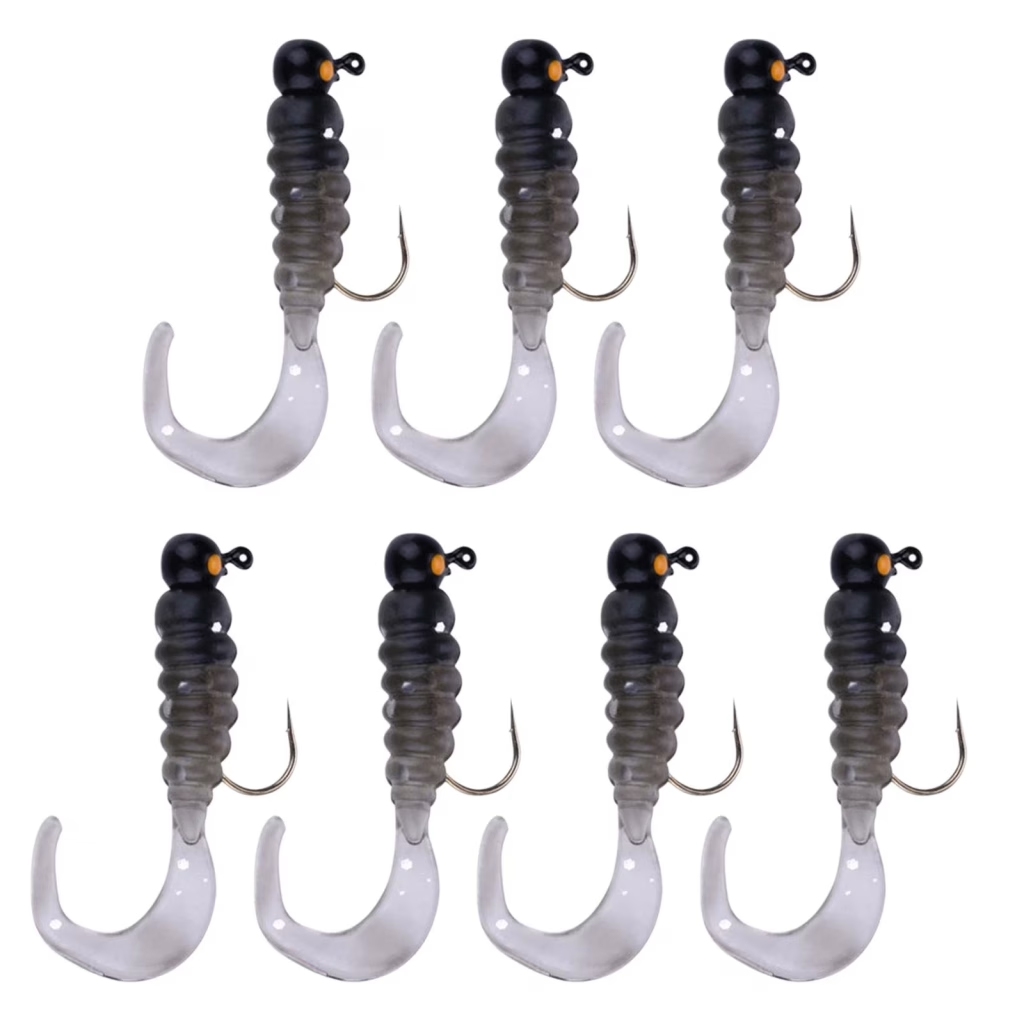
If you've ever watched someone else pull fish after fish on a simple soft plastic while you struggled with flashier lures, there's a good chance they were fishing a grub. Learning how to fish a grub is one of the most practical skills an angler can develop, and it doesn't require expensive gear or years of experience. It's a bait that works across species, seasons, and water types.
A soft plastic grub is a short, compact bait, usually between 2 and 5 inches long, with a curly or straight tail that kicks and pulses as it moves through the water. Paired with a jighead, it mimics everything from baitfish to leeches to crayfish. Manufacturer specifications from major brands like Zoom and Berkley indicate that a standard 4-inch curly tail grub on a 1/8 oz jighead falls at roughly 1 foot per second, which puts it in the strike zone quickly without spooking fish.
The real magic, though, is in understanding what's happening below the surface, and that's where most written guides fall short.
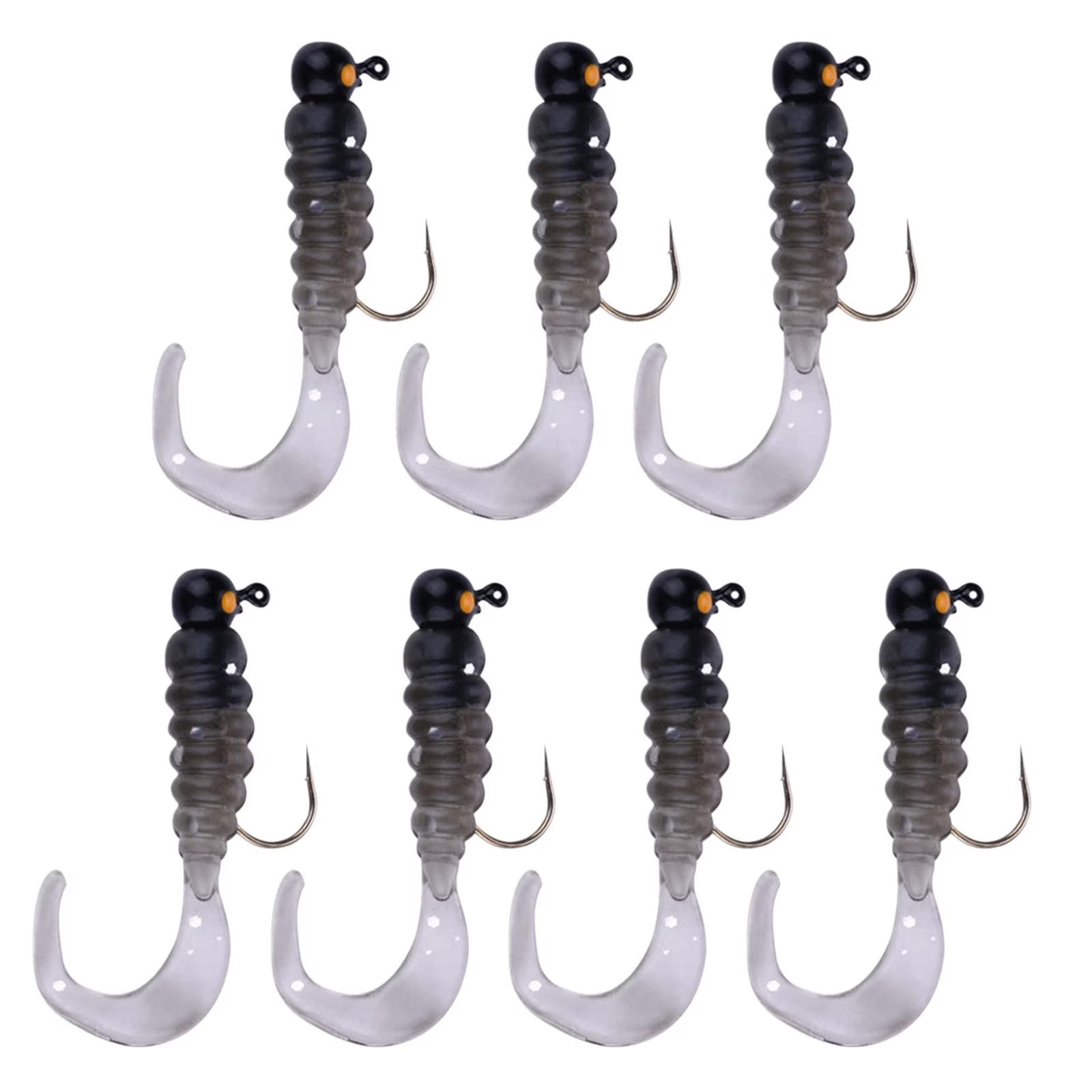
Image source: Bing (Web (fair-use with source credit))
Quick Answer
To fish a grub, thread a soft plastic curly tail grub onto a jighead so the body sits straight. Cast it out and let it fall on a semi-slack line. Watch your line for any tick or movement during the fall.
Once it hits bottom, use a slow drag or lift-and-drop retrieve. Pause between movements. Most strikes come on the fall or during the pause.
What a Grub Actually Is and Why It Works
A grub is a short soft plastic bait with a tail designed to displace water. The most common style is the curly tail grub, where the tail curls into a tight spiral. As water flows past that curled tail, it spins and kicks, creating vibration and a pressure wave that fish detect through their lateral line system.
That lateral line is key. Fish don't always see a grub clearly, especially in stained water. They feel it.
The curly tail's corkscrew action pushes a consistent pressure wave that says "food" to anything nearby. A straight tail grub produces a subtler action, more of a side-to-side glide, which can be better when fish are pressured or the water is very clear.
Grubs come in a range of sizes. A 2-inch grub is a finesse presentation for panfish and small bass. A 3-inch or 4-inch grub is the all-around sweet spot.
A 5-inch or larger grub starts to imitate a bigger forage profile, like a shad or a large leech, and draws reaction strikes from larger predators.
The body itself is usually a simple tube or slightly tapered shape. Some have ribbed or segmented bodies that add extra water displacement. Others are smooth.
The material is typically a PVC-based soft plastic, and many manufacturers add salt or scent to the mix. That salt makes the bait sink a little faster and encourages fish to hold on longer once they bite.
The Visual Side of Grub Fishing Most Guides Skip
Here's where this topic really demands a visual understanding. Reading about a grub's action and actually seeing what it looks like underwater are two very different things. The way a curly tail spins on a slow lift, the way the body shudders on the pause, the way a fish inhales it without moving the line much at all.
These are things you need to see or feel to fully grasp.
When you watch a grub fall on a slack line, the tail kicks in a slow, wide spiral. Tighten the line slightly and the kick becomes faster and more compact. That difference in tail speed is what separates a bait that looks alive from one that looks like a piece of plastic drifting through the water.
The bite itself is often subtle. You might see your line jump slightly. You might feel a soft tick through the rod.
Sometimes the line just goes slack unexpectedly because a fish picked up the bait and swam toward you. These are visual and tactile cues that are hard to learn from text alone. If you can, fish with someone who's experienced with grubs the first few times out.
Watching how they read the line and set the hook will teach you more in an afternoon than a dozen articles.
Matching Your Grub and Jighead to the Situation
The jighead is half the presentation. Get the weight wrong and your grub either plummets past the fish or drifts above them without triggering a reaction.
Here's a practical breakdown of common pairings:
| Jighead Weight | Grub Size | Best For | Fall Rate (approx.) |
|---|---|---|---|
| 1/64 oz | 2" | Shallow panfish, calm water | Very slow |
| 1/32 oz | 2"–3" | Finesse bass, light current | Slow |
| 1/16 oz | 3" | General purpose, 4–8 ft depth | Moderate |
| 1/8 oz | 3"–4" | All-around bass, 8–15 ft depth | Moderate-fast |
| 1/4 oz | 4"–5" | Deep water, heavy current, windy days | Fast |
The shape of the jighead matters too. A standard ball jighead is the go-to for most grub fishing. It falls nose-first and stands up on bottom when it lands.
A stand-up jighead has a flat base that keeps the bait vertical on the bottom, which can be effective when you're dead-dragging across hard structure. An underspin jighead has a small blade above the hook that adds flash and vibration, useful in stained water or low-light conditions.
Hook size should match the grub body. For a 3-inch grub, a #2 or #1 hook works well. For a 4-inch or 5-inch grub, step up to a 1/0.
The hook point should exit the top third of the grub body, not the middle. If it exits too far back, the bait won't track straight and the tail action suffers.
Choosing the Right Grub Size, Color, and Tail Style
Size comes first. Match your grub to the forage in the water you're fishing. In most lakes and rivers, a 3-inch or 4-inch grub covers the majority of situations.
If you're targeting crappie or bluegill, drop to a 2-inch. If you're after big bass in water with large shad or bluegill, a 5-inch grub makes sense.
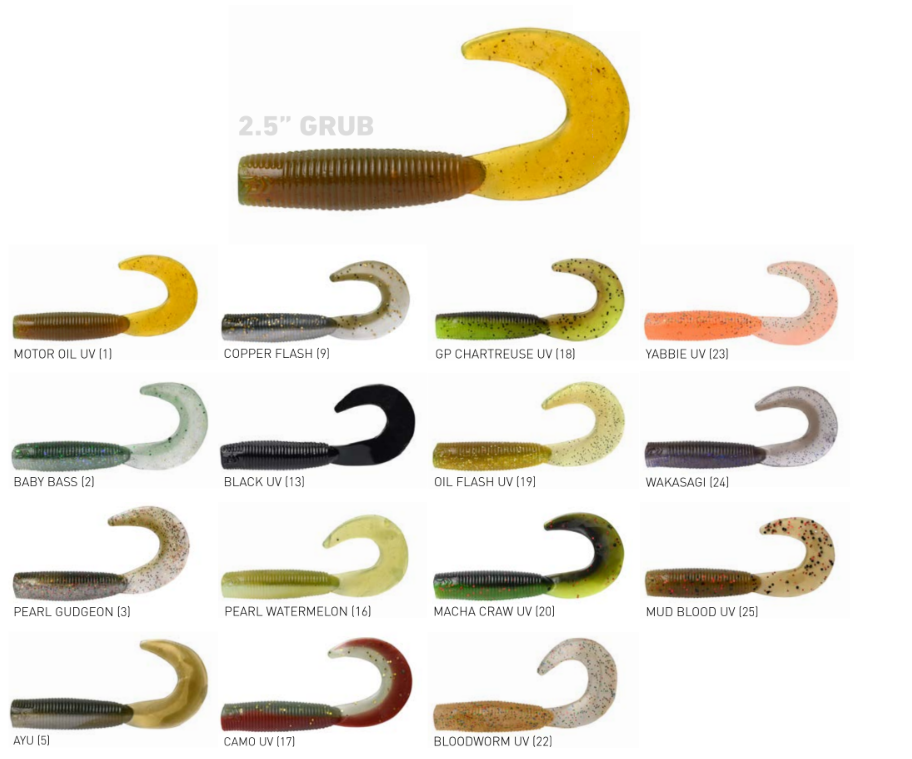
Color follows water clarity. In clear water, go natural. Smoke, watermelon, pumpkinseed, and translucent patterns work well because they look like real forage without standing out unnaturally.
In stained or muddy water, go darker or brighter. Solid black, chartreuse, and bright white create a silhouette or flash that fish can track more easily.
Tail style changes the action profile. A curly tail grub produces the most vibration and works well when fish are active or the water is off-color. A straight tail grub has a more subtle, gliding action that excels in clear water or when fish are pressured and wary.
A double-tail grub splits the difference, offering extra movement without the aggressive spin of a curly tail.
One practical note: keep your grubs in their original packaging and out of direct sunlight. Soft plastics dry out, crack, and lose their action over time, especially in heat. A pack left in a hot tackle bag for a summer will be noticeably stiffer and less effective by fall.
How to Rig a Grub on a Jighead the Right Way
Rigging a grub sounds simple, and it is, but doing it correctly makes a real difference in how the bait performs.
Start by holding the jighead so the hook point faces up. Insert the hook point into the nose of the grub and thread it straight through the body toward the tail. The key word is straight.
If the hook travels at an angle through the body, the grub will sit crooked on the jighead, and the tail won't kick properly.
Push the hook through until the jighead collar seats firmly against the grub's nose. The hook point should exit the top of the grub body, roughly one-third of the way back from the nose. Bend the grub slightly to check that the hook point is exposed and not buried in the plastic.
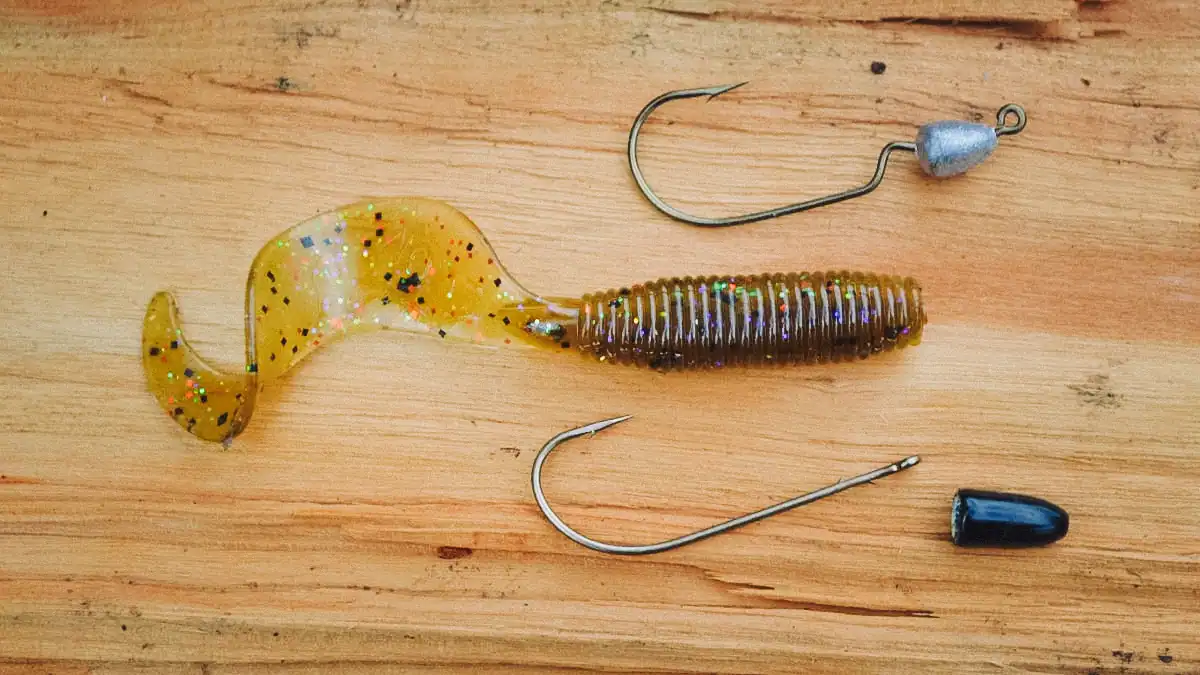
Check the alignment. Hold the rig up and look at it from the side. The grub body should run straight back from the jighead, not curve to one side.
If it's crooked, pull it off and re-rig. A straight body means the tail kicks evenly, which creates a consistent pressure wave that fish track more easily.
One common mistake is leaving too much hook shank exposed between the jighead and where the hook enters the grub body. That gap lets the grub slide back during the cast, which kills the action. Seat the grub firmly against the jighead collar every time.
If you're fishing heavy cover or targeting larger fish, you can add a small drop of super glue where the grub meets the jighead collar. It's not essential, but it keeps the bait seated longer, especially after multiple casts or a few fish.
Reading the Fall: What to Watch, Feel, and Listen For
The fall is where most grub bites happen, and it's the phase most beginners ignore completely. You cast, the bait sinks, and you start reeling immediately because you assume the fish only hit on the retrieve. That's usually wrong.
The majority of strikes come during that initial drop or right after the bait settles on the bottom.
Watch your line as the grub falls. If you see the line jump, twitch, or start moving sideways, a fish has picked it up. If the line goes slack when it should still be sinking, that's a bite too.
Positive line movement, slack line, or the line simply stopping before it should have hit bottom. All three mean a fish has the bait.
Feel matters just as much. Maintain a semi-slack line during the fall so you can detect subtle ticks through the rod tip. A light or extra-fast rod tip helps here because it transmits those small vibrations much better than a heavy rod.
If you feel anything that doesn't seem like the bait ticking along the bottom, reel down until you feel weight and set the hook.
Sound is the one nobody talks about. When fish are feeding aggressively, you can sometimes hear the strike through the rod and line, a faint tick or click that's distinct from the soft contact of the grub dragging across rocks or gravel. It takes time to learn that difference, but experienced grub anglers will tell you they set the hook on sound as often as sight or feel.
Core Retrieve Techniques (With What Each One Looks Like Underwater)
There are four retrieves that cover nearly every grub fishing situation. Each one produces a different underwater profile, and understanding what the bait looks like during each technique makes your presentation much more intentional.
Slow Roll. Reel just fast enough to keep the curly tail spinning while the grub stays near the bottom. The bait looks like a small creature swimming steadily along the floor. This works well in cool water when fish are lethargic but still feeding.
Keep the rod tip low, around the 10 o'clock position, and maintain steady contact with the bottom.
Lift and Drop. Reel in the slack, lift the rod tip to about 11 or 12 o'clock, then drop it back down as you reel up the slack. The grub rises off the bottom with a kicking tail, then flutters back down on a semi-slack line. This is the most effective retrieve for bass holding near structure because the fluttering fall triggers reaction strikes.
Most fish hit it on the drop, not the lift.
Drag and Pause. Pull the grub along the bottom with a slow sideways sweep of the rod, then pause for two to three seconds. The grub settles and the tail continues to pulsate in the water current. During the pause, watch your line closely.
This retrieve excels around hard bottoms, gravel points, and riprap banks where fish sit tight to structure.
Swim and Kill. Reel the grub at a moderate pace through the middle of the water column, then stop reeling and let it sink for a moment before resuming. The sudden change from active swimming to a helpless sink looks like an injured baitfish. This triggers strikes from fish that are suspended or cruising open water rather than hugging the bottom.
Where to Fish a Grub Around Structure, Weeds, and Open Water
Location determines whether you drag, swim, or dead-stick your grub. Different structures call for different presentations.
Weed edges. Drag the grub slowly along the outside edge of a weed bed. The transition from open water to vegetation is where predators wait to ambush forage. Keep the bait just above the weeds.
If you feel it hanging up, lift over the weed top and let it fall back down on the other side.
Docks and overhead cover. Skip the grub under docks by casting with a sidearm motion. Once under the structure, let it fall on a slack line. Bass often hold tight to dock pilings and eat within seconds of the bait entering their shade.
Fish it slowly, and expect the bite to come almost immediately after the drop.
Rocky points and riprap. Drag and pause along rocky structure. The grub clicking against rocks sounds like a crayfish scuttling along the bottom. Work the bait from shallow to deeper water, covering the entire depth range of the point.
Brush piles and laydowns. Pitch the grub directly into or next to the brush. Let it fall through the branches. Pause once it settles on the bottom of the brush pile.
This is a sight-fishing situation where you often see the fish take the bait as it drops through the limbs.
Open water flats. When fish are cruising shallow flats, swim the grub through the middle of the water column. Cover ground quickly but pause periodically. A cruising bass will often strike during the pause when the bait stops looking like it's trying to escape.
Seasonal Adjustments: How to Adapt to Temperature and Conditions
Water temperature drives everything about how you fish a grub. The bait stays the same, but your presentation should change dramatically across the seasons.
Spring. As water temperatures climb into the 50s and 60s, fish move shallow to feed before spawning. Fish grubs slowly along shallow flats, around emerging vegetation, and near spawning bays. A 3-inch or 4-inch grub on a 1/16 oz jighead works well in the 4-to-8-foot range.
Slow retrieves with long pauses are key because fish are active but not yet in full feeding mode.
Summer. Fish move deeper or hold tight to shade and cover during the hottest parts of the day. Fish grubs deeper, from 10 to 20 feet, using heavier jigheads like 1/8 oz or 1/4 oz. Early morning and evening are prime times to throw grubs shallow over spawning flats and feeding areas.
Fall. This is prime grub time. Baitfish are everywhere, and predators are feeding aggressively to prepare for winter. Cover water quickly with a swimming or slow-roll retrieve.
A 4-inch or 5-inch grub matches the larger forage profile that bass and walleye target in fall. Focus on points, creek channels, and anywhere baitfish are schooling.
Cold water and winter. Slow everything down. A 2-inch grub on a 1/32 oz jighead, dragged painfully slowly along the bottom, is often the only thing that produces bites when water temperatures drop below 50°F. Make long pauses.
Watch your line with intense focus. Bites in cold water feel like someone gently placed a feather on your line.
Wind matters too. A stiff breeze pushes your line bow, making it harder to detect bites during the fall. Use a slightly heavier jighead than you normally would for the depth.
The extra weight cuts through the bow and keeps your line more vertical, which improves bite detection.
Common Grub Fishing Mistakes That Kill Your Bite
Most grub fishing errors come down to speed and inattention. Fish the bait too fast and you miss the subtle bites that grub fishing depends on.
Retrieving too quickly. A grub's action comes from slow movement and pauses. If you're reeling at a steady pace without stopping, you're probably fishing too fast. The tail can't kick properly at high speed, and you're covering water without triggering strikes.
Ignoring the fall. Starting the retrieve before the bait hits bottom is the number one missed opportunity. The fall is where the majority of bites occur. Let it sink, watch your line, and keep it slack enough to detect a pick-up.
Wrong jighead weight. Too heavy and the bait falls past the strike zone before fish can react. Too light and it hangs above them or drifts in the current without staying in the zone. Match the weight to depth and current, and don't be afraid to switch mid-trip if conditions change.
Overlooking line management. Slack line gives you bite sensitivity but costs you hook-setting power. The balance is a semi-slack line, some bow but not a pile of loose line on the water. Reel down quickly before setting the hook so you're pulling on the fish, not on slack.
Not checking bait alignment. After every few casts or after catching a fish, check that the grub is still seated straight on the jighead. A twisted or slid-back grub kills the tail action and looks unnatural. Take the extra five seconds to re-rig.
Fishing the same retrieve for an entire outing. If you're not getting bites, change something. Switch from a slow roll to a lift-and-drop. Downsize from a 4-inch to a 3-inch.
Move from 1/8 oz to 1/16 oz. Grub fishing rewards experimentation. The fish will tell you what they want if you pay attention.
Quick Reference Guide: Grub Sizes, Jighead Weights, and When to Use Them
| Grub Size | Jighead Weight | Target Species | Best Depth | Primary Retrieve |
|---|---|---|---|---|
| 2" | 1/64–1/32 oz | Crappie, bluegill, trout | 2–8 ft | Slow roll, drag |
| 3" | 1/32–1/16 oz | Bass, walleye, panfish | 4–12 ft | Lift and drop, swim and kill |
| 4" | 1/16–1/8 oz | Bass, walleye, pike | 6–15 ft | All retrieves |
| 5" | 1/8–1/4 oz | Largemouth bass, walleye, large pike | 10–20 ft | Slow roll, swimming |
This table covers the majority of real-world scenarios. Start here, then adjust based on what the fish tell you on any given day.