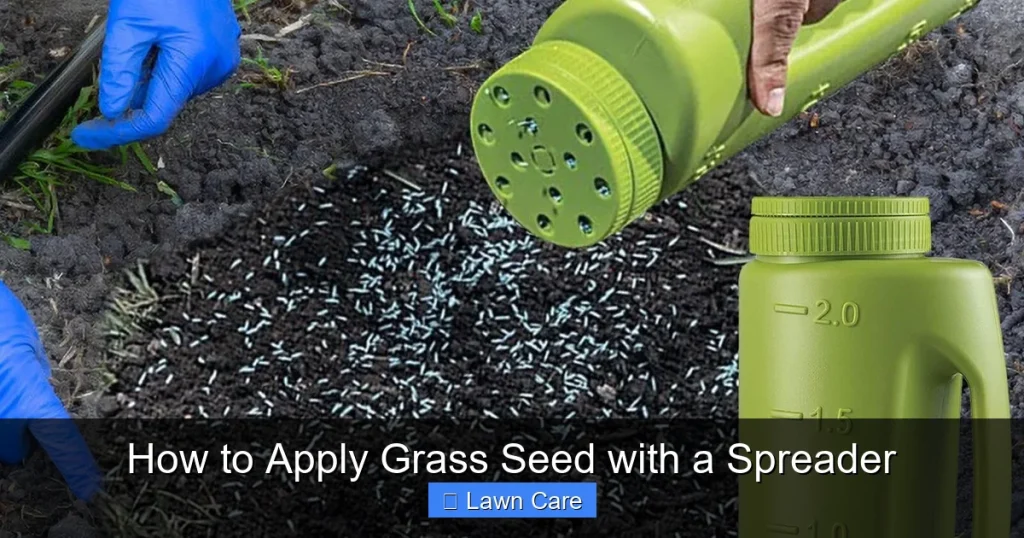
Applying grass seed with a spreader ensures even distribution for a healthy, uniform lawn. This comprehensive guide walks you through selecting the right spreader, preparing your lawn, calibrating the spreader, and applying the seed correctly. Follow these steps for a beautiful, thick lawn that will impress your neighbors.
# How to Apply Grass Seed with a Spreader
Want to transform your patchy, sad-looking lawn into a lush, green carpet? Applying grass seed with a spreader is the most effective way to achieve this. Spreading grass seed evenly is key to a healthy, uniform lawn, and a spreader makes this task much easier and more efficient. This guide will walk you through everything you need to know, from choosing the right spreader to caring for your newly seeded lawn. Let’s get started on creating that dream lawn!
## Understanding Grass Seed Spreaders
Before you can apply grass seed, you need to understand the tools available. There are two main types of spreaders for lawn care: broadcast spreaders and drop spreaders. Each has its pros and cons, and the best choice for you depends on your lawn’s size and your personal preferences.
### Broadcast (Rotary) Spreaders
Broadcast spreaders, also known as rotary spreaders, are the most common type. They work by spinning a hopper that flings seed outward in a wide arc, covering a large area quickly.
* Pros:
* Cover large areas efficiently.
* Good for irregularly shaped lawns.
* Generally faster than drop spreaders.
* Cons:
* Can be less precise, potentially leading to over-seeding or under-seeding if not used carefully.
* Wind can affect distribution, pushing seed where you don’t want it.
* May not be ideal for very small or intricate areas.
### Drop Spreaders
Drop spreaders, as their name suggests, drop seed directly onto the ground in a straight line behind the unit. They offer more precise application and are excellent for targeting specific areas.
* Pros:
* High precision, making them ideal for spreading seed evenly and avoiding overlap.
* Excellent for smaller lawns or for patching bare spots.
* Less affected by wind.
* Cons:
* Slower to cover large areas.
* Can be more challenging to use on very uneven terrain.
* Requires careful overlap of passes to avoid missed strips.
## Preparing Your Lawn for Seeding
A successful seeding project starts long before you spread the first seed. Proper lawn preparation is critical for ensuring that your new grass seed has the best possible environment to germinate and thrive.
### Step 1: Test Your Soil
Understanding your soil’s condition is the first step. A soil test will tell you about its pH level and nutrient content. This information is vital for choosing the right grass seed and for making any necessary amendments, like adding lime or fertilizer. You can get a soil test kit from your local garden center or send a sample to your local cooperative extension office.
### Step 2: Clear Debris and Weeds
Your lawn needs to be clean for the seed to make good contact with the soil. Remove any rocks, sticks, dead grass, or other debris. You’ll also want to get rid of any weeds. You can do this manually or by applying a weed killer. If you use a weed killer, make sure it’s safe for newly seeded areas or wait the recommended time before seeding.
### Step 3: Loosen the Soil
For new grass to establish strong roots, the soil needs to be loose and workable.
* For bare ground or heavily compacted areas: Use a tiller or a garden fork to loosen the top 4-6 inches of soil. This will also help incorporate any soil amendments you’ve added.
* For overseeding an existing lawn: You don’t need to till. Instead, use a rake to scratch the surface of the soil. This creates small grooves where the seed can settle and get good contact with the soil. This step is crucial to break up any thatch and ensure the seed isn’t just sitting on top of dead grass.
### Step 4: Rake the Area Smooth
After loosening the soil, use a lawn rake to smooth out the area. Remove any remaining debris, fill in any holes, and create a relatively level surface. A smooth surface helps with even watering and prevents the seed from washing away.
## Calibrating Your Spreader and Setting the Rate
This is perhaps the most critical step for successful seed application. Applying too much seed wastes money and can lead to grass seedlings that are too crowded, weak, and susceptible to disease. Applying too little seed will result in a thin, patchy lawn.
### Step 1: Find the Recommended Rate
Look at the grass seed bag. It will specify the recommended seeding rate per square foot or per 1,000 square feet. Pay attention to whether it’s for new lawns or overseeding, as the rates can differ.
### Step 2: Consult Your Spreader’s Manual
Your spreader will have a manual that provides recommended settings for various products, including grass seed. However, these settings are often just a starting point.
### Step 3: Calculate Your Lawn Area
Measure the length and width of the area you need to seed and multiply them to get the square footage. For irregular shapes, break them down into smaller, manageable rectangles or squares.
### Step 4: Perform a Test Application
This is where calibration truly happens.
1. Load a small amount of seed into your spreader. Don’t fill it completely.
2. Set your spreader to the lowest recommended setting from the manual or the seed bag.
3. Sprinkle a known amount of seed (e.g., 1/4 cup) in a contained area, like a tarp or a large piece of cardboard, while simulating your walking pace.
4. Measure the area covered by that small amount of seed.
5. Calculate if the amount of seed applied per square foot matches the recommended rate on the bag. For example, if the bag says 4 ounces per 1,000 sq ft, and you used 1/8 ounce and covered 250 sq ft, you’re applying the correct rate (1/8 oz / 250 sq ft = 0.0005 oz/sq ft; 0.0005 oz/sq ft * 1000 sq ft = 0.5 oz/1000 sq ft, which is 4 oz/1000 sq ft if you multiply by 8). Adjust the spreader setting up or down as needed and repeat the test until you are confident in the rate.
It’s better to err on the side of slightly under-seeding and do a second pass than to over-seed.
## Applying the Grass Seed
Now comes the exciting part! With your lawn prepared and your spreader calibrated, it’s time to get that seed down.
### Step 1: Load the Spreader
Carefully pour the grass seed into the hopper of your spreader. Avoid overfilling, as this can make the spreader heavy and difficult to control. If you’re using a broadcast spreader, it’s a good idea to do a test run by turning the handle to ensure the seed is flowing properly before you start on the lawn.
### Step 2: Start Seeding – Broadcast Spreader Technique
1. Start at the edge of your lawn.
2. Begin walking at a steady, consistent pace. This is crucial for even distribution.
3. Engage the spreader (turn the handle or trigger) once you start moving.
4. Walk in parallel lines across your lawn. Plan your path to ensure you cover the entire area.
5. Overlap each pass by about half the spread width to avoid missed spots. If your spreader has a 5-foot spread width, overlap by about 2.5 feet. This is a general guideline; consult your spreader’s manual for its effective spread width.
6. For the second pass, walk perpendicular to your first set of passes. This ensures a very even distribution. For example, if you went north-south on the first pass, go east-west on the second.
7. Turn off the spreader before you stop walking, especially at the end of a row.
### Step 3: Start Seeding – Drop Spreader Technique
1. Start at one edge of your lawn.
2. Set your spreader to the appropriate setting and begin walking.
3. Walk in straight, parallel lines. Make sure each pass is directly next to the previous one, with no gaps. This might require careful observation.
4. Overlap each pass slightly to ensure complete coverage.
5. For the second pass, walk perpendicular to your first set of passes. This is especially important with drop spreaders to create a uniform appearance.
6. Disengage the spreader before you stop walking.
### Practical Tip: For Overseeding or Patching
If you are overseeding an existing lawn or patching bare spots, you can use a broadcast spreader for the main area and then use a drop spreader for precise application over the bare patches to ensure optimal seed density. If you only have a broadcast spreader, be extra careful with your overlapping passes. You might even consider a method like spreading grass seed without a spreader using a fertilizer spreader if you need more control for small areas, though a properly calibrated broadcast spreader can also work.
## Post-Application Care for New Grass Seed
Applying the seed is only half the battle. Proper post-seeding care is essential for germination and establishment.
### Step 1: Light Raking (Optional but Recommended)
Gently rake the seeded area. This helps to ensure good seed-to-soil contact by lightly covering the seed with a thin layer of soil. Don’t bury the seed too deeply – most grass seeds need light to germinate. Aim for about 1/8 to 1/4 inch of soil coverage.
### Step 2: Watering is Crucial
This is arguably the most important step after seeding. The soil should be kept consistently moist, but not waterlogged, until the grass is established.
* Frequency: Water lightly 1-2 times a day, especially in warm or dry weather. The goal is to keep the top layer of soil damp.
* Method: Use a gentle spray from your hose or a sprinkler system. Avoid high-pressure watering, which can wash away the seeds.
* Duration: Water for shorter periods more frequently. As the grass begins to grow, you can gradually reduce the frequency and increase the duration of watering.
* When to Stop: Continue this watering regimen until the new grass is about 2-3 inches tall. Then, you can transition to a more typical watering schedule.
### Step 3: Avoid Foot Traffic and Mowing
Keep people and pets off the newly seeded areas as much as possible. Their weight can damage the delicate seedlings and compact the soil.
Wait until the new grass reaches about 3-4 inches in height before mowing. When you do mow, set your mower to a higher setting than usual for the first few mowings. This encourages stronger root development. Never remove more than one-third of the grass blade height at a time.
### Step 4: Fertilizing
If your soil test indicated a need for nutrients, apply a starter fertilizer specifically designed for new grass. This type of fertilizer typically has a higher phosphorus content, which promotes root growth. Follow the instructions on the fertilizer bag for application rates and timing, but it’s often applied shortly after seeding or when the grass reaches about 1 inch in height.
## Troubleshooting Common Seeding Problems
Even with careful planning, you might encounter a few issues.
* Uneven Germination: This usually points to inconsistent moisture levels or uneven seed distribution. Ensure you’re watering consistently and check your spreader’s calibration for future applications. If it’s patchy, you might need to overseed those areas again. You can learn about how to patch lawn with leftover grass seed for these spots.
* Seed Washed Away: Heavy rain or improper watering can cause seed to wash downhill, creating bare spots and thick patches elsewhere. Consider using a broadcast spreader for better distribution and ensure your watering is gentle and consistent. If you have steep slopes, you might need to use erosion control mats.
* Grass Not Germinating: This could be due to old seed (check the expiration date), poor soil contact, or incorrect watering (too dry or too wet). Ensure the seed is fresh and you’ve raked it in lightly.
* Weeds Taking Over: If weeds germinate faster than your grass, they can outcompete the new seedlings. This is why proper weed removal before seeding is so important. Be patient, as your grass will eventually thicken up and suppress many weeds.
## Conclusion
Applying grass seed with a spreader is a straightforward process that can lead to a beautiful, healthy lawn. By understanding your spreader, preparing your lawn thoroughly, calibrating your settings carefully, applying the seed evenly, and providing proper post-seeding care, you’ll be well on your way to achieving the lawn of your dreams. Remember that patience and consistent effort are key to a truly impressive lawn. Enjoy your green oasis!
- Understand Spreader Types: Choose between broadcast (rotary) and drop spreaders based on your lawn size and preference for precision.
- Prepare Your Lawn: Proper preparation, including soil testing and raking, is crucial for seed germination and healthy growth.
- Calibrate Your Spreader: Always calibrate your spreader according to the seed bag instructions for the correct application rate.
- Apply Seed Evenly: Use a consistent walking pace and overlapping passes to ensure even seed distribution, avoiding bare spots or clumps.
- Post-Application Care: Watering and light raking after seeding are essential for establishing new grass.