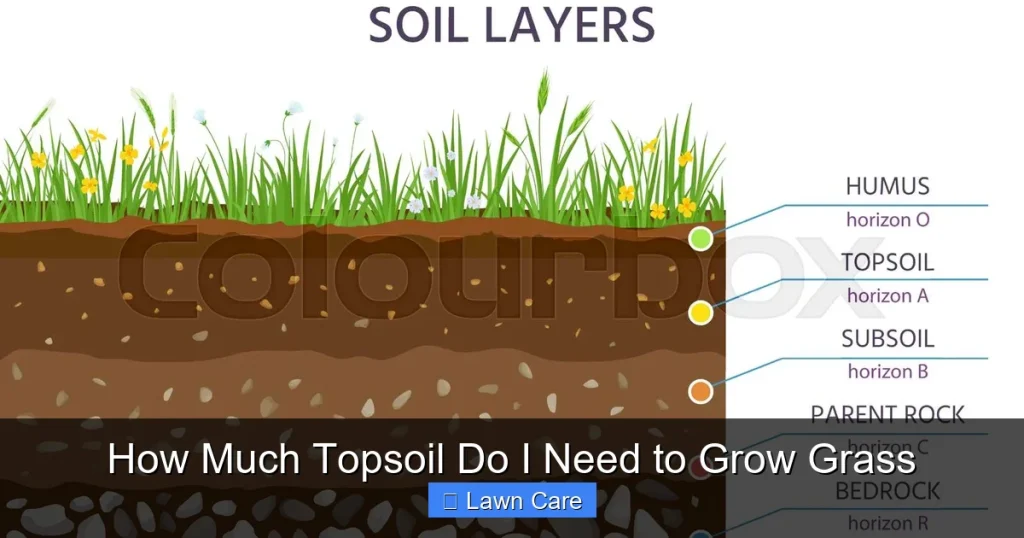
Growing a healthy lawn starts with the right amount of topsoil. This guide provides a clear, step-by-step process to calculate your topsoil needs, ensuring your grass has the ideal foundation for growth. Understanding your area’s dimensions and desired topsoil depth is key to preventing under or over-purchasing. Follow these simple steps for a greener, more vibrant lawn.
# How Much Topsoil Do I Need to Grow Grass
A beautiful, green lawn is a dream for many homeowners. It’s the perfect spot for summer barbecues, playing with kids and pets, or simply relaxing with a good book. But achieving that lush carpet of grass isn’t just about throwing down seeds or sod and hoping for the best. The foundation of a healthy lawn lies beneath the surface – in the soil. Topsoil is the nutrient-rich upper layer of soil that supports plant life. Providing your grass with enough high-quality topsoil is crucial for its establishment, growth, and overall health.
But how much topsoil do you actually need? This is a common question, and the answer isn’t a one-size-fits-all. It depends on the size of your lawn area and how deep you need to go. This comprehensive guide will walk you through the simple steps to calculate your exact topsoil needs, ensuring you buy the right amount without overspending or ending up short. We’ll cover everything from measuring your lawn to understanding soil depth and making the final purchase.
## Why Topsoil is Essential for a Healthy Lawn
Before we dive into the calculations, let’s briefly touch upon why topsoil is so important for growing grass.
* **Nutrient Richness:** Topsoil is packed with the organic matter and essential nutrients that grass needs to thrive. These include nitrogen, phosphorus, and potassium, as well as vital micronutrients.
* **Water Retention and Drainage:** Good topsoil strikes a balance. It can hold enough moisture to keep grass hydrated between waterings but also allows for proper drainage, preventing waterlogged conditions that can lead to root rot and disease.
* **Root Development:** A loose, friable topsoil structure allows grass roots to penetrate deeply, anchoring the grass and enabling it to access water and nutrients more effectively. Compacted or poor-quality soil restricts root growth.
* **Weed Suppression:** A healthy, dense lawn grown in good topsoil can naturally outcompete many common weeds.
If your existing soil is sandy, compacted clay, or generally poor quality, adding a layer of quality topsoil can transform it into an ideal growing medium.
## Step-by-Step: Calculating Your Topsoil Needs
Calculating the amount of topsoil you need is a straightforward process involving a few key measurements and a simple formula. We’ll break it down into manageable steps.
## Step 1: Measure Your Lawn Area
The first and most critical step is to accurately measure the area of your lawn where you intend to add or create a new topsoil layer. You’ll need to know the length and width of this area in feet.
### Calculating Square Footage for Rectangular or Square Areas
This is the simplest scenario.
* Measure the length of your lawn area in feet.
* Measure the width of your lawn area in feet.
* Multiply the length by the width.
Formula: Length (ft) x Width (ft) = Area (sq ft)
Example: If your lawn area is 50 feet long and 30 feet wide, the area is 50 ft x 30 ft = 1500 square feet.
### Calculating Square Footage for Irregular Shapes
If your lawn area isn’t a perfect rectangle or square, you’ll need to break it down into smaller, manageable shapes like rectangles, squares, or triangles.
* **Divide the area:** Mentally (or physically draw it on paper) divide the irregular shape into several simpler geometric shapes.
* **Measure each shape:** Measure the dimensions of each individual shape.
* **Calculate the area of each shape:**
* Rectangles/Squares: Length x Width
* Triangles: (Base x Height) / 2
* **Sum the areas:** Add up the areas of all the individual shapes to get the total square footage of your lawn area.
Example: Imagine a L-shaped lawn. You could divide it into two rectangles.
* Rectangle 1: 40 ft x 10 ft = 400 sq ft
* Rectangle 2: 20 ft x 20 ft = 400 sq ft
* Total Area: 400 sq ft + 400 sq ft = 800 sq ft
### Tip: Use a Measuring Wheel
For larger areas or if you want to be extra precise, a measuring wheel can be very helpful.
## Step 2: Determine the Desired Topsoil Depth
The next crucial factor is how deep you want your topsoil layer to be. This is often referred to as the “depth” or “thickness” of the topsoil.
### Recommended Topsoil Depth for Grass
For establishing a new lawn or significantly improving existing soil, a depth of **4 to 6 inches** is generally recommended.
* **4 inches:** This is often sufficient for overseeding an existing lawn or for areas where the existing soil is already reasonably good.
* **6 inches:** This is ideal for new lawn installations, areas with poor soil quality (like heavy clay or pure sand), or when you want to ensure the best possible start for your grass. It provides ample room for root development and nutrient availability.
### Adjusting Depth Based on Needs
* **New Lawn Installation:** Aim for 4-6 inches.
* **Overseeding:** You might only need 1-2 inches to fill in patches and provide a good seedbed. However, for better long-term health, a slightly deeper layer is always beneficial.
* **Amending Existing Soil:** If you’re amending compacted clay or sandy soil, a 3-4 inch layer of good topsoil can make a significant difference. For detailed guidance on amending specific soil types, you might find our article on how much topsoil over sand to grow grass very useful.
## Step 3: Convert Depth to Feet
Your measurements for area are in square feet. However, to calculate volume, you need consistent units. Therefore, convert your desired depth from inches to feet.
Formula: Depth (inches) / 12 inches/foot = Depth (ft)
Examples:
* For 4 inches of topsoil: 4 inches / 12 = 0.33 feet
* For 6 inches of topsoil: 6 inches / 12 = 0.5 feet
## Step 4: Calculate the Volume in Cubic Feet
Now you can calculate the total volume of topsoil needed in cubic feet.
Formula: Area (sq ft) x Depth (ft) = Volume (cubic ft)
Example: Using our previous lawn area of 1500 sq ft and a desired depth of 4 inches (0.33 ft):
1500 sq ft x 0.33 ft = 495 cubic feet
## Step 5: Convert Cubic Feet to Cubic Yards
Topsoil is almost always sold by the cubic yard. So, your final step in calculation is to convert your cubic feet measurement into cubic yards.
There are 27 cubic feet in 1 cubic yard.
Formula: Volume (cubic ft) / 27 cubic ft/cubic yard = Volume (cubic yards)
Example: Continuing with our example of 495 cubic feet:
495 cubic ft / 27 cubic ft/cubic yard = 18.33 cubic yards
So, for a 1500 sq ft lawn requiring 4 inches of topsoil, you would need approximately 18.33 cubic yards.
## Step 6: Add a Buffer for Compaction and Waste
It’s important to remember that topsoil, especially when freshly delivered, is fluffy. As it settles over time, it will compact, and you’ll lose some volume. Also, during the spreading process, there’s always a small amount of spillage or uneven distribution.
To account for this, it’s recommended to add a buffer of **5-10%** to your calculated amount.
### Calculating the Buffer
* **Multiply your total cubic yards by 0.05 for a 5% buffer, or by 0.10 for a 10% buffer.**
Example: For 18.33 cubic yards, let’s add a 10% buffer:
18.33 cubic yards x 0.10 = 1.83 cubic yards
### Final Calculation
* **Add the buffer to your original total.**
Example:
18.33 cubic yards (original) + 1.83 cubic yards (buffer) = 20.16 cubic yards
Therefore, for a 1500 sq ft lawn needing 4 inches of topsoil, you should aim to purchase around **20.5 cubic yards** (rounding up to the nearest half-yard is common when ordering). It’s always better to have a little extra than to run short.
## Understanding Different Topsoil Types
When purchasing topsoil, you’ll encounter different types. Understanding these will help you choose the best option for your needs.
* **Screened Topsoil:** This is the most common type for lawns. It has been put through a screen to remove rocks, debris, and large clumps, resulting in a fine, consistent texture.
* **Unscreened Topsoil:** Cheaper but contains rocks and debris. Generally not recommended for fine lawn areas.
* **Composted Topsoil:** Topsoil that has been blended with compost. This is an excellent option as it’s rich in organic matter, which further enhances nutrient content and soil structure.
* **Specialty Mixes:** Some suppliers offer blends designed for specific purposes, like sandy loam mixes for better drainage or mixes enhanced with peat moss.
For general lawn growth, screened topsoil or a screened topsoil/compost blend is usually your best bet.
## Practical Tips for Buying and Spreading Topsoil
* **Buy in Bulk:** For larger projects, purchasing topsoil by the cubic yard in bulk from a local landscape supplier is far more economical than buying small bags from a garden center.
* **Delivery:** Most bulk suppliers offer delivery. Confirm delivery fees and minimum order quantities.
* **Check Soil Quality:** If possible, ask to see a sample of the topsoil before purchasing, or read reviews of the supplier. Good quality topsoil should be dark, crumbly, and have a rich, earthy smell.
* **Spreading:** Use a wheelbarrow and a shovel or rake to spread the topsoil evenly across your lawn area. Start in the furthest corner and work your way out.
* **Rake Smooth:** After spreading, use a metal rake to level the surface, remove any remaining small clumps or debris, and create a smooth seedbed.
* **Lightly Water:** Once spread and leveled, lightly water the area to help settle the topsoil and prepare it for seeding or sodding.
## Troubleshooting Common Topsoil Issues
* **Running Short:** If you find you’re running short, the easiest solution is to order more. It’s better to have a little extra than to have patches of different depths.
* **Too Much Topsoil:** While you’ve aimed to calculate correctly, if you somehow end up with a significant amount of extra topsoil, you can use it for other garden beds, to amend other areas of your yard, or store it for future use.
* **Poor Drainage After Adding Topsoil:** If your topsoil seems to be holding too much water, it might be too heavy with clay. In the future, consider amending with more organic matter like compost or sand (if appropriate for your specific soil type, as discussed in how much topsoil over sand to grow grass). Ensure your lawn area has proper grading.
* **Grass Not Growing Well:** If grass struggles to establish even after adding topsoil, it might be due to other factors like insufficient sunlight (consider how to grow grass in shaded areas naturally), poor watering practices, or the wrong type of grass seed for your climate. Ensure you also consider how much grass seed you need for the area, as detailed in how much grass seed do I need.
## Conclusion
Providing the right amount of quality topsoil is a foundational step for cultivating a thriving lawn. By accurately measuring your area, determining the appropriate depth, and using the simple cubic yard calculation, you can confidently purchase the exact amount of topsoil needed. Remember to factor in compaction and waste to ensure you have just enough for a perfect, healthy lawn. A little preparation and accurate calculation go a long way in transforming your yard into the green oasis you desire.
- Calculate the Area: Measure your lawn’s length and width to determine its square footage, which is the fundamental number for all topsoil calculations.
- Determine Topsoil Depth: The ideal topsoil depth for grass growth is typically between 4 to 6 inches, though specific needs can vary.
- Use the Cubic Yard Formula: Convert your square footage and desired depth into cubic yards, the standard unit for purchasing topsoil.
- Account for Compaction: Remember that topsoil will settle over time, so it’s often wise to add a little extra to compensate for compaction.
- Consider Existing Soil Conditions: If you’re amending existing soil, particularly sandy soil, you might need a different approach or quantity. For example, check out our guide on how much topsoil over sand to grow grass.
- Factor in Waste and Spillage: Always add a small buffer (5-10%) to your total to account for any minor spillage or uneven distribution.