Figuring out how much grass seed for 1 acre is crucial for a healthy lawn. This guide breaks down the process, from understanding seed coverage rates to accounting for specific grass types and your lawn’s condition. Follow these steps to ensure you buy the right amount and achieve a beautiful, dense lawn.
So, you’ve got an acre of land and you’re dreaming of a lush, green carpet of grass. That’s fantastic! But before you rush out and buy bags of seed, there’s a crucial question to answer: **how much grass seed for 1 acre** do you actually need? It’s not as simple as grabbing a random bag. Too little, and you’ll end up with a patchy, sad-looking lawn. Too much, and you’ll be wasting money and resources.
This comprehensive guide will walk you through everything you need to know to accurately calculate the amount of grass seed required for your one-acre project. We’ll cover measuring your space, understanding seed coverage rates, considering different grass types, and accounting for the condition of your land. By the end, you’ll be confident in your seed-buying decisions.
- Coverage Rate is King: The most important factor is the grass seed’s recommended coverage rate, usually found on the packaging and measured in pounds per 1,000 square feet.
- New Lawn vs. Overseeding: Seeding a new lawn requires more seed per acre than overseeding an existing one.
- Grass Type Matters: Different grass species have varying seed sizes and germination rates, affecting the amount needed.
- Lawn Condition Influences Needs: Bare patches, soil quality, and desired lawn density will impact your final seed calculation.
- Accurate Measurement is Key: Properly measuring your acreage is the first step to avoid buying too much or too little seed.
Understanding the Basics: Coverage Rates and Acreage
Before we dive into calculations, let’s get a handle on two fundamental concepts: coverage rate and acreage.
What is Coverage Rate?
Grass seed packaging almost always includes a “coverage rate.” This tells you how much area a specific weight of seed is expected to cover. It’s typically expressed as pounds per 1,000 square feet (lbs/1,000 sq ft). This is your most important number for estimating how much seed you’ll need.
How to Measure Your Acreage
You might think you know the size of your property, but it’s always best to confirm. A standard acre is 43,560 square feet. If you’re not sure how to measure, here are a few methods:
Using Online Mapping Tools
Many online mapping services, like Google Maps or specialized land measurement tools, allow you to draw boundaries around your property and get an area calculation. This is a quick and often accurate method.
Manual Measurement and Calculation
If your property is a simple shape (like a rectangle or square), you can measure the length and width of the area you intend to seed. Multiply these measurements to get the square footage. For example, if your area is 200 feet long by 100 feet wide, that’s 20,000 square feet.
Understanding Irregular Shapes
If your acre has an unusual shape, you might need to break it down into smaller, more manageable geometric shapes (rectangles, triangles) and calculate the area of each, then sum them up. Alternatively, use a measuring wheel to walk the perimeter and then use specialized software or consult a professional for more precise calculations on irregular plots.
Calculating Your Grass Seed Needs

Visual guide about How Much Grass Seed for 1 Acre
Image source: inchcalculator.com
Now that you understand coverage rates and how to measure your area, let’s crunch some numbers.
Step 1: Determine the Total Square Footage to Seed
This is where your measurements from the previous section come in handy. If you’re seeding the entire acre, you’ll use 43,560 square feet. If you’re only seeding a portion, use the specific square footage you measured.
Step 2: Find the Recommended Coverage Rate
Look at the grass seed bag you plan to buy. The label will tell you the recommended rate. Let’s say a bag of fescue blend states a coverage rate of 5 lbs per 1,000 square feet for new lawns.
Step 3: Calculate the Total Seed Needed for New Lawns
To figure out the total amount of seed for a new lawn, you’ll use this formula:
(Total Square Footage / 1,000) * Coverage Rate (lbs/1,000 sq ft) = Total Seed Needed (lbs)
Let’s apply this to our one-acre example:
(43,560 sq ft / 1,000 sq ft) * 5 lbs/1,000 sq ft = 43.56 * 5 lbs = 217.8 lbs
So, for a full acre being seeded for the first time, you would need approximately 218 pounds of this specific fescue blend. This is a substantial amount, highlighting why precise calculations are important. If you’re just looking for a general idea, there are many online resources that can help you with how much grass seed per acre.
Step 4: Adjust for Overseeding
Overseeding means adding grass seed to an existing lawn to thicken it up and fill in bare spots. This process requires less seed than establishing a new lawn because the existing grass provides some cover and competition.
The coverage rate for overseeding is typically lower. For our fescue example, the bag might recommend 3 lbs per 1,000 square feet for overseeding.
Let’s recalculate for overseeding one acre:
(43,560 sq ft / 1,000 sq ft) * 3 lbs/1,000 sq ft = 43.56 * 3 lbs = 130.68 lbs
For overseeding, you’d need about 131 pounds of the same fescue blend. You can find more detailed information on how much grass seed for overseeding by consulting specific guides.
Factors That Influence Seed Amount
Visual guide about How Much Grass Seed for 1 Acre
Image source: wikihow.com
While the coverage rate is the primary driver, several other factors can influence how much grass seed you’ll ultimately need.
Type of Grass Seed
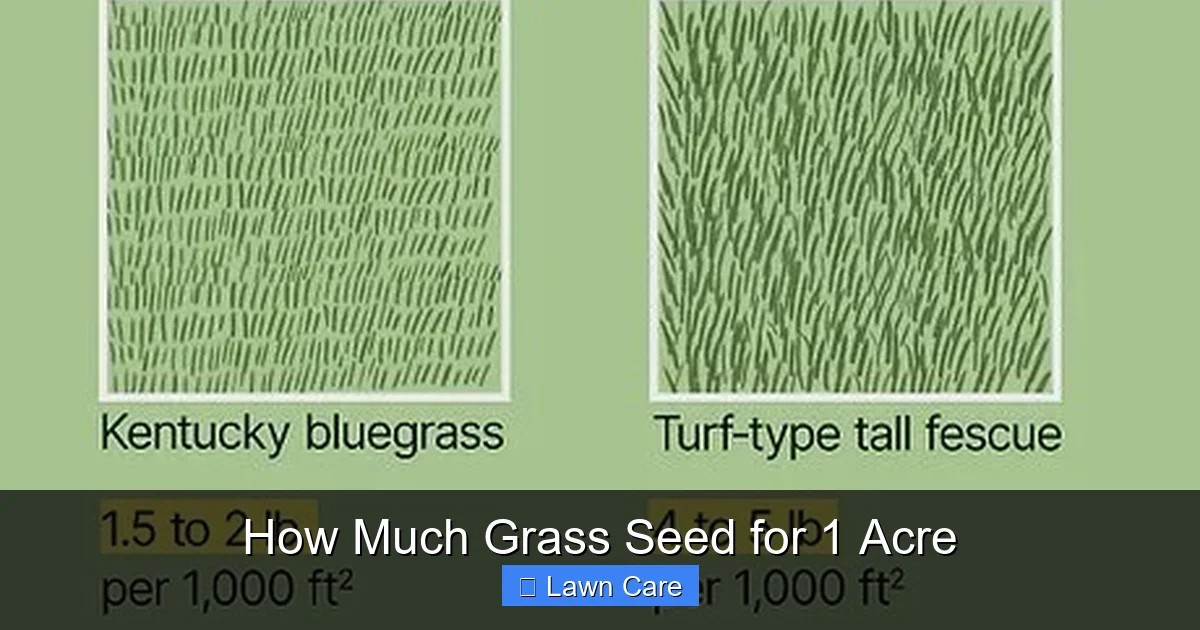
Different grass species have different seed sizes and densities. Smaller seeds, like those of some fine fescues, might require a slightly different application rate compared to larger seeds, like ryegrass or fescue. Always refer to the specific recommendations for the seed mix you choose. For instance, the amount of seed needed for cattle pasture might differ significantly from residential lawn seed. You can learn more about specific grass types and their needs.
Desired Lawn Density
Do you want a super-thick, golf-course-quality lawn, or is a moderately dense lawn acceptable? To achieve higher density, you might want to increase the seed rate slightly, perhaps by 5-10%. Conversely, if you’re just aiming for basic coverage, sticking to the manufacturer’s recommendation is usually sufficient.
Lawn Condition and Soil Quality
* **Bare Patches:** If you have large areas that are completely bare, you’ll need to apply seed at the new lawn rate for those sections.
* **Poor Soil:** If your soil is compacted, lacks nutrients, or drains poorly, germination and growth might be slower and less successful. In such cases, using a slightly higher seed rate can help compensate for potential losses. You can also improve your chances significantly by choosing the right soil for new grass seed.
* **Weed Pressure:** If you have significant weed competition, a denser stand of grass can help suppress weeds. This might justify a slightly higher seed rate.
Application Method
How you plan to spread the seed can also play a small role. If you’re using a broadcast spreader, you’ll want to ensure even distribution. If you’re hand-spreading, try to be as consistent as possible. Overlapping passes slightly can help ensure no gaps are missed.
When to Buy More Than You Calculate
It’s often wise to purchase a little more seed than your exact calculation. Here’s why:
* **Mistakes Happen:** You might miscalculate, mismeasure, or have an unforeseen issue during application.
* **Future Repairs:** Having extra seed on hand is invaluable for patching bare spots that might appear later in the season or in subsequent years. This is especially true if you’re planning ongoing lawn care.
* **Seed Lot Variation:** While rare, there can be slight variations in seed viability between batches.
A common recommendation is to add 5-10% extra seed to your total. For our 218 lbs example, adding 10% would mean buying an extra 21.8 lbs, bringing your total to about 240 lbs.
Troubleshooting Common Seeding Issues
Even with careful planning, problems can arise. Here are a few common ones and how to address them:
Problem: Seed Didn’t Germinate or Germinated Sparsely
* **Possible Causes:** Dry conditions, poor seed-to-soil contact, incorrect planting depth, disease, or poor seed quality.
* **Solutions:** Ensure consistent moisture (watering new grass seed correctly is vital!), rake the area gently to improve seed-to-soil contact, and consider a soil test to check for nutrient deficiencies or pH issues. If the seed quality was suspect, you might need to reseed.
Problem: Seed Was Washed Away by Rain
* **Possible Causes:** Heavy rainfall on sloped areas, or seed not properly incorporated into the soil.
* **Solutions:** For future seeding on slopes, consider using erosion control blankets or a straw mulch layer (applying the right amount of straw to cover grass seed is key). Ensure seed is lightly raked into the soil to hold it in place.
Problem: Uneven Germination or Patchy Growth
* **Possible Causes:** Inconsistent watering, uneven spreader application, or variations in soil conditions across the acre.
* **Solutions:** Adjust your watering schedule to ensure all areas receive adequate moisture. If using a spreader, calibrate it correctly and consider overlapping your passes. Addressing soil issues in patchy areas can also help.
Conclusion
Determining **how much grass seed for 1 acre** requires a blend of careful measurement, understanding product specifications, and considering the unique conditions of your land. By following the steps outlined in this guide—measuring your area, noting the coverage rate, differentiating between new lawns and overseeding, and factoring in grass type and lawn condition—you’ll be well-equipped to make an informed purchase. Investing a little extra time in this calculation will pay dividends in the form of a healthier, more beautiful, and more resilient lawn for years to come. Happy seeding!