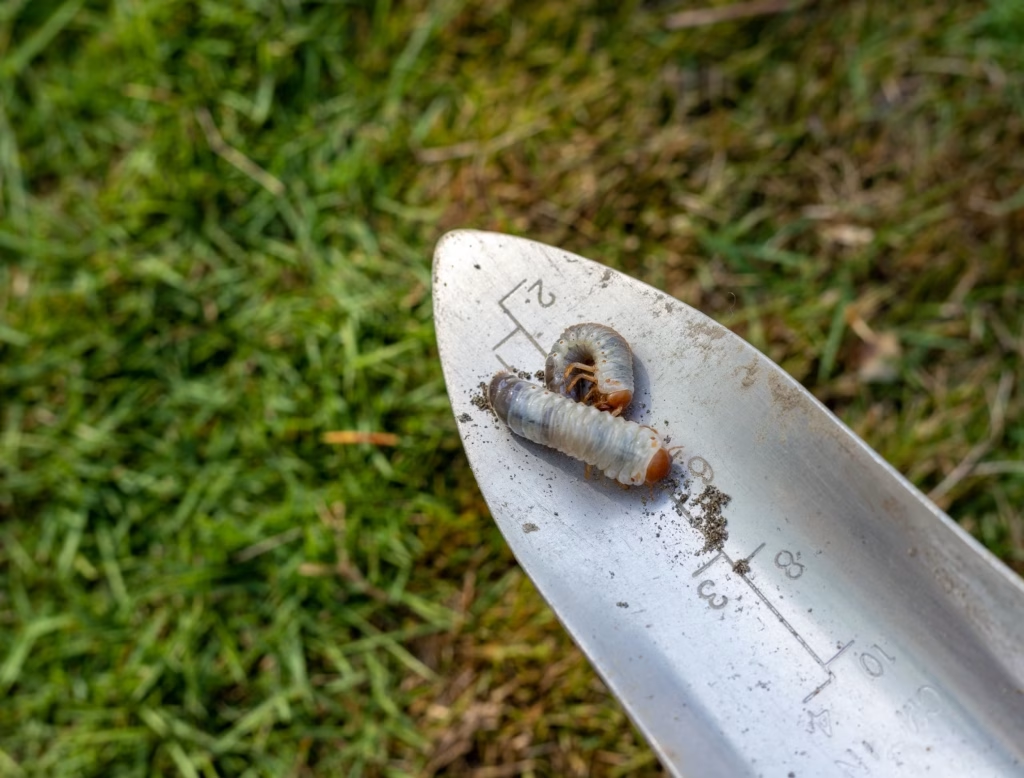
Getting asked "how do you get grubs in your lawn" usually means one of two things: either you've found curled-up white larvae while digging and want to know how they got there, or you're staring at mysterious brown patches and grubs are your prime suspect. The answer comes down to adult beetles finding your turf an attractive place to lay eggs, and a handful of lawn conditions making it even more appealing to them.
The timeline matters a great deal. Adult beetles such as Japanese beetles (Popillia japonica) and European chafers (Amphimallon majale) emerge in mid to late summer, mate, and deposit eggs in the top few inches of moist soil. Those eggs hatch in about 10 to 14 days, and the young larvae immediately start feeding on turf roots.
By the time you notice damage in late summer or early fall, the grubs have already been working underground for weeks.

Image source: Wikimedia Commons / Сарапулов (CC BY)
Quick Answer
Grubs appear in your lawn when adult scarab beetles lay eggs in moist turf soil during mid to late summer. The eggs hatch into larvae that feed on grass roots from August through fall. Overwatering, thick thatch, bright outdoor lighting, and nearby beetle habitat all increase the likelihood of an infestation.
The species varies by region, with Japanese beetles and European chafers being the most common culprits.
Why Grubs Show Up in Your Lawn in the First Place
White grubs are the larval stage of scarab beetles, and the most frequent offenders in residential lawns are Japanese beetles, European chafers, May/June beetles (Phyllophaga species), masked chafers (Cyclocephala species), and oriental beetles (Anomala orientalis). Each follows roughly the same pattern: adults emerge from the soil in early to midsummer, feed on ornamental plants and trees for a few weeks, then return to turf to lay eggs.
The females are selective about egg-laying sites. They prefer moist, well-irrigated soil because the tiny larvae desiccate easily once they hatch. That's why overwatered lawns, low spots that hold moisture, and south-facing slopes with consistent sun exposure tend to attract more egg-laying activity.
A thick thatch layer (more than half an inch) also buffers the soil surface from temperature swings and drying winds, creating a stable nursery for developing eggs.
Once the eggs hatch, the grubs go through three larval instars over several weeks. First-instar grubs are tiny and cause minimal visible damage. It's the third-instar stage in late summer and fall when they're large enough to sever substantial root systems, which is when brown patches suddenly appear.
They then burrow deeper into the soil profile before winter, return to the root zone the following spring for a brief feeding period, pupate, and emerge as adult beetles to restart the cycle, usually as of late June.
How to Confirm You Actually Have Grubs (Not Just a Dry Lawn)
Grub damage looks a lot of other common lawn problems. Drought stress, fungal disease like brown patch or dollar spot, dog urine spots, fertilizer burn, and compacted soil can all produce similar brown patches. Before you invest in any treatment, you need to verify that grubs are actually present and in numbers high enough to warrant action.
Three simple field tests will give you a reliable answer.
The Tug Test
Grab a handful of the brown or thinning grass at the edge of a suspect patch and give it a firm but gentle tug. Grub-damaged turf will lift almost like a carpet because the roots have been severed beneath the surface. If the blades resist and the root system holds, you're more likely dealing with a surface-level issue like drought or disease.
The Roll-Back Test
If the tug test raises suspicion, use the corner of a shovel or a spade to peel back a one-foot square of turf at the border between dead and healthy grass. Healthy sod will show a network of white roots anchoring into the soil. Grub-damaged sod will separate cleanly and may reveal curled white larvae resting in the root zone.
Image source: Wikimedia Commons / Сарапулов (CC BY)
The Shovel Sample — Getting a Real Count
A loose patch of grass doesn't necessarily mean you need to treat. Cool-season turf like Kentucky bluegrass and tall fescue can tolerate a moderate grub population without visible decline. Cut a square flap of turf roughly 12 inches on each side and about 2 to 3 inches deep.
Peel it back and count every grub you see in the soil and root mass. Repeat this in at least three different spots across the lawn for a fair average.
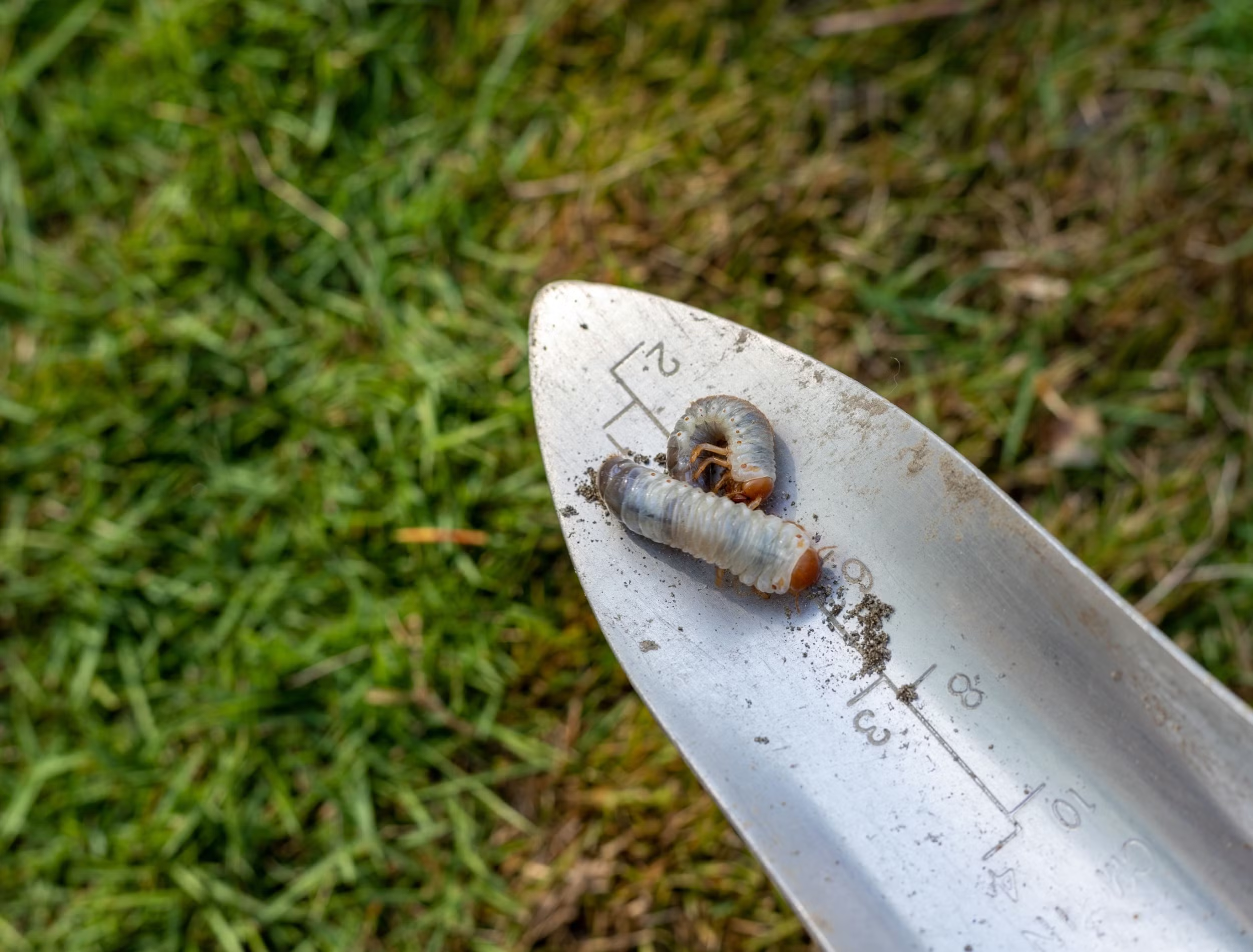
Image source: Bing (Web (fair-use with source credit))
How Many Grubs Is Too Many?
The treatment threshold depends on turf species, overall lawn health, and irrigation capacity. According to university turfgrass programs, the following count guidelines give a practical starting point for a typical home lawn.
| Grub Count per Sq Ft | Severity | Action Needed |
|---|---|---|
| 1-4 | Low | Monitor. Healthy turf can typically outgrow this level, especially if irrigated. |
| 5-9 | Moderate | Borderline. Treat if the lawn is stressed, newly seeded, or you're seeing animal digging. |
| 10-14 | High | Treat with a curative product. Root damage and visible thinning are likely. |
| 15+ | Severe | Immediate treatment warranted. Significant turf loss expected without intervention. |
A well-maintained, irrigated lawn of Kentucky bluegrass can often tolerate 10 to 15 grubs per square foot without showing symptoms because the remaining root mass and regular water support recovery. A drought-stressed lawn or a newly sodded area might show damage at counts as low as 3 to 5. Likewise, if skunks, raccoons, or birds are tearing up your turf at night, you have a functional problem regardless of the exact count; they're responding to the presence of grubs as a food source.
The Grub Life Cycle and Why Timing Changes Everything
Effective grub control depends almost entirely on matching your intervention to the right stage of the insect's development. The adult beetles fly and feed above ground from roughly late June through August depending on species and latitude, then burrow back into the soil to lay eggs. Those eggs hatch within two weeks, and the young larvae begin feeding immediately.
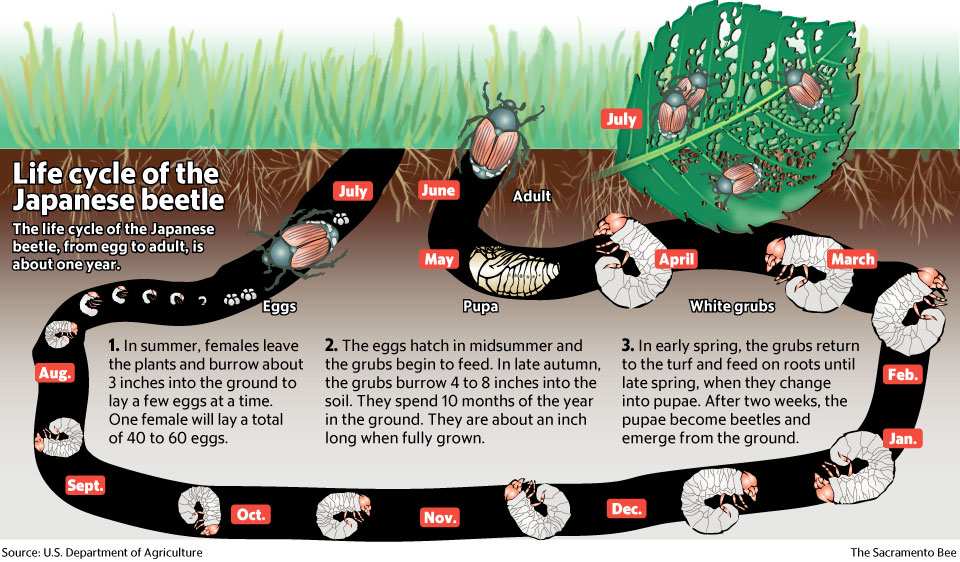
Image source: Bing (Web (fair-use with source credit))
Curative insecticides work best against first and second instar grubs (roughly late July through September), while the larvae are small and feeding actively near the soil surface. By October in most northern regions, the grugs have grown large and begun their downward migration, making them extremely difficult to kill with any product. This is the single most common timing mistake homeowners make: applying curative products too late in the season when the grubs are already big and deep.
Spring feeding by overwintered grubs does occur, but it's usually minimal compared to the late summer and fall flush. Most university extension services recommend a preventive application in late spring to early summer the following year rather than attempting a curative approach the following spring, since the surviving grugs are large, nearing pupation, and resistant to most contact treatments at that stage. Soil temperatures at a 4-inch depth reaching the mid-60s (around 15°C) signal that egg hatch is approaching, which is the ideal window to get preventive products down.
Why Your Lawn Might Be Attracting Beetles
Not every lawn in a beetle-heavy neighborhood ends up with a grub problem. Certain conditions make your turf significantly more appealing to egg-laying females. Addressing these factors can reduce future infestations without a single product application.
Overwatering and Irrigation
Consistently moist soil is the single biggest attractant for egg-laying beetles. If you're watering daily or running sprinklers on a fixed schedule regardless of rainfall, you're essentially rolling out a welcome mat. Beetle females probe the soil surface with their abdomens and prefer damp ground for egg deposition because the tiny larvae will desiccate in dry conditions.
Cutting back to deep, infrequent watering (roughly one inch per week total from rain and irrigation combined) keeps the top inch of soil drier between cycles. This alone can reduce egg survival meaningfully. Watering early in the morning also allows the surface to dry during the day, which is less attractive to beetles searching for oviposition sites in the evening.
Lawn Lighting
Outdoor lights, especially mercury vapor and bright white LEDs, draw adult beetles in during their flight period. Japanese beetles and June bugs are strongly phototactic, meaning they're attracted to light sources. If you have floodlights or porch lights running near the lawn during June and July, you're concentrating beetles right over your turf.
Switching to warm-toned amber or yellow bug lights reduces attraction significantly. Motion-activated fixtures instead of all-night lighting also help. This won't eliminate beetles entirely, but it removes one factor that concentrates them directly over your grass.
Nearby Trees, Crops, and Garden Beds
Adult beetles feed on a wide range of plants before they ever touch your lawn. Japanese beetles in particular favor linden trees, birch, crabapple, roses, grapes, and various vegetable crops. European chafers feed on oak, maple, and walnut foliage.
If your property or an immediate neighbor has heavy beetle feeding on ornamental trees and shrubs, the egg-laying females are already on site.
Agricultural fields nearby can also be a source. Pastureland, cornfields, and soybean fields often harbor large populations of May/June beetles and masked chafers. Suburban developments built on former farmland frequently experience higher grub pressure for this reason.
Thatch and Soil Conditions
A thatch layer thicker than half an inch acts as insulation, keeping soil moisture and temperature stable. This creates an ideal microclimate for both eggs and young larvae. Compacted clay soils that hold moisture longer than sandy soils also tend to see higher grub survival rates.
Annual core aeration and dethatching when the layer exceeds three-quarters of an inch disrupts this environment. It also improves water infiltration, which paradoxically helps the lawn while making the surface less hospitable to beetle eggs.
Proximity to Neighbouring Infestations
Grubs don't respect property lines. If an adjacent property has an untreated infestation, adult beetles will emerge, fly, and lay eggs across the entire block. This is one reason why grub problems often recur year after year in established neighborhoods even after a homeowner treats successfully.
The beetles simply reinfest from untreated surrounding areas.
What to Do Right Now Based on What You're Seeing
Your next step depends entirely on what you've found so far. The right action for a light, early-season situation is completely different from what a heavy fall infestation demands.
Few Grubs, No Damage — Monitor
If your shovel samples turned up fewer than five grubs per square foot and the turf looks healthy, hold off on any treatment. Beneficial organisms like ground beetles, parasitic wasps, and naturally occurring soil pathogens often keep light populations in check. Continue monitoring monthly through September.
If counts climb or brown patches appear, revisit the curative options below.
Moderate Grub Count with Early Damage — Curative Treatment
Counts between five and nine per square foot with visible thinning call for a curative insecticide applied as soon as possible. The goal is to kill the grugs while they're still small and feeding near the surface. Trichlorfon (Dylox) is the standard curative option because it acts fast and works on larger, later-instar grugs that preventive products can't touch.
Apply when soil temperatures are still above 10°C at a 4-inch depth, and water in thoroughly according to the label.
Heavy Infestation with Animal Digging — Immediate Action
Skunks and raccoons can destroy a lawn overnight once they discover a concentrated food source. If animals are actively digging, apply a curative insecticide right away to reduce the grub population, then repair the damaged areas. Excluding animals with temporary fencing or motion-activated deterrents can prevent further destruction while the treatment takes effect.
The grugs need to be controlled at the source, or the animals will keep returning.
Late Summer/Fall — Assess and Plan Ahead for Next Year
If you're reading this in October or later and finding large grugs, curative treatments are unlikely to provide meaningful control at this stage. The grugs are too big and too deep. Focus instead on documenting the damage, planning a preventive application for the following May through early July, and overseeding damaged areas in early fall or the following spring to restore turf density before the next beetle flight.
Preventive vs. Curative Grub Control: Choosing the Right Approach
These two strategies target completely different stages of the grub life cycle, and mixing them up is the most common reason treatments fail.
Preventive control means applying a long-residual insecticide before the grugs hatch, so the product is already in the root zone when the larvae begin feeding. Chlorantraniliprole (the active ingredient in GrubEx and similar products) is the current standard for preventive applications. It has low toxicity to mammals and birds, binds well to soil particles, and provides season-long residual activity when applied between late May and early July.
The product doesn't kill eggs. It kills the young larvae as they start feeding on treated roots.
Curative control targets grugs that are already present and causing damage. This requires a faster-acting product with shorter residual activity, applied when grugs are small and accessible near the soil surface. Trichlorfon (Dylox) is the go-to curative option because it kills on contact and through ingestion within 1 to 3 days.
It breaks down quickly in soil, which is why it doesn't work as a preventive. The application window is narrow: late July through September in most regions.
| Factor | Preventive | Curative |
|---|---|---|
| Timing | Late May through early July | Late July through September |
| Target stage | Newly hatched larvae | Small to medium larvae |
| Active ingredient examples | Chlorantraniliprole | Trichlorfon |
| Residual activity | Season-long (4+ months) | Short (days to 2 weeks) |
| Best for | Known recurring problems | Active, confirmed infestation |
| Application difficulty | Easy, wide window | Narrow window, must catch grugs small |
If you've had grugs two years in a row, preventive is almost always the better investment. If this is your first time dealing with them and you've confirmed a moderate to heavy population, curative makes more sense for this season, followed by preventive the following year.
Chemical vs. Biological Treatments: What Actually Works
You have two broad categories to choose from, and each has a realistic set of strengths and limitations. Neither is universally superior. The right pick depends on your timing, your tolerance for reapplication, and whether you're dealing with a specific beetle species.
Chlorantraniliprole (Preventive, Season-Long)
This is the workhorse of modern grub prevention. It's a systemic insecticide, meaning turf roots absorb it and the grugs ingest it while feeding. It's effective at very low application rates and has a favorable safety profile for humans, pets, and earthworms.
The main drawback is timing. Apply too early and the residual may fade before peak egg hatch. Apply too late and the larvae may have already grown large enough to cause damage before encountering a lethal dose.
The sweet spot is typically mid to late June in the Northeast and Midwest, and late May to early June in warmer southern regions.
Dylox / Trichlorfon (Curative, Fast Knockdown)
Trichlorfon is an organophosphate insecticide that works on contact and by ingestion. It's one of the few products that can kill larger, third-instar grugs, which is why it's the standard recommendation for late-summer curative applications. It degrades rapidly in soil (half-life of roughly 1 to 4 days depending on pH and temperature), so it won't carry over into the following season.
Some states restrict its use to licensed applicators, so check your local regulations before purchasing.
Beneficial Nematodes (Biological, Needs Good Timing)
Heterorhabditis bacteriophora is the nematode species most commonly used for grub control. These microscopic roundworms actively hunt grugs in the soil, enter their bodies, and release symbiotic bacteria that kill the host within 24 to 48 hours. They're completely non-toxic to humans, pets, and plants.
The catch is that they're living organisms. They need to be kept cool during transport, applied in the evening to avoid UV exposure, and watered into moist soil. They also require soil temperatures above 15°C to be active, which limits the application window to late summer in northern climates.
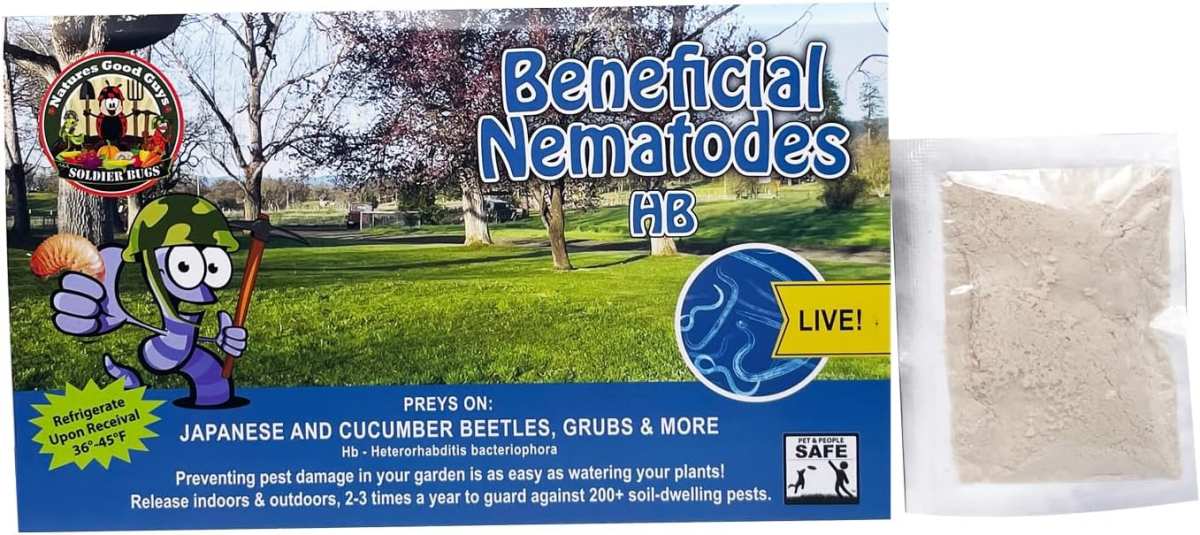
Image source: Bing (Web (fair-use with source credit))
Milky Spore (Long-Term, Japanese Beetle Specific)
Milky spore disease, caused by the bacterium Paenibacillus popilliae, specifically targets Japanese beetle grugs. When ingested, the spores multiply in the grub's blood and kill it, then release billions of new spores back into the soil. It takes 2 to 4 years to establish fully in a lawn, but once established it can persist for 10 years or more.
It's ineffective against European chafers, May beetles, and other grub species, so it only makes sense if Japanese beetles are your confirmed problem.
Common Mistakes That Make Grub Problems Worse
The biggest mistake is treating too late in the season. By October in most northern regions, grugs have grown large and burrowed deep. No product works reliably at that point.
Another common error is applying preventive insecticides in spring instead of the previous early summer. Chlorantraniliprole needs to be in the root zone before eggs hatch, not months before. Overwatering right after application can also push granules through the thatch too quickly, reducing contact with the root zone where grugs feed.
When to Call in a Lawn Care Professional
If your grub count exceeds 15 per square foot across multiple sample sites, or if you're dealing with recurring annual infestations despite treatment, a licensed lawn care operator can access restricted products and calibrated equipment that DIY options don't match. Professionals also have access to trichlorfon formulations and application rates that may be restricted to certified applicators in some states. If animal damage is severe and ongoing, professional exclusion combined with treatment often resolves what spot-treating cannot.
Preventing Grubs From Coming Back Next Season
Once you've dealt with an active infestation, the goal shifts to breaking the cycle. Apply a preventive product like chlorantraniliprole in late May to early July the following year. Reduce irrigation frequency during beetle flight season.
Switch outdoor lighting to warm-spectrum bulbs. Address thatch if it's over half an inch thick. Overseed damaged areas in early fall to restore dense turf, which is more resilient to future grub feeding.
If Japanese beetles are your primary problem, consider milky spore as a long-term biological solution alongside your annual preventive program.
Frequently Asked Questions
What time of year do grugs cause the most damage?
Late August through October is when visible damage peaks. The grugs have been feeding since hatching in July and August, and by fall they're large enough to sever substantial root systems. Spring damage is usually minimal because the surviving grugs are nearing pupation and feed only briefly.
Can my lawn recover from grub damage on its own?
Light damage often recovers with adequate watering and fertilization. Heavy damage where turf peels back cleanly usually needs reseeding or sodding. The key is addressing the grugs first so new grass isn't destroyed as it establishes.
Do grub treatments harm earthworms and beneficial insects?
Chlorantraniliprole has minimal impact on earthworms and most beneficial insects when applied according to label directions. Trichlorfon is broader-spectrum and can affect non-target organisms. Beneficial nematodes are the most targeted option, affecting only soil-dwelling insect larvae.
How long does it take for grub control products to work?
Preventive products like chlorantraniliprole begin working as soon as young larvae feed on treated roots, typically within days of hatching. Curative products like trichlorfon kill actively feeding grugs within 1 to 3 days. Beneficial nematodes take 24 to 48 hours to kill once they've located a host grub.
Will treating for grugs stop skunks and raccoons from digging?
Yes, once the grub population is reduced, animals will stop foraging in your lawn. However, there's a lag period. Apply curative treatment as soon as animal activity is noticed, and expect digging to continue for a week or two until the food source is depleted.