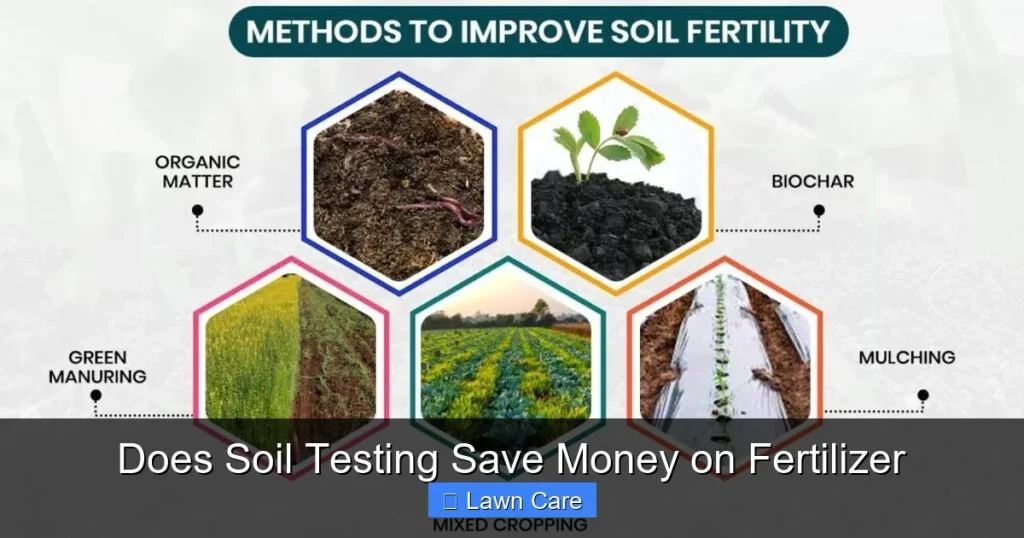
Yes, soil testing absolutely saves money on fertilizer! By understanding your soil’s specific needs, you avoid over-fertilizing, which is a waste of money and harmful to the environment. Soil testing identifies nutrient deficiencies and excesses, allowing you to apply only what your lawn truly needs. This targeted approach leads to a healthier, more vibrant lawn while significantly cutting down on fertilizer costs.
# Does Soil Testing Save Money on Fertilizer?
Are you tired of spending a fortune on fertilizer only to see lackluster results? It’s a common frustration for many homeowners. You want a lush, green lawn, but the guesswork involved in fertilizing can feel overwhelming and expensive. The good news is there’s a smart, science-backed way to approach lawn fertilization that not only yields better results but also saves you money. That method is soil testing.
In this comprehensive guide, we’ll delve into how soil testing works its magic to cut down your fertilizer bills. You’ll learn why it’s an essential step for any homeowner serious about lawn care and how to get started with your own soil test. By the end, you’ll understand how testing transforms your lawn care strategy from a costly gamble into a precise, budget-friendly plan.
## Understanding the Problem: The Cost of Guessing
Before we talk about the solution, let’s understand why guessing with fertilizer is so expensive.
### Why Guessing Leads to Wasted Money
When you don’t know what your soil needs, you tend to rely on general recommendations or simply apply fertilizer because it’s “time to fertilize.” This often leads to one of two scenarios, both of which cost you money:
* **Over-fertilization:** You apply more fertilizer than your lawn can use. The excess nutrients don’t just disappear; they can leach into waterways, causing pollution, or remain in the soil, potentially harming your grass. This means you’ve paid for fertilizer that your lawn never even benefited from.
* **Under-fertilization or Incorrect Fertilization:** You apply the wrong type or amount of fertilizer, or you miss key nutrients. Your grass won’t grow as vigorously, its color might be dull, and it could be more susceptible to pests and diseases. This can lead to needing more frequent applications, buying specialized products to fix emerging problems, or even having to reseed or re-sod sections of your lawn – all expensive propositions.
### Environmental Impact of Unnecessary Fertilization
Beyond your wallet, over-fertilizing has significant environmental consequences. Excess nitrogen and phosphorus can run off into local rivers, lakes, and oceans, leading to eutrophication – a process that depletes oxygen and harms aquatic life. This is a cost we all bear.
## The Solution: Soil Testing for Precision Lawn Care
Soil testing is the cornerstone of efficient and economical lawn care. It provides a clear picture of your soil’s health and what it needs to support a thriving lawn.
### What is Soil Testing?
At its core, soil testing is a scientific analysis of your soil to determine its physical and chemical properties. For lawn care, the most crucial aspects tested are:
* **Nutrient Levels:** This includes macronutrients like nitrogen (N), phosphorus (P), and potassium (K), as well as secondary nutrients and micronutrients.
* **pH Level:** This measures how acidic or alkaline your soil is. pH directly impacts how well grass can absorb nutrients.
* **Organic Matter Content:** This indicates the amount of decomposed plant and animal material, which is vital for soil structure and nutrient retention.
### How Soil Testing Saves You Money on Fertilizer
The savings come from taking the guesswork out of the equation. Here’s how:
#### 1. Accurate Nutrient Application
Soil tests reveal exactly which nutrients your soil is deficient in and which it has in abundance. This allows you to buy and apply only the specific fertilizers your lawn needs, rather than a generic “all-purpose” blend that might contain nutrients your soil already has plenty of.
* **Example:** If your soil test shows you have adequate levels of phosphorus, you can choose a fertilizer with a lower or zero middle number (P) in the N-P-K ratio, saving you money on an ingredient you don’t need.
#### 2. Optimized pH for Nutrient Uptake
If your soil’s pH is too high or too low, grass can’t effectively absorb many of the nutrients you apply, even if they are present in the soil or fertilizer. A soil test will tell you if your pH needs adjustment.
* **Example:** If your soil is too acidic (low pH), grass may struggle to take up nitrogen. By adding lime (as recommended by the test), you raise the pH, making existing nitrogen more available to your grass and reducing the need to apply excessive amounts of nitrogen fertilizer. This is crucial for understanding what fertilizer to use on Bermuda grass, for instance, as different grass types have varying pH preferences.
#### 3. Preventing Waste from Over-fertilization
Knowing precisely what your lawn requires prevents you from buying and applying more fertilizer than necessary. Over-applying nutrients is like throwing money down the drain. It doesn’t make your grass grow faster or greener; it just wastes resources and can even harm the grass.
#### 4. Tailored Fertilizer Choices
Test results provide specific recommendations for the type and amount of fertilizer to use. This means you can select products that are formulated to address your soil’s unique needs.
* **Example:** If your soil is sandy, it might not hold onto nutrients as well. A soil test can help inform you about this, and you might then choose a slow-release fertilizer or a fertilizer strategy that suits sandy soils, as discussed in articles about does sandy soil require different summer fertilizer.
#### 5. Long-Term Lawn Health and Reduced Costs
A healthy lawn is a resilient lawn. By ensuring your soil has the right balance of nutrients and the correct pH, you create an environment where grass grows strong. This makes your lawn less susceptible to:
* **Pests and Diseases:** Strong grass can better resist common lawn problems, reducing the need for costly pest or disease treatments.
* **Weeds:** A dense, healthy lawn outcompetes weeds for space, light, and nutrients, minimizing the need for herbicides.
* **Drought Stress:** Well-nourished grass with good soil structure can better manage water, potentially reducing your watering bills and stress during dry spells.
Ultimately, investing in soil testing is an investment in the long-term health of your lawn, which prevents expensive emergency fixes down the line. You can even explore if grass can grow without fertilizer if the soil is healthy, a concept directly tied to soil health. Can grass grow without fertilizer if soil is healthy?
## How to Get a Soil Test: A Step-by-Step Guide
Getting your soil tested is a straightforward process. There are generally two main options: DIY kits or professional lab testing. Professional lab testing is usually more accurate and provides more detailed recommendations.
### Step 1: Choose Your Testing Method
* **DIY Test Kits:** These are readily available at garden centers or online. They offer a quick snapshot of pH and sometimes major nutrients. They are less precise than lab tests but can give you a general idea.
* **University Extension Offices or Private Labs:** This is the recommended route for the most accurate results and comprehensive recommendations. Most land-grant universities have agricultural extension services that offer soil testing for a small fee. Private soil testing labs are also an option.
### Step 2: Collect Soil Samples
This is a critical step for accurate results. You need to collect samples that represent your entire lawn area.
#### Sub-step 2.1: Determine Sampling Area
* Divide your lawn into areas with similar soil types, grass types, or drainage conditions. For most home lawns, one or two areas might be sufficient.
#### Sub-step 2.2: Gather Your Tools
* You’ll need a clean trowel or shovel, a clean bucket, a plastic bag or container for each sample, and a pencil and paper to label your samples.
#### Sub-step 2.3: Take Multiple Samples from Each Area
* For each area you’re testing, take 5-10 small samples from different spots.
* Dig down about 4-6 inches, which is the root zone for most turfgrass.
* Scrape off any grass and thatch from the top of the sample before placing it in your bucket.
* Ensure you are not sampling from areas that have recently been fertilized (wait at least a few weeks).
### Step 3: Prepare and Submit Your Samples
#### Sub-step 3.1: Mix and Dry Samples
* Once you have collected all the subsamples for one area, mix them thoroughly in the clean bucket.
* If the soil is very wet, spread it out on a clean piece of cardboard or newspaper to air dry for a few hours. Do not bake it in an oven, as this can alter the results.
#### Sub-step 3.2: Bag and Label
* Place about one to two cups of the mixed, dry soil into a clean plastic bag or the container provided by the lab.
* Label each bag clearly with the area it represents (e.g., “Front Yard,” “Back Shade Area”) and the date.
#### Sub-step 3.3: Fill Out the Submission Form
* Your chosen lab or extension office will provide a form. Fill it out completely. Include details about your lawn, such as the type of grass, how long it’s been established, any past fertilization or amendment history, and your goals for the lawn. This information helps the lab provide more tailored recommendations.
#### Sub-step 3.4: Submit Your Samples
* Follow the instructions provided by the lab or extension office for submission. This usually involves mailing the samples or dropping them off in person.
### Step 4: Interpret Your Results and Apply Recommendations
This is where the magic happens. Your soil test report will provide valuable insights.
#### Sub-step 4.1: Understand the Report
* The report will show the levels of various nutrients, your soil’s pH, and often its organic matter content.
* It will also provide recommendations for fertilizer applications, liming or sulfur application (to adjust pH), and other soil amendments. These recommendations are typically given in pounds per 1,000 square feet.
#### Sub-step 4.2: Choose the Right Fertilizer
* **N-P-K Ratio:** The report will specify the recommended ratio of Nitrogen (N), Phosphorus (P), and Potassium (K). Look for fertilizers that closely match these recommendations. For example, if the recommendation is for a high-nitrogen, low-phosphorus fertilizer, you’ll look for an N-P-K number like 20-5-10.
* **Specific Nutrients:** If a specific micronutrient is deficient, the report might suggest a fertilizer containing that nutrient.
#### Sub-step 4.3: Apply Correctly
* Follow the recommended application rates precisely. Using a spreader ensures even distribution.
* Pay attention to the timing of applications, as the report might suggest when during the year to apply certain nutrients. For example, if you have Bermuda grass, you’ll want to know what fertilizer to use on Bermuda grass and when, which a soil test can help inform.
#### Sub-step 4.4: Adjust pH if Needed
* If the report indicates a need to adjust pH, follow the recommendations for lime (to raise pH) or sulfur (to lower pH). This might involve multiple applications over time.
## When to Test Your Soil
Ideally, you should test your soil every 1-3 years.
* **Initial Testing:** It’s crucial to test your soil when you first establish a new lawn or if you’ve been having persistent problems with your current lawn.
* **Routine Testing:** After the initial test and any necessary amendments, testing every 2-3 years helps you monitor changes and adjust your fertilization program as needed. This ensures you continue to save money and maintain optimal lawn health.
## Troubleshooting Common Soil Testing Questions
### My test shows high levels of a nutrient. What does that mean?
This means your soil has more than enough of that particular nutrient, and you should avoid fertilizers that contain it. Applying more would be a waste of money and could potentially harm your lawn or the environment. Focus on fertilizers that provide the nutrients your soil is lacking.
### My pH is off. How quickly can I fix it?
Adjusting soil pH is not an overnight fix. It takes time for amendments like lime or sulfur to react with the soil. Follow the lab’s recommendations for application rates and schedule, which usually involve multiple applications spread over several months or even a year or two. Patience is key!
### I can’t find a fertilizer with the exact N-P-K ratio recommended. What should I do?
It’s rare to find a perfect match. In this case, choose a fertilizer that is closest to the recommendation, prioritizing the most critical nutrient if there’s a significant imbalance. For instance, if your lawn is severely nitrogen-deficient, choose a high-nitrogen fertilizer, even if the phosphorus or potassium levels are slightly off. You can also use multiple fertilizers to achieve the desired blend, though this requires more careful calculation.
### What if my soil is heavily compacted?
While soil testing primarily focuses on nutrient and pH levels, compaction is a significant soil health issue. A soil test report might not directly address compaction, but problems like poor drainage or slow growth are often symptoms. Practices like aeration, which helps improve soil health by loosening compacted soil and improving air and water penetration, can be very beneficial and work hand-in-hand with a good fertilization plan. You might also consider if dethatching helps grass and soil breathe. Does dethatching help grass and soil breathe?
## Conclusion: The Smart Path to a Greener, More Economical Lawn
The question of whether soil testing saves money on fertilizer has a resounding answer: YES! By moving away from guesswork and embracing a data-driven approach, you can achieve a healthier, more vibrant lawn while significantly reducing your spending on fertilizer. Soil testing empowers you with the knowledge to apply precisely what your lawn needs, when it needs it, and in the right amounts. This not only benefits your wallet but also contributes to a healthier environment.
Investing a small amount of time and money into a soil test is one of the most effective lawn care strategies you can adopt. It’s the foundation for all other lawn care practices, leading to a more resilient, beautiful, and cost-effective lawn year after year. So, the next time you’re tempted to grab that bag of generic fertilizer, remember the smart choice: test your soil first.
Key Takeaways
- Soil testing is a cost-effective first step: Instead of guessing what your lawn needs, a soil test reveals precise nutrient levels, preventing you from wasting money on unnecessary or excessive fertilizer applications.
- Prevents over-fertilization: Applying too much fertilizer is not only a financial drain but can also damage your lawn and the environment. Soil tests guide you to the correct amounts.
- Identifies specific nutrient needs: Your lawn might be lacking certain essential nutrients (like nitrogen, phosphorus, or potassium) or have an excess of others. A test pinpoints these issues.
- Optimizes pH levels: Soil pH affects nutrient availability. Testing helps you adjust pH, ensuring that the nutrients you do apply are effectively absorbed by the grass.
- Tailors fertilizer recommendations: Based on the test results, you can choose the most appropriate fertilizer blend and application rate for your specific lawn type and soil conditions.
- Promotes long-term lawn health: A consistently fed lawn based on soil test data will be more resilient, drought-tolerant, and disease-resistant, reducing the need for costly treatments later.
- It’s an investment, not an expense: While there’s a small upfront cost for testing, the savings on fertilizer over time, coupled with a healthier lawn, make it a highly worthwhile investment.