Do grubs die in the winter
Do grubs die in the winter
That's the question every homeowner asks after a hard freeze, staring at a brown lawn and hoping nature took care of the problem for free. The honest answer is more complicated than a simple yes or no, and getting it wrong can cost you a whole growing season. Most grub species have evolved to survive freezing temperatures by burrowing deep below the frost line, entering a dormant state called diapause that gets them through the coldest months in surprisingly good shape.
Our research into turf pest management and published entomology literature shows that winter grub survival depends on four key factors: your region's lowest sustained soil temperatures, the specific grub species in your lawn, how deep the frost line reached, and whether snow cover provided insulation. In northern states with prolonged sub-15°F soil temperatures and little snow cover, some mortality is possible. In most of the country, the grubs are very much alive, waiting to feed again.
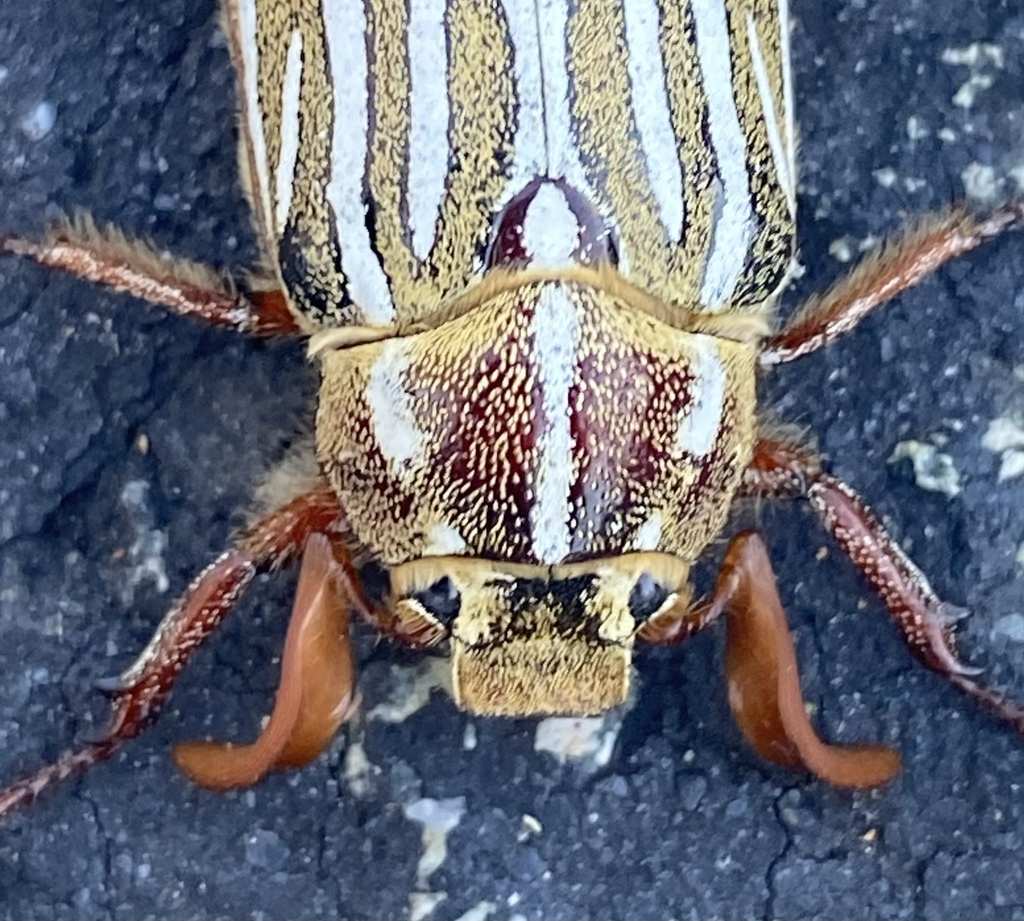
Image source: iNaturalist / Irene
The Short Answer: Most Grubs Survive Winter Just Fine
No, most grubs do not die in the winter. They are adapted to survive freezing conditions.
Grubs burrow deep below the frost line where soil stays warmer. There they enter diapause, a dormant state that slows their metabolism.
Some die-off happens during extreme cold with no snow cover. For most regions, the vast majority survive and re-emerge in spring.
Quick Answer
Most grubs survive winter by burrowing below the frost line and entering diapause. Sustained soil temperatures below 15°F may cause some mortality in several common species, but a typical winter in most of the US and UK does not kill enough grubs to prevent spring turf damage. The specific species, depth of snow cover, soil type, and your local climate zone all determine how many make it through.
Assuming winter did the work for you is one of the costliest mistakes in lawn care management.
What Actually Happens Underground When It Gets Cold
When soil temperatures start dropping in late fall, grubs don't just sit there and take it. They actively respond to cooling soil by migrating downward through the root zone, chasing the boundary where soil stays just warm enough to avoid freezing. This movement is triggered by temperature shifts at 2 to 4 inches, which is why you'll rarely find active grubs in the top few inches of soil once overnight lows consistently hit the 40s°F.
Once they reach the right depth, typically somewhere between 6 and 18 inches depending on the species and the region, they enter diapause. This isn't just slowing down. Their metabolic rate drops dramatically, their feeding stops almost completely, and their bodies produce cryoprotectants like glycerol that act as a natural antifreeze.
Think of it as a controlled shutdown, not a failure state.
The tricky part for homeowners is that this whole process happens out of sight. Your lawn can look dormant and healthy above ground while dozens of grubs per square foot sit safely inches below, barely alive but perfectly intact. By the time spring soil temperatures climb back above 50°F at the 2-inch depth, those same grubs resume feeding right at the root zone, often before you've even scheduled your first mow.
How Different Grub Species Handle Freezing Temperatures
Not all grubs are built the same when it comes to cold tolerance. The species living in your lawn makes a real difference in winter survival rates, and that's where most generic advice falls short. Treating "grubs" as a single category leads to bad timing on treatments and false expectations about natural die-off.
Here's what the published research and extension data tell us about the most common species:
| Grub Species | Typical Overwintering Depth | Relative Cold Tolerance | Notes |
|---|---|---|---|
| Japanese beetle (Popillia japonica) | 6–12 inches | Moderate | Most vulnerable of the common northern species; some mortality in extreme cold |
| European chafer (Amphimallon majale) | 6–12 inches | High | Hardier than Japanese beetles; very common in the Northeast and Midwest |
| June bug / May beetle (Phyllophaga spp.) | 8–18 inches | High | Deeper burrowers, well below most frost lines in northern states |
| Masked chafer (Cyclocephala spp.) | 4–10 inches | Moderate | Active later into fall, which can delay deep migration |
| Green June beetle (Cotinis nitida) | 4–8 inches | Low to moderate | Southern species; rarely faces truly lethal temperatures |
| Billbug (Sphenophorus spp.) | Inside stems / thatch layer | Low (cold climates) | Less cold-hardy; northern populations can see significant winter die-off |
Japanese beetle grubs are the most studied, and the data is fairly consistent: they can handle soil temperatures down to about 15°F for short periods, but sustained cold below that threshold with no snow insulation will cause meaningful mortality. European chafers are notably tougher. Many extension entomologists throughout cooler climates have documented European chafer populations surviving winters that should have knocked Japanese beetle numbers back significantly.
June bug grubs take a different strategy entirely. They're deeper burrowers, often reaching 18 inches or more in northern soils, which puts them well below even a deep frost line. That depth is their survival insurance.
They're sitting in soil that never freezes solid regardless of what the air temperature does.
A practical takeaway: if you're in the upper Midwest or Northeast dealing primarily with June bug grubs, don't count on a cold winter to reduce your population. If you're in the Mid-Atlantic with mostly Japanese beetles, a sustained deep freeze without snow actually helps. The shorter answer is that species identification should drive your expectations and your treatment plan, not a blanket assumption.
Why Your Grubs Probably Didn't Die Last Winter
Let's talk about the most common scenario, because it's the one that catches people off guard year after year. You had a grub problem last fall. Snow covered your lawn most of winter.
Spring arrives, the snow melts, and your lawn starts showing damage patches in April and May. You assumed the cold would sort it out. It didn't.
Here's why. Snow cover is an incredibly effective insulator. Once you get about 3 to 4 inches of settled snow on the ground, the soil surface beneath it can be 20 to 30°F warmer than the air temperature above the snow.
That's basic soil physics. The snow traps ground heat and prevents it from radiating away. Research from northern university extension programs consistently show an insulating effect that keeps soil temperatures at the 2-inch depth hovering right around 30 to 32°F, even when air temperatures plunge well below zero.
So your grubs, sitting at 6 to 12 inches, are essentially in a temperature-stable bunker while a blizzard rages above them. They're not even close to the lethal cold they would face if that same air temperature hit bare ground. This is one of the biggest reasons that a snowy winter almost never delivers the grub control people hope for.
The other factor is timing. Grubs don't start their deep migration until soil temperatures at the root zone begin consistently dropping, and in a warm autumn they may not move down until late November or even December. If cold comes early and hard before they've migrated, you get more die-off.
Most years in most regions, the transition is gradual enough that the grubs have time to reach safety before the worst cold arrives. That's a comfortable reality, not a grim one, but understanding it explains why winter control is unreliable as a strategy.
The Big Variables That Change Everything
If you want to know whether grubs in your specific lawn are likely to survive winter, four factors matter more than air temperature alone.
Your Geographic Location and Hardiness Zone
The USDA Plant Hardiness Zone map, updated by the USDA Agricultural Research Service, gives a reliable baseline for understanding your winter grub survival odds. Zones 3 and 4, including most of Minnesota, Wisconsin, and northern New England, see the most potential for natural grub mortality because sustained soil temperatures regularly drop into the range where even hardy species begin to struggle. Zones 5 and 6, covering much of the Midwest, Mid-Atlantic, and parts of the Pacific Northwest, deliver mixed results.
The occasional polar vortex event can penetrate deep enough to cause die-off, but most winters don't get the job done. Zones 7 and south, basically the lower third of the US, are in minimal danger territory. Soil temperatures at grub depth rarely approach lethal levels, and some species remain semi-active through much of the winter in Zones 8 to 10.
For our research across temperate regions, the story is broadly similar. Most of England and Wales see winters too mild to cause significant grub mortality, while Scotland and northern England offer a slightly better chance during harsh winters.

Snow Cover: Nature's Insulation Blanket
We've touched on this, but it deserves its own emphasis because it's the single biggest contributor to grub survival during cold winters. That protective snow blanket explains why a subzero January in Minneapolis or Chicago doesn't reduce grub populations the way you'd expect. Once the ground is insulated, soil temperatures stabilize and rarely drop below 28°F at depth, even during prolonged cold spells.
The flip side matters just as much. A cold snap with no snow cover, especially in a mild-climate region like the Mid-Atlantic, can be more damaging to grub populations than a deeper freeze up north beneath a foot of powder. An exposed ground gives the cold air direct access to the soil profile, and the frost line can plunge fast.
Several state extension services have documented exactly this pattern. A dry, bare January freeze can cause significantly more grub mortality than a snowy February with the same air temperatures.
Soil Type and Moisture
Sandy soils freeze faster and deeper than clay or loam soils because they hold less moisture and moisture acts as a heat reservoir. If your lawn is on sandy soil, the frost line reaches deeper and actual grub mortality is higher compared to a heavy clay lawn in the same region. This variable gets overlooked by homeowners and even some lawn care professionals.
Soil moisture before freeze-up also plays a role. Moist soil holds heat better than dry soil because water has a high specific heat capacity. A wet fall followed by a gradual freeze is actually a worst-case scenario for grub mortality.
A dry fall and sudden deep cold is better if your goal is natural reduction, but even that rarely delivers complete control.
Species Matters More Than People Think
If you haven't identified which grub species dominates your lawn, you're guessing about winter survival. The species breakdown from regional extension surveys tells a consistent story. European chafers and June bug grubs survive northern winters at very high rates regardless of how cold it gets.
Japanese beetle grubs see meaningful die-off only in the coldest, snow-free winters in Zones 5 and north. Green June beetle grubs, common in the southern and transition zones, face almost zero cold-related mortality.
If you had a confirmed Japanese beetle grub problem in northern Ohio or Pennsylvania, a harsh snowless winter actually gave you a head start this year. If your problem is European chafers in the same area, you're essentially starting from the same point as last fall. That distinction alone changes your entire management approach heading into the growing season.
When Winter Cold Does Kill Grubs (and When It Doesn't)
Winter cold kills grubs only under specific conditions that rarely align in most regions. The combination of sustained soil temperatures below 15°F, no snow cover, and shallow-burrowing species creates the only realistic scenario for meaningful natural die-off. Even then, you're looking at partial reduction, not elimination.
Sustained Extreme Cold Scenarios 15°F and Below
Soil temperature, not air temperature, is what matters. A week of single-digit air temperatures means nothing if the soil at grub depth stays above 20°F. The threshold where cold starts killing grubs consistently is sustained soil temperatures at or below 15°F at the depth where grubs are overwintering.
That typically requires air temperatures well below zero for multiple consecutive days with no insulating snow cover.
This scenario happens most reliably in USDA Zones 3 and 4, particularly in Minnesota, North Dakota, northern Wisconsin, and northern New England. Even in those regions, it doesn't happen every winter. A single polar vortex event in January can do the work, but a mild January followed by a snowy February essentially resets the clock.
The grubs that survived the initial cold are now insulated and safe for the remainder of the season.
The Grubs Most Likely to Survive a Freeze
European chafer grubs and June bug grubs are the survivors. European chafers have documented cold tolerance into the low teens Fahrenheit, and their typical overwintering depth of 6 to 12 inches puts them below the frost line in most northern states. June bug grubs go even deeper, often reaching 18 inches, which makes them virtually immune to winter kill outside of the most extreme Arctic outbreaks.
Japanese beetle grubs are the weak link in this group. They overwinter at similar depths to European chafers but lack the same cold tolerance. Research from multiple state extension services consistently shows Japanese beetle populations taking a harder hit during severe winters compared to other species.
If your lawn has a mixed population, a harsh winter may shift the balance toward European chafers and June bugs simply because the Japanese beetles didn't make it.
Grubs That Already Acclimated or Migrated Deep
Grubs that entered diapause early and reached their maximum depth before the first hard freeze have the best survival odds. A gradual cooling trend through October and November gives them time to acclimate physiologically, building up glycerol concentrations and completing their downward migration. An abrupt temperature plunge in early November, before they've moved deep, can catch them in the upper soil profile where frost penetrates fastest.
This timing factor explains why two back-to-back winters with similar low temperatures can produce very different grub survival rates. The winter that follows a warm, gradual autumn delivers high survival. The winter that follows a sudden cold snap in late October can cause surprising die-off, even if the overall winter isn't particularly severe.
What Surviving Grubs Do in Spring
When soil temperatures at the 2-inch depth consistently reach 50°F, typically in March or April depending on your region, overwintered grubs begin migrating back up into the root zone. This is the most damaging phase of their entire life cycle because the grubs are large, well-fed from the previous fall, and ravenous after months of dormancy.
Spring Feeding Surge and Root Damage
Spring grub damage often looks worse than fall damage, and there's a good reason for that. The grubs that survived winter are mature third-instar larvae, the largest and most voracious stage. They can sever turfgrass roots faster than the plants can regenerate them.
Kentucky bluegrass and perennial ryegrass, two of the most common lawn species in northern regions, are particularly vulnerable during this window.
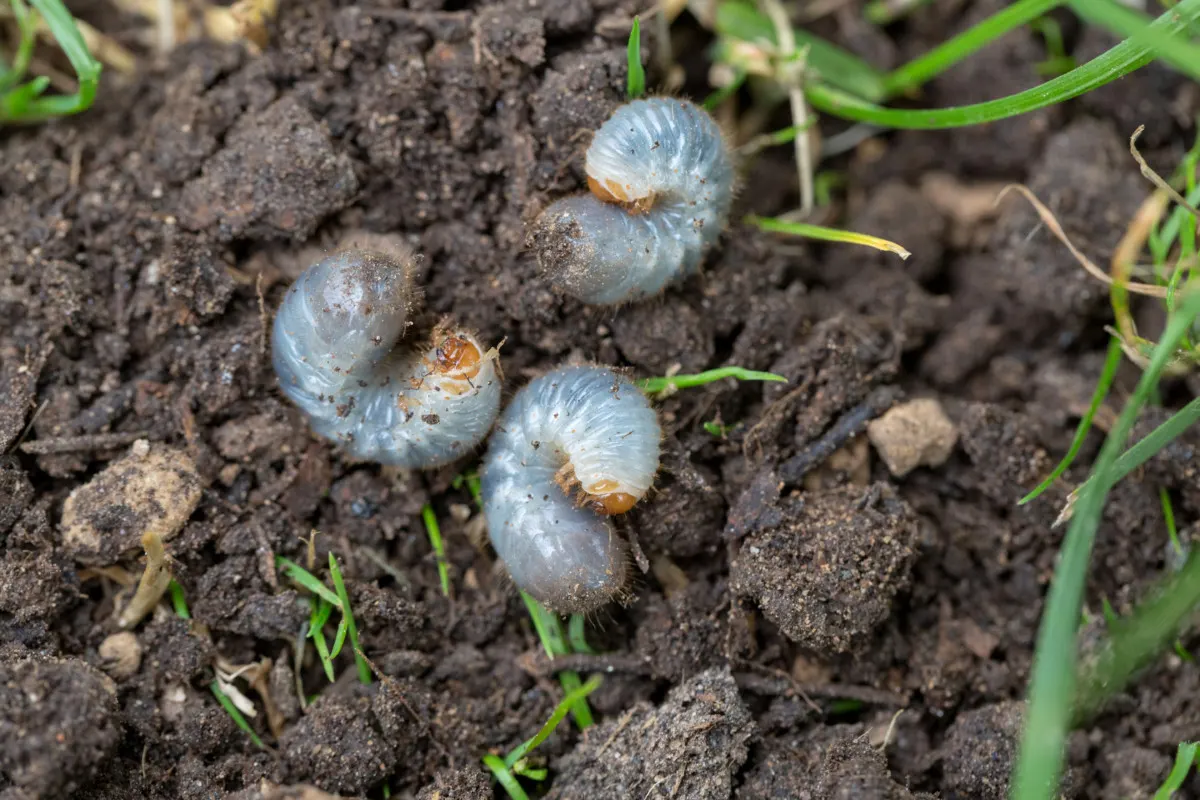
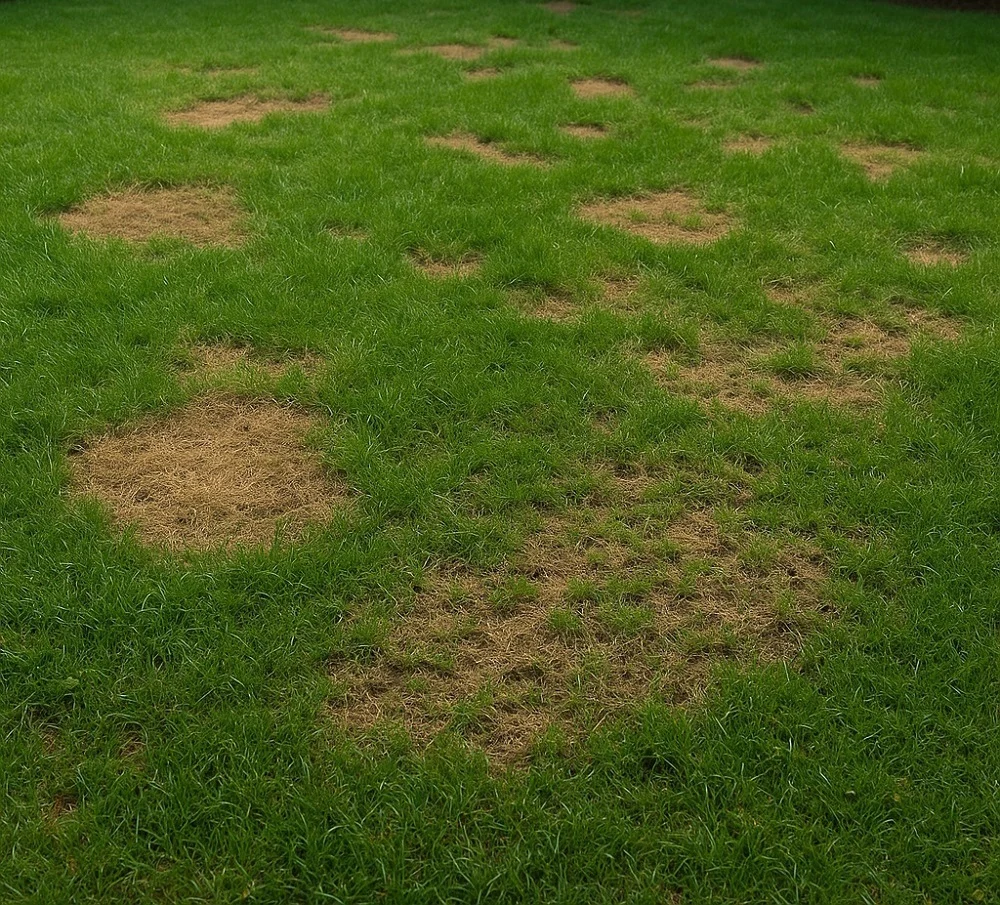
The telltale sign is turf that pulls up easily from the soil surface, like peeling back a carpet. Beneath it, you'll find the grubs curled in a C-shape, actively feeding. By the time you see brown patches from the curb, the root damage underneath is already extensive.
This is the point where many homeowners first realize winter didn't solve their problem.
Animal Tearing Up Your Lawn in Search of Grubs
Skunks, raccoons, and birds are excellent grub detectors, and their activity in spring is a reliable indicator that overwintered grubs are present and active. Skunks in particular will peel back sections of turf in neat strips to access the grubs underneath. A single skunk can do more visible damage in one night than grubs do in a week.
If you're seeing animal digging in March or April, that's confirmation that your grub population survived winter intact. It's also a sign that the grubs are shallow enough in the soil profile to be worth the animals' effort, meaning they've already migrated up into the root zone and are actively feeding.
Why Cold Erased Some Problems in the South
In southern regions where green June beetle grubs are the primary pest, winter cold is essentially irrelevant to population control. Green June beetle grubs overwinter at shallow depths, often just 4 to 8 inches, but the soil at those depths rarely approaches lethal temperatures south of Zone 7. Some southern extension services have documented green June beetle grubs remaining partially active through winter in Zone 8, with soil temperatures staying above 40°F at grub depth for most of the season.
This means southern homeowners can't rely on any winter die-off at all. The grubs are a year-round management consideration, and treatment timing follows a completely different schedule than in northern regions.
The Smart Approach to Year-Round Grub Management
Effective grub management isn't about hoping for a cold winter. It's about understanding the life cycle and intervening at the right points. The grubs that survived winter will pupate and emerge as adult beetles in late spring to early summer, typically May through July depending on the species.
Those adults lay eggs in moist soil in mid to late summer, and the new generation of grubs begins feeding in the root zone by August.
When and How to Inspect for Active Grubs
The best time to scout for grubs is late August through October, when the new generation is small, shallow, and most vulnerable to treatment. Cut a 1-foot square of turf at a few spots around your lawn and peel it back. Count the grubs you find in the root zone and top 2 inches of soil.
The economic threshold for most cool-season turf species is 5 to 10 grubs per square foot. Below that, healthy turf can usually outgrow the damage. Above that, treatment is warranted.
Spring inspection is also useful but serves a different purpose. Finding grubs in spring confirms that winter didn't control your population and helps you plan for preventive treatment the following summer. It's too late for effective curative control on spring grubs because they're large, deep, and about to pupate.
Preventive vs. Curative Treatment: Picking the Right Window
Preventive treatments target the young grubs shortly after egg hatch, typically late July through September in northern regions. Products containing imidacloprid or chlorantraniliprole are applied during this window and remain active in the soil long enough to catch the vulnerable early-instar grubs as they begin feeding. This is the most effective and cost-efficient approach for lawns with a history of grub damage.
Curative treatments target larger, actively feeding grubs in spring or fall. Products containing trichlorfon or carbaryl work faster but require precise timing. The window is narrow: soil temperatures between 50 and 60°F at 2-inch depth, when grubs are actively feeding near the surface.
Miss that window and the grugs are either too deep or too mature for reliable control.
Biological Controls That Work with Soil Temperatures
Beneficial nematodes, specifically Heterorhabditis bacteriophora, are a biological control option that can be effective when applied correctly. The catch is that nematodes require soil temperatures above 45°F to be active and need consistent soil moisture to move through the soil profile. That makes them a viable option for fall curative treatment in most regions, but a poor choice for spring when soil temperatures fluctuate and rainfall is unpredictable.
Milky spore disease, caused by the bacterium Paenibacillus popilliae, targets Japanese beetle grubs specifically. It's not effective against European chafers, June bugs, or other species. Milky spore takes several years to build up in the soil and works best as a long-term preventive strategy in regions where Japanese beetles are the dominant pest.
Selecting the Right Product for Your Situation
The right product depends on your timing, your target species, and your comfort with chemical versus biological options. For preventive control in a lawn with recurring Japanese beetle problems, a mid-summer application of a chlorantraniliprole-based product is the standard recommendation from most university extension programs. For a lawn with mixed species and a preference for biological control, fall application of Heterorhabditis nematodes when soil temperatures are in the 50 to 60°F range offers reasonable efficacy.
Always read the product label completely. The label specifies application rates, timing windows, safety precautions, and re-entry intervals. In many states, applying a pesticide in a manner inconsistent with its label is a violation of both federal and state law.
Common Mistakes People Make Assuming Winter Killed Their Grubs
The biggest mistake is doing nothing and hoping. Every spring, extension offices across the country field calls from homeowners who assumed a cold winter eliminated their grub problem, only to discover extensive damage by May. Winter is not a reliable grub control strategy in most regions, and treating it as one guarantees you'll be dealing with the same or worse damage the following year.
The second mistake is applying curative treatments too late in spring. By the time you see damage, the grubs are often large, deep, and preparing to pupate. Curative insecticides work best on small, actively feeding grubs near the surface.
A spring application in May or June, when damage is already visible, is often too late to prevent significant harm.
The third mistake is misidentifying the grub species and choosing the wrong treatment. Milky spore won't touch European chafers. Nematodes won't work in cold soil.
Preventive products applied in September won't help if your primary pest is already in the pupal stage by then. Proper identification, even a basic one, prevents wasted money and missed windows.
The fourth mistake is overtreating. Not every grub in your lawn requires a chemical response. Populations below the economic threshold of 5 to 10 grubs per square foot rarely cause visible damage to healthy, well-maintained turf.
Regular watering, proper mowing height, and adequate fertilization help turf outgrow low-level grub feeding without any intervention at all.
What the Research and Regional Extension Services Say
The consensus across university turfgrass programs and state extension services is consistent: winter cold alone is not a dependable grub management strategy for most regions. Research published in the Journal of Economic Entomology and Environmental Entomology consistently shows that grub survival through winter is the norm, not the exception, across the majority of the United States and temperate regions globally.
The USDA Animal and Plant Health Inspection Service tracks grub species distribution and provides regional pest alerts that help local extension offices time their recommendations. State-level integrated pest management programs, such as those run by Michigan State University, Penn State, and the University of Massachusetts, publish annual grub management calendars tailored to local climate conditions and dominant species.
These resources all point to the same conclusion. If you have a documented grub problem, plan for active management. Don't wait for winter to do the work.
The grubs almost certainly survived, and they'll be back in your root zone as soon as the soil warms up.
Frequently Asked Questions
At what temperature do grubs die in winter?
Sustained soil temperatures at or below 15°F at grub depth can cause mortality, particularly for Japanese beetle grubs. Most common grub species can survive brief exposure to colder temperatures, especially if they've entered diapause and migrated below the frost line.
Do grubs come back after winter?
Yes. Grubs that survive winter resume feeding in spring when soil temperatures reach about 50°F at the 2-inch depth. They then pupate and emerge as adult beetles in late spring to early summer, completing the cycle.
Can grubs survive under snow?
Snow cover insulates soil and significantly improves grub survival. Just 3 to 4 inches of settled snow can keep soil temperatures 20 to 30°F warmer than the air above, protecting grubs from lethal cold.
What is the best time to treat for grubs?
Late July through September is the optimal window for preventive treatments targeting newly hatched grubs. Fall curative treatments work when soil temperatures are between 50 and 60°F and grubs are actively feeding near the surface.
How do I know if grubs survived winter in my lawn?
Look for spring feeding damage in April and May, animal digging activity, or conduct a direct inspection by cutting and peeling back a square foot of turf. Finding active grubs in the root zone confirms winter survival.
Will a cold winter get rid of grubs naturally?
Only in the coldest regions with sustained extreme cold and no snow cover. For most homeowners in most regions, winter reduces grub populations modestly at best and should not be relied upon as a control method.