You're probably here because you just dug a pale, squirming larva out of your garden and wanted to know one thing flat-out: do grub worms bite? It's a reasonable question. Something wriggling in the soil near your skin makes anyone pause, especially if you've got kids or pets rolling around on the lawn.
The short answer is no, white grubs don't bite humans or pets. Their mouthparts are designed for one job, chewing through grass roots underground. But the confusion makes perfect sense, because the itchy red bumps you're blaming on grubs usually have a different culprit entirely.
White grubs are scarab beetle larvae, part of the Scarabaeidae family, and a single square foot of heavily infested soil can hold 10 or more of them feeding quietly below the surface, which explains why people connect them with skin irritation even though grubs simply cannot bite.
Quick Answer
No, grub worms do not bite people or pets. White grubs lack the mouthparts and venom needed to bite human skin. They chew grass roots underground using small mandibles.
The itching people blame on grubs usually comes from fleas, chiggers, or fire ants living in the same lawn. White grubs damage lawns, not skin.
Why You're Really Asking About Grub Worms
The real question behind "do grub worms bite" is usually "what's biting me in my yard?" People find white grubs while gardening, notice bug bites on their legs or their dog's belly, and connect the two. It's an easy mental shortcut, but it sends a lot of homeowners down the wrong path.
When you treat grubs as the biting pest, you waste time and often money on the wrong solution. Meanwhile, the actual biters keep thriving. Worse, some people dump unnecessary pesticides onto their lawn trying to kill something that was never the enemy.
Grubs are a real lawn problem, no question, but they're a root-chewing pest, not a biting one.
The fastest way to tell if your yard trouble is grubs is to isolate the symptom. Itchy welts, bites on ankles, or a dog scratching constantly point to entirely different pests. Sponge-brown patches of grass that peel back like loose carpet, that's classic grub damage.
Once you separate the two issues, you can fix both properly.
The Straight Answer: Do Grub Worms Bite?
No, they do not. White grubs have zero interest in biting anything above ground. Their anatomy simply isn't built for it.
The mandibles on a white grub are small, hard structures meant to slice through grass roots and organic matter in the soil. They don't have the musculature, jaw structure, or behavioral drive to puncture skin, let alone break through it.
Grubs also lack venom glands, stingers, or any defensive mechanism that could hurt humans or animals. If you pick one up, the most you'll feel is a faint tickle as it wiggles. No pinch, no puncture, no reaction afterward beyond maybe feeling a little squeamish.
The Entomological Society of America and university extension programs across the country consistently classify white grubs as plant-feeding larvae with no medical significance to humans. They're a horticultural pest, not a health one.
What White Grubs Actually Are
White grubs are the larval stage of scarab beetles, a large family that includes Japanese beetles, June beetles, European chafers, masked chafers, and green June beetles. Every one of these beetles lays eggs in soil, and those eggs hatch into the C-shaped, cream-colored larvae most people call grub worms.
Here's what a typical white grub looks like:
- C-shaped body curled up when disturbed
- Cream or white body with a distinct brown head capsule
- Three pairs of small legs clustered near the head
- Soft, pliable skin that's easy to tear
- Size varies from about ¼ inch (newly hatched) up to 2 inches for mature green June beetle larvae
Different species show slight variations. European chafer grubs tend to stay smaller. Japanese beetle grubs grow to about an inch.
Green June beetle larvae are the largest and more active, sometimes crawling across the soil surface at night.
All of them, though, share the same basic design: a root-eating machine built entirely for life underground. They go through a fairly predictable life cycle. Adult beetles lay eggs in midsummer.
Larvae hatch and feed on roots through late summer and fall. They burrow deeper to overwinter, then return closer to the surface the following spring to feed again before pupating into adult beetles.

Image source: Wikimedia Commons / Garst, Warren, 1922-2016, photographer (CC BY-SA)
Why People Think Grub Worms Bite
The confusion makes sense when you walk through a typical scenario. A homeowner is weeding a flower bed, pulls up a handful of soil, and finds several white grubs. An hour later, they notice red bumps on their arms or legs.
The brain connects the dots, grubs cause the bumps, except they don't.
Here are the real reasons people make the false connection:
- Timing overlap: Grubs are most visible and active during the same warm months when chiggers, fleas, and fire ants are biting heavily.
- Location overlap: Both grubs and biting pests occupy the same lawn environment, so proximity gets confused with causation.
- Misidentification: People sometimes mistake other larvae for grubs, including species that do have defensive hairs or bristles.
- Skin sensitivity: Bare skin contacting soil, plant debris, or fungal spores while gardening can cause mild irritation that gets blamed on whatever bug was nearby.
- Pet symptoms: Dogs and cats that roll in grub-infested lawns may end up with flea bites, and the owner sees the grubs, not the fleas.
Our research into homeowner forums and extension service inquiries shows this confusion peaks in late summer, exactly when grub populations and biting insect populations are both at their highest. Two unrelated problems peak at the same time, and most people reasonably assume they're related.
What Those Mouthparts Are Really For
Let's look at what grubs are actually equipped to do. The mandibles of a white grub are hard, dark, and located at the front of that brown head capsule. Under magnification, you can see they're curved and serrated on the inner edge.
They're built for one purpose, shearing through fibrous plant material underground.
These mandibles operate in a scissor-like motion, cutting grass roots into small pieces the grub can digest. They're remarkably efficient at it. A heavy grub population can sever the root system of an entire lawn section in just a few weeks.
Here's what the mouthparts absolutely cannot do:
- They can't puncture human or animal skin
- They can't deliver venom of any kind
- They can't clamp down hard enough to feel like a bite
- They don't have the structural support to lever against soil or skin the way ant mandibles do
A white grub's mouth is essentially a tiny pair of garden shears pointed downward into the dirt. There's simply nothing about that anatomy that translates to biting a person.
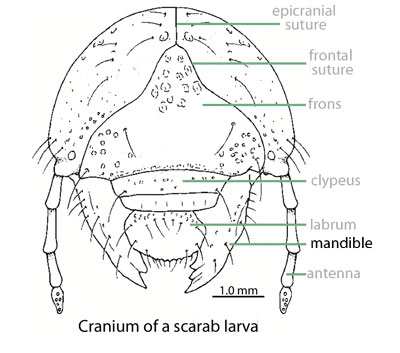
Image source: Bing (Web (fair-use with source credit))
What's Actually Biting You Instead
If grubs aren't the biting pest, what is? The most common biters found in the same lawn and garden environments where white grubs live include several species that are genuinely problematic for people and pets.
Fleas are the top suspect. These tiny insects feed on mammals and leave clusters of small, intensely itchy red bumps, often around the ankles and lower legs. They thrive in shady, moist lawn areas, exactly the conditions many grubs also favor.
Chiggers, actually the larval stage of trombiculid mites, attach to skin around tight clothing areas (waistbands, sock lines) and cause red, swollen welts that itch for days. People walking through tall grass or weedy areas pick them up easily.
Fire ants build visible mounds in lawns and deliver painful, burning stings that develop into white pustules. Their presence often overlaps with grub-heavy turf, since both like sunny, well-drained soil.
Mosquitoes and no-see-ums contribute to outdoor biting and are simply a fact of summer lawn life.
If you're finding grubs in your soil and also experiencing bites, check for these actual biters. Look between your pet's toes for flea dirt (small black specks), inspect lawn edges for ant mounds, and note whether bites cluster around your waist or ankles after yard work. That information will tell you far more than the grubs can about what's actually getting you.
When Grubs Are Actually a Problem
Grubs don't bite, but they absolutely destroy lawns. The damage happens underground first, by cutting off the roots that supply water and nutrients to the grass. By the time you see brown patches on the surface, the root system below is already heavily compromised.
Here's what grub damage looks like in stages:
| Stage | What You See | What's Happening Below |
|---|---|---|
| Early | Slight yellowing in patches | Larvae feeding on fine roots, grass still attached |
| Moderate | Brown, spongy turf that feels loose | Root system mostly severed, sod lifts easily |
| Severe | Large dead patches, turf rolls back like a carpet | Root system completely destroyed, secondary damage from animals digging |
The real kicker is that grub damage gets a helping hand from wildlife. Skunks, raccoons, armadillos, and birds will tear up your lawn overnight to get at the grubs. They can destroy in one evening what it took the grubs months to set up.
If you're seeing torn-up patches of sod, the grubs were probably there first, and the animals came second.
University extension programs typically recommend treatment when you find 5 to 10 white grubs per square foot of cool-season turf. Warm-season grasses tolerate slightly higher numbers, sometimes 10 to 15 per square foot before damage becomes visible. Cut a 1-foot square of turf, peel it back, and count what's in the soil.
That's the only reliable way to know if your grub population has crossed the threshold.

Image source: Bing (Web (fair-use with source credit))
How to Tell White Grubs Apart From Everything Else
Not every wriggly white thing in your soil is a grub. Several other larvae share similar coloring and habitat, and some of them are genuinely irritating to skin or destructive in different ways.
The most reliable feature for identifying a white grub is the C-shaped body curl. A true grub will curl into a comma shape when disturbed. Wireworms, the larvae of click beetles, are straight, hard-bodied, and shiny.
Cutworms are fat caterpillars that curl into a loose C but have visible prolegs along their belly. Fungus gnat larvae are tiny, almost translucent, and found in overly wet potting soil rather than lawn turf.
Here's a quick identification breakdown:
| Creature | Body Shape | Legs | Where You'd Find It | Skin Irritation? |
|---|---|---|---|---|
| White grub (scarab larva) | Tight C-curl | 3 small pairs near head | Lawn soil, 1–4 inches deep | No |
| Wireworm (click beetle larva) | Straight, hard | 3 pairs near root crops, garden beds | No | |
| Cutworm (moth larva) | Loose C-curl | 3 pairs + prolegs | Garden soil at surface, chews stems | No |
| Fungus gnat larva | Thin, translucent | None visible | Houseplant pots, wet soil | No |
| Millipede | Long, segmented, many legs | Dozens of pairs | Mulch, leaf litter | Can secrete irritating fluid |
| Sowbug/pillbug | Flat, armored, seven pairs | 7 pairs | Under mulch, damp areas | No |
If you're holding something in your hand and wondering whether it bites, stop worrying the moment you see that tight C-curl. That's the signature pose of a white grub, and white grubs are harmless to your skin.

Image source: Bing (Web (fair-use with source credit))
How to Check Your Lawn for Grubs
Doing a proper soil check takes less than 10 minutes and tells you everything. You don't need special tools, just a flat shovel or a sturdy trowel and a willingness to get your hands dirty.
Step 1: Pick your sampling spots. Focus on areas where grass looks stressed, yellowish, or thinning. Also check sunny, south-facing slopes and areas near outdoor lights, where adult beetles tend to lay more eggs.
Step 2: Cut a 1-foot square. Slice three sides of a 12 by 12-inch block about 2 to 3 inches deep. Peel back the turf like a flap, keeping it attached on one side so you can fold it back.
Step 3: Count what's underneath. Look through the soil and the root zone. Crumble the dirt gently to expose any grubs hiding below. Count every grub you find in that square foot.
Step 4: Check a couple more spots. Sample at least three or four locations around the affected area. Grub populations aren't evenly distributed, so one spot might be clean while another nearby is loaded.
Step 5: Evaluate your numbers. For cool-season grasses like fescue, Kentucky bluegrass, and perennial ryegrass, treat if you're consistently finding more than 5 grubs per square foot. Warm-season grasses like Bermuda and zoysia can usually handle up to 10 per square foot before damage becomes visible.
If you find 10 or more grubs per square foot consistently across multiple samples, your lawn is in damage territory and it's time for treatment.
What to Do If You Find Too Many Grubs
Once you've confirmed an over-threshold population, your treatment path depends on the time of year and how badly damaged the turf already is.
Curative treatment (late summer through early fall) targets grubs that are actively feeding and large enough to cause visible damage. Products containing trichlorfon (sold under various brand names) or carbaryl work quickly, often within 24 to 72 hours. Apply them to moist soil and water in lightly afterward, about ¼ inch of irrigation, so the active ingredient reaches the root zone where the grubs are feeding.
Preventive treatment (June to July) targets newly hatched grubs before they grow large enough to cause serious damage. Products containing imidacloprid or chlorantraniliprole are applied earlier in the season and need to be in the soil before eggs hatch. These have a longer residual effect but require precise timing.
Biological options give you a slower but lower-maintenance route. Milky spore disease (Paenibacillus popilliae) targets Japanese beetle grubs specifically and takes 2 to 3 years to build up in the soil, but can persist for a decade afterward. Beneficial nematodes, particularly Heterorhabditis bacteriophora, are applied as a curative treatment in late summer.
They actively hunt grubs in the soil and are most effective when soil temperatures are above 60°F.
Cultural practices help too. Deep, infrequent watering encourages grass roots to grow deeper, making them harder for grubs to completely destroy. Overseeding damaged areas in early fall, after curative treatment has knocked back the grub population, fills in the gaps before winter.
Avoid these common errors:
- Applying preventive products in September, the grubs are already large and these won't touch them effectively
- Treating without sampling first, you might be solving a problem you don't have
- Skipping the watering-in step, granular products need moisture to move down into the root zone
- Treating only once in heavily infested areas, some species return year after year and may need multi-year management
Frequently Asked Questions About Grub Worms
Can a white grub bite a person picking it up?
No. A white grub's mandibles cannot exert enough force to break human skin. You might feel the larva wriggling against your palm, but it has no biting capability toward mammals.
The mandibles are designed for cutting plant roots, not puncturing tissue.
Are grub worms harmful to dogs or cats that eat them?
White grubs are not toxic to pets. Dogs and cats that eat a few grubs while rooting around in the lawn won't experience any adverse effects. The main concern with pets is that skunks and raccoons tearing up the lawn for grubs can create a mess, not that the grubs themselves pose a direct threat.
What do grub bites look like, if they don't bite?
Grub bites don't exist. If you have red, itchy bumps after working in the garden, the likely causes are chiggers, contact with plant material, or another biting insect present in the same area. Grubs cannot and do not bite human skin under any normal circumstances.
How can I tell grubs apart from other white larvae in soil?
The tight C-shaped curl is the quickest identifier. White grubs have three pairs of small legs near a distinct brown head capsule, a soft cream-colored body, and no visible prolegs along the belly. Wireworms are straight and hard-bodied.
Cutworms are fatter and show additional stubby legs along their underside.
What time of year are grubs most active in lawns?
Grubs are most active in late summer and early fall, typically August through October across most of the United States. This is when larvae are largest and feeding most aggressively, causing the visible brown patches homeowners notice. A second feeding period sometimes occurs in spring, but it's usually less damaging because the grass is actively growing and can tolerate some root loss.
How many grubs per square foot is too many?
For cool-season grasses, most university extension programs recommend treatment at 5 to 10 grubs per square foot. Warm-season grasses can tolerate slightly higher numbers, up to about 15 per square foot, before damage becomes visible. These thresholds help you avoid unnecessary treatments while catching damaging populations before turf loss becomes severe.
What to Do If You Find Too Many Grubs
Curative products containing trichlorfon or carbaryl work fast, usually within 24 to 72 hours, when grubs are actively feeding in late summer. Water in granular applications with about ¼ inch of irrigation so the active ingredient reaches the root zone where grubs live.
Preventive products with imidacloprid or chlorantraniliprole need to be applied by early July. These work on newly hatched grubs before they grow large enough to cause visible damage. Timing matters more with these than with curative treatments.
Keeping Grubs Under Control Long-Term
Long-term grub management combines cultural practices with targeted treatments. Deep, infrequent watering pushes grass roots deeper, making them harder for grubs to destroy completely.
Milky spore disease takes 2 to 3 years to establish in soil but can persist for over a decade once established. It only targets Japanese beetle grubs, so identify your species first. Beneficial nematodes give seasonal control when applied in late summer and are safe around pets and people.
Rebuild damaged areas by reseeding after knocking back the grub population, and schedule annual soil checks in your worst-hit spots to catch the next wave early.
Keeping Grubs Under Control Long-Term
Good lawn care practices raise the threshold your turf can absorb. Deep watering every 5 to 7 days beats daily light sprinkles every time, because deeper roots survive grub feeding better than shallow ones. Mowing at the high end of your grass species' recommended range helps too.
Milky spore disease takes 2 to 3 years to build up in soil but can persist for over a decade. It targets only Japanese beetle grubs, so correctly identifying your species pays off before you invest in this approach. Beneficial nematodes such as Heterorhabditis bacteriophora give a reliable seasonal knockdown when applied in late summer, and they actively hunt through soil rather than waiting for grubs to passively ingest something.
Rebuild damaged areas by reseeding after knocking back the grub population, then schedule annual soil checks in your worst-hit spots to catch the next wave early. Most university extension services maintain updated guidance on products and timing for your specific region. State departments of agriculture report product availability restrictions that shift from year to year, so a quick check with your local extension office is worth the time.
Frequently Asked Questions About Grub Worms
Are grubs poisonous if a child or pet eats one?
No. White grubs are not toxic. A curious toddler or dog that swallows a grub won't experience any adverse reaction beyond the usual risk of swallowing any small object.
They have no venom, no defensive toxins, and no harmful gut contents.
Do green June beetle grubs bite differently than other white grubs?
No. Green June beetle larvae are larger and more active than other grub species, sometimes seen crawling on the soil surface at night. They still cannot bite or harm people and pets.
Their mouthparts work the same way despite their larger size.
Can grub worms carry diseases that affect people?
No medical or veterinary literature links white grub larvae to disease transmission. They are not vectors for any pathogens that affect humans or domestic animals. The only health-adjacent concern is pesticide exposure if you over-treat a lawn.
What's the difference between grub damage and drought stress?
Grub damage peels back easily because the roots are severed, while drought-stressed turf stays anchored and springs back when you lift a corner. Grub patches also progress quickly in late summer, sometimes going from green to brown in under two weeks, while drought damage creeps more slowly through the season.
When should I treat for grubs?
Curative treatments work in August and September when grubs are actively feeding near the surface. Preventive treatments need to go down in June or July before eggs hatch. Applying preventive products in fall wastes product and money, the grubs are already large and these won't knock them down effectively.