
Achieving a vibrant Bermuda lawn starts with choosing the best lawn fertilizer for Bermuda grass. This guide will walk you through understanding your soil’s unique needs, deciphering N-P-K ratios, and selecting high-nitrogen formulas crucial for Bermuda’s vigorous growth. You’ll learn the perfect timing and application methods to ensure a dense, healthy, and emerald-green turf, avoiding common pitfalls and maximizing your lawn’s potential.
Hey there, fellow lawn enthusiast! Are you dreaming of that perfect, carpet-like green lawn that makes your neighbors stop and stare? If you have Bermuda grass, you’re halfway there, as this warm-season superstar has the potential to be truly stunning. But achieving that vibrant, healthy turf isn’t just about watering and mowing; it’s also about knowing how to feed it right. And that’s where choosing the best lawn fertilizer for Bermuda grass comes in.
This comprehensive guide is designed to be your ultimate resource for everything you need to know about fertilizing Bermuda grass. We’ll demystify N-P-K ratios, explain why a soil test is your best friend, walk you through selecting the right product, and show you exactly when and how to apply it for maximum impact. By the time you’re done reading, you’ll be armed with all the knowledge to transform your Bermuda lawn into the envy of the neighborhood. Let’s dig in!
Key Takeaways
- Soil Testing is Essential: Always begin with a soil test to understand your lawn’s specific nutrient deficiencies and pH levels, guiding your fertilizer choice for Bermuda grass.
- High Nitrogen is Key: Bermuda grass thrives on nitrogen. Look for fertilizers with a high first number in the N-P-K ratio (e.g., 4-1-2 or 3-1-2, like 15-5-10 or 27-0-0) to promote lush green growth.
- Timing Matters Immensely: Fertilize Bermuda grass during its active growing season, from late spring (when soil temperatures consistently hit 65°F) through late summer, avoiding applications during dormancy.
- Slow-Release is Often Best: Opt for slow-release nitrogen fertilizers to provide a steady supply of nutrients, reducing the risk of burn and promoting sustained growth for your Bermuda lawn.
- Application Accuracy Prevents Problems: Calibrate your spreader and apply fertilizer evenly, following label instructions precisely, to prevent over-fertilization, streaks, and chemical burns.
- Micronutrients Boost Greenness: Don’t forget micronutrients like iron, especially if your Bermuda grass appears yellow, as they significantly contribute to that deep, desirable green color.
Understanding Bermuda Grass Needs
Bermuda grass is a remarkable plant known for its aggressive growth, drought tolerance, and ability to recover quickly from stress. To harness these qualities and maintain a thick, beautiful lawn, you need to understand its fundamental requirements.
Why Bermuda Grass is Unique
Bermuda is a warm-season grass, meaning it thrives in hot temperatures and goes dormant in colder months. It’s a sun-loving powerhouse that spreads rapidly via stolons (above-ground runners) and rhizomes (underground runners), forming a dense, durable turf. This vigorous growth habit means it’s a “hungry” grass, requiring consistent nutrients to look its best.
The Role of Fertilizer for Bermuda Grass
Think of fertilizer as food for your lawn. Just like we need a balanced diet, Bermuda grass needs specific nutrients to grow strong, green, and healthy. Fertilizer helps:
- Promote lush, deep green color.
- Encourage dense growth, crowding out weeds.
- Improve overall health and stress tolerance (drought, foot traffic).
- Support root development for better nutrient and water absorption.
Without the right nutrients, even the best lawn fertilizer for Bermuda grass can’t do its job, and your lawn can become thin, yellow, and susceptible to disease.
The N-P-K Ratio: Your Fertilizer GPS
Every bag of fertilizer has three prominent numbers, like “15-5-10” or “27-0-0.” This is the N-P-K ratio, representing the percentage by weight of Nitrogen (N), Phosphorus (P), and Potassium (K) in the bag. Understanding these numbers is crucial when searching for the best lawn fertilizer for Bermuda grass.
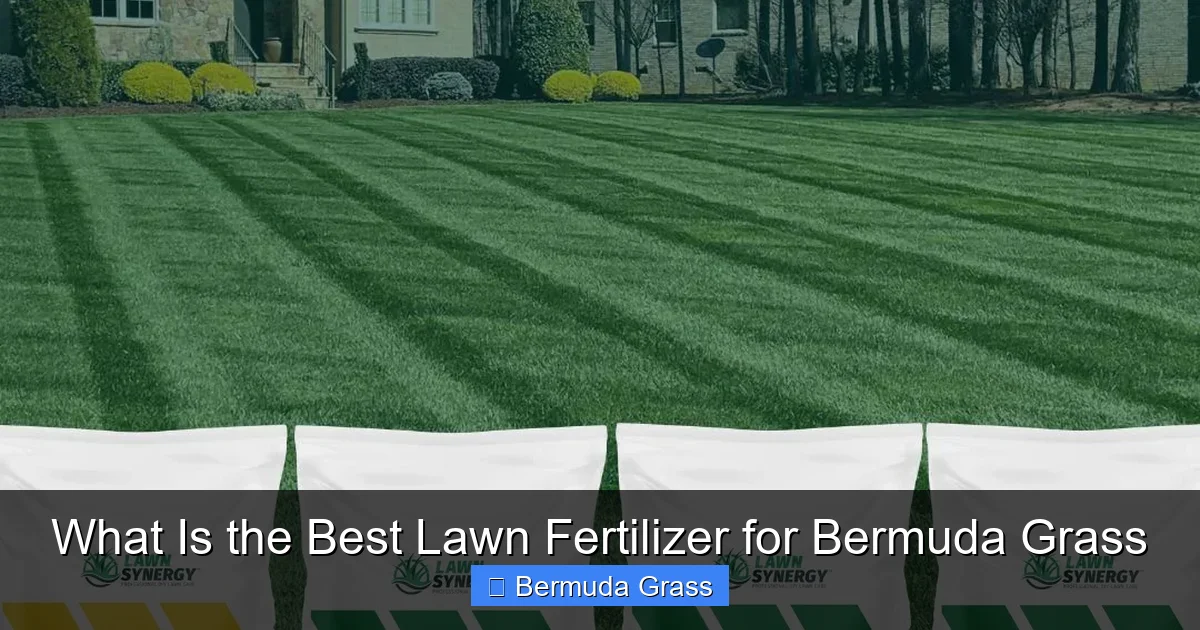
Visual guide about What Is the Best Lawn Fertilizer for Bermuda Grass
Image source: lawnsynergy.com
What N-P-K Means for Your Bermuda Lawn
- Nitrogen (N): This is the king for green, leafy growth. Nitrogen gives your Bermuda grass that vibrant green color and fuels its rapid growth. It’s the most critical nutrient for Bermuda.
- Phosphorus (P): Essential for strong root development, seed germination, and flowering. While important for young lawns and new sod, established Bermuda lawns often require less phosphorus unless a soil test indicates a deficiency.
- Potassium (K): Often called the “stress reducer,” potassium helps your grass withstand environmental stresses like drought, heat, cold, and disease. It’s vital for overall plant health.
Ideal N-P-K Ratios for Bermuda Grass
For established Bermuda lawns, the focus is generally on high nitrogen. Look for ratios where the first number (N) is significantly higher than the second (P) and third (K). Common ideal ratios are:
- 4-1-2 ratio: For example, a 16-4-8, 20-5-10, or 24-6-12 fertilizer.
- 3-1-2 ratio: For example, a 15-5-10 or 21-7-14 fertilizer.
- High-Nitrogen (low P, low K): Sometimes, if your soil test confirms adequate P and K, a fertilizer like 27-0-0 or 30-0-0 (often urea-based) can be the best lawn fertilizer for Bermuda grass for green-up.
Remember, these are general guidelines. Your soil test results might suggest a different approach.
Soil Testing: The First & Most Important Step
You wouldn’t guess what your car needs without checking the oil, right? The same goes for your lawn. A soil test is the single most important step in determining the best lawn fertilizer for Bermuda grass and avoiding wasteful or harmful applications.
Why a Soil Test is Crucial
A soil test tells you:
- Current Nutrient Levels: It identifies exactly which nutrients your soil is abundant or deficient in (N, P, K, and micronutrients).
- Soil pH: Bermuda grass thrives in a slightly acidic to neutral pH range (6.0-7.0). If your pH is too high or too low, nutrients won’t be absorbed effectively, no matter how much fertilizer you apply.
- Organic Matter Content: Helps determine soil health.
Guessing leads to over-fertilization (which can burn your lawn and harm the environment) or under-fertilization (resulting in a weak, unhealthy lawn).
How to Perform a Soil Test
It’s simpler than you think:
- Obtain a Kit: Your local university extension office is the best resource, often providing affordable kits and detailed analysis. You can also find DIY kits online or at garden centers, though university labs are usually more comprehensive.
- Collect Samples: Using a clean trowel or soil probe, take 10-15 random samples from different areas of your lawn. Dig down about 4-6 inches.
- Mix and Send: Mix all samples together in a clean bucket, remove any debris (roots, rocks), and then scoop about a cup into the provided bag or container. Fill out the submission form with details about your lawn (e.g., “Bermuda grass”).
Interpreting Your Results
Once you get your report (it can take a few weeks), it will provide recommendations tailored to your specific lawn. It will tell you if you need to adjust your pH (with lime to raise it, or sulfur to lower it) and what N-P-K ratios, along with any micronutrients, are recommended for the best lawn fertilizer for Bermuda grass in your unique situation.
Choosing the Best Lawn Fertilizer for Bermuda Grass
Now that you know your soil’s needs, let’s talk about choosing the right product. The market is flooded with options, but for Bermuda grass, we can narrow it down.
High-Nitrogen Fertilizers: The Bermuda Fuel
As established, nitrogen is key. When looking for the best lawn fertilizer for Bermuda grass, prioritize options where the first number (N) is high.
Granular vs. Liquid Fertilizers
- Granular Fertilizers: These are solid pellets. They are generally easier to apply evenly with a spreader and often contain slow-release nitrogen, providing a consistent feed over several weeks. Most homeowners find granular fertilizers convenient and effective.
- Liquid Fertilizers: Applied with a hose-end sprayer or pump sprayer, liquids offer quick nutrient uptake. They are great for a fast green-up or for applying micronutrients like iron. However, they need to be applied more frequently and require precise mixing.
Slow-Release vs. Quick-Release Nitrogen
- Slow-Release Nitrogen (SRN): This is often the preferred choice for Bermuda grass. SRN breaks down over time, providing a steady supply of nutrients for 6-8 weeks. This prevents sudden growth flushes, reduces the risk of “burning” your lawn, and promotes more consistent, healthy growth. Look for terms like “ureaform,” “methylene urea,” or “coated urea” on the label.
- Quick-Release Nitrogen: Delivers nutrients rapidly, offering a fast green-up. While useful for a quick boost, it carries a higher risk of burning the lawn if over-applied and doesn’t last as long. Use sparingly and with caution.
Specific N-P-K Ratios for Bermuda Grass
Based on typical Bermuda needs, and especially guided by your soil test, look for fertilizers with ratios like:
- 15-5-10
- 16-4-8
- 20-5-10
- 24-0-12 (if phosphorus is not needed)
- 27-0-0 or 30-0-0 (if only nitrogen is needed for a green-up and P/K are sufficient)
These ratios provide the high nitrogen Bermuda loves, balanced with enough potassium for stress tolerance, and a moderate amount of phosphorus (which can be adjusted based on soil tests).
The Power of Micronutrients: Especially Iron
While N-P-K are macronutrients, micronutrients also play a vital role. Iron is particularly important for Bermuda grass, as it promotes a deep, dark green color without triggering excessive growth. If your lawn looks yellowish but isn’t responding to nitrogen, an iron supplement (often found in liquid form) might be exactly what it needs to achieve that vibrant green hue. Many high-quality fertilizers for Bermuda will include some micronutrients.
Weed & Feed Products: A Two-in-One Solution?
“Weed and feed” products combine fertilizer with herbicides (either pre-emergent or post-emergent). While convenient, they aren’t always the best lawn fertilizer for Bermuda grass in every situation. You need to ensure the herbicide is safe for Bermuda and that the timing aligns with both your fertilizing schedule and weed control needs. Applying post-emergent herbicides during extremely hot weather, for example, can stress your lawn.
Timing is Everything: When to Fertilize Bermuda Grass
Even with the best product, applying fertilizer at the wrong time can be ineffective or even harmful. Bermuda grass has a distinct growing season, and your fertilization schedule should align with it.
Spring Green-up: Waking Up Your Lawn
This is your first major feeding. Wait until your Bermuda grass has fully emerged from dormancy and soil temperatures consistently reach 65°F at a 4-inch depth (usually late April to May, depending on your region). The grass should be about 50% green before you apply the first fertilizer of the season. This application helps it green up quickly and begin aggressive growth.
Summer Feeding: Fueling Peak Growth
Bermuda is a summer lover! This is its prime growing season. Plan to fertilize every 4-8 weeks throughout the summer, depending on whether you’re using slow-release or quick-release nitrogen. Aim for consistent feeding to maintain its lush appearance. Follow label instructions carefully for application rates.
Late Summer/Early Fall: Preparing for Rest
As temperatures begin to drop in late summer (late August to September), apply your last nitrogen-heavy fertilizer. This application should be 6-8 weeks before the first anticipated frost. Avoid fertilizing too late in the fall with high nitrogen, as it can stimulate new growth that is vulnerable to winter damage. Instead, consider a winterizer fertilizer that is higher in potassium to help with winter hardiness, if your soil test suggests it.
Winter Dormancy: No Feeding Required
Once Bermuda grass goes dormant and turns brown (typically after the first hard frost), do not apply fertilizer. It won’t absorb the nutrients and you’ll just be wasting product and potentially harming the environment.
How to Apply Fertilizer Correctly for Your Bermuda Lawn
You’ve chosen the best lawn fertilizer for Bermuda grass, and you know when to apply it. Now, let’s ensure you apply it correctly for an even, healthy result.
Safety First: Protect Yourself
Always wear appropriate personal protective equipment (PPE). This includes gloves, eye protection, and closed-toe shoes. Avoid skin contact with fertilizer, and wash your hands thoroughly after application.
Read the Label: Your Instruction Manual
The fertilizer bag is your most important tool. It contains critical information: application rates, spreader settings, safety precautions, and specific watering instructions. Never guess; always read and follow the label precisely.
Calibrate Your Spreader: Precision Matters
An improperly calibrated spreader can lead to uneven growth, streaks, or burned patches.
- Rotary Spreader (Broadcast Spreader): These throw granules in a wide arc. They are generally faster for large lawns.
- Drop Spreader: These drop granules directly beneath the hopper. They offer more precision for smaller areas or near flowerbeds.
To calibrate, consult your spreader’s manual and the fertilizer bag for recommended settings. Test on a paved area to see the spread pattern before applying to your lawn.
Application Techniques: Even Coverage is Key
- Divide and Conquer: For granular fertilizer, divide the total amount of fertilizer in your spreader in half. Apply the first half in one direction (e.g., north-south), and the second half perpendicular to the first (e.g., east-west). This “cross-hatch” pattern helps ensure even coverage.
- Overlap Slightly: With a rotary spreader, slightly overlap your passes to avoid striping.
- Edge Control: With a rotary spreader, close the hopper or direct the spread away from driveways, sidewalks, and landscape beds to avoid burning plants or staining concrete.
Watering In: Activate and Prevent Burn
After applying granular fertilizer, always water your lawn thoroughly. This helps:
- Wash the fertilizer off the grass blades and down to the soil, where it can be absorbed by the roots.
- Activate the fertilizer, especially slow-release types.
- Prevent “fertilizer burn” – the browning or scorching of grass blades caused by concentrated fertilizer salts sitting on the leaves.
If using a liquid fertilizer, ensure the lawn is moist (but not saturated) before application, and then water lightly after to help it penetrate the soil.
Common Mistakes to Avoid When Fertilizing Bermuda Grass
Even with the best lawn fertilizer for Bermuda grass, mistakes can happen. Here are some common pitfalls to steer clear of:
- Over-fertilizing: Applying too much nitrogen can lead to fertilizer burn, characterized by yellowing or browning patches, and can also promote excessive growth that weakens the grass.
- Under-fertilizing: Not providing enough nutrients will result in a thin, pale, and unhealthy lawn that struggles to compete with weeds.
- Applying at the Wrong Time: Fertilizing during dormancy or too late in the fall can be wasteful and damaging.
- Ignoring Soil Test Results: Guessing what your soil needs is a recipe for an unbalanced nutrient profile and potential problems.
- Using the Wrong Type of Fertilizer: Forgetting the high-nitrogen needs of Bermuda or using a fertilizer meant for cool-season grasses won’t give you the desired results.
- Uneven Application: This leads to patchy growth, streaks of dark green and light green, and can be frustrating to correct.
Troubleshooting Common Bermuda Grass Fertilizer Issues
Sometimes, despite your best efforts, your lawn might not look perfect. Here’s how to address some common issues:
Yellowing Grass: What’s Missing?
If your Bermuda grass is yellowing, it could be:
- Nitrogen Deficiency: The most common cause. Apply a high-nitrogen fertilizer.
- Iron Deficiency: If the veins of the grass blades are still green, but the rest is yellow, it’s likely iron. Apply a chelated iron supplement.
- Incorrect pH: If your soil pH is too high or low, nutrients can be “locked up” and unavailable. A soil test will confirm this.
- Overwatering/Poor Drainage: Can lead to nutrient leaching or root issues.
Brown or Burned Patches: Too Much of a Good Thing?
This is classic fertilizer burn, usually caused by:
- Over-application: Too much fertilizer in one spot.
- Improper Spreader Calibration: Laying down too much product.
- Not Watering In: Fertilizer salts left on grass blades scorch them.
To fix it, immediately water the affected area heavily to dilute the salts. In severe cases, the grass may need to recover over time or be reseeded/resodded.
Uneven Growth or Streaks: A Spreader Issue?
This typically points to an application problem. You might have:
- Improper Overlap: Not overlapping enough, creating “missed” strips.
- Incorrect Spreader Setting: Spreading too wide or too narrow.
- Blocked Hopper: A clog preventing even flow.
Calibrate your spreader, ensure proper technique, and consider the “cross-hatch” method mentioned earlier.
Weed Proliferation Despite Fertilizing
Fertilizer feeds everything, including weeds. If weeds are a problem, your strategy might need adjustment:
- Pre-Emergent Timing: You might be missing the window for pre-emergent herbicides (applied in early spring and late summer/early fall).
- Post-Emergent Application: Spot-treat existing weeds with a selective herbicide safe for Bermuda grass.
- Dense Turf: A thick, healthy Bermuda lawn is the best defense against weeds. Consistent fertilization helps create this barrier.
Maintaining a Healthy Bermuda Lawn Beyond Fertilizer
While choosing the best lawn fertilizer for Bermuda grass is vital, it’s just one piece of the puzzle. A holistic approach will give you the best results:
- Mowing: Mow Bermuda grass short (1-2 inches) and frequently (every 5-7 days during peak season) to encourage lateral growth and density.
- Watering: Water deeply and infrequently to encourage deep root growth. Aim for about 1 inch of water per week, either from rain or irrigation.
- Weed Control: Implement a proactive weed control program, including pre-emergents in spring and fall, and spot-treating post-emergents as needed.
- Aeration: Annually or biennially, aerate your lawn to relieve soil compaction, allowing water, air, and nutrients to better reach the roots.
Conclusion
You’re now equipped with the knowledge to achieve a truly spectacular Bermuda lawn! The secret lies in understanding your lawn’s specific needs through a soil test, selecting a high-nitrogen fertilizer with the right N-P-K ratio (often a 4-1-2 or 3-1-2 blend), and applying it precisely at the optimal times throughout the growing season. Remember that the best lawn fertilizer for Bermuda grass isn’t just one product, but the right product for your unique soil, applied correctly.
By following these guidelines, avoiding common mistakes, and pairing your fertilization efforts with good mowing and watering practices, you’ll be well on your way to enjoying that dense, vibrant, and resilient Bermuda lawn you’ve always dreamed of. Happy fertilizing!