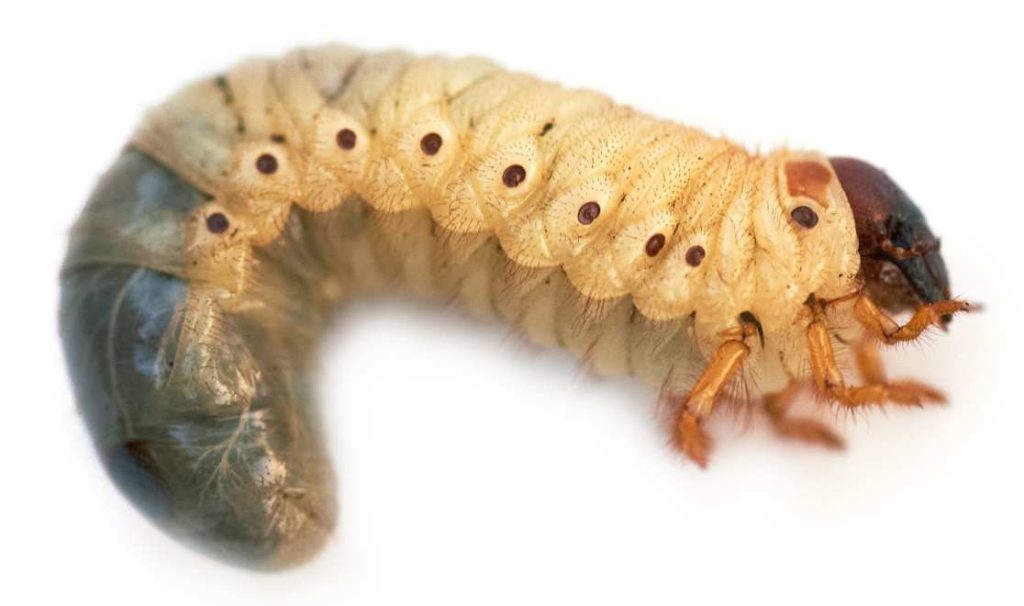
You've got brown patches that don't green up with watering. You grab a corner of the turf and it lifts like loose carpet. That's the classic sign, and it means something has been chewing through your grass roots below the surface.
Understanding what causes grubs in your lawn isn't just about knowing beetles lay eggs. It's about why your specific lawn got hit this year, what conditions invited those beetles in the first place, and what you can do to break the cycle. The treatment threshold most university extension programs use is 5 to 10 grubs per square foot for cool-season turf, but the real story starts long before you count anything.

Image source: Wikimedia Commons / Сарапулов (CC BY)
Quick Answer
Grubs appear in your lawn when adult beetles lay eggs in moist soil during summer. The eggs hatch into larvae that feed on grass roots through fall. Your lawn becomes a target when soil stays moist during egg-laying season, thatch builds up, or beetle populations are high in your region.
Species like Japanese beetle, European chafer, and May beetle each follow different timing patterns based on where you live.
Why Grubs Show Up in Your Lawn (And Why Yours Specifically)
Here's what most people miss. Grubs don't randomly appear. Your lawn got targeted because a combination of conditions lined up to make it attractive to egg-laying beetles.
Adult beetles are looking for specific things when they choose where to lay eggs. Moist soil is number one. If your lawn stays damp during the peak egg-laying window, usually mid-June through early August, you're essentially rolling out a welcome mat.
Overwatering during this period is one of the biggest self-inflicted causes of grub problems.
Thatch is the second major factor. A thatch layer thicker than half an inch holds moisture near the soil surface and gives beetles an ideal environment to work in. It also protects eggs and newly hatched larvae from drying out.
If you haven't dethatched in a few years, you're stacking the odds against yourself.
Soil compaction matters too. Compacted soil holds more moisture and stays cooler longer, which beetles prefer. Heavy clay soils tend to hold grub populations more than sandy, well-drained soils for this reason.
Then there's the simple reality of where you live. If you're in the Northeast, European chafers are likely your main culprit. Mid-Atlantic and Midwest lawns deal heavily with Japanese beetles.
The South sees more green June beetles and May beetle species. Your regional beetle population is the starting point for everything else.
The Grub Lifecycle: How Beetles Turn Into Lawn Destroyers
The lifecycle explains why timing is everything when it comes to treatment. Adult beetles emerge from the ground in late spring and early summer. They feed on trees, shrubs, and garden plants for a few weeks.
Then they mate and females burrow back into the soil to lay eggs.
A single female can lay 40 to 60 eggs in her lifetime, usually in clusters a few inches below the surface. Those eggs hatch within about two weeks, and the tiny larvae immediately start feeding on fine grass roots. This is the first instar stage, and the grubs are small enough that you won't see visible damage yet.
By late summer, they've molted into the second and third instar stages. This is when feeding damage accelerates. Third instar grubs are roughly an inch long and can destroy a surprising amount of root system in a short period.
The brown patches you see in September and October are the result of weeks of feeding that happened before the surface showed any signs.
As soil temperatures drop below 50°F, grubs burrow deeper and enter a dormant state for winter. They move back up to the root zone in spring, feed briefly, then pupate and emerge as adult beetles to restart the cycle.
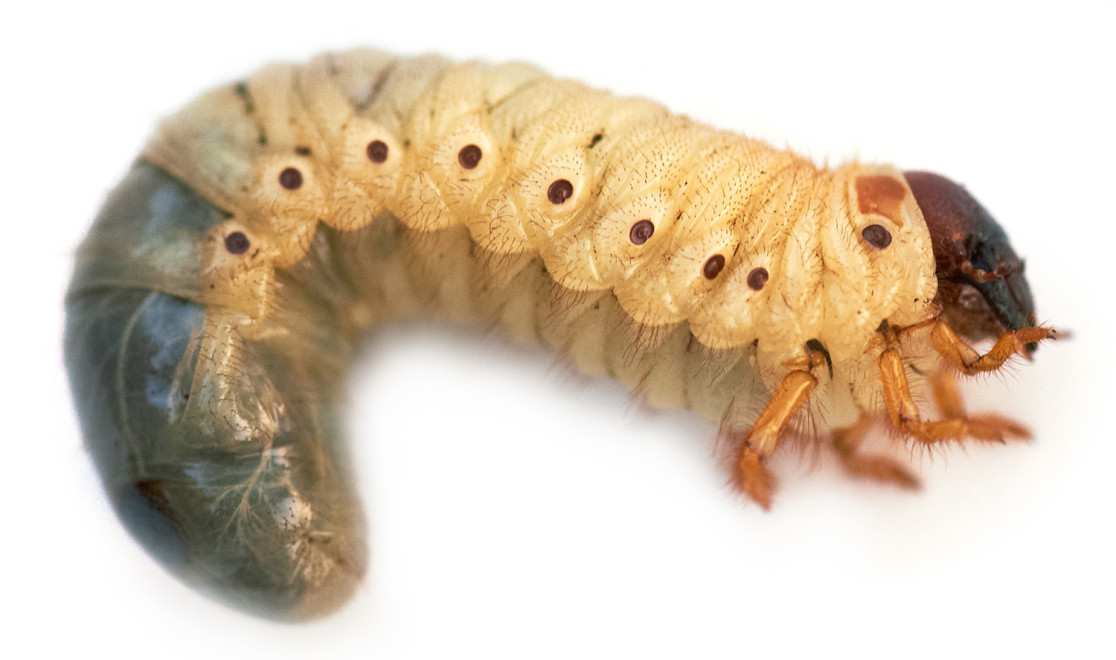
Image source: Bing (Web (fair-use with source credit))
This lifecycle is why the treatment window matters so much. Small grubs in late summer and early fall are far easier to kill than large, mature grubs in spring. The grubs are closer to the surface, they're actively feeding, and they haven't yet developed the tough cuticle that makes older larvae harder to control.
Which Grub Species Is in Your Lawn (And Why It Matters)
Not all grubs are the same, and the species in your lawn determines when you need to act. Here's a breakdown of the most common ones and where they typically show up.
| Species | Region | Peak Egg-Laying | Key Identifier |
|---|---|---|---|
| Japanese beetle | Midwest, Mid-Atlantic, expanding north | Late June to late July | V-shaped raster pattern on tail end |
| European chafer | Northeast, Pacific Northwest | Late June to mid-July | Y-shaped raster pattern |
| May/June beetle | Nationwide, especially South and Midwest | May to early July | Large grubs, up to 1.5 inches |
| Black turfgrass ataenius | Northeast, Mid-Atlantic | June to August | Small grubs, often in golf course turf |
| Green June beetle | Southeast, Mid-Atlantic | July to August | Large, active on surface at night |
| Asiatic garden beetle | Northeast, Mid-Atlantic | July to August | Attracted to lights, small-medium grubs |
The raster pattern is the most reliable way to identify grub species without waiting for the adult to emerge. That's the arrangement of tiny hairs and spines on the underside of the grub's tail end. You need a hand lens to see it clearly, but it's the gold standard for species ID.
Why does this matter? Because each species has a slightly different egg-laying window. If you're treating based on a generic calendar date and your dominant species lays eggs two weeks earlier or later than the one your neighbor is dealing with, you could miss the window entirely.
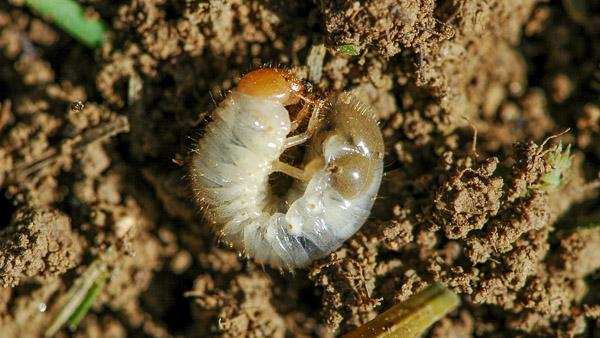
Image source: Bing (Web (fair-use with source credit))
Japanese beetles are the most widely recognized, but they're not the only game in town. In many areas, European chafers have actually overtaken them as the primary lawn grub pest. The chafers are especially problematic because adults fly at dusk and are less noticeable than Japanese beetles, so homeowners often don't realize the population is building until damage appears.
The Real Triggers: What Makes Your Lawn a Target
Beyond the basic conditions of moisture and thatch, several specific factors make some lawns magnets for grubs while neighboring properties stay clean.
Irrigation timing is probably the biggest one you can control. If you're running sprinklers heavily in June and July, you're keeping the top few inches of soil moist right when beetles are looking for egg-laying sites. Cutting back irrigation during this period, if your grass can tolerate it, removes one of the primary attractants.
Nearby adult food sources matter. Japanese beetles feed on over 300 plant species. If you've got linden trees, roses, grapes, or Japanese maples near your lawn, you're hosting the adult beetles before they ever think about laying eggs in your turf. The adults congregate, mate, and then females move into the nearest suitable soil.
Lawn history plays a role. If you had grubs last year and didn't treat, the surviving larvae became adults this summer and laid eggs right back in the same area. Grub problems tend to recur in the same spots year after year because the cycle is self-reinforcing.
Soil type and drainage are underlying factors. Lawns with heavy clay or poor drainage hold moisture longer and stay attractive to egg-laying beetles. Sandy, well-drained soils dry out faster and are less appealing. This doesn't mean sandy lawns are immune, but they're less likely to sustain heavy populations.
Mowing height has a subtle effect. Shorter lawns dry out faster at the soil surface, which can slightly reduce attractiveness to egg-laying beetles. Taller, denser turf holds more humidity near the ground. It's a small factor, but it adds up when combined with other conditions.
Light exposure at night is an underappreciated trigger. Asiatic garden beetles and some chafer species are strongly attracted to outdoor lighting. If you have bright security lights or landscape lighting near your lawn, you may be drawing adult beetles in from a wider area than you'd expect.
How to Confirm You Actually Have Grubs (Not Just Brown Grass)
Before you treat anything, you need to verify that grubs are actually the cause. Brown patches in a lawn can come from several things, and treating for grubs when the real problem is fungal disease or drought stress wastes time and money.
The test is straightforward. Cut a one-foot square of turf at the edge of a brown patch, pull it back, and count the grubs in the soil and roots underneath. Do this in three or four spots across the damaged area.
If you're finding more than 5 to 10 grubs per square foot in cool-season turf, treatment is warranted.
Here's what to look for beyond just the count.
- Root damage. Grub feeding strips the fine roots away from the turf. If the grass pulls up easily and the roots look chewed or shortened, that's a strong indicator.
- Secondary animal activity. Skunks, raccoons, and birds tearing up your lawn at night or early morning are often after grubs. If you see digging concentrated in the same areas as the brown patches, grubs are likely underneath.
- Texture of the turf. Grub-damaged turf feels spongy underfoot because the root system is compromised. It rolls back like a carpet because there's nothing anchoring it to the soil.
- Timing of appearance. Grub damage typically shows up in late August through October, or in spring after a harsh winter. If your brown patches appeared in July during a heat wave, drought stress is more likely the culprit.
One common mistake is assuming that brown grass in early fall is always grub damage. Sometimes it's a combination. Moderate grub feeding that wouldn't cause visible damage on its own becomes obvious when the grass is also stressed by heat or drought.
The grubs lower the lawn's resilience, and the drought finishes it off.
If you're not finding grubs in your initial test but the damage pattern fits, check deeper. Late-season grubs may have already moved down for winter, or the damage you're seeing now could be from spring feeding that happened months ago. In that case, the grubs have already pupated and emerged as adults, and treatment won't help until the next generation of eggs is laid.
Curative vs. Preventive: Choosing the Right Treatment Window
Your treatment approach depends entirely on when you're reading this and what stage the grubs are in right now. There are two distinct strategies, and picking the wrong one wastes your effort.
Preventive treatment targets eggs and newly hatched grubs before they can do meaningful damage. You apply in late May through late June, depending on your region and species. Products like chlorantraniliprole (Acelepryn) or imidacloprid work here.
The goal is to have the active ingredient in the root zone when eggs hatch. This is the most effective approach for lawns with a history of grub problems.
Curative treatment targets grubs that are already feeding. You apply in late August through mid-October when grubs are small and actively feeding near the surface. Trichlorfon (Dylox) is the go-to curative option because it kills quickly, within one to three days.
It has a short soil residual, so timing needs to be precise.
Here's the decision logic. If you're reading this in spring and seeing damage, the grubs have already done their work. Treatment now won't reverse the damage.
Mark your calendar for preventive application next June. If it's late summer and you've confirmed grubs above the treatment threshold, curative treatment now can prevent further damage before winter.
If you're in the middle of summer and haven't seen damage yet but had grubs last year, preventive treatment is your best bet. The eggs are being laid right now, and you want the product in place before they hatch.
Chemical, Biological, or Organic — Which Grub Treatment Fits Your Situation
There's no single best product. The right choice depends on your timing, your comfort level with chemicals, and whether you have pets, kids, or pollinator concerns.
Synthetic insecticides offer the most reliable kill rate. Chlorantraniliprole is a preventive option with lower toxicity to bees and a wider application window. Imidacloprid is effective but has faced regulatory restrictions in some states due to pollinator concerns, so check your local status before purchasing.
Trichlorfon (Dylox) is the strongest curative option and works fast, but it's a restricted-use product in some states.
Beneficial nematodes are a biological option that works as a curative treatment. Heterorhabditis bacteriophora is the species most commonly used for grubs. You mix them with water and apply to moist soil in late summer. They actively seek out grubs and release bacteria that kill the host.
The catch is they need soil temperatures above 60°F, adequate moisture, and UV protection, so apply in the evening and water immediately.

Image source: Bing (Web (fair-use with source credit))
Milky spore (Paenibacillus popilliae) is a bacterial disease that specifically targets Japanese beetle grubs. It's a long-term solution, not a quick fix. Once established in the soil, it can persist for 10 to 15 years.
But it only works against Japanese beetles, and it takes one to three years to build up enough presence to be effective. If your grub species is European chafer or May beetle, milky spore won't help.
Neem oil (azadirachtin) acts as a repellent and feeding deterrent rather than a direct kill. It's useful as part of an integrated approach but won't control an established grub population on its own.
When to Call in a Professional vs. Handle It Yourself
Most homeowners can handle grub treatment themselves with a broadcast spreader and the right product. There are situations where calling a licensed applicator makes more sense.
DIY makes sense when:
- You've confirmed grubs and know your species
- The affected area is under 5,000 square feet
- You're comfortable calibrating a spreader and reading a product label
- You're using granular products that don't require specialized equipment
Call a professional when:
- The infestation covers a large property and you need commercial-grade products
- You're dealing with a restricted-use product that requires a license
- You've tried DIY treatment for two consecutive years and grubs keep coming back
- You need a full lawn care program that includes grub prevention alongside fertilization and weed control
Professional services typically cost more per application but they bring accurate species identification, calibrated equipment, and access to products not available to homeowners. If you're in a region with heavy Japanese beetle pressure and your lawn is a high-maintenance property, the investment often pays for itself in saved turf replacement costs.
Mistakes That Make Grub Problems Worse
The most common mistake is treating at the wrong time. Applying preventive insecticide in September is pointless because the eggs have already hatched and the grubs are too large for preventive products to work. Similarly, applying a curative product in May means it will degrade before grubs are even present.
Overwatering during egg-laying season is another one. If you're running sprinklers daily in June and July, you're creating the exact soil conditions beetles look for. Cutting back to deep, infrequent watering during this period makes your lawn significantly less attractive.
Using milky spore as a standalone solution for non-Japanese beetle species is a waste of money. It's a great product for the right situation, but it's not universal. Know your grub species before investing.
Skipping the count is a mistake too. Not every brown patch is grubs, and not every grub presence requires treatment. If you're finding two or three grubs per square foot, your lawn can tolerate that without intervention.
Save the treatment for when populations actually cross the threshold.
Finally, ignoring the thatch layer undermines everything else you do. Even the best insecticide won't penetrate a thick thatch layer effectively. The product sits on top while grubs feed below.
Dethatch before treating if your thatch is over half an inch.
Repairing the Damage and Keeping Grubs From Coming Back
Once you've addressed the active grub population, the recovery work starts. Dead patches need to be reseeded or sodded in early fall when soil temperatures are still warm but air temperatures are cooling down.
Pull up the dead turf and loosen the top inch of soil. Apply a starter fertilizer with phosphorus to encourage root growth. Seed at the recommended rate for your grass type and keep the area consistently moist for the first two to three weeks.
A light layer of straw mulch helps retain moisture and prevents birds from eating the seed.
For long-term prevention, focus on the conditions that attracted beetles in the first place. Dethatch annually if your thatch builds up quickly. Adjust irrigation to reduce surface moisture during June and July.
Maintain a mowing height of three to four inches for most cool-season grasses to promote deeper rooting and faster recovery.
Consider a preventive grub treatment program if you've had recurring problems. One properly timed application in late spring is more effective and less expensive than dealing with damage repair year after year. Rotate active ingredients if you treat annually to reduce the chance of resistance building up in local grub populations.
A healthy, well-maintained lawn can tolerate some grub feeding without showing visible damage. The goal isn't necessarily zero grubs. It's keeping populations below the threshold where your grass can outgrow the damage.
Regional Timing Guide: When to Act Based on Where You Live
Your location determines which species you're dealing with and when they're most active. Here's a general breakdown, but always check with your local university extension service for precise flight timing in your area.
Northeast and Mid-Atlantic: European chafer dominates, with Japanese beetle as a secondary threat. Adult flight peaks in late June. Preventive treatment should go down in mid to late June.
Curative window runs from late August through early October.
Midwest: Japanese beetle is the primary concern. Adults emerge in late June through July. Preventive application in late June to early July.
Curative treatment from mid-August through early October.
Southeast: Green June beetle and May beetle species are common. Earlier emergence means preventive treatment in late May to mid-June. Curative window starts earlier too, often late July through September.
Pacific Northwest: European chafer has expanded significantly into western Oregon and Washington. Timing mirrors the Northeast, with preventive treatment in late June.
Soil temperature is a more reliable trigger than calendar date. When soil temperatures at four inches depth consistently hit 60°F and stay there, adult beetles start emerging. That's your signal to have preventive product ready to apply.
Frequently Asked Questions
How do I know if grubs are causing my brown patches or if it's just drought?
Pull up a section of the affected turf. If it lifts easily like a carpet and you find C-shaped white grubs in the top inch or two of soil, grubs are the cause. If the grass is dry and brittle but roots are intact with no grubs present, drought is more likely.
Can my lawn recover from grub damage on its own?
Yes, if the damage is moderate and the root system isn't completely destroyed. Light grub feeding, below about five grubs per square foot, often doesn't cause permanent damage in a well-maintained lawn. Watering and a light fertilizer application can help recovery.
When is the absolute best time to treat for grubs?
Late August through early October for curative treatment, when grubs are small and actively feeding near the surface. Late May through June for preventive treatment, targeting eggs and newly hatched larvae before they grow.
Do grub treatments harm earthworms and beneficial soil organisms?
Most synthetic grub insecticides have minimal impact on earthworms. Beneficial nematodes are highly specific to target pests. Neem oil and milky spore are also considered safe for non-target soil organisms.
Always follow label directions to minimize any unintended effects.
How long does grub damage take to show up after eggs hatch?
Typically four to six weeks of feeding before visible symptoms appear. By the time you see brown patches in fall, the grubs have been feeding since mid to late summer. This is why waiting until you see damage to treat means you're already behind.
Will grub problems come back next year if I treat this year?
Treatment kills the current generation but doesn't prevent adults from returning to lay new eggs next summer. If your lawn conditions remain attractive, thatch builds up, and regional beetle populations stay high, grubs will likely return. A consistent preventive program combined with cultural practices like dethatching and irrigation management gives you the best long-term control.