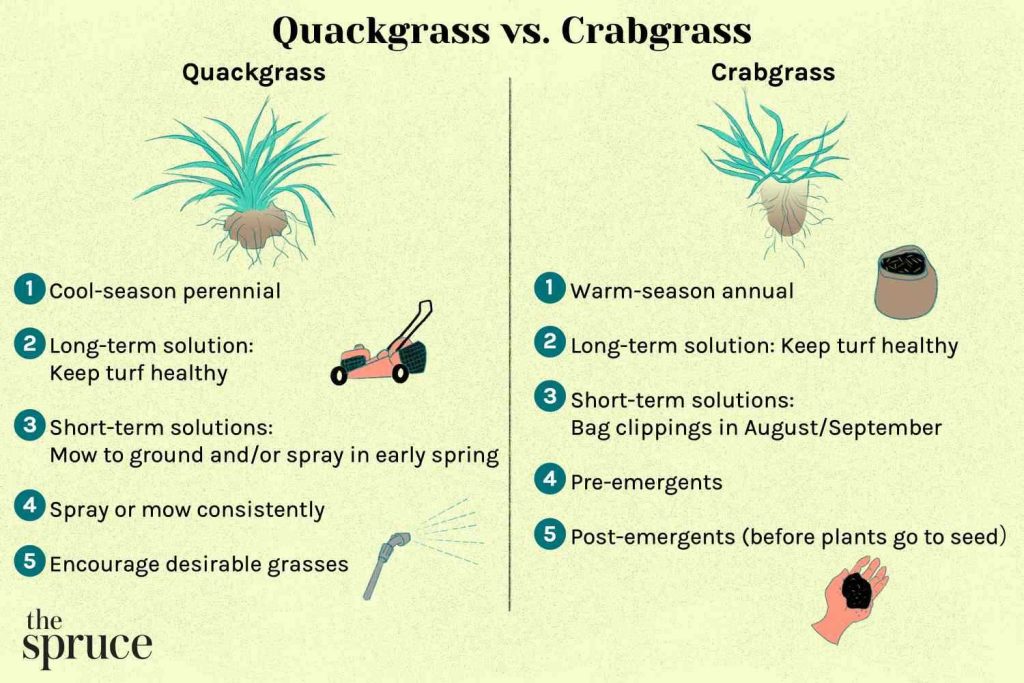
Quick Answer: No, crabgrass and quackgrass are not the same. Though both are types of grassy weeds, they differ in many aspects, including appearance, growth habit, and control methods.
Introduction:
Ever wondered if crabgrass and quackgrass are one and the same? If you find yourself constantly battling with these grassy intruders in your lawn or garden, it’s essential to understand the distinctions between them. While they may share similarities in being unwanted weeds, crabgrass and quackgrass have distinct characteristics that set them apart.
Let’s dive in and explore the differences between these two invasive grasses. Understanding their unique features will help you identify and effectively deal with them in your outdoor spaces. From appearance to growth habits and control methods, we will cover everything you need to know to keep these nuisances at bay.
So, if you’re ready to gain some valuable insights into distinguishing between crabgrass and quackgrass, let’s get started. It’s time to arm yourself with knowledge and reclaim your beautiful lawn or garden!

Is Crabgrass and Quackgrass the Same?
Crabgrass and quackgrass are two common types of weeds that can invade lawns and cause frustration for homeowners. While they may seem similar at first glance, they are actually two distinct species with different characteristics. In this article, we will explore the differences and similarities between crabgrass and quackgrass, helping you identify and effectively combat these stubborn weeds.
1. Crabgrass: The Intruder
Crabgrass, scientifically known as Digitaria, is an annual weed that thrives in warm climates. It is characterized by its wide blades and its tendency to grow in clumps. Crabgrass can quickly spread in lawns, crowding out desirable grasses and creating unsightly patches. Here are some key features and behavior of crabgrass:
- Appearance: Crabgrass leaves are wider and lighter in color compared to surrounding grass. They usually have a folded appearance.
- Growth patterns: It grows in a star-like pattern, spreading outward in a circular shape from a central point.
- Germination: Crabgrass seeds germinate when soil temperatures reach around 55 to 60 degrees Fahrenheit (12 to 15 degrees Celsius) in spring.
- Life cycle: Crabgrass is an annual weed, meaning it completes its life cycle in one year. It dies off during the winter, leaving behind a new batch of seeds for the following year.
- Propagation: This weed primarily spreads through its seeds, which can remain viable in the soil for several years.
2. Quackgrass: The Persistent Invader
Quackgrass, scientifically known as Elymus repens, is a perennial grassy weed that is considered one of the most challenging to control. It is notorious for its ability to quickly infiltrate lawns and gardens, forming dense, interconnected root systems. Here are some distinguishing characteristics of quackgrass:
- Appearance: Quackgrass has flat, rough-edged leaves that closely resemble the desirable grasses in your lawn, making it difficult to identify.
- Growth patterns: Unlike crabgrass, quackgrass spreads by underground stems, called rhizomes, which can quickly form new shoots and dominate the surrounding area.
- Perennial nature: Quackgrass is a perennial weed, meaning it can come back year after year unless effectively controlled.
- Germination: While it can spread through rhizomes, quackgrass also produces seeds that can germinate in both spring and fall.
- Resilience: Quackgrass is known for its resilience and ability to survive under various conditions, including drought and frequent mowing.
3. Key Differences
While crabgrass and quackgrass share some similarities, understanding their distinct differences is crucial for effective weed management. Here are the key differences between the two weeds:
- Growth habit: Crabgrass grows in clumps, while quackgrass spreads through rhizomes.
- Life cycle: Crabgrass is an annual weed, whereas quackgrass is a perennial weed.
- Germination: Crabgrass seeds germinate in the spring, while quackgrass seeds can germinate in both spring and fall.
- Appearance: Crabgrass has wider blades and a lighter color, while quackgrass closely resembles desirable grasses and is challenging to identify.
4. Effective Control and Prevention
Now that we have explored the differences between crabgrass and quackgrass, let’s discuss how to control and prevent their invasion in your lawn:
- Maintenance practices: Regular mowing, proper watering, and fertilization can help promote a healthy lawn and create a less favorable environment for weeds.
- Pre-emergent herbicides: Applying pre-emergent herbicides in early spring can prevent crabgrass seeds from germinating, providing effective control.
- Post-emergent herbicides: Selective herbicides can be used to target and eliminate crabgrass and quackgrass without harming desirable grasses.
- Hand pulling: For small infestations, manually removing crabgrass and quackgrass can be an effective control method. Make sure to remove the entire root system to prevent regrowth.
5. Seeking Professional Assistance
If your lawn is heavily infested with crabgrass or quackgrass, or if you are unsure about identifying and managing these weeds, seeking professional assistance from a lawn care expert can be beneficial. They have the knowledge and experience to provide tailored solutions and recommendations based on your specific situation.
Remember, weed control is an ongoing process that requires consistent efforts to maintain a healthy and weed-free lawn. Understanding the differences between crabgrass and quackgrass and applying appropriate control methods will help you achieve a beautiful and thriving lawn throughout the year.
Quack Grass vs Crab Grass 🌾❓🌵 What is the difference and how do you get rid of them?
Frequently Asked Questions
Is crabgrass and quackgrass the same?
No, crabgrass and quackgrass are not the same. They are two different types of grass weeds that have distinct characteristics.
What is crabgrass?
Crabgrass is an annual grassy weed that commonly invades lawns and gardens. It has a prostrate growth habit and spreads quickly through its creeping stems, known as stolons.
What is quackgrass?
Quackgrass, on the other hand, is a perennial grassy weed that spreads by underground rhizomes. It has an upright growth habit and is known for its broad leaves and distinctive seed heads.
How can I distinguish between crabgrass and quackgrass?
One way to differentiate between these two weeds is by examining the leaf blades. Crabgrass leaves are generally wider and have a lighter green color, while quackgrass leaves are narrower and tend to be darker green. Additionally, crabgrass seed heads are finger-like clusters, while quackgrass produces a more open and branched seed head.
Do crabgrass and quackgrass require different control methods?
Yes, since crabgrass and quackgrass have different growth habits and life cycles, they may require different control methods. Crabgrass is an annual weed, so pre-emergent herbicides can be used to prevent its germination. Quackgrass, being a perennial weed, is more challenging to control and often requires a combination of cultural practices and selective herbicides.
Can crabgrass and quackgrass be manually removed?
While manual removal can be effective for controlling small patches of crabgrass, it is generally not recommended for quackgrass. Due to its extensive rhizomatous root system, attempting to pull out quackgrass can result in the plant regenerating from any remaining rhizomes. It is advisable to consult with a professional or use targeted herbicides for quackgrass control.
Final Thoughts
In conclusion, while both crabgrass and quackgrass are types of grassy weeds that can be invasive and troublesome, they are not the same. The main differences lie in their appearances, growth habits, and control methods. Crabgrass has wider leaves and germinates in warmer temperatures, while quackgrass has narrow leaves and can tolerate cooler climates. When it comes to controlling these weeds, herbicides specifically formulated for each type are recommended. Therefore, it is important to identify the specific grassy weed you are dealing with before implementing any control measures. Is crabgrass and quackgrass the same? No, they are distinct species with unique characteristics.