If you've ever tried growing watermelon in Michigan, you already know the frustration. You've got maybe 140 to 160 frost-free days in the southern part of the state, and even fewer up north. Watermelon wants heat, time, and warm soil, and Michigan doesn't hand those out freely.
Learning how to grow watermelon in michigan means working with a shorter season than the traditional melon-growing regions. The good news is that with the right variety, proper timing, and a few season-extension tricks, you can absolutely pull ripe melons out of a Michigan garden before the first fall frost hits.
Quick Answer
Grow short-season watermelon varieties in Michigan. Start seeds indoors three to four weeks before your last frost date. Transplant outside once soil hits 70°F.
Use black plastic mulch and row covers to extend the season. Harvest 70 to 85 days after transplanting.
Why Most Michigan Gardeners Lose Their Watermelon Crop (And How to Be the One Who Doesn't)
The number one reason watermelon fails in Michigan is simple. Gardeners pick the wrong variety or plant too late, and the fruit doesn't have enough warm days to finish ripening. A 100-day watermelon grown in Georgia is a safe bet.
That same variety planted in Grand Rapids is a gamble you'll probably lose.
The fix isn't complicated, but it does require planning. You need a variety that finishes in 70 to 85 days. You need to start seeds indoors, not direct-sow in cold May soil.
And you need to warm up the ground before your seedlings ever touch it. Michigan State University Extension consistently recommends black plastic mulch for cucurbit production in the state because it raises soil temperature by 5 to 10°F compared to bare ground.
Another common killer is poor pollination. Watermelon plants produce separate male and female flowers, and they need bees to move pollen between them. Cool, rainy Michigan springs can keep bees grounded right when flowers are open.
If you see flowers dropping without fruit setting, that's your sign to hand-pollinate.
The gardeners who succeed with watermelon in Michigan treat it like a season-extension project, not a toss-the-seeds-in-the-dirt project. That mindset shift makes all the difference.
First, Pick the Right Watermelon Variety for Michigan's Short Season
What "Short-Season" Actually Means for Your Melons
Short-season watermelon varieties need roughly 70 to 85 days from transplant to harvest. That's the critical number. Full-size varieties that need 95 to 110 days are a non-starter for most of Michigan unless you're growing in a heated greenhouse.
Days to maturity are counted from transplanting, not from when you start seeds indoors. So if a seed packet says "80 days," that's 80 days in the ground outside, not 80 days from when you planted the seed in your kitchen window.
The Best Short-Season Varieties That Finish Before Michigan's First Frost
Here are the varieties that consistently perform well in Michigan's climate:
| Variety | Days to Maturity | Fruit Size | Type | Notes |
|---|---|---|---|---|
| Sugar Baby | 75–80 | 8–10 lbs | Icebox | Most reliable for Michigan |
| Yellow Doll | 75–80 | 5–8 lbs | Icebox | Yellow flesh, very sweet |
| Crimson Sweet | 80–85 | 15–20 lbs | Classic | Needs warmest microclimate |
| Golden Midget | 70 | 3–5 lbs | Icebox | Earliest to ripen |
| Blacktail Mountain | 70–75 | 6–10 lbs | Icebox | Excellent disease resistance |
| Jubilee | 80–85 | 25–30 lbs | Classic | Large, needs longest season |
Sugar Baby is the go-to recommendation from extension services across the Great Lakes region. It's small, it's fast, and it's forgiving. If you're in northern Michigan or the Upper Peninsula, stick with 70-day varieties like Golden Midget or Blacktail Mountain.
If you're in southern Michigan with a longer season, you can push into 80-to-85-day types like Crimson Sweet.
Seedless (triploid) varieties are an option, but they require a pollinator variety planted alongside them, and they're less tolerant of cool soil conditions. For a first attempt in Michigan, stick with seeded varieties. They're more vigorous and more forgiving of temperature swings.
Timing Everything Right: Michigan's Frost Dates and Growing Degree Days
When to Start Seeds Indoors (It's Earlier Than You Think)
Start watermelon seeds indoors three to four weeks before your planned transplant date. That's typically mid-April for southern Michigan and late April for northern Michigan.
Watermelon seedlings grow fast. Give them three to four weeks indoors max. Any longer and they'll outgrow their pots, get leggy, and transplant poorly.
Use 4-inch biodegradable pots if possible. Watermelon roots hate being disturbed during transplanting, and peat or coir pots go straight into the ground.
Germination happens fastest at 80 to 90°F soil temperature. A seedling heat mat is the single best investment for starting melon seeds indoors. Without one, your kitchen counter probably sits around 65 to 70°F, and germination will be slow and spotty.
When to Transplant Outside (Soil Temperature Is the Real Trigger)
Here's where most people go wrong. They look at the calendar and plant after the last frost date. But frost date alone doesn't tell you enough.
You need soil temperature of at least 70°F, and ideally 75°F or warmer.
In southern Michigan, that usually means late May to early June. In northern Michigan, it's often mid-June. The West Michigan lakeshore warms up more slowly in spring because of Lake Michigan's cooling effect, so don't be surprised if you're planting a week later than someone 30 miles inland.
Use a soil thermometer. Stick it 2 inches deep in the morning for three consecutive days. If you're reading 70°F or above, you're good to go.
If not, wait.
Growing degree days (GDD) are another useful metric. Watermelon needs roughly 900 to 1,100 GDD above a base of 50°F to reach maturity. Michigan State University Extension tracks GDD accumulations across the state, and you can check your local running total to estimate whether your melons will finish in time.
Deciding on Your Growing Setup: Open Row, Plastic Mulch, Season Extension, or Container
Growing on Black Plastic Mulch: The Michigan Workhorse
If you take one piece of advice from this article, let it be this. Use black plastic mulch. It's the single most effective technique for growing watermelon in Michigan.
Black plastic mulch raises soil temperature by 5 to 10°F compared to bare soil. It suppresses weeds. It retains soil moisture.
And it keeps the fruit clean and off the ground, which reduces rot and pest damage.
Here's how to set it up:
- Prepare your bed with compost and a balanced fertilizer.
- Lay drip irrigation tape along the planting line.
- Cover the bed with 1-mil black plastic mulch, pulling it tight and burying the edges.
- Wait one to two weeks for the soil to warm up under the plastic.
- Cut X-shaped holes at your spacing intervals and transplant through them.
You can buy black plastic mulch in rolls from most garden supply retailers or online. For Michigan's climate, standard 1-mil thickness works fine. Biodegradable plastic mulch options exist but break down faster, which means less season-long weed control.
Low Tunnels and Floating Row Covers: Buying You 2–3 Extra Weeks
A floating row cover draped over wire hoops creates a low tunnel that traps heat and protects young plants from wind and light frost. In Michigan, this setup can effectively add 2 to 3°F of frost protection and 5 to 10°F of daytime heat accumulation.
Install low tunnels right after transplanting. Remove the row cover once daytime temperatures consistently hit 85°F inside the tunnel, or once flowers open and need pollinator access. If you leave it on during bloom, you'll block bees and get zero fruit.
Floating row covers without hoops work too. Drape them directly over plants for the first two to three weeks after transplanting. They provide modest frost protection and keep cucumber beetles off young seedlings, which matters because cucumber beetles vector bacterial wilt, a disease that can kill watermelon vines overnight.
Raised Beds: Worth It in Michigan's Heavy Soils
Much of Michigan has heavy clay soil that drains poorly and warms up slowly. Raised beds solve both problems. They drain faster, warm up earlier in spring, and give you full control over your soil mix.
A raised bed for watermelon should be at least 12 inches deep. Fill it with a mix of topsoil, compost, and coarse sand or perlite for drainage. Space vining varieties 6 feet apart within the bed.
Bush varieties can go 3 feet apart.
If you're dealing with heavy clay and don't want to build raised beds, at minimum amend your soil with 2 to 3 inches of compost worked into the top 8 inches before laying plastic mulch.
Growing Watermelons in Containers (If Space Is Tight)
You can grow watermelon in containers, but you need to pick the right variety and the right pot. Stick with bush or compact varieties like Sugar Baby or Golden Midget. Use at least a 15-gallon container per plant.
Container growing works well on patios and decks where you can position pots against a south-facing wall for maximum heat reflection. The tradeoff is that containers dry out fast and need daily watering in July heat. Plan on drip irrigation or a soaker hose even for container plants.
Step-by-Step Process: From Seed to Harvest
Step 1: Prepare and Amend Your Soil Before You Plant Anything
Test your soil pH. Watermelon wants a range of 6.0 to 6.8. Michigan soils tend to be slightly alkaline, so you may need to add sulfur to bring pH down.
Work in 2 to 3 inches of aged compost or well-rotted manure the fall before planting if possible. If you're prepping in spring, at least two weeks before transplanting, mix in a balanced fertilizer.
Good drainage is non-negotiable. Watermelon roots rot in waterlogged soil. If your garden has heavy clay or standing water issues, build raised beds or plant on slightly mounded rows.
Step 2: Start Seeds Indoors at the Right Time
Fill 4-inch pots with seed-starting mix. Plant one seed per pot, 1 inch deep. Place pots on a seedling heat mat set to 80 to 85°F.
Keep the soil moist but not soaked.
Seeds should germinate in 3 to 7 days at proper temperature. Once they sprout, move them under grow lights or to your sunniest south-facing window. Provide 14 to 16 hours of light per day.
Thin to the strongest seedling per pot if multiple emerge.
Step 3: Harden Off Seedlings Without Killing Them
About 7 to 10 days before your transplant date, start hardening off. Set seedlings outside in a sheltered spot for 1 hour on day one. Gradually increase exposure by an hour each day.
Bring them in at night for the first few days.
By day seven, they should be outside full-time if temperatures stay above 50°F. This process toughens the stems and prepares plants for wind and direct sun. Skipping it is one of the fastest ways to lose transplants.
Step 4: Transplant Under Cover and Lock In the Heat
Cut holes in your black plastic mulch. Plant seedlings at the same depth they were in their pots. Water them in thoroughly with a diluted starter fertilizer solution.
Immediately install row covers or low tunnels. Secure the edges with soil or landscape staples. Water every 2 to 3 days during the first week while plants establish.
Step 5: Install Drip Irrigation (Seriously, Don't Skip This)
Watermelon needs consistent moisture, but wet leaves invite fungal disease. Drip irrigation under plastic mulch delivers water to the root zone without ever touching the foliage. Run drip lines for 30 to 45 minutes every 2 to 3 days, adjusting for rainfall.
Watermelon needs 1 to 2 inches of water per week. In Michigan's sandy southern soils, you may need to water more frequently. In clay-heavy northern soils, less often.
Step 6: Pollination — What to Do When the Bees Don't Show Up
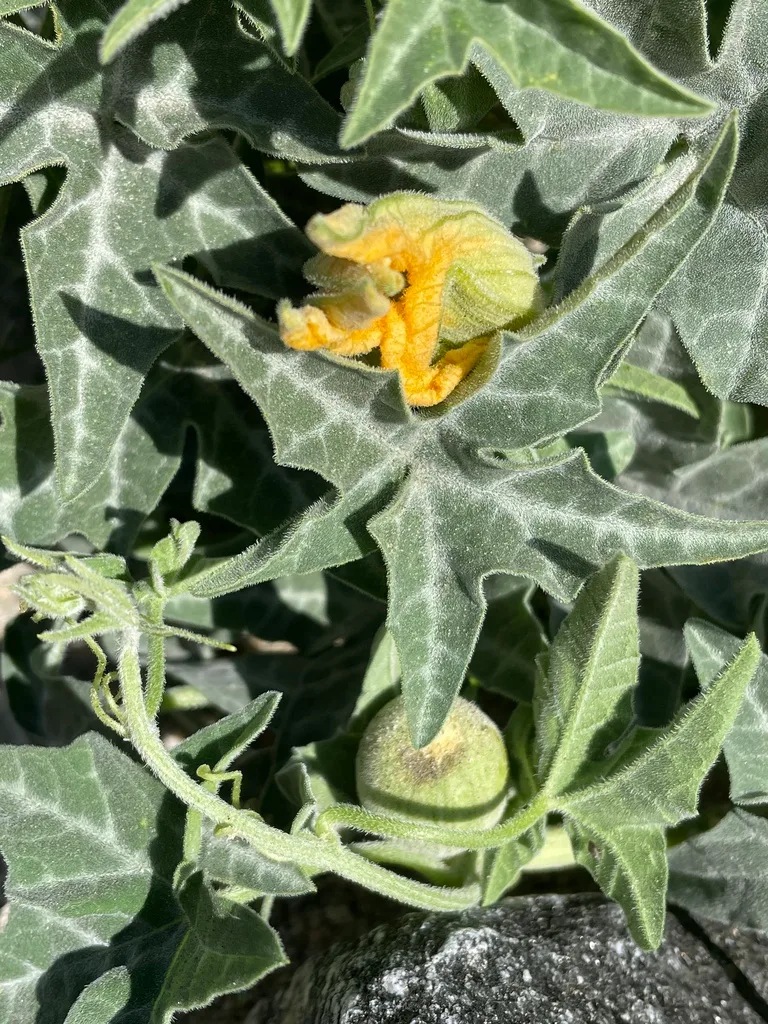
Watermelon plants produce male flowers first, then female flowers a week or later. Male flowers are on thin stems. Female flowers have a tiny fruit bulge at the base.
Both open in the morning and close by afternoon.
If bee activity is low during bloom, hand-pollinate. Pick a freshly opened male flower, remove the petals, and press the stamen directly against the center of a female flower. Do this early in the morning for best results.
Step 7: Fertilize at the Right Stages
Apply a balanced fertilizer at planting. Switch to a low-nitrogen, high-phosphorus formula when vines start running. Apply a third dose when fruits are golf-ball sized.
Too much nitrogen late in the season produces vines and leaves at the expense of fruit.
Step 8: Scout for Pests and Disease Every Single Week
Check plants weekly for cucumber beetles, aphids, powdery mildew, and downy mildew. Cucumber beetles are the most dangerous because they spread bacterial wilt. Use pyrethrin sprays or hand-pick beetles early in the season.
Powdery mildew shows up as white dust on leaves and is manageable with neem oil or sulfur-based fungicides if caught early.
Step 9: Cut Back Water Before Harvest for Sweeter Fruit
About one week before you expect to harvest, reduce watering. This concentrates sugars in the fruit and produces a sweeter melon. Don't stop watering entirely.
Just cut back by about half.
Step 10: How to Actually Tell When a Watermelon Is Ripe
Look for three signs. First, the curly tendril nearest the fruit turns brown and dry. Second, the ground spot (where the melon touches the soil) turns from white to yellow.
Third, the rind loses its glossy sheen and becomes dull. Thumping for a hollow sound is unreliable for beginners. Stick with the tendril and ground spot indicators.
The Biggest Mistakes Michigan Gardeners Make With Watermelon
Planting long-season varieties is the most common error. A 100-day watermelon planted in Michigan on June 1st needs to finish by early September. Northern Michigan's first frost often arrives in late September.
That leaves zero margin for a cool August or a slow start.
Starting seeds too late is the second biggest mistake. If you direct-sow in late May, your plants don't really get going until mid-July. Flowers don't open until August.
Fruit doesn't ripen until October. By then, frost has already hit. Always start indoors three to four weeks before transplant date.
Overwatering kills more watermelon roots in Michigan than drought does. Heavy clay soils in much of the state hold water for days after rain. If you're watering on a schedule without checking soil moisture, you're probably drowning the roots.
Stick your finger 2 inches into the soil. If it's still damp, skip the watering.
Ignoring pollination is another silent killer. If flowers are falling off without fruit forming, bees aren't doing their job. Hand-pollinate every female flower you see open in the morning.
It takes 30 seconds per flower and can double your fruit set.
Quick-Reference Data: Spacing, Temperatures, and Timelines at a Glance
| Parameter | Value |
|---|---|
| USDA Zones (MI) | 4b to 6b |
| Last frost (southern MI) | Late April to mid May |
| Last frost (northern MI) | Late May to early June |
| Soil temp for germination | 70 to 95°F (optimal 85°F) |
| Soil temp for transplanting | 70°F minimum |
| Seed starting indoors | 3 to 4 weeks before transplant |
| Seed depth | 1 inch |
| Plant spacing (vining) | 2 to 3 ft between plants, 6 to 8 ft between rows |
| Plant spacing (bush) | 2 to 3 ft between plants, 4 to 5 ft between rows |
| Water needs | 1 to 2 inches per week |
| Days to maturity | 70 to 85 days from transplant |
| GDD to maturity | 900 to 1,100 (base 50°F) |
| Harvest window (MI) | Late July through September |
What's Different About Growing Watermelon in Northern Michigan vs. Southern Michigan
Southern Michigan (Zones 5b to 6b) gives you roughly 140 to 160 frost-free days. That's enough time for most short-season varieties without aggressive season extension. You can grow Sugar Baby or Crimson Sweet with black plastic mulch and basic row covers and expect ripe fruit by mid-August.
Northern Michigan (Zones 4b to 5a) drops you to 100 to 130 frost-free days. That's tight. You need the earliest varieties (70-day types), black plastic mulch, and low tunnels or wall-o-water transplants to guarantee ripening.
Even then, you're harvesting in late August or early September, right at the edge of frost season.
The Upper Peninsula (Zones 4a to 5a) is the most challenging. High tunnels or greenhouse starts are almost necessary for reliable harvests. Without one, stick exclusively to 70-day varieties and accept that some years the weather won't cooperate.
West Michigan's lakeshore has a unique microclimate. Lake Michigan keeps spring temperatures cooler, delaying your planting date. But it also moderates fall temperatures, giving you a few extra frost-free days on the back end.
That can actually work in your favor for late-maturing varieties.
Frequently Asked Questions
Can I grow watermelon in Michigan without season extension?
Yes, in southern Michigan (Zones 5b to 6b) with short-season varieties. Use black plastic mulch and choose 75-day or earlier types. You'll get ripe fruit, but your margin for error is thin.
Season extension makes success much more reliable.
What is the best watermelon variety for Michigan?
Sugar Baby is the most recommended variety for Michigan by extension services. It matures in 75 to 80 days, produces reliably sweet 8-to-10-pound fruit, and handles temperature swings better than larger varieties.
When should I plant watermelon seeds in Michigan?
Start seeds indoors in mid to late April for southern Michigan. Transplant outside in late May to early June once soil reaches 70°F. For northern Michigan, start indoors in late April to early May and transplant in mid-June.
How do I know when my watermelon is ready to pick?
Check three indicators. The curly tendril nearest the fruit turns brown and dry. The ground spot turns from white to creamy yellow.
The rind goes from glossy to dull. All three together confirm ripeness.
Why are my watermelon flowers falling off without fruit?
This is almost always a pollination problem. Watermelon has separate male and female flowers. If bees aren't transferring pollen, flowers drop without setting fruit.
Hand-pollinate in the morning by pressing a male flower's stamen onto the center of a female flower.
Can I grow watermelon in containers in Michigan?
Yes. Use a compact variety like Sugar Baby or Golden Midget. Choose at least a 15-gallon container per plant.
Place pots against a south-facing wall for heat reflection. Water daily during July heat, as containers dry out fast.