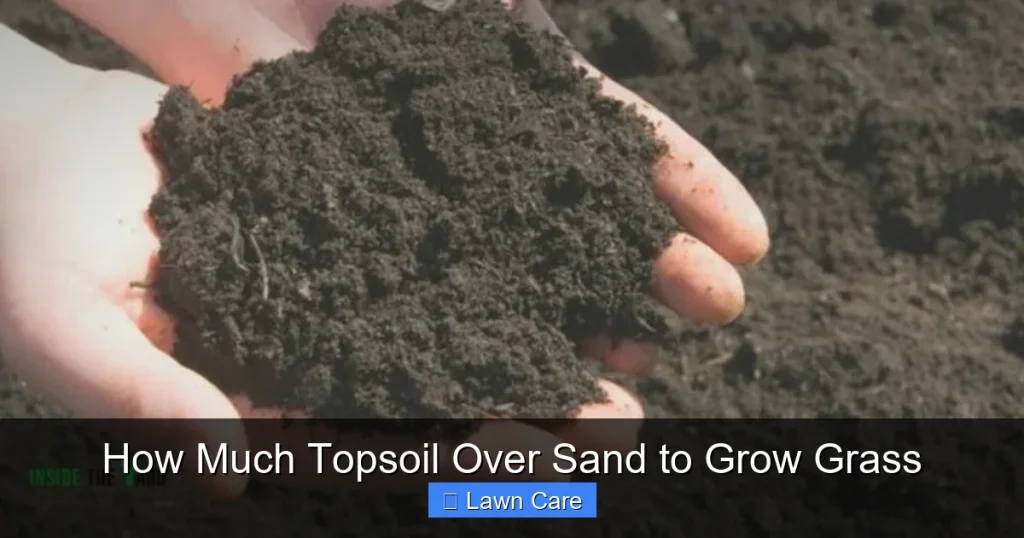
Growing grass on sandy soil presents unique challenges, but with the right approach, you can achieve a vibrant lawn. This guide explains the crucial role of topsoil and provides actionable steps for determining the ideal amount of topsoil to layer over sand. By understanding soil composition and following our expert advice, you can cultivate a healthy, green yard.
# How Much Topsoil Over Sand to Grow Grass
So, you have a yard with sandy soil, and you’re dreaming of lush, green grass. We get it! Sandy soil can be a bit tricky. It drains water super fast, doesn’t hold onto nutrients very well, and can feel like a losing battle for a beautiful lawn. But don’t despair! With the right strategy, you can absolutely transform that sandy patch into a vibrant, healthy green space. The secret? It’s all about understanding your soil and giving your grass the foundation it needs to thrive.
This guide is your go-to resource for figuring out exactly how much topsoil you need to add over your existing sand to grow grass successfully. We’ll walk you through everything from preparing your sandy base to choosing the right topsoil and applying it correctly. By the end, you’ll have a clear plan to create a lawn you’ll be proud of.
## Why Sandy Soil is a Challenge for Grass
Before we talk about solutions, let’s quickly understand why sand isn’t the best natural habitat for most lawn grasses.
### Poor Nutrient Retention
Sand particles are large and have a gritty texture. This means there are large pore spaces between them. Water flows through these spaces very quickly, taking essential nutrients along for the ride. Grass roots need these nutrients to grow strong and healthy. When they’re constantly being washed away, your grass will likely look thin, discolored, and struggle to establish.
### Low Moisture Retention
Because water drains so quickly, sandy soil dries out much faster than other soil types. Grass needs consistent moisture to survive and grow. In sandy conditions, you’ll find yourself watering much more frequently, and even then, the water might not be reaching deep enough for the grass roots to benefit. This leads to drought stress, browning, and struggling plants.
### Lack of Organic Matter
Healthy soil is full of organic matter – decomposed plant and animal material. Organic matter acts like a sponge, holding onto water and nutrients. It also improves soil structure, making it easier for roots to penetrate. Pure sand typically has very little of this vital component.
## The Crucial Role of Topsoil
This is where topsoil comes in to save the day! Topsoil is the uppermost layer of soil, and it’s usually rich in organic matter and beneficial microorganisms. It’s the layer that naturally supports plant life. When you add topsoil over sand, you’re essentially creating a hospitable environment for your grass.
### What Topsoil Provides
* Nutrients: Topsoil is packed with the minerals and elements grass needs to grow.
* Moisture Retention: The organic content in topsoil acts like a sponge, holding water and making it available to grass roots for longer periods.
* Improved Structure: It creates a better medium for root development, allowing them to anchor and spread effectively.
* Healthy Microbial Life: Topsoil teems with beneficial bacteria and fungi that help plants access nutrients and stay healthy.
## How Much Topsoil Do You Actually Need?
This is the million-dollar question! The answer isn’t a single, rigid number because it depends on a few factors, but we can give you a solid range and guide you through the decision-making process.
### The General Rule of Thumb: 4 to 6 Inches
For most lawn applications, **a topsoil layer of 4 to 6 inches is generally recommended over sandy subsoil.** This depth provides enough material to:
* Sustain the grass’s nutrient and moisture needs.
* Allow for proper root development.
* Give you some wiggle room for minor settling or compaction over time.
### Factors Influencing Your Decision
1. **Your Existing Soil Condition:** How sandy is your soil? If it’s pure beach sand, you’ll need a more substantial layer. If it’s more like a sandy loam, you might get away with slightly less.
2. **Your Grass Type:** Some grass varieties are more tolerant of sandy conditions than others. Drought-tolerant grasses might need a slightly thinner layer of topsoil than those requiring more consistent moisture. For example, if you’re looking at [how to grow bermuda grass in texas](https://lawnhelpful.com/how-to-grow-bermuda-grass-in-texas/), which is known for its resilience, you might be able to optimize with a well-amended layer.
3. **Your Budget and Material Availability:** Topsoil can be expensive, and transporting large quantities adds to the cost. You need to balance your ideal depth with what’s financially feasible.
4. **Your Lawn Goals:** Are you aiming for a perfect, golf-course-quality lawn, or a nice, functional green space for your family? Higher quality lawns often benefit from deeper, richer topsoil layers.
## Step-by-Step Guide to Adding Topsoil Over Sand
Now, let’s get down to business. Here’s how you can successfully layer topsoil over your sandy base.
### Step 1: Assess and Prepare Your Sandy Base
Don’t just dump topsoil on top! Proper preparation is key to preventing future problems.
#### H3: Test Your Soil (Optional but Recommended)
A simple soil test can tell you about your soil’s pH and nutrient levels. This information can help you choose the right type of topsoil and amendments.
#### H3: Improve Drainage and Aeration
Even though sand drains well, compacting it further can create issues.
* De-thatch and Aerate: If there’s any existing grass or organic debris, remove it. Aerate the sandy soil with a garden fork or a core aerator to loosen it up.
* Incorporate Organic Matter: This is critical for sandy soil! Spread a generous layer (2-4 inches) of compost, well-rotted manure, or other organic material over the entire area. Work it into the top 4-6 inches of the existing sand. This significantly improves its ability to hold water and nutrients, making the base much more receptive to the topsoil you’ll add. This step is often more important than the depth of topsoil itself when [how to grow grass in florida sand](https://lawnhelpful.com/how-to-grow-grass-in-florida-sand/).
### Step 2: Calculate Your Topsoil Needs
Knowing how much topsoil to buy is essential. You’ll be working with cubic yards.
#### H3: Measure Your Area
* Measure the length and width of the area you want to cover in feet.
* Multiply length by width to get the square footage.
#### H3: Determine the Volume in Cubic Feet
* Decide on your desired topsoil depth in inches (let’s say 4 inches for this example).
* Convert inches to feet: 4 inches / 12 inches/foot = 0.33 feet.
* Multiply your square footage by your depth in feet: Square Footage x Depth (in feet) = Cubic Feet.
#### H3: Convert Cubic Feet to Cubic Yards
Topsoil is typically sold by the cubic yard.
* There are 27 cubic feet in 1 cubic yard.
* Divide your total cubic feet by 27: Cubic Feet / 27 = Cubic Yards.
Example Calculation:
Let’s say you have a rectangular lawn area that is 50 feet long and 30 feet wide, and you want to add 4 inches of topsoil.
* Square footage = 50 ft x 30 ft = 1500 sq ft.
* Depth in feet = 4 inches / 12 inches/ft = 0.33 ft.
* Cubic feet = 1500 sq ft x 0.33 ft = 495 cubic feet.
* Cubic yards = 495 cubic feet / 27 cubic feet/yard = 18.33 cubic yards.
It’s always a good idea to round up slightly to account for settling and any unevenness in your base. So, for this example, you’d aim to purchase around 19 cubic yards of topsoil.
### Step 3: Choose the Right Topsoil
Not all topsoil is created equal.
#### H3: Look for High-Quality, Screened Topsoil
* Compost-Rich: Look for topsoil that clearly contains a good amount of compost or other organic matter. This is what gives it its dark color and nutrient-rich qualities.
* Screened: Ensure the topsoil has been screened to remove large rocks, debris, and clumps. This makes it easier to spread and provides a smoother surface for grass.
* Local Sourcing: If possible, buy from a reputable local supplier. They may have topsoil mixes tailored to your region’s climate and soil types, which could be beneficial for specific challenges like [how to grow grass in florida sand](https://lawnhelpful.com/how-to-grow-grass-in-florida-sand/).
#### H3: Avoid “Fill Dirt” or Unscreened Soil
These can contain weed seeds, rocks, and materials that will hinder grass growth.
### Step 4: Apply the Topsoil
This is where the magic happens!
#### H3: Delivery and Initial Spreading
* Have the topsoil delivered as close to the area as possible.
* Use shovels and wheelbarrows to spread the topsoil evenly across your prepared sandy base. Start by creating small mounds and then raking them out.
#### H3: Raking and Leveling
* Use a landscape rake to spread the topsoil evenly to your desired depth (aim for that 4-6 inch target).
* Work in multiple directions to ensure an even surface.
* Your goal is a smooth, level surface with no low spots where water could pool or high spots where it might dry out too quickly.
#### H3: Light Compaction (Optional)
After raking, you might want to lightly compact the soil.
* Walk over the area, or use a roller. Be careful not to over-compact it, as this can restrict root growth. The goal is to settle the soil slightly so it doesn’t shift too much.
* If you incorporated organic matter in Step 1, this step might be less critical as the organic matter helps bind the soil.
### Step 5: Prepare for Seeding or Sodding
With your new topsoil layer in place, your lawn is ready for its green occupants.
#### H3: Final Raking and Fine Tuning
* Give the surface a final, light raking to create a fine, crumbly texture perfect for seed germination or sod rooting. Remove any remaining debris.
#### H3: Consider a Starter Fertilizer
* Apply a starter fertilizer according to the product’s instructions. This provides essential nutrients to help new grass establish quickly. Choose one formulated for new lawns.
#### H3: Seed or Sod
* Now you’re ready to sow grass seed or lay sod. Follow best practices for your chosen method. For seeds, ensure good seed-to-soil contact. For sod, lay it tightly together.
## Troubleshooting Common Issues
Even with the best planning, you might encounter a few bumps along the way.
### Problem: Grass is thin or looks yellow
* Possible Cause: Insufficient topsoil depth, poor quality topsoil, or lack of nutrients.
* Solution:
* Check the depth of your topsoil layer. If it’s less than 4 inches in places, consider adding more.
* Apply a balanced lawn fertilizer. For new lawns, a starter fertilizer is ideal.
* If you have a sandy loam and not pure sand, you might be experiencing nutrient deficiency. Try amending the topsoil with compost. If you’re looking to [how to fix burned grass from over fertilizing](https://lawnhelpful.com/how-to-fix-burned-grass-from-over-fertilizing/), this highlights the importance of balanced nutrient application.
### Problem: Water pools in certain areas
* Possible Cause: Uneven grading or compaction.
* Solution:
* Identify low spots. You may need to lightly excavate them and add a bit more topsoil, then re-grade.
* Ensure the area is not overly compacted. Aeration can help if needed.
### Problem: Grass struggles to establish or dies off quickly
* Possible Cause: Poor soil structure, insufficient moisture, or the wrong grass type.
* Solution:
* Ensure you incorporated plenty of organic matter into the sandy base before adding topsoil. This is a long-term fix for moisture and structure.
* Water consistently, especially during the establishment phase. Watering deeply and less frequently is usually better than frequent shallow watering.
* Research grass varieties that do well in your specific climate and soil conditions. For instance, if you’re in a hot region, exploring [how to grow grass fast and cheap](https://lawnhelpful.com/how-to-grow-grass-fast-and-cheap/) might lead you to drought-tolerant options suitable for sandy soil.
## Maintaining Your New Lawn
Adding topsoil is the foundation, but ongoing care is vital for a thriving lawn.
### Watering Wisely
* Water deeply and less often to encourage deep root growth. Sandy soils require more frequent watering than clay soils, but the goal is always to get water down to the root zone.
* Monitor soil moisture by pushing a screwdriver into the ground; if it goes in easily, it’s likely moist enough.
### Fertilizing Appropriately
* Use a balanced fertilizer designed for lawns. Follow the application schedule recommended for your grass type and climate.
* Avoid over-fertilizing, which can burn your grass.
### Mowing Correctly
* Mow at the height recommended for your grass type. Taller grass shades the soil, reducing evaporation and suppressing weeds.
* Never remove more than one-third of the grass blade height at a time.
## Conclusion: Building a Better Lawn on Sand
Transforming a sandy yard into a lush green lawn is entirely achievable with the right approach. By understanding the limitations of sand and the benefits of quality topsoil, you can create the perfect environment for grass to flourish. Remember, the ideal depth is generally **4 to 6 inches of good quality, screened topsoil**, but the real secret weapon is incorporating plenty of organic matter into your sandy base *before* adding the topsoil.
With careful preparation, accurate measurement, and a commitment to ongoing care, you’ll be enjoying a beautiful, healthy lawn in no time. Don’t let sandy soil discourage you – with this guide, you have the knowledge to build a truly thriving green space. Happy gardening!
- Understanding Sand: Sandy soil drains quickly, lacks nutrients, and struggles to retain moisture, making it a challenging base for grass.
- The Role of Topsoil: Topsoil is the nutrient-rich, organic layer that provides essential elements for healthy grass growth, including water retention and nutrient supply.
- Ideal Topsoil Depth: For most lawn applications, a topsoil layer of 4 to 6 inches is generally recommended over sandy subsoil to create a suitable growing environment.
- Soil Amendments are Key: Incorporating organic matter, like compost, into the existing sand before adding topsoil significantly improves soil structure and fertility.
- Grass Type Matters: Selecting grass varieties well-suited to sandy conditions can significantly increase your chances of success, even with a good topsoil layer.
- Proper Installation: Layering topsoil correctly, avoiding compaction, and ensuring good drainage are vital steps for a healthy lawn foundation.
- Ongoing Care: Even with the right foundation, consistent watering, fertilization, and appropriate mowing are necessary for maintaining a thriving lawn on sandy soil.