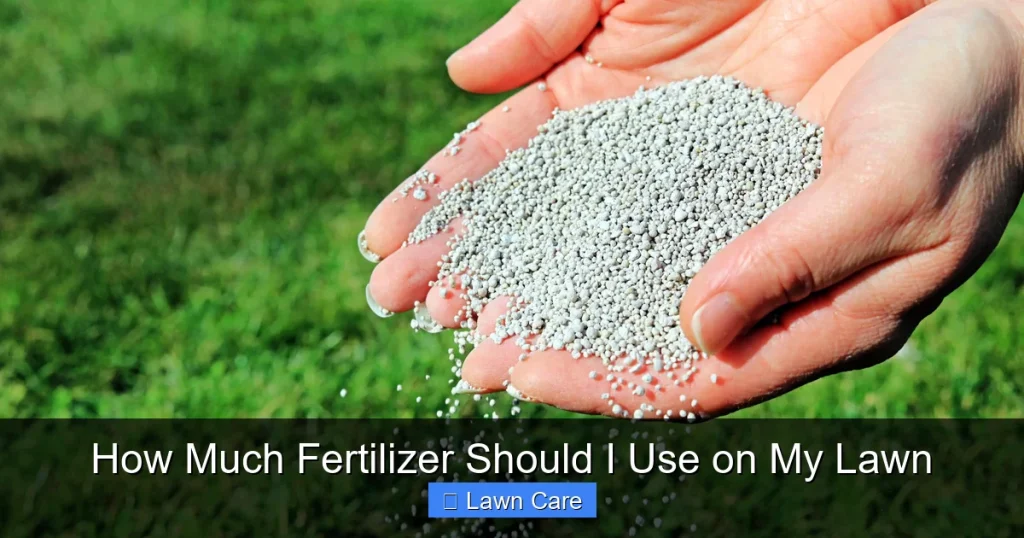
Figuring out how much fertilizer to use on your lawn doesn’t have to be a mystery! This guide breaks down everything you need to know, from understanding fertilizer labels to calculating application rates for a vibrant, healthy lawn. We’ll help you avoid common mistakes and achieve the best results.
# How Much Fertilizer Should I Use on My Lawn
So, you want that perfectly green, lush carpet of grass that makes your neighbors jealous? Fertilizing is a big part of achieving that dream lawn. But here’s the tricky part: too little, and you won’t see the results you want. Too much, and you can actually harm your grass, pollute waterways, and waste your hard-earned money. It’s a balancing act, for sure!
You might be looking at a bag of fertilizer, seeing those three numbers – N-P-K – and feeling a bit lost. Or maybe you’ve heard different advice from friends or seen conflicting recommendations online. Don’t worry, we’ve all been there. The good news is that figuring out how much fertilizer to use on your lawn is totally manageable once you understand a few key principles. We’re going to break it all down so you can confidently give your lawn the nourishment it needs.
## Understanding Fertilizer Labels: Your First Step
Before you even think about scooping fertilizer, you need to understand what you’re looking at. The most important thing on any fertilizer bag is the N-P-K ratio. These are the chemical symbols for the three primary macronutrients that plants, including your grass, need to thrive:
### Nitrogen (N)
This is the big player when it comes to green, leafy growth. Nitrogen is responsible for chlorophyll production, which is what makes grass green and allows it to photosynthesize (make its own food). If your lawn looks a bit pale or yellowish, it’s likely screaming for more nitrogen.
### Phosphorus (P)
Phosphorus is crucial for root development, flowering, and seed formation. While it’s vital for new lawns and establishing grass, mature lawns usually have enough phosphorus already in the soil. Over-application can be harmful and contribute to water pollution.
### Potassium (K)
Potassium helps plants withstand stress from heat, cold, drought, and disease. It also plays a role in overall plant health and vigor. A healthy level of potassium makes your lawn more resilient.
The numbers on the bag, like 10-10-10 or 20-5-10, represent the percentage by weight of nitrogen, phosphorus, and potassium, respectively, in the bag. So, a 50-pound bag of 20-5-10 fertilizer contains 20% nitrogen, 5% phosphorus, and 10% potassium.
## Calculating Your Lawn’s Square Footage
This is a critical step that many people skip, leading to over or under-fertilization. You need to know the size of the area you’re treating.
### Measuring Your Lawn
The easiest way to measure a rectangular or square lawn is to multiply its length by its width. For example, if your lawn is 50 feet long and 30 feet wide, its area is 50 x 30 = 1,500 square feet.
### Irregularly Shaped Lawns
If your lawn isn’t a perfect rectangle, break it down into smaller, regular shapes (rectangles, squares, triangles). Measure each section, calculate its area, and then add them all together. For odd-shaped areas, you can even use a long measuring tape or a wheel measure to trace the perimeter and estimate the area. You can also find online tools or apps that help you calculate lawn square footage from satellite imagery.
Knowing your square footage allows you to use the fertilizer manufacturer’s recommendations accurately. Without this, you’re just guessing.
## Determining the Right Application Rate
This is where the magic happens, and it all boils down to applying the correct amount of nutrients to your lawn. Most lawn care professionals and fertilizer manufacturers recommend applying about **1 pound of actual nitrogen per 1,000 square feet of lawn per application**. This is a widely accepted standard for healthy lawn growth without causing damage.
### How to Calculate “Actual Nitrogen”
Let’s use our 20-5-10 fertilizer example again. This bag contains 20% nitrogen. If you have a 1,000 square foot lawn, and you want to apply 1 pound of actual nitrogen, you need to figure out how much of the *fertilizer product* you need.
The formula is:
(Desired amount of actual nutrient) / (Percentage of nutrient in fertilizer) = Amount of fertilizer product needed
So, for 1 pound of actual nitrogen per 1,000 sq ft:
1 lb N / 0.20 (which is 20% as a decimal) = 5 pounds of fertilizer product per 1,000 sq ft.
This means for every 1,000 square feet of your lawn, you should spread 5 pounds of that 20-5-10 fertilizer.
### Adjusting for Your Lawn Size
If your lawn is 1,500 square feet, you’ll need:
5 pounds/1,000 sq ft * 1.5 (for 1,500 sq ft) = 7.5 pounds of the 20-5-10 fertilizer.
### Common Pitfalls to Avoid
* Using the bag’s coverage rate directly: Some bags say “covers 5,000 sq ft.” This is the total area the bag can cover if you use the manufacturer’s recommended rate. You still need to know your lawn’s size and calculate how much of *that specific bag* you need for your lawn size, based on the 1 lb of N per 1,000 sq ft guideline.
* Confusing total weight with nutrient weight: Remember, the N-P-K numbers are percentages. A 50-pound bag of 20-5-10 doesn’t contain 50 pounds of nitrogen. It contains 10 pounds of nitrogen (50 lbs * 0.20).
## Considering Your Grass Type and Soil Health
Not all lawns are created equal. The type of grass you have and the condition of your soil significantly influence how much fertilizer your lawn needs and when it needs it.
### Grass Types and Their Needs
Different grass species have different nutrient requirements. For example, cool-season grasses like fescues and ryegrasses typically need more nitrogen during the spring and fall, while warm-season grasses like Bermuda and Zoysia have their peak growth and nutrient needs during the hotter months.
* Cool-season grasses: Often benefit from 2-4 pounds of nitrogen per 1,000 sq ft per year, split into 2-3 applications during the spring and fall.
* Warm-season grasses: May need 3-5 pounds of nitrogen per 1,000 sq ft per year, applied primarily during the late spring and summer when they are actively growing.
### The Importance of Soil Testing
This is one of the most overlooked steps for a healthy lawn. A soil test from your local extension office or a reputable lab can tell you:
* pH level: This affects how well your grass can absorb nutrients. Most turf grasses prefer a slightly acidic to neutral pH (around 6.0-7.0).
* Nutrient deficiencies: It reveals if you have too little or too much of specific nutrients like phosphorus or potassium. If your soil test shows adequate levels of P and K, you can opt for a fertilizer with a higher nitrogen number and lower or zero P and K. This saves money and prevents environmental harm.
* Organic matter content: This indicates the soil’s ability to retain moisture and nutrients.
Based on a soil test, you can tailor your fertilizer choice and application amount. If your soil is deficient in potassium, you might choose a fertilizer with a higher potassium number. If your soil already has plenty of phosphorus, you’d want to avoid fertilizers with a high P number. For soil amendment questions, you might look into resources on how much gypsum to use on your lawn.
## Timing is Everything: When to Fertilize
Applying fertilizer at the right time of year is just as important as applying the right amount.
### Fertilizing Cool-Season Grasses
* Spring: A light application can help green up the lawn after winter. Focus on nitrogen.
* Fall: This is the most crucial feeding time for cool-season grasses. It helps them store energy for winter and prepare for strong spring growth. Use a fertilizer with a good balance of nitrogen and potassium.
* Avoid: Fertilizing in the heat of summer can stress the grass.
### Fertilizing Warm-Season Grasses
* Late Spring/Early Summer: As the grass begins to actively grow after its dormancy period, it’s time for the first feeding.
* Mid-Summer: A second application can help maintain growth and color.
* Late Summer/Early Fall: A final feeding can help the grass recover from summer stress and store energy for winter dormancy.
* Avoid: Fertilizing too late in the fall can encourage tender new growth that may be damaged by frost.
### Important Considerations
* Rainfall: Avoid fertilizing right before a heavy rainstorm, as much of the fertilizer can be washed away. Conversely, light rain after application helps it dissolve into the soil.
* Mowing: Always follow the recommended waiting period before mowing after fertilizing, or vice-versa. Generally, it’s a good idea to wait a day or two after fertilizing before mowing, and to mow before fertilizing if the lawn is dry. You can learn more about how long you should wait to mow the lawn after fertilizing.
* Watering: Ensure your lawn is adequately watered. Fertilizers are most effective when the grass is actively growing and has access to moisture. You can also refer to our guide on how often should you water your lawn.
## Best Practices for Application
Even with the correct amount, how you apply the fertilizer matters.
### Granular Fertilizers
* Use a spreader: A broadcast spreader (for larger lawns) or a drop spreader (for more precise application on smaller lawns) is essential.
* Calibrate your spreader: Most fertilizer bags have spreader settings printed on them. Make sure your spreader is calibrated correctly so you’re applying the right amount evenly.
* Apply evenly: Overlap your passes slightly to avoid stripes of darker or lighter green grass. Walk at a steady pace.
* Sweep it up: If you get any fertilizer on sidewalks or driveways, sweep it back onto the lawn. Fertilizer can stain concrete and is a pollutant when it washes into storm drains.
### Liquid Fertilizers
* Follow dilution instructions: Liquid fertilizers need to be diluted according to the package directions.
* Use a sprayer: Apply with a hose-end sprayer or a backpack sprayer.
* Ensure complete coverage: Make sure you cover the entire lawn evenly.
### When to Avoid Fertilizing
* Dormant lawns: If your grass is dormant (brown and not growing), it can’t use the fertilizer.
* Newly seeded or sodded lawns: Wait until the new grass has been established for a few weeks before fertilizing. Check specific recommendations for newly seeded lawns.
* During extreme heat or drought: This can burn the grass. Focus on watering to help it recover. You might also want to look into how to protect your lawn from drought stress.
## Troubleshooting Common Fertilizing Issues
Sometimes, things don’t go perfectly. Here are a few common problems and how to address them.
### Yellowing or Stunted Growth
This is the most common sign of needing fertilizer, especially nitrogen. If your soil test is good, and you haven’t fertilized in a while, a balanced fertilizer or one higher in nitrogen might be needed.
### Brown Patches
Brown patches can be caused by many things, including disease, pests, pet urine, or over-fertilizing. If you suspect over-fertilization, water the lawn heavily to flush out excess salts. If the problem persists, you might need to investigate other causes, like how to fix brown patches in your lawn.
### Too Much Fertilizer Burn
If you see yellow or brown areas that look “scorched” or like rings, you may have over-fertilized. Water the affected areas deeply and frequently to help leach the excess fertilizer out of the soil. In severe cases, you may need to remove and replace the damaged sod.
### Fertilizer on Hard Surfaces
As mentioned, always sweep excess fertilizer off driveways and sidewalks. This prevents staining and runoff into waterways. If you’ve accidentally spilled a large amount, try to scoop it up.
Getting the amount of fertilizer right is a key component of overall lawn care. It’s a practice that, when done correctly, contributes to a healthy, vibrant, and resilient lawn. It’s also part of a bigger picture of lawn maintenance. For instance, if you’re curious about other lawn care costs, you might find our guide on how much should I be paying for lawn care helpful.
### Conclusion
The question of “how much fertilizer should I use on my lawn” isn’t a one-size-fits-all answer. It’s about understanding your lawn’s specific needs, the fertilizer product you’re using, and the environment you’re working in. By measuring your lawn, reading labels carefully, understanding N-P-K ratios, considering your grass type and soil health, and timing your applications wisely, you can achieve that beautiful, green lawn you’ve always wanted. Remember, a little knowledge goes a long way in avoiding costly mistakes and creating a truly thriving landscape. Happy fertilizing!
Key Takeaways
- Understand the N-P-K ratio: The three numbers on a fertilizer bag represent Nitrogen, Phosphorus, and Potassium, crucial for lawn health.
- Determine your lawn’s square footage: Accurately measuring your lawn is the first step to calculating the correct fertilizer amount.
- Read the fertilizer label carefully: Labels provide specific application instructions and coverage rates for the product.
- Calculate your application rate: Most fertilizers recommend applying 1 pound of actual nitrogen per 1,000 square feet.
- Consider your grass type and soil needs: Different grasses have varying nutrient requirements, and soil tests reveal existing nutrient levels.
- Factor in the time of year: Fertilizing at the right time optimizes nutrient uptake and promotes healthy growth.
- Avoid over-fertilizing: Too much fertilizer can damage your lawn, harm the environment, and be a waste of money.
Quick Answers to Common Questions
How often should I fertilize my lawn?
The frequency depends on your grass type and the fertilizer used. Cool-season grasses are typically fertilized 2-3 times a year (spring and fall), while warm-season grasses are fertilized 2-3 times during their active growing season (late spring through late summer).
What does the N-P-K ratio on a fertilizer bag mean?
N-P-K stands for Nitrogen, Phosphorus, and Potassium. These are the three primary macronutrients essential for lawn health. The numbers represent the percentage by weight of each nutrient in the fertilizer.
How do I measure my lawn’s square footage?
For rectangular lawns, multiply length by width. For irregularly shaped lawns, break them down into smaller geometric shapes, measure each, and add the areas together. Online tools can also assist.
Can I use too much fertilizer?
Yes, absolutely. Over-fertilizing can burn your lawn, leading to brown patches and weakened grass. It can also contribute to water pollution and is a waste of money.
Should I fertilize if my lawn is brown?
It depends. If the lawn is dormant due to drought or cold, fertilizing will not help and may even harm it. If the brown is due to a nutrient deficiency and the grass is still capable of growth, a light application might be beneficial after watering. Always check the soil and grass condition first.
Frequently Asked Questions
What is the best time of year to fertilize my lawn?
The best time depends on your grass type. Cool-season grasses benefit most from fall fertilization, while warm-season grasses thrive with applications in late spring and summer. Always consider the growing cycle of your specific grass.
How do I know if my lawn needs fertilizer?
Signs your lawn might need fertilizer include pale or yellowish grass, slow growth, thin patches, and increased susceptibility to weeds and diseases. A soil test can confirm nutrient deficiencies.
What is “slow-release” fertilizer and is it better?
Slow-release fertilizers release nutrients gradually over time, providing a steadier food supply to your lawn and reducing the risk of burning. This generally leads to more consistent growth and can be a good option for many homeowners.
Can fertilizer harm my pets?
While most lawn fertilizers are not highly toxic, they can cause stomach upset if ingested. It’s always best to keep pets off the lawn for at least 24-48 hours after application and until the fertilizer has been watered in. Always follow product label instructions.
What should I do if I accidentally apply too much fertilizer?
If you notice signs of fertilizer burn (yellowing or browning of grass), water the lawn deeply and repeatedly. This helps to leach the excess salts from the fertilizer down through the soil profile, away from the grass roots. You may need to repeat this process over several days.
How much should I water my lawn after fertilizing?
Generally, you should water your lawn lightly after applying granular fertilizer to help it dissolve and move into the soil. Avoid overwatering, which can wash away nutrients. If using liquid fertilizer, follow the product’s specific watering instructions.