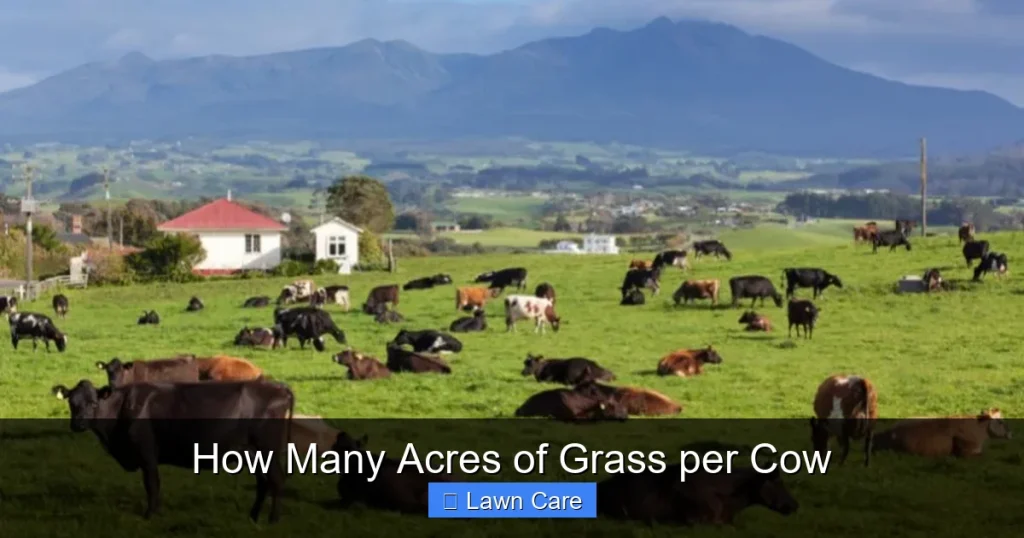
Determining the right number of acres of grass per cow is crucial for sustainable livestock management. This guide will help you understand the key factors involved in calculating appropriate stocking rates. By considering grass quality, cow needs, and environmental conditions, you can ensure a healthy pasture and well-fed herd.
# How Many Acres of Grass per Cow
Managing livestock, whether it’s for a small hobby farm or a large commercial operation, hinges on one fundamental question: how much land is needed to feed your animals? Specifically, when it comes to cattle, understanding “how many acres of grass per cow” is essential for ensuring healthy grazing, preventing overgrazing, and maintaining a sustainable environment. It’s not a one-size-fits-all answer, as many factors come into play. This comprehensive guide will walk you through everything you need to know to make informed decisions about your pasture management.
### Understanding the Core Concept: Stocking Rate
The term “stocking rate” refers to the amount of land required to support a specific number of animals over a given period. When we talk about acres of grass per cow, we’re essentially discussing the stocking rate for cattle on pasture. A lower number of acres per cow means a higher stocking rate, and a higher number of acres per cow means a lower stocking rate.
### Why is This Calculation So Important?
Getting the stocking rate right is vital for several reasons:
* Animal Health and Nutrition: If the stocking rate is too high, cows may not get enough to eat, leading to malnutrition, reduced milk production (if applicable), and lower overall health.
* Pasture Health: Overstocking can lead to overgrazing. This means cows eat the grass faster than it can regrow, depleting the pasture’s root systems, reducing its ability to sequester carbon, and potentially leading to soil erosion and desertification.
* Environmental Sustainability: Healthy pastures contribute to a healthy ecosystem. Properly managed land supports biodiversity, improves water quality, and helps mitigate climate change.
* Economic Viability: For ranchers, efficient land use translates directly to profitability. Understocking means unused resources, while overstocking can lead to costly pasture degradation and animal health issues.
### The Key Factors Influencing Acres of Grass per Cow
So, what determines how much land a single cow needs? It’s a complex interplay of factors.
#### 1. Forage Quality and Type
This is arguably the most significant factor. Not all grasses are created equal in terms of nutritional content and yield.
##### Cool-Season vs. Warm-Season Grasses
* Cool-season grasses (like fescue, orchardgrass, timothy) grow best in cooler temperatures and are often more palatable and nutritious. They can support more animals per acre.
* Warm-season grasses (like Bermuda grass, bahiagrass) thrive in hotter weather. Some varieties can be very productive but may have lower nutritional value or palatability at certain growth stages. You might need more acres for these. Understanding the different types of grass is a great first step.
##### Nutritional Value
Grasses that are high in protein, energy, and essential minerals will sustain a cow more effectively. Younger, greener grass is generally more nutritious than mature, dry grass. The stage of growth is critical. If you’re planting new grass, knowing how many pounds of grass seed per square foot you need for optimal establishment is important, as this directly impacts future forage quality.
##### Forage Yield
The sheer amount of grass produced per acre is a direct measure of its carrying capacity. Factors like soil fertility, rainfall, and sunlight influence yield. For example, a highly fertile pasture in a region with ample rainfall might produce several tons of dry matter per acre, while a less fertile, drier area might produce much less.
#### 2. Cow’s Nutritional Needs
A cow is not just a cow. Different animals have different requirements.
##### Dry Matter Intake (DMI)
This refers to the total amount of food a cow eats per day, expressed as a percentage of its body weight, usually on a dry matter basis (meaning without the water content). A mature beef cow typically consumes 2.5% to 3% of its body weight in dry matter daily. For example, a 1,000-pound cow might eat 25 to 30 pounds of dry matter per day.
##### Energy and Protein Requirements
These needs vary based on the cow’s life stage:
* Beef Cow (non-lactating): Lower energy and protein needs.
* Beef Cow (lactating): Significantly higher needs to produce milk.
* Growing Calves: Need energy and protein for growth.
* Bulls: High energy needs, especially during breeding season.
##### Breed and Size
Larger breeds or those with higher metabolic rates will naturally consume more forage. A Charolais cow will likely need more acreage than a smaller Jersey cow.
#### 3. Environmental Factors
The environment plays a crucial role in grass growth and availability.
##### Climate and Rainfall
Regions with consistent, adequate rainfall and favorable temperatures will support more productive pastures and thus higher stocking rates. Drought conditions can drastically reduce forage availability, necessitating a lower stocking rate or supplemental feeding.
##### Soil Type and Fertility
Healthy, fertile soils promote vigorous grass growth. Soils that are poor, compacted, or acidic will support less forage. Soil testing can reveal nutrient deficiencies that can be corrected with amendments.
##### Sunlight Exposure
Grass needs sunlight to grow. Pastures with good sun exposure will generally be more productive than those shaded by trees or buildings. Some grasses, like Bermuda grass, need a significant amount of sunlight, often around 8 hours of sun.
#### 4. Grazing Management System
How you manage your pastures can dramatically impact how many animals they can support.
##### Continuous Grazing
Animals have access to the entire pasture for the entire grazing period. This is the simplest system but often leads to overgrazing of the most palatable plants and underutilization of less desirable ones. It generally requires a lower stocking rate to be sustainable.
##### Rotational Grazing
This involves dividing pastures into smaller paddocks and moving animals from one paddock to another. This allows plants to regrow and rest, leading to healthier, more productive pastures.
* Simple Rotational Grazing: Moving cows every few days or weeks.
* Managed Rotational Grazing/Intensive Grazing: More frequent moves (daily or even multiple times a day) can maximize forage utilization and pasture health, potentially increasing carrying capacity significantly.
##### Deferred Grazing
Certain areas are intentionally not grazed during specific periods to allow for seed production or regrowth.
#### 5. Seasonality and Growth Cycles
Grass growth is not constant. It typically follows seasonal patterns.
* Peak Growth: Usually in spring and early summer in temperate climates.
* Slowdown: Growth slows in hot, dry summers and during winter.
* Dormancy: In colder regions, grasses may go dormant in winter.
This means the number of acres needed might fluctuate throughout the year. Supplemental feeding or moving animals may be necessary during periods of low forage availability.
### Calculating Acres of Grass per Cow: A Practical Approach
While there’s no single magic number, we can establish a baseline and adjust it.
#### Rule of Thumb: The Animal Unit Month (AUM)
A common metric in ranching is the Animal Unit Month (AUM).
* One Animal Unit (AU) is typically defined as one mature cow (1,000 lbs) with a calf (200 lbs) at her side, consuming 26 lbs of dry matter per day.
* One AUM is the amount of forage needed to sustain one AU for one month.
Estimates for AUMs per acre vary widely:
* High-quality pasture: 1-2 AUMs per acre per month.
* Average pasture: 0.5-1 AUM per acre per month.
* Poor-quality pasture: Less than 0.5 AUM per acre per month.
If a cow needs 1 AUM per month, and your pasture provides 0.75 AUM per acre per month, you would need roughly 1.33 acres per cow per month (1 AUM / 0.75 AUM/acre = 1.33 acres). If you need to support a cow for a 6-month grazing season, you’d need 8 acres per cow (1.33 acres/month * 6 months).
#### Estimating Forage Production
1. Estimate your pasture’s annual forage yield. This can be done through local extension offices, by looking at neighboring farm yields, or by conducting your own small-scale yield measurements. Assume an average yield for your region and soil type. For instance, let’s say your pasture produces 5,000 pounds of dry matter per acre per year.
2. Calculate a cow’s annual dry matter need. A 1,000-pound cow eating 2.5% of its body weight per day for 365 days:
* Daily intake: 1,000 lbs * 0.025 = 25 lbs dry matter
* Annual intake: 25 lbs/day * 365 days = 9,125 lbs dry matter per year.
3. Determine acres needed per cow:
* Acres per cow = Annual cow requirement / Annual forage yield per acre
* Acres per cow = 9,125 lbs / 5,000 lbs/acre = 1.825 acres per cow.
This calculation is a starting point. You need to adjust it based on the factors mentioned earlier. If your forage is low quality, you’ll need more acres. If you have poor rainfall, you’ll need more acres. If you are using intensive rotational grazing, you might be able to support more animals on less land over time.
#### General Guidelines (Highly Variable!)
* Good to Excellent Pasture (high-quality, well-managed): 1 to 2 acres per cow per month, or 6 to 12 acres per cow for a 6-month grazing season.
* Average Pasture: 2 to 4 acres per cow per month, or 12 to 24 acres per cow for a 6-month grazing season.
* Poor Pasture (low yield, low quality, dry conditions): 4+ acres per cow per month, or 24+ acres per cow for a 6-month grazing season.
These are very rough estimates. Always observe your pasture and your animals.
### Practical Tips for Optimizing Pasture Use
1. Know Your Grass: Identify the dominant grasses in your pasture. This will help you understand their growth habits and nutritional profiles. You might be interested in learning how many types of crabgrass are there, for instance, to better identify and manage it.
2. Soil Test Regularly: Understand your soil’s pH, nutrient levels, and organic matter content. This information is crucial for making informed decisions about fertilization and liming.
3. Implement Rotational Grazing: Even a simple system can make a significant difference. Divide your pastures into smaller paddocks.
4. Monitor Pasture Health: Look for signs of overgrazing (grass less than 3-4 inches tall) or undergrazing (grass growing too tall and becoming less palatable).
5. Provide Water: Ensure a reliable water source is accessible to all grazing areas. Lack of water can stress animals and reduce their forage intake.
6. Observe Your Cows: Are they gaining weight? Are they looking healthy? Are they spending a lot of time searching for food? Their condition is a direct indicator of whether your stocking rate is appropriate.
7. Consider Supplemental Feeding: During periods of low forage production, you may need to provide hay or supplements to maintain animal health.
8. Manage Weeds: Weeds compete with desirable grasses for nutrients, water, and sunlight. Learning how to get rid of weeds in grass can improve forage quality and quantity.
### Troubleshooting Common Pasture Issues
* Issue: Pasture is consistently overgrazed.
* Cause: Stocking rate is too high, or grazing period is too long.
* Solution: Reduce the number of animals or increase the pasture size. Implement a more aggressive rotational grazing system to allow for longer rest periods.
* Issue: Pasture has large areas of ungrazed, mature grass.
* Cause: Palatability issues (grass is too mature, weeds have taken over), or the stocking rate is too low.
* Solution: Consider overseeding with more palatable species. Use grazing management to force animals to eat less desirable grass. Increase the stocking rate if the pasture can support it.
* Issue: Pasture is drying out rapidly or showing signs of drought stress.
* Cause: Insufficient rainfall, high temperatures, or compacted soil.
* Solution: Reduce stocking rate temporarily. Implement drought-tolerant grass species. Aerate compacted soil to improve water infiltration. Ensure access to shade for animals.
### Conclusion
Determining “how many acres of grass per cow” is a dynamic process, not a static calculation. It requires careful observation, a good understanding of your land’s capabilities, and the nutritional needs of your livestock. By considering forage quality, cow requirements, environmental conditions, and implementing smart grazing management techniques, you can create a healthy, productive pasture that sustains your herd and benefits the environment. Start with a baseline calculation, monitor your pasture and animals closely, and be prepared to adjust your stocking rate as needed. Sustainable grazing is a journey of continuous learning and adaptation.
Key Takeaways
- Grazing capacity varies greatly: The number of acres of grass per cow isn’t a fixed number. It depends heavily on the quality and type of forage, the season, and the management practices employed.
- Nutritional needs are paramount: A cow’s nutritional requirements, including dry matter intake and energy needs, directly influence how much grass it consumes and thus the land required to support it.
- Forage quality is king: Lush, nutrient-rich grasses require less acreage than sparse, low-quality forage. Understanding your pasture’s nutritional profile is essential.
- Stocking rate is dynamic: Optimal stocking rates can change throughout the year due to growth cycles, weather patterns, and rest periods for the pasture.
- Management makes a difference: Rotational grazing and proper pasture management can significantly increase the number of animals a piece of land can support.
- Consider non-forage factors: Water availability, shade, and shelter also play a role in determining how many cows can be comfortably and productively maintained on a given area.