You've probably spotted little white worms in your potting soil or noticed something nibbling at your plant roots and wondered: do worms eat plant roots? It's one of those questions that seems simple but has a surprisingly layered answer. The truth is, the word "worms" covers a huge range of soil organisms, and they don't all behave the same way around your plants.
Most of the time, the worms you're seeing are earthworms or pot worms, and they're actually breaking down dead organic matter, not attacking living roots. But certain soil-dwelling organisms, like root-knot nematodes and fungus gnat larvae, absolutely do feed on living root tissue. Understanding which one you're dealing with is the key to knowing whether you should worry or relax.
Let's walk through it step by step.
Image source: Wikimedia Commons / K0nvaliya (CC BY-SA)
Quick Answer
Most earthworms do not eat plant roots. They consume decaying organic matter, not living tissue. However, some soil organisms commonly called "worms," like root-knot nematodes and fungus gnat larvae, do attack roots.
The answer depends entirely on which organism you're dealing with. Proper identification is the first step.
Why People Get This Wrong: Earthworms vs. Root-Feeding Pests
The biggest source of confusion is that people lump every small, squishy thing in the soil under the label "worms." That's like calling every insect in your garden a "beetle." Earthworms, nematodes, pot worms, and insect larvae are completely different organisms with completely different diets.
Earthworms are detritivores. That means they eat decomposing plant material, microbes, and organic matter in the soil. Their digestive systems are designed to process dead stuff, not living tissue.
When you see an earthworm near a plant root, it's almost certainly feeding on decaying matter in the soil, not the root itself.
Root-feeding pests, on the other hand, have evolved specifically to attack living plant tissue. Root-knot nematodes use a needle-like mouthpart to pierce root cells and feed on the fluids inside. Fungus gnat larvae chew through fine root hairs and tender root tips.
These organisms are biologically wired to eat roots, and that's exactly what they do.
The confusion gets worse because damaged roots often attract earthworms to the area. The earthworms show up to feed on the already-decaying tissue, and then the gardener blames them for the damage. It's a classic case of correlation without causation.
What Earthworms Actually Eat (And Why They're Usually Your Friend)
Earthworms are nature's recyclers. They consume dead leaves, rotting wood, decomposing roots, and the microorganisms that break those things down. A single earthworm can process roughly half its body weight in organic matter per day, and a healthy garden soil might contain 10 to 50 earthworms per cubic foot.
Their digestive process is what makes them so valuable. As organic matter passes through an earthworm's gut, it gets broken down into nutrient-rich castings. These castings contain nitrogen, phosphorus, and potassium in forms that plants can readily absorb.
Research from the USDA Natural Resources Conservation Service confirms that earthworm activity improves soil aeration, water infiltration, and nutrient cycling.
Here's what earthworms eat versus what they don't:
| Earthworms DO Eat | Earthworms DO NOT Eat |
|---|---|
| Dead leaves and plant debris | Living, healthy roots |
| Decomposing wood and bark | Fresh green foliage |
| Soil microorganisms (bacteria, fungi) | Seeds and seedlings |
| Animal manure | Woody stems |
| Compost and humus | Root exudates from living plants |
The one exception is when roots are already damaged or rotting. Earthworms will move in and consume the dead tissue, which is actually beneficial because it speeds up decomposition and prevents fungal pathogens from spreading. They're cleanup crews, not attackers.
If you're growing Bermuda grass or other warm-season turf, earthworm activity is generally a sign of healthy soil. Their tunnels help water and air reach deeper root zones, which is especially valuable in compacted clay soils.
The Real Culprits: Worms and Larvae That DO Attack Roots
Now let's talk about the organisms that actually do eat plant roots. These are the ones you need to watch for, and they're often misidentified as harmless earthworms.
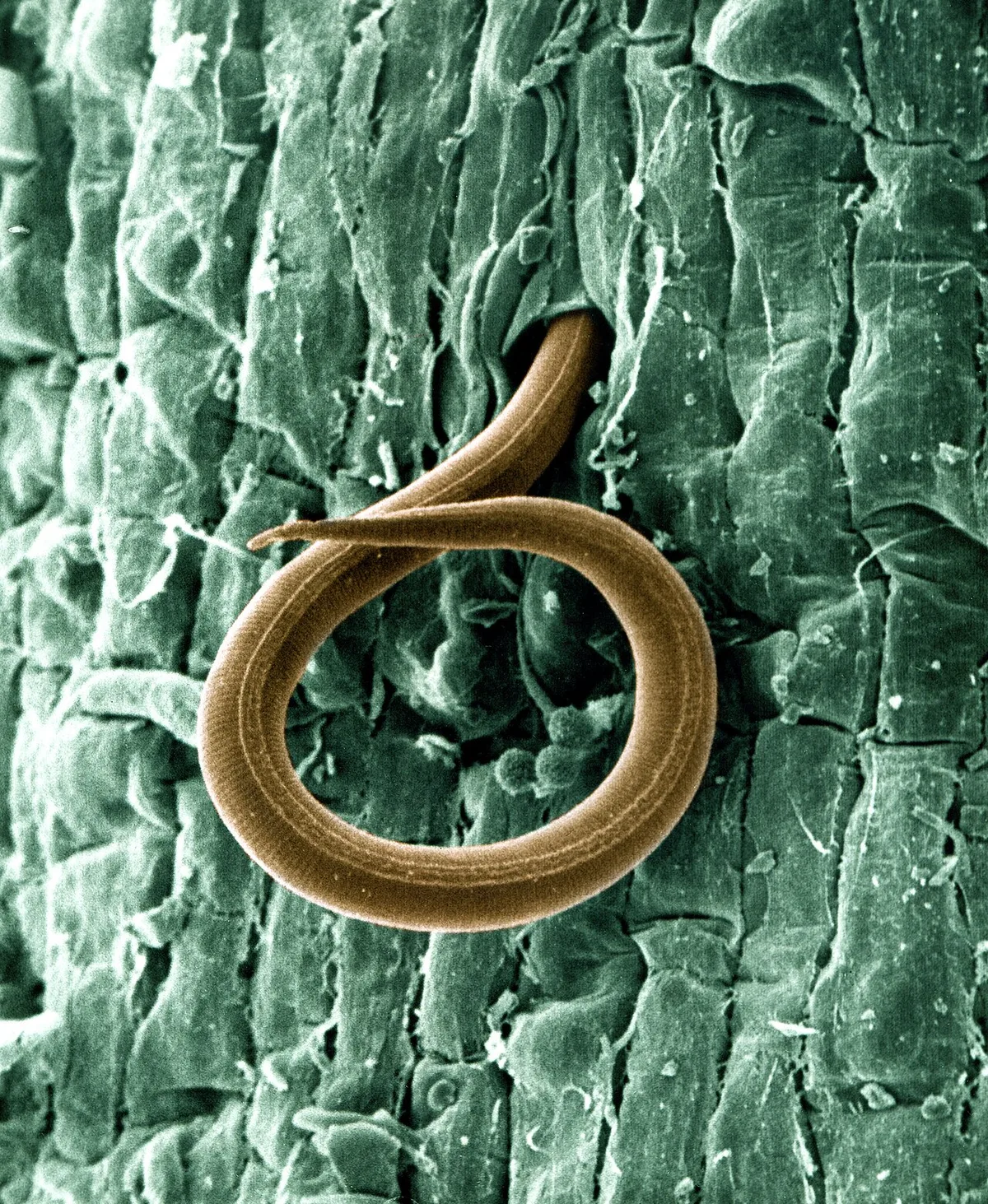
Image source: Wikimedia Commons / Photo by William Wergin and Richard Sayre. Colorized by Stephen Ausmus. U.S. Department of Agriculture (CC BY)
Root-Knot Nematodes
Root-knot nematodes (Meloidogyne species) are microscopic, worm-like organisms that are among the most destructive plant parasites in the world. They're not true worms. They're roundworms, and you can't see them with the naked eye.
What you CAN see is the damage: swollen, knotted galls on roots that look like beads on a string.
These nematodes pierce root cells with a stylet, a needle-like feeding structure, and inject chemicals that cause the root cells to enlarge and multiply. This creates the characteristic galls. The nematode then feeds on these modified cells.
Heavy infestations can reduce crop yields by 50% or more, according to university extension research.
Fungus Gnat Larvae
If you've got houseplants or seedlings in containers, fungus gnat larvae (Sciaridae family) are probably the most common root-feeding "worm" you'll encounter. These tiny white larvae, about a quarter-inch long, live in the top inch or two of moist potting soil and chew on fine root hairs and tender root tips.
They're especially damaging to seedlings and young transplants that haven't developed extensive root systems yet. The adults are small black flies that hover around your plants, but the real damage happens underground where the larvae feed.
Root Maggots
Root maggots (Delia species) are the larval stage of small flies that look like miniature houseflies. They tunnel directly into the roots of brassica crops like cabbage, broccoli, radishes, and onions. Once inside the root, they're protected from most surface treatments, and the damage opens the door to rot-causing pathogens.
Wireworms
Wireworms are the larvae of click beetles (Elateridae family). They're hard-bodied, golden-brown, and about half an inch to an inch long. They bore into roots, tubers, and seeds, and they can live in the soil for two to six years before pupating.
They're especially problematic in gardens that were recently converted from grass or sod.
Cutworms
Cutworms are caterpillars, not worms at all, but they get lumped into the category because of their appearance and soil-dwelling habits. They chew through stems right at the soil line and can also feed on shallow roots. They're nocturnal, so you'll often find plants toppled over in the morning with no obvious culprit.
How to Tell What's Living in Your Soil
Identifying what's actually in your soil is the most important step. Here's a practical process you can follow.
Step 1: Identify the Organism
Grab a small hand trowel and dig around the base of an affected plant. Look carefully at what you find. Earthworms are large, segmented, and reddish-brown.
Pot worms are tiny, white, and thread-like. Fungus gnat larvae are small, translucent white, with a distinctive black head. Wireworms are hard, shiny, and golden-brown.
Cutworms are soft-bodied caterpillars that curl into a C-shape when disturbed.
If you can't see anything but the roots look swollen or knotted, you're likely dealing with root-knot nematodes. Those require a soil test to confirm.
Step 2: Check the Damage Pattern
Different organisms leave different signatures. Here's a quick reference:
| Organism | Damage Signs | Where to Look |
|---|---|---|
| Earthworms | No damage to living roots; castings present | Throughout soil |
| Root-knot nematodes | Swollen galls on roots; stunted growth | On root surface |
| Fungus gnat larvae | Chewed root hairs; wilting seedlings | Top 1-2 inches of soil |
| Root maggots | Tunnels inside roots; rotting | Inside root tissue |
| Wireworms | Holes bored into roots and tubers | Throughout root zone |
| Cutworms | Severed stems at soil line; toppled plants | Soil surface, nighttime |
Step 3: Assess the Growing Conditions
Overwatered containers are a magnet for fungus gnat larvae. Gardens recently converted from sod are prime wireworm territory. Sandy soils tend to have more nematode pressure.
Warm, humid greenhouse environments favor almost every root-feeding pest on this list.
If you're dealing with fungus in Bermuda grass or other turf issues, the root damage you're seeing might be from a combination of soil pests and fungal pathogens working together. That's why proper identification matters so much.
When Worms Are a Problem vs. When They're Helping
So when should you actually worry? The answer depends on what you're growing and what organism you've identified.
Earthworms are almost always beneficial. If you're growing vegetables, flowers, or turf like Bermuda grass seed, their presence is a strong indicator of healthy soil biology. The only minor downside is that their castings can create small mounds on lawns, which some homeowners find unsightly.
That's a cosmetic issue, not a plant health issue.
Pot worms are also harmless. They show up in large numbers when soil stays consistently moist, which can actually be a signal that you're overwatering. They won't hurt your plants, but they might be telling you to back off on the watering can.
The organisms that ARE a problem are the ones we covered earlier: root-knot nematodes, fungus gnat larvae, root maggots, wireworms, and cutworms. These cause measurable damage. Stunted growth, wilting despite adequate water, yellowing leaves, and root rot are all signs that a parasitic organism is at work.
Here's a simple rule of thumb. If the organism is large enough to see clearly and it's reddish-brown and segmented, it's an earthworm, and it's helping. If it's tiny, white, or you can't see it at all but your plants are struggling, you need to investigate further.
What to Do If You Have Root-Feeding Pests
Once you've identified the culprit, the treatment approach changes based on where you're growing.
For Indoor Plants and Containers
Fungus gnat larvae are the most common issue here. Let the top inch or two of soil dry out completely between waterings. That alone can break their life cycle.
You can also water with a diluted hydrogen peroxide solution (one part 3% peroxide to four parts water) to kill larvae in the soil. Sticky traps near the soil surface catch adult gnats and prevent them from laying more eggs.
For pot worms, reduce watering frequency and improve drainage. They'll die off once the soil surface dries between waterings.
For Garden Beds and Raised Planters
Root maggots and wireworms are the usual suspects in outdoor beds. Crop rotation is your most effective long-term strategy. Don't plant brassicas in the same spot two years in a row if you've had root maggot problems.
Floating row covers placed over young plants at transplant time prevent adult flies from laying eggs near the base of the plant.
Beneficial nematodes (Steinernema and Heterorhabditis species) can be watered into the soil to target root-feeding larvae. These are living organisms you buy and apply, and they actively seek out pest larvae without harming earthworms or other beneficial soil life.
For Greenhouses and Nurseries
Greenhouse environments are high-risk because the warm, humid conditions favor almost every root pest. Soil solarization, covering moist soil with clear plastic for four to six weeks during the hottest part of summer, can reduce nematode and larvae populations significantly. Integrated pest management (IPM) programs that combine biological controls, cultural practices, and targeted treatments are the standard approach in commercial settings.
How to Protect Your Roots Without Killing Beneficial Worms
This is where a lot of gardeners go wrong. They see damage, panic, and reach for a broad-spectrum pesticide. That kills the earthworms along with the pests, and you end up worse off in the long run.
Earthworms are sensitive to certain chemicals, particularly carbaryl and some organophosphate insecticides. When you kill them, you lose the soil aeration, nutrient cycling, and water infiltration benefits they provide. It's like firing your best employee to deal with a problem caused by someone else.
Instead, use targeted approaches. Beneficial nematodes attack pest larvae but leave earthworms alone. Hydrogen peroxide drenches kill fungus gnat larvae in container soil without harming earthworms in garden beds.
Row covers and crop rotation prevent pest problems without any chemical input at all.
If you're establishing a new Bermuda grass seedling lawn, healthy earthworm populations in the soil will help those young roots establish faster. Protecting them is part of protecting your plants.
Common Mistakes Gardeners Make With Soil Pests
The number one mistake is misidentification. Gardeners see worms near damaged roots and assume the worms caused the damage. In most cases, the roots were already damaged by something else, and the earthworms showed up to clean up the mess.
The second mistake is overreacting with chemicals. Broad-spectrum pesticides don't discriminate. They kill the beneficial organisms right along with the pests, and the pest populations often rebound faster because you've eliminated their natural predators.
The third mistake is ignoring soil conditions. Overwatering creates the exact environment that fungus gnat larvae and pot worms thrive in. Poor drainage does the same.
Before you treat for pests, ask yourself whether your watering habits are part of the problem.
The fourth mistake is not acting soon enough when root-knot nematodes are present. By the time you see above-ground symptoms like wilting and stunting, the nematode population is already well established. Early soil testing is the only way to catch it before serious damage occurs.
When to Test Your Soil (And Where to Send It)
If you've tried the identification steps above and still can't figure out what's causing the damage, it's time for a soil test. This is especially important if you're seeing galls on roots, which points to root-knot nematodes.
University extension services are your best resource. Most state universities with agricultural programs offer nematode soil testing for a small fee. You collect a soil sample from the root zone of affected plants, following the lab's specific instructions, and mail it in.
Results typically come back within one to two weeks and tell you exactly which nematode species are present and at what population levels.
The University of California IPM program and Cornell University's nematode diagnostic lab are two well-known examples, but most land-grant universities offer similar services. Check with your local cooperative extension office for the lab nearest you.
Soil testing is also smart if you're converting a new area to garden use, especially if it was previously lawn or sod. Knowing what's in the soil before you plant lets you choose resistant varieties or take preventive measures from the start.
Quick Decision Guide: What's Eating Your Roots?
Use this flowchart logic to narrow down the culprit fast.
If you can see the organism clearly:
- Large, reddish-brown, segmented. It's an earthworm. It's not eating your roots. Leave it alone.
- Tiny, white, thread-like, in moist container soil. Likely pot worms or fungus gnat larvae. Check for black heads. If present, they're gnat larvae and need treatment.
- Hard-bodied, golden-brown, shiny. That's a wireworm. It's boring into roots and tubers. Apply beneficial nematodes.
- Soft caterpillar, curls into C-shape when disturbed. That's a cutworm. It's chewing stems at soil line. Use physical barriers or hand-pick at night.
If you can't see the organism but roots look abnormal:
- Swollen, knotted galls on roots. Root-knot nematodes. Submit a soil sample to your local extension lab.
- Roots are tunneling and rotting, but no visible organism. Likely root maggots inside the tissue. Use row covers on future plantings.
If roots look fine but plants are wilting:
- The problem may not be soil-related. Check for stem borers, vascular diseases, or water stress before treating for pests.
Frequently Asked Questions
Do earthworms ever eat healthy plant roots?
No. Earthworms are detritivores. They consume decomposing organic matter, not living tissue.
If roots are already dead or rotting, earthworms will break that material down, but they don't attack healthy roots.
Are the white worms in my potting soil harmful?
It depends on the species. Pot worms are harmless decomposers. Fungus gnat larvae have a distinctive black head and do chew on fine root hairs.
Look closely at the head end to tell them apart.
How do I know if I have root-knot nematodes?
The most reliable sign is swollen, irregular galls on the roots that look like beads or knots. Above-ground symptoms include stunting, yellowing, and wilting that doesn't improve with watering. A soil test through your university extension service confirms the diagnosis.
Can I use pesticides without killing earthworms?
Most broad-spectrum insecticides will harm earthworms. Targeted approaches like beneficial nematodes, hydrogen peroxide drenches for containers, and physical barriers like row covers are safer for earthworm populations.
Do worms eat grass roots?
Earthworms don't eat living grass roots. However, certain pests like white grubs (beetle larvae) and chinch bugs do damage turf roots. If you're seeing thinning in your Bermuda grass or other turf, pull up a section of sod and look for C-shaped grubs near the root zone.
What's the best way to prevent root damage from soil pests?
Start with proper identification. Then use crop rotation, appropriate watering practices, resistant plant varieties when available, and beneficial organisms like Steinernema nematodes. Healthy soil with good organic matter supports earthworm populations that outcompete many pest species naturally.