You walk outside to grab some basil for tonight's sauce and something's off. The leaves are curling upward like little green cups, and your first thought is probably "it needs more water." That's the instinct most gardeners have, and it's wrong about half the time. When basil leaves curl upward, the cause could be anything from thirst to root rot to a fungal disease that'll wipe out your whole crop if you don't act fast.
The tricky part is that multiple problems produce nearly identical symptoms. Overwatering, underwatering, pests, heat stress, and the dreaded basil downy mildew can all make leaves cup upward. In our research, the most reliable approach is a step-by-step diagnostic process that rules out the most common causes in order, so you treat the right problem the first time.
Let's walk through it.
Quick Answer
Basil leaves curl upward for six main reasons: overwatering, underwatering, pest infestation, disease, environmental stress, or herbicide exposure. Overwatering is the most common cause in home gardens. Check your soil moisture first, then inspect leaf undersides for pests or fungal growth.
If neither fits, evaluate recent weather, light conditions, or nearby chemical use.
The 6 Most Common Causes — Ranked by Likelihood
Not all causes of upward leaf curl are equally probable. Here's what our research shows, ordered from most to least common in home and container gardens:
| Cause | Frequency | Severity | Reversible? |
|---|---|---|---|
| Overwatering / root rot | Very common | Moderate to severe | Yes, if caught early |
| Underwatering / heat stress | Common | Mild to moderate | Yes, usually quickly |
| Pest infestation (aphids, mites, whiteflies) | Common | Moderate | Yes, with treatment |
| Basil downy mildew | Occasional to common (humid climates) | Severe | Difficult to stop once established |
| Herbicide drift | Occasional | Severe | No, damage is permanent on affected leaves |
| Nutrient imbalance / fertilizer burn | Less common | Mild to moderate | Yes, with soil flushing |
Overwatering tops the list because basil roots are surprisingly sensitive to oxygen deprivation. People water basil like they water everything else, a little every day, and the roots suffocate. Underwatering is next, especially during summer heat waves when container basil can dry out in hours.
Pests and disease round out the serious threats, while herbicide drift and nutrient issues tend to be situational.
Step 1: Check Your Soil Moisture First (It's Almost Always This)
This is where most diagnoses should start, and where most gardeners get it wrong. Stick your finger into the soil about 1 to 2 inches deep, right at the base of the stem. What you're feeling for is simple: soggy and cool, bone dry, or just barely moist.
If the soil is soggy or waterlogged:
You're overwatering, and the roots are likely struggling. Basil wants consistently moist soil, not wet soil. When roots sit in waterlogged conditions, they can't take up oxygen, and the plant responds by curling its leaves upward.
You might also notice yellowing lower leaves, a slightly mushy stem base, or a faint sour smell from the pot. If you pull the plant out and the roots look brown and slimy instead of white and firm, you've got root rot caused by Pythium or Rhizoctonia fungi.
Stop watering immediately. Let the top inch of soil dry out completely before you water again. If the pot doesn't have drainage holes, drill some or repot into a container that does.
For severe root rot, you may need to trim the damaged roots and repot in fresh, well-draining mix.
If the soil is bone dry and pulling away from the pot edges:
Your basil is thirsty. Underwatering causes leaves to curl upward as the plant tries to reduce surface area and conserve moisture. The leaves may also feel thinner or slightly crispy at the edges.
Water deeply until it runs out the drainage holes, and the plant should perk up within a few hours.
If the soil feels just right, barely moist:
Move on to Step 2. Your problem isn't water-related.
A few quick notes on watering habits. Basil in containers needs more frequent watering than basil in the ground, sometimes twice daily during peak summer. Basil in the ground prefers deep, infrequent watering over shallow, daily sprinkles.
And morning watering is best because it gives leaves time to dry before nightfall, which reduces fungal disease risk. For more on keeping container herbs healthy through hot weather, check out our guide on how to get bermuda grass to spread 2, which covers root zone management principles that apply to any potted plant.
Step 2: Inspect the Undersides of Leaves for Pests
Grab a magnifying glass or your phone's macro lens and flip a few leaves over. This is where the culprits hide. The undersides of basil leaves are prime real estate for several sap-sucking pests that cause upward curling as they feed.
Spider mites (Tetranychus urticae):
These are tiny, almost invisible arachnids that love hot, dry conditions. Look for fine webbing on the undersides of leaves and where stems meet leaves. The leaves themselves may have tiny yellow or white stippling marks.
Spider mites reproduce fast. A single female can lay about 20 eggs per day, and populations can explode within a week. If you see webbing, you've already got a significant infestation.
Aphids:
Small, soft-bodied insects, usually green or black, clustered on new growth and leaf undersides. They secrete a sticky substance called honeydew that you'll notice on leaves or the soil surface. Aphids cause leaf distortion and curling as they suck sap from tender tissue.
They also transmit viral diseases, so catching them early matters.
Whiteflies (Trialeurodes vaporariorum):
Tiny white flying insects that scatter when you disturb the plant. Like aphids, they feed on sap and produce honeydew. Heavy infestations cause leaves to yellow, curl, and eventually drop.
Broadleaf mites (Phyllocoptruta oleivora):
These are even smaller than spider mites and cause a distinctive inward and upward curling that can look almost like a botanical origami project. They're common in greenhouse and indoor basil where humidity stays moderate.
What to do about pests:
- Spray the plant thoroughly with a strong jet of water to dislodge aphids, mites, and whiteflies. Focus on leaf undersides.
- Apply neem oil at a 1 to 2 percent solution (1 to 2 teaspoons per quart of water with a few drops of dish soap as an emulsifier). Neem oil works as both a pest deterrent and a mild fungicide.
- Insecticidal soap is effective for soft-bodied insects. It works on contact, so thorough coverage matters.
- Repeat treatment every 5 to 7 days until you stop seeing new damage.
- Isolate the affected plant from any other herbs or vegetables to prevent spread.
If you're growing basil indoors or in a greenhouse, pest pressure tends to be higher because there are no natural predators. Introducing beneficial insects like ladybugs or predatory mites can help maintain long-term control. For related reading on managing fungal issues in garden plants, our article on fungus in bermuda grass covers diagnostic principles that transfer well to herb gardening.
Step 3: Rule Out Disease — Downy Mildew, Fusarium Wilt, and Root Rot
If your soil moisture is fine and you don't see pests, disease becomes the prime suspect. Three diseases cause upward leaf curl in basil, and each requires a very different response.
Basil downy mildew (Peronospora belbahrii):
This is the big one. It's an oomycete disease, not a true fungus, and it's devastated commercial and home basil crops worldwide since it was first identified in the US in 2007. Early symptoms include yellowing between the leaf veins, followed by upward leaf curling.
The definitive sign is a gray to purple fuzzy growth on the undersides of leaves, visible in humid conditions or early in the morning.
Downy mildew thrives at 60 to 75 degrees Fahrenheit with humidity above 85 percent and extended leaf wetness. It spreads via windborne spores, which means your neighbor's infected basil can seed your garden from hundreds of yards away. Once established, it's extremely difficult to stop with fungicides.
Copper-based sprays can help prevent infection but won't cure actively infected leaves.
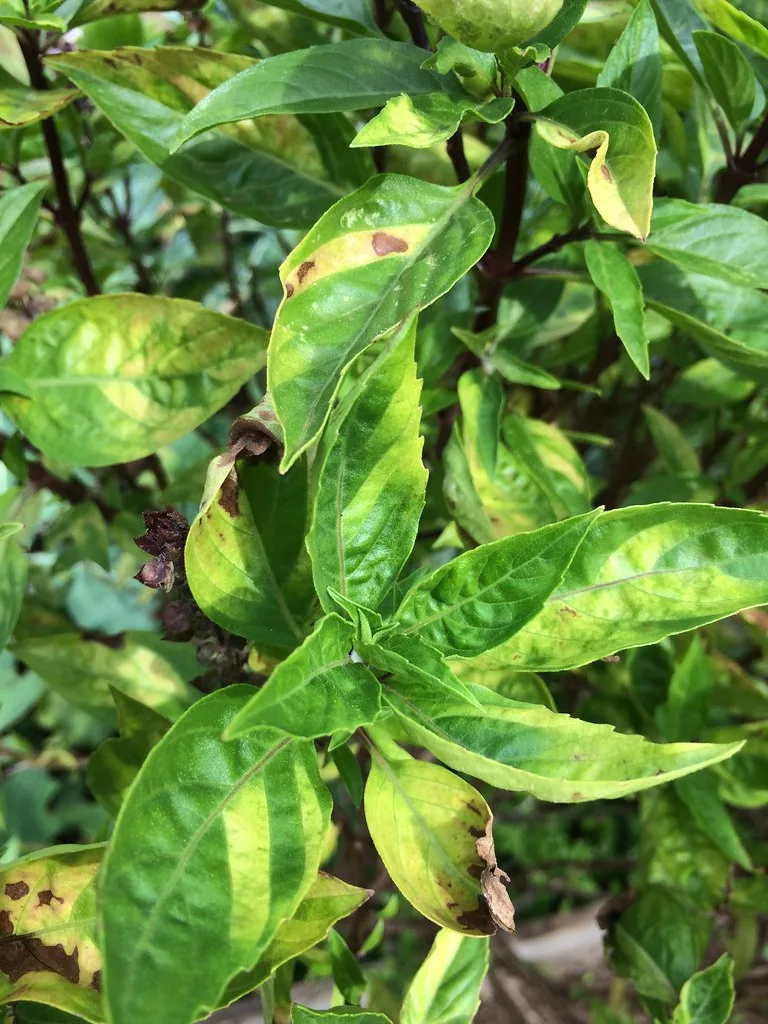
If you confirm downy mildew, remove and destroy all infected plant material. Do not compost it. Improve airflow around remaining plants by spacing them wider and pruning lower leaves.
If this is a recurring problem, switch to resistant cultivars like 'Prospera', 'Devotion', 'Amazel', or 'Amethyst', which carry genetic resistance to Peronospora belbahrii. These varieties cost more than standard seed, typically 2 to 3x the price per packet, but they're worth it if downy mildew is established in your area.
Basil fusarium wilt (Fusarium oxysporum f. sp. basilici):
This fungal disease is less common but far more deadly. It enters through the roots and colonizes the vascular tissue, blocking water uptake. The first sign is often one-sided wilting, where leaves on one branch or one side of the plant curl and droop while the other side looks fine.
As the disease progresses, the entire plant wilts, turns brown, and dies.
If you split a suspect stem lengthwise and see brown or dark streaks inside the vascular tissue, that's fusarium. There is no cure. The pathogen survives in soil for 5 to 10 years or longer, so you cannot replant basil in that spot.
Remove the plant, bag it, and discard it. Do not compost. Soil solarization, covering moist soil with clear plastic for 4 to 6 weeks during the hottest part of summer, can reduce pathogen levels in garden beds.
Root rot (Pythium, Rhizoctonia):
We touched on this in Step 1, but it deserves its own mention. Root rot fungi attack when soil stays too wet for too long. Above ground, the plant wilts and curls despite having plenty of moisture at the roots.
Below ground, roots turn brown, mushy, and sparse. The treatment is the same as overwatering: reduce water, improve drainage, and in severe cases, trim rotted roots and repot in fresh mix.
For authoritative guidance on identifying and managing basil diseases, the University of California IPM program offers detailed photo galleries and treatment protocols. The University of Florida IFAS Extension also publishes excellent diagnostic resources specific to basil downy mildew.
Step 4: Evaluate Environmental Stress — Heat, Light, and Herbicide Drift
Sometimes the problem isn't in the soil or on the leaves. It's in the air around your plant.
Heat stress:
Basil grows best between 70 and 85 degrees Fahrenheit. When temperatures push above 95 degrees, especially combined with direct afternoon sun, leaves curl upward to reduce surface area and slow transpiration. This is a protective response, not a disease.
The leaves usually recover by evening when temperatures drop. If your basil is in a container, move it to a spot with afternoon shade during heat waves. Mulching around in-ground basil helps keep root zones cooler.
Insufficient light:
Basil needs 6 to 8 hours of direct sun per day. Less than 4 hours causes leggy, weak growth that's more susceptible to pests and less resilient to other stressors. Leaves may curl or stretch toward the light source.
If you're growing basil indoors, a south-facing window is the minimum. Most indoor growers supplement with a full-spectrum LED grow light positioned 6 to 12 inches above the canopy for 12 to 14 hours daily.
Herbicide drift:
This one catches people off guard. If your basil suddenly develops dramatic upward cupping on new growth, and the leaves look twisted or distorted in ways that don't match any disease pattern, consider herbicide drift. Lawn treatments containing 2,4-D or dicamba can travel on the wind for considerable distances and cause exactly these symptoms on broadleaf plants like basil.
The damage is permanent on affected leaves, though the plant may recover and put out new growth if exposure stops. If you suspect drift, ask neighbors about recent lawn treatments. Your local agricultural extension office can test plant tissue for herbicide residue if documentation matters, for instance if you're pursuing a complaint.
Step 5: Assess Nutrient and Fertilizer Issues
Nutrient problems are the least common cause of leaf curl, but they're worth checking if everything else checks out.
Over-fertilization:
More is not better with basil. Excess nitrogen causes rapid, weak growth that curls and makes the plant a magnet for aphids. If you've been fertilizing weekly or using a high-nitrogen formula, you may be overdoing it.
Basil is a light feeder. A balanced fertilizer applied once every 4 to 6 weeks during the growing season is plenty. If you suspect over-fertilization, flush the soil thoroughly with clean water to leach out excess salts.
Potassium deficiency:
A lack of potassium can cause leaf edges to curl upward and turn brown or crispy. This is more common in container basil where nutrients leach out with frequent watering. A balanced fertilizer or a potassium supplement like kelp meal corrects this within a couple of weeks.
Salt buildup:
If you've been using tap water in a container, dissolved salts can accumulate in the soil over time. High salt concentrations cause leaf burn, curling, and stunted growth. You'll sometimes see a white crust on the soil surface or pot edges.
Flush the soil with distilled or rainwater, and consider switching your water source.
At this point, you've worked through the five diagnostic steps. If you still can't identify the cause, take a clear photo of the whole plant, close-ups of affected leaves from both sides, and a shot of the stem base and soil. Your local university extension service or a plant identification app can help with the final diagnosis.